When Were Composite B
The composite bow is one of history’s most remarkable inventions. Its power, compactness, and unique construction changed the way people hunted and fought. But when exactly were composite bows invented? The answer is not simple. It connects many cultures, thousands of years, and the development of technology.
Understanding the story of the composite bow gives us a window into ancient innovation and the movement of people and ideas across continents.
What Is A Composite Bow?
A composite bow is not made from a single piece of wood like a simple bow. Instead, it combines several materials, usually wood, horn, and sinew, to make a stronger, more flexible weapon. The horn is on the inside (facing the archer), wood forms the core, and sinew covers the outside. This design lets the bow bend more without breaking, storing more energy and shooting arrows faster and farther.
This construction method is complicated. It needs special skills, time, and careful work. But the result is a bow that is smaller and more powerful than wooden bows of the same size. This made composite bows especially useful for horse riders and armies that needed to move quickly.
The Origins: Early Evidence And Theories
Historians and archaeologists have debated the origin of composite bows for decades. There is no single moment or inventor. Instead, the composite bow seems to have appeared in different places at different times, often linked to the movement of steppe nomads.
Earliest Known Composite Bows
The oldest solid evidence of composite bows comes from ancient Egypt and Mesopotamia. Artifacts and images suggest that by around 2300 BCE, people in these regions were already using bows made from more than one material. However, most experts agree that the Eurasian Steppe, the vast grasslands stretching from Hungary to China, was likely the birthplace of the true composite bow as we know it.
The Steppe Nomads
The steppe nomads, such as the Scythians and later the Huns and Mongols, are famous for their use of composite bows. They needed weapons that were light, strong, and easy to use on horseback. Their lifestyle encouraged the spread and improvement of composite bow technology. The earliest clear archaeological finds of steppe composite bows date to around 1500, 1200 BCE in the region north of the Black Sea.
Comparing Early Bows
To understand how composite bows stood out, compare them to other bow types from the same period:
| Bow Type | Main Materials | Typical Draw Weight | Effective Range |
|---|---|---|---|
| Simple Wooden Bow | Wood | 20, 50 lbs | 60, 100 m |
| Self Bow (Longbow) | Wood | 40, 80 lbs | 120, 250 m |
| Composite Bow | Wood, Horn, Sinew | 30, 100 lbs | 200, 400 m |
| Recurve Bow | Wood or Composite | 30, 80 lbs | 150, 350 m |
This table shows why composite bows became so popular for mounted warriors: high power in a small, easy-to-handle package.

Credit: www.bow-international.com
Materials And Construction: The Secret To Success
A composite bow is complex to build. Each material plays a special role:
- Wood: The core, chosen for lightness and flexibility.
- Horn: Placed on the belly (the side facing the archer), it compresses when the bow is drawn.
- Sinew: Glued to the back (the side away from the archer), it stretches under tension.
The bow is glued with animal hide glue and left to cure for months. This process makes the bow very strong for its size. The combination of materials allows the bow to store more energy and release it quickly.
Pro Tip: The choice of materials and the exact method of layering greatly affect the bow’s performance. Even small changes can make the bow more brittle or less powerful.
Timeline: When Did Composite Bows Appear?
Pinpointing the exact invention date of the composite bow is hard. However, based on current archaeological evidence and written records, here is a timeline showing the development and spread of composite bows:
| Year (Approx.) | Region | Evidence/Notes |
|---|---|---|
| ~2300 BCE | Mesopotamia, Egypt | Art in royal tombs shows multi-material bows; possible early composites |
| ~2000 BCE | Central Asia | Possible composite bow fragments found (not confirmed) |
| ~1500, 1200 BCE | Black Sea Steppe | Definite composite bows in Scythian burials |
| 1000 BCE | China | Written records of composite bows in use |
| 600 BCE | Persian Empire | Composite bows standard in Persian military |
| 400, 200 BCE | Mongolia, Korea | Spread of composite bow technology eastward |
| 200 BCE, 200 CE | Roman Empire | Composite bows appear in Roman auxiliary troops |
This timeline shows that the composite bow was not invented in one place at one time. Instead, it was a gradual process, spreading and changing as different cultures adopted and improved the technology.
How Composite Bows Changed Warfare
The arrival of the composite bow changed the balance of power on many battlefields. Its small size and high power made it ideal for fast attacks, especially from horseback.
Steppe Armies
Nomadic peoples like the Scythians, Huns, and later the Mongols used composite bows to build powerful empires. Their armies could shoot while riding at full speed, striking enemies from a distance and avoiding close combat. The Mongol Empire, for example, owed much of its success to skilled archers using composite bows.
The Ancient Near East
Empires like the Assyrians and Persians made composite bows standard weapons for their elite soldiers. These bows allowed armies to attack from behind shields or on chariots, keeping them safe while causing damage.
Example
A modern replica of a Scythian composite bow is surprisingly easy to carry and shoot from awkward positions. The short length made it perfect for riding or shooting from cover, which is much harder with a longbow.
Comparison: Composite Bow Vs. Longbow
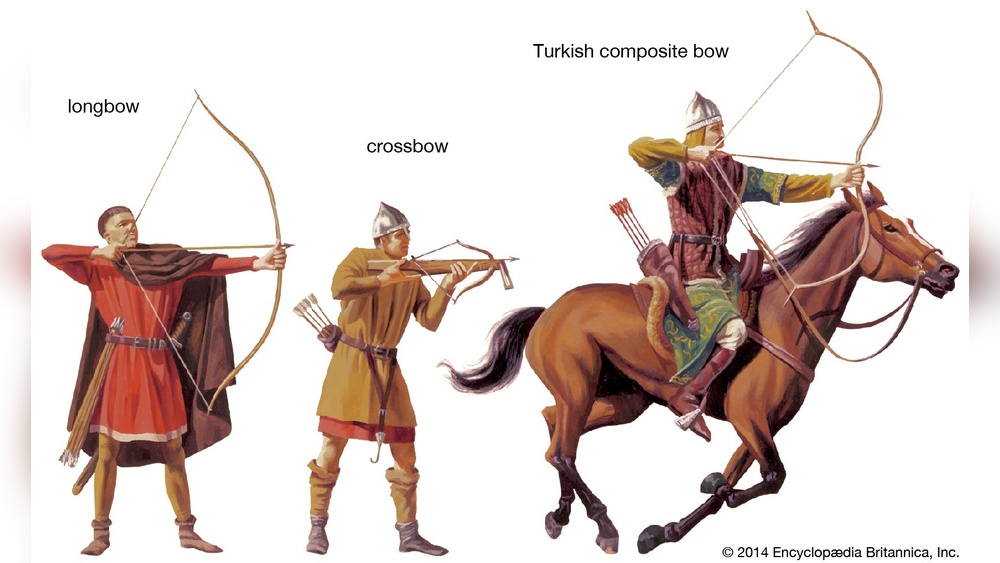
The longbow, famous in medieval England, is another powerful bow type. But it is quite different from the composite bow. Here’s how they compare:
| Feature | Composite Bow | Longbow |
|---|---|---|
| Length | Short (80, 120 cm) | Long (150, 180 cm) |
| Materials | Wood, horn, sinew | Single piece of wood (usually yew) |
| Draw Weight | 30, 100 lbs | 80, 180 lbs |
| Best Use | Mounted archery, fast shooting | Foot archery, massed volleys |
| Climate Resistance | Poor in wet climates | Better in wet climates |
This side-by-side view helps explain why different cultures preferred different bows. The composite bow excelled in dry, open areas where mobility mattered most.
The Spread Of Composite Bows Across Cultures
The composite bow did not stay in one region. Its design was so effective that it spread to many cultures, each making changes to suit local needs.
Ancient Egypt And Mesopotamia
Art from ancient Egypt and Mesopotamia shows archers using bows that look like composite bows. These images, along with some surviving bow fragments, suggest that the idea was already spreading by the third millennium BCE. Egyptian pharaohs valued chariot archers who used composite bows for their power and reach.
Scythians And Sarmatians
The Scythians (roughly 900 BCE, 200 BCE) perfected a short, highly recurved composite bow. Archaeologists have found well-preserved examples in frozen tombs in southern Siberia. These bows are famous for their ability to shoot long distances from horseback. The Sarmatians, who came later, continued this tradition.
Persians And Parthians
The Persian Empire made composite bows a regular part of its military. Persian archers could shoot accurately while riding, and the bow became a symbol of Persian power. The Parthians are known for the “Parthian shot”, shooting backward while riding away, made possible by the short, strong composite bow.
Han China
By 1000 BCE, composite bows were common in China. The Han Dynasty (206 BCE, 220 CE) used them in large armies. Ancient Chinese texts describe bow construction and use in detail, showing the technology was well understood and valued.
The Mongols
The Mongol composite bow is perhaps the most famous of all. During the 13th century, Mongol armies swept across Asia and into Europe, winning battles with their mobile archers. The Mongol bow was small, strong, and able to shoot farther than most European bows of the time.
Middle East And The Mediterranean
Composite bows also spread to the Middle East and Rome. Roman armies, especially their eastern units, adopted the composite bow for its power and versatility. In the Islamic world, composite bows became a major weapon, used from the time of the Arab conquests through the Ottoman Empire.
Warning: Composite bows are sensitive to moisture. In wet climates, the glue can soften, and the bow can fall apart. This limited their use in rainy regions like northern Europe.
How Composite Bows Were Made
Making a composite bow takes skill and patience. The process is very different from making a self bow.
Materials Needed
- Wood (maple, birch, or mulberry)
- Horn (usually water buffalo or cattle)
- Animal sinew
- Fish bladder or animal hide glue
Steps In Building
- Prepare the core: Shape a piece of wood into the core of the bow.
- Attach the horn: Glue strips of horn to the belly of the bow. The horn compresses when the bow is drawn.
- Apply sinew: Glue layers of sinew to the back of the bow. Sinew stretches under tension.
- Shape and wrap: After the glue dries, shape the bow to its final form and wrap with birch bark or leather for protection.
- Cure and tiller: Let the bow cure for several months. Test and adjust (tiller) the bow to make sure it bends evenly.
This process could take six months to a year. Only skilled craftsmen could make effective composite bows.
Why Composite Bows Were So Effective
There are several reasons why the composite bow was a superior weapon for many ancient armies:
- Compact Size: Easy to use on horseback or in tight spaces.
- High Power: Could shoot arrows at high speed, with enough force to penetrate armor.
- Long Range: Shot farther than most self bows of the same length.
- Versatility: Worked well for hunting and war.
But there were also downsides:
- Sensitive to Humidity: Moisture could weaken the glue and ruin the bow.
- Difficult and Expensive to Make: Skilled workers and special materials were needed.

Credit: odinsonarchery.com
Two Insights Beginners Often Miss
- Not all recurved bows are composite bows. Some bows are recurved (the limbs curve away from the archer at the ends) but made from a single piece of wood. True composite bows always use several materials.
- Composite bows require regular maintenance. Owners had to keep them dry and check for damage. Unlike modern bows, they could lose power or break if not cared for properly.
The Decline And Legacy Of Composite Bows
Composite bows remained a top weapon for over 3,000 years. But starting in the 16th century, the rise of firearms made bows less important in warfare. Gunpowder weapons could shoot farther and penetrate armor more easily.
However, composite bows did not disappear overnight. They stayed in use for hunting and sport, especially in Asia and the Middle East. Even today, traditional bowyers in countries like Turkey and Korea continue to build and use composite bows for competition and cultural events.
The composite bow’s influence can also be seen in modern recurve bows used in Olympic archery. These bows use modern materials, but the basic idea, combining different materials for the best performance, comes from the ancient composite bow.

Credit: archery360.com
Frequently Asked Questions
What Is The Main Difference Between A Composite Bow And A Recurve Bow?
A composite bow is defined by its materials: it uses a combination of horn, wood, and sinew. A recurve bow refers to the shape, where the tips curve away from the archer. Some recurve bows are composite, but others are made from a single piece of wood or modern materials. All composite bows are recurved, but not all recurved bows are composite.