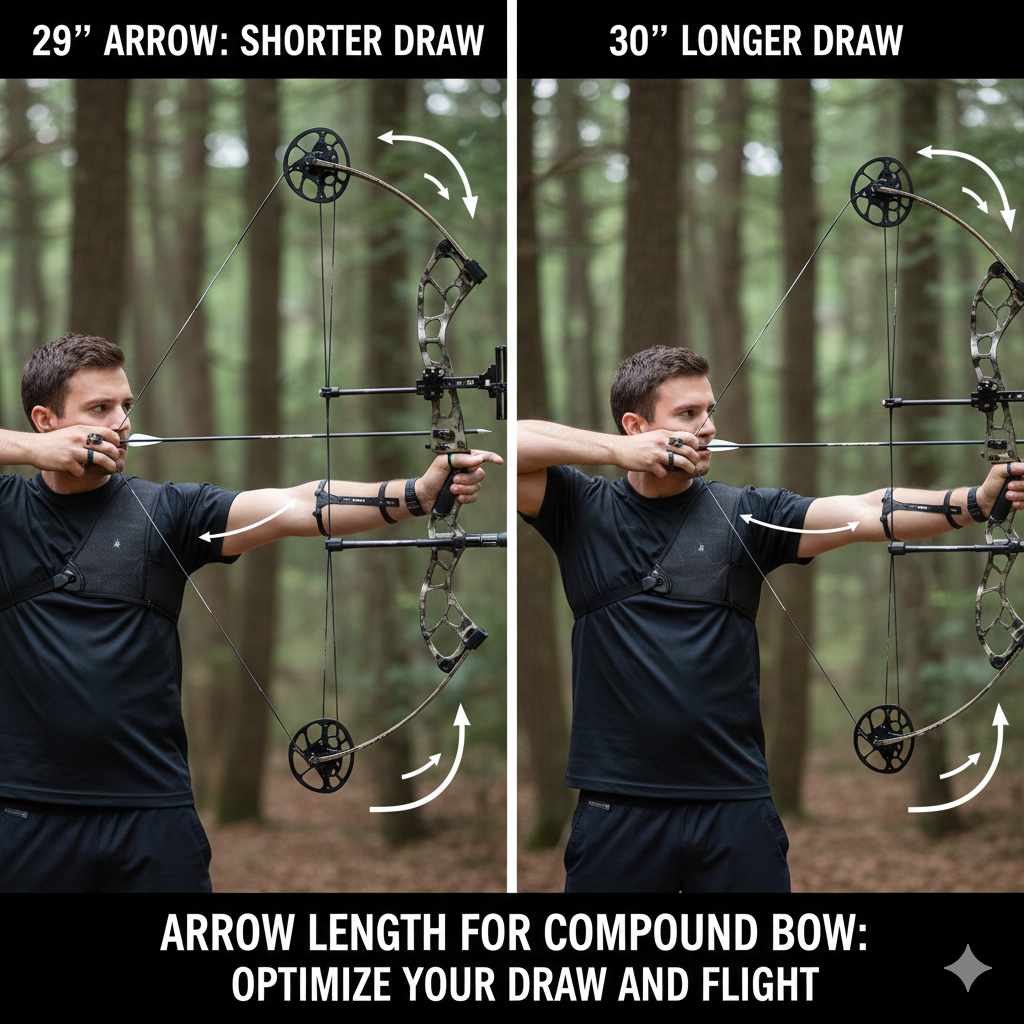
Choosing the right arrow length is a big deal for anyone getting started with a compound bow. It’s something that often leaves new archers scratching their heads! Picking between 29″ vs 30″ Arrows for Compound Bow: Which Is Better? is a common question, and it can feel tricky at first. Don’t worry! This post will break down the process step by step, making it super easy to figure out the perfect arrow length for your setup. We’ll explore the main factors, so you can start shooting with more accuracy and confidence. Let’s get started!
What Arrow Length Really Means for Your Shots
Arrow length is much more important than you might think when you first start. It directly influences your bow’s performance. The length affects arrow spine, which is how much the arrow bends when shot. It also influences arrow weight. Plus, it affects how well the arrow clears your bow and whether it’s safe to shoot. A too-short arrow can be dangerous, while a too-long arrow can impact accuracy. Getting it right is key to better shooting and preventing problems. Knowing the differences between different lengths, such as the debate around 29″ vs 30″ Arrows for Compound Bow: Which Is Better?, is a good starting point.
Arrow Spine Explained Simply
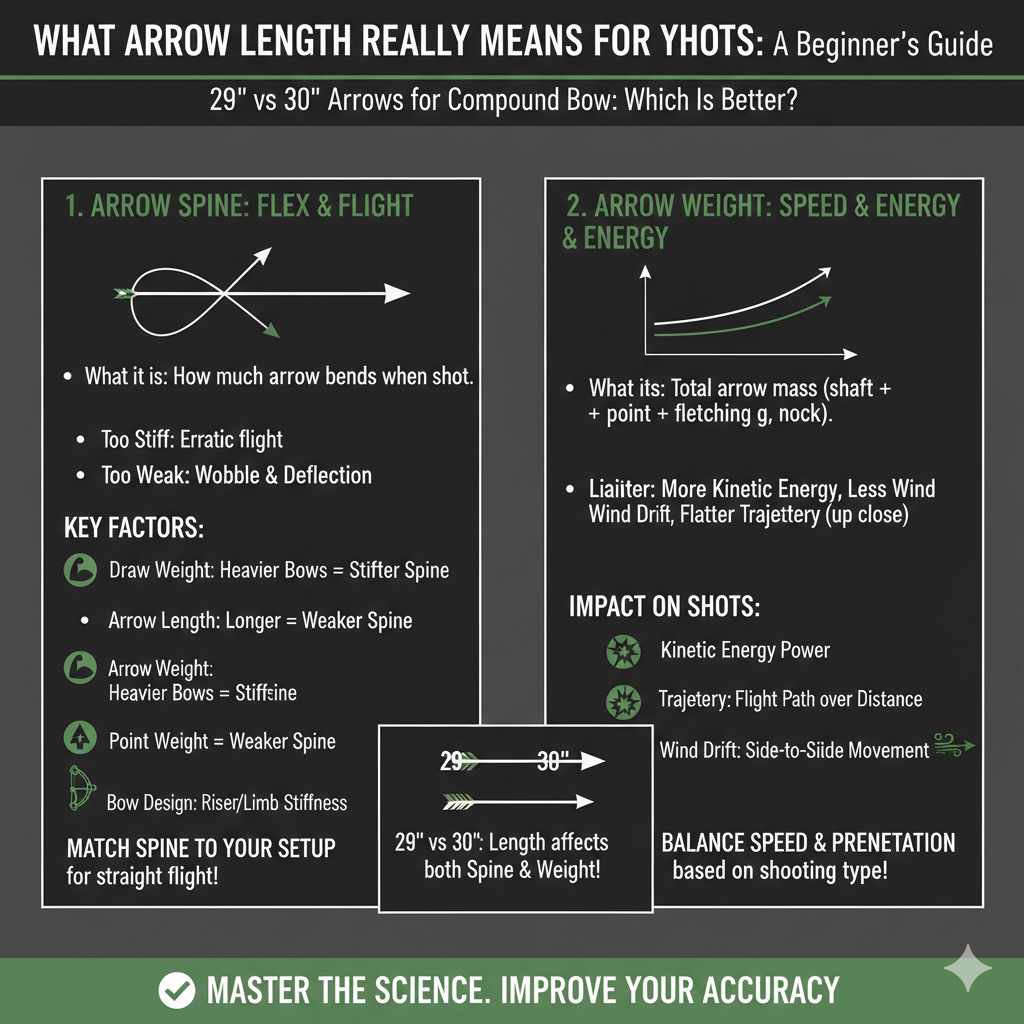
Arrow spine is a measurement of how much an arrow flexes, or bends, when you shoot it. Think of it like a diving board. A stiffer spine means less bend, while a weaker spine means more bend. This bend is important because the arrow has to flex around your bow’s riser. Matching the arrow spine to your bow’s draw weight and arrow length is important for consistent accuracy. An arrow with the wrong spine can wobble in flight, making your shots miss their target. This is a critical element when evaluating 29″ vs 30″ Arrows for Compound Bow: Which Is Better?, as different lengths will impact spine.
- Draw Weight: Heavier draw weights require stiffer spines.
- Arrow Length: Longer arrows generally require weaker spines, while shorter arrows require stiffer spines.
- Point Weight: Heavier points can also impact arrow flex.
- Bow Design: Some bows are more forgiving of spine variations than others.
Choosing the right spine ensures your arrows fly straight, improving your grouping. A properly spined arrow will flex around your bow’s grip and limbs without hitting them. It all boils down to selecting the right arrow for your setup. For instance, in the 29″ vs 30″ Arrows for Compound Bow: Which Is Better? question, the specific draw weight of the bow would influence the final selection.
Arrow Weight’s Role in Accuracy
Arrow weight has a big say in the performance of your shots. Heavier arrows tend to maintain their speed and energy better over distance. This means they are less affected by wind and will have a flatter trajectory, making them a good option for target shooting and hunting. On the other hand, lighter arrows move faster initially, but they lose speed quickly and are more affected by the wind. The total arrow weight includes the shaft, the point, the fletchings, and the nock. When you’re thinking about 29″ vs 30″ Arrows for Compound Bow: Which Is Better?, consider how length affects weight, because longer arrows generally weigh more.
- Kinetic Energy: Heavier arrows have more kinetic energy, making them more effective at penetrating targets.
- Trajectory: Lighter arrows have a flatter trajectory, while heavier arrows drop more over distance.
- Wind Drift: Heavier arrows are less affected by wind.
- Bow Efficiency: Matching your arrow weight to your bow can help improve shooting performance.
The correct arrow weight for you depends on what kind of shooting you’ll be doing. For instance, a hunting setup might benefit from a heavier arrow for increased penetration. Some archers prefer a lighter arrow for faster speeds, but this can lead to less accuracy at longer distances. The weight also affects your bow’s performance. A common rule is to aim for around 6-8 grains of arrow weight per pound of draw weight. For example, a 60-pound bow could use an arrow weighing around 360-480 grains. Considering the arrow weight is a key step in evaluating 29″ vs 30″ Arrows for Compound Bow: Which Is Better?.
Measuring Your Draw Length Accurately
Knowing your draw length is the most important step in choosing arrow length. Your draw length is the distance from your bowstring at full draw to the deepest point of your bow’s grip, plus 1.75 inches. This measurement impacts your arrow’s performance and safety, so getting it right is important. This is one of the most essential steps in the debate regarding 29″ vs 30″ Arrows for Compound Bow: Which Is Better? as it’s impossible to answer this question without first knowing your draw length.
Using the Arm Span Method
The arm span method is an easy way to estimate your draw length. It’s a good starting point, especially for beginners. The process involves measuring the distance from fingertip to fingertip while you stretch your arms out to the sides. Divide that measurement by 2.5. The result gives you an estimate of your draw length. This method gives you a solid base for evaluating 29″ vs 30″ Arrows for Compound Bow: Which Is Better?, but it is not the only measurement.
- Arm Span Measurement: Stand with your arms stretched straight out to the sides. Get a friend to measure from the tip of your middle finger on one hand to the tip of your middle finger on the other.
- Calculate Draw Length: Divide your arm span measurement (in inches) by 2.5. For example, if your arm span is 70 inches, your estimated draw length is 28 inches.
- Check for Accuracy: This method provides an estimate, so consider further measurement methods.
- Make Adjustments: Depending on your physique, you might need to adjust this value slightly.
While the arm span method is useful, it is important to remember it’s not always exact. It is a good starting point, but other measurement methods or professional guidance are needed for the most precise draw length. For instance, this method can help you quickly narrow down if you should start testing with 29″ or 30″ arrows in the question about 29″ vs 30″ Arrows for Compound Bow: Which Is Better?.
The Wall Test Measurement Explained
The wall test is a more accurate way to measure your draw length. It involves mimicking your shooting form against a wall. The process uses a measuring tape and a helper. The idea is to replicate your bow draw at full draw and measure the distance. This method gives a more personalized draw length that is specific to your stance. It’s useful in making a decision between 29″ vs 30″ Arrows for Compound Bow: Which Is Better?.
- Stand Against a Wall: Stand with your feet shoulder-width apart, facing a wall.
- Simulate Full Draw: Extend your bow arm towards the wall, simulating your full draw position. Your shoulder should be relaxed, not tensed.
- Measure to the Wall: Use a measuring tape to measure from the wall to the corner of your mouth (the point where your face touches the bowstring).
- Add 1.75 Inches: Add 1.75 inches to that measurement. This is your estimated draw length.
The wall test is more precise than the arm span method because it considers your shooting form. However, if you are new to archery, it’s wise to consult a professional to ensure your form is correct during the test. Your draw length is key to accuracy and performance. This is why you must understand the measurement techniques, to determine the ideal length for your needs when considering 29″ vs 30″ Arrows for Compound Bow: Which Is Better?.
Choosing the Right Arrow Length for Optimal Performance
Once you know your draw length, selecting the right arrow length becomes easier. The most common recommendation is to add 1 inch to your draw length. For example, if your draw length is 28 inches, a 29-inch arrow would be a good starting point. This approach is generally safe and helps ensure the arrow extends past your bow’s riser. When evaluating 29″ vs 30″ Arrows for Compound Bow: Which Is Better?, matching your arrow length to your draw length is important.
Factors to Consider
While adding 1 inch to your draw length is a good general rule, several other factors can affect the best arrow length for you. These include your bow type, the type of shooting you do, and your personal preferences. For instance, hunting requires a bit more length to ensure the arrow extends past your hand. 29″ vs 30″ Arrows for Compound Bow: Which Is Better? depends on the type of archery you are involved in.
- Bow Type: Different bows might require slight adjustments to arrow length.
- Shooting Style: Your shooting form and technique can influence the best arrow length.
- Safety: Ensuring your arrow is long enough to avoid falling off the rest is vital.
- Hunting vs. Target: Hunters might prefer longer arrows for added safety and weight.
Consider consulting with an archery expert for a personalized fit. They can measure you and recommend the best arrow length and spine for your bow. Also, they can consider other factors like your anchor point, the position you hold your bow, and your string angle. These professional recommendations are helpful when thinking about the question of 29″ vs 30″ Arrows for Compound Bow: Which Is Better?.
Arrow Overhang Explained
Arrow overhang refers to how much of the arrow extends past the front of your bow. It’s the difference between the arrow’s total length and your draw length. Overhang is key, as it determines how far the arrow sits in front of the bow when it is fully drawn. It affects arrow weight and spine. A proper overhang helps with accuracy and safety. Considering this element will help decide the question of 29″ vs 30″ Arrows for Compound Bow: Which Is Better?.
- Safety: The arrow must extend past the riser for safe shooting.
- Accuracy: Too little overhang can cause the arrow to hit the riser.
- Weight Distribution: The overhang affects how weight is balanced, influencing arrow flight.
- Personal Preference: Some archers prefer a specific amount of overhang.
The goal is to find the right balance between safety and performance. Most archers want an overhang of about 1 to 2 inches beyond their draw length. This overhang length balances your bow and the arrow. If you are starting out, having your arrows cut longer than your draw length by one inch is a good starting point. Adjusting the overhang can impact both safety and the balance of your setup. This is why it is useful for deciding between 29″ vs 30″ Arrows for Compound Bow: Which Is Better?, as different bow setups require a specific overhang.
Testing and Fine-Tuning Your Arrow Length
After you have estimated your arrow length, the next step is testing and fine-tuning. This phase is important, as it helps you identify the best arrow length for your bow and shooting style. You can do so by shooting arrows and watching their flight, then adjusting. This hands-on part is important in your approach to 29″ vs 30″ Arrows for Compound Bow: Which Is Better?.
Paper Tuning for Arrow Flight
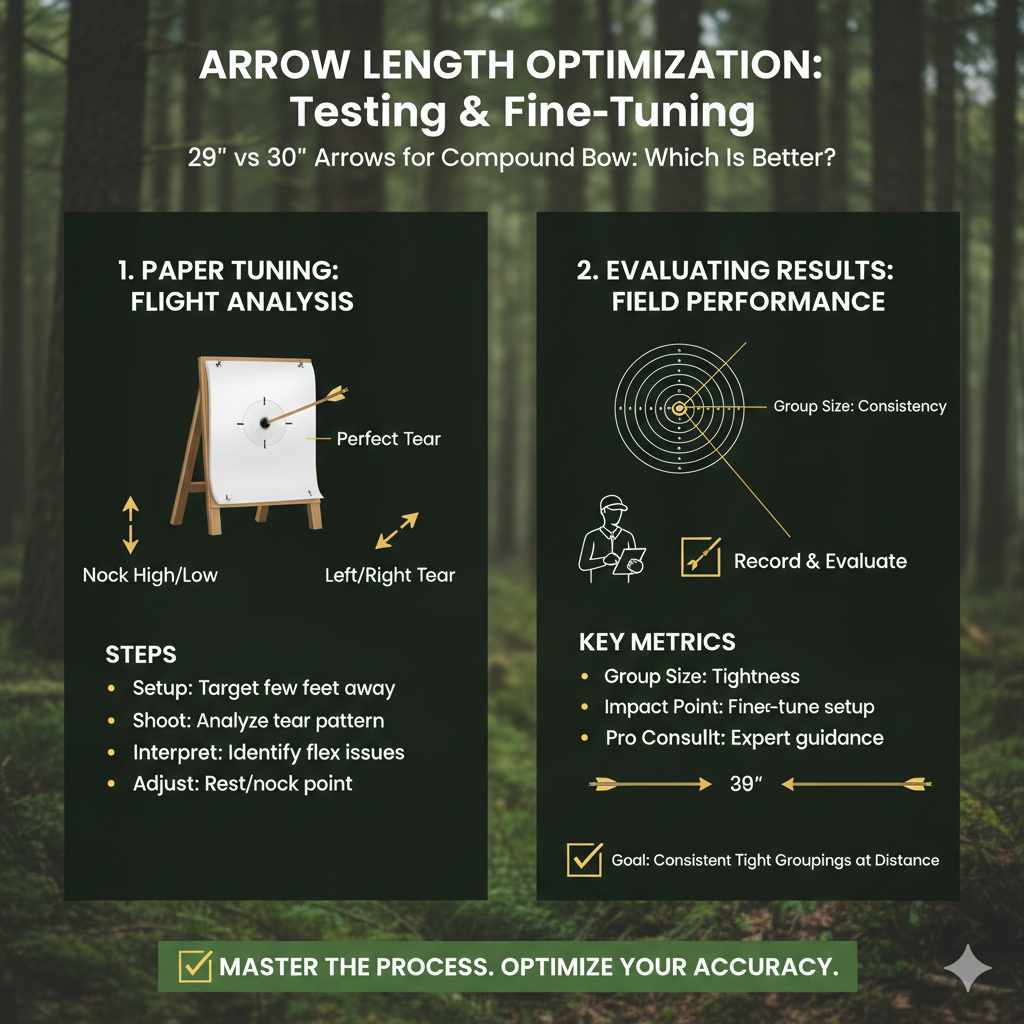
Paper tuning is an important part of the fine-tuning process. It is a method of shooting arrows through a sheet of paper to analyze how the arrow is flying. The process helps you see how well the arrow is tuned to your bow and how much it is flexing as it leaves the bow. The results from the paper tuning can help you make adjustments. It is useful in resolving the debate of 29″ vs 30″ Arrows for Compound Bow: Which Is Better?.
- Setup: Set up a paper target a few feet in front of your bow.
- Shoot: Shoot an arrow through the paper and observe the tear pattern.
- Interpret Tears: A perfect tear shows a clean hole. A tear will show problems with the arrow spine or rest position.
- Adjust: Adjust your arrow rest, nock position, or potentially the arrow spine.
By observing the tear pattern, you can identify any problems with your arrow flight. The pattern will show if your arrow is nock high, nock low, or flexing sideways. A nock high or low tear suggests the arrow is flexing too much up or down. A left or right tear indicates horizontal flexing. These insights can help when deciding about 29″ vs 30″ Arrows for Compound Bow: Which Is Better? by showing you if one arrow length is consistently more accurate than the other.
Evaluating the Results
Once you start shooting, evaluate how the arrows are performing. You will be able to see if they are grouping tightly. Observe their accuracy at various distances. You’ll be able to compare the flight of arrows and assess which length works best for your bow setup. This evaluation process involves seeing how the arrows group at different distances. It involves analyzing your arrow groupings to determine which arrow length gives you the tightest grouping. The results inform the decision of 29″ vs 30″ Arrows for Compound Bow: Which Is Better?.
- Group Size: The size of your arrow groups shows how consistent your shots are.
- Impact Point: Note where your arrows are hitting on the target.
- Adjustments: If you notice inconsistencies, you can adjust your arrow rest and nock point.
- Consulting with a Pro: If you are new, asking for help can improve your shooting.
Observe how your arrows fly over distance. Are they consistently hitting the same point? If they are not, you might need to adjust your arrow length. Evaluate your shooting with both arrow lengths. Observe the groupings, flight paths, and overall accuracy of each length. Record the results of your shooting. Which arrow length gives you the best results? The goal is to see which length leads to the most consistent and accurate shots. Testing and analysis are key when evaluating 29″ vs 30″ Arrows for Compound Bow: Which Is Better?.
Frequently Asked Questions
Question: Can I cut my arrows shorter if they are too long?
Answer: Yes, you can usually cut your arrows shorter. However, make sure you don’t cut them too short, as this can be dangerous and affect your shooting. It’s usually best to start with longer arrows and trim them down as needed.
Question: Does arrow length affect arrow spine?
Answer: Yes, arrow length affects arrow spine. Generally, longer arrows will have a weaker spine (more flex), while shorter arrows will have a stiffer spine (less flex). Matching your arrow spine to your bow’s draw weight and arrow length is important.
Question: How do I know if my arrows are too long or too short?
Answer: Too-long arrows will likely shoot accurately but might feel a bit unwieldy. Too-short arrows are a safety risk. You should be able to see the end of the arrow extend at least past your hand at full draw, and you should be able to shoot without issues.
Question: What if my draw length is between two standard arrow lengths?
Answer: If your draw length falls between two standard arrow lengths, it’s usually better to go with the longer arrow and then trim it down as needed. This ensures safety and gives you some room for adjustment.
Question: Should I always add 1 inch to my draw length for arrow length?
Answer: Adding 1 inch to your draw length is a good starting point, but it’s not a hard-and-fast rule. Consider factors like your bow type, shooting style, and safety. You can adjust the length as needed for better results.
Final Thoughts
Selecting the right arrow length is an important part of making sure you get good shots. Finding the perfect fit between 29″ vs 30″ Arrows for Compound Bow: Which Is Better? means finding the length that matches your draw length, bow, and shooting style. Taking the time to correctly measure your draw length is the first step. Next, consider factors like arrow spine and weight. Remember to test different arrow lengths and make small adjustments. Paper tuning and target practice are essential for improving accuracy. Don’t be afraid to ask for help from a professional archer for advice! Now that you’ve got the info, you’re ready to pick the best arrows for your bow and shoot with confidence!