340 vs 400 Arrow Spine: Clear Comparison Explained for Archers
Choosing the right arrow spine can be tough! If you’re new to archery, figuring out the difference between 340 vs 400 Arrow Spine: Clear Comparison can seem confusing. Don’t worry, we’ve all been there! This post will break down everything you need to know in a way that’s easy to follow. We’ll simplify the topic and guide you through the process step-by-step. Get ready to learn how to pick the best arrow spine for your bow and shooting style. Let’s get started!
What is Arrow Spine and Why Does It Matter?


Arrow spine is a measurement of an arrow’s flexibility. It’s essentially how much an arrow bends when a certain weight is applied to it. This bend, or flex, is critical for accurate shooting. If an arrow doesn’t flex correctly as it leaves the bow, it won’t fly straight. This can lead to missed shots and frustration on the range. The right spine ensures the arrow interacts properly with the bow and the archer’s form.
How Spine Affects Arrow Flight
When an arrow is shot, it flexes as it leaves the bow. This flex is caused by the force of the bow pushing the arrow forward. The arrow’s spine determines how much it bends. An arrow with the correct spine will bend in a controlled manner, correcting itself mid-flight. An arrow with too stiff a spine won’t bend enough and will fly to the left (for a right-handed archer). An arrow with too weak a spine will bend too much and fly to the right. The correct spine balances these forces, leading to better accuracy.
- Archer’s Paradox: This describes how an arrow bends around the bow riser. The arrow flexes as it leaves the bow, and if the spine is correct, it corrects itself to fly straight.
- Fletching Influence: Fletchings (the vanes on the arrow) also play a role. They guide the arrow in flight and can affect how the arrow corrects its path, especially in crosswinds.
- Impact on Grouping: The correct spine leads to tighter groupings (arrows hitting closer together). Incorrect spine can cause arrows to land far apart, making it difficult to sight in your bow.
Factors Influencing Arrow Spine Selection
Several things impact the right arrow spine for an archer. These factors all work together to determine the best match for your setup. Considering each of these aspects helps to narrow down the choices and find the perfect arrow spine. It is a process of fine-tuning until the best results are achieved.
- Bow Draw Weight: The amount of force you use to pull the bow. Heavier draw weights need stiffer spines.
- Draw Length: The distance you pull the string back. Longer draw lengths often require weaker spines.
- Arrow Length: Longer arrows tend to have weaker spines because they have more surface area to flex.
- Arrow Point Weight: Heavier points make the arrow’s spine seem weaker.
- Bow Type: Compound bows and recurve bows have different requirements. Compound bows usually need stiffer spines.

Comparing 340 vs 400 Arrow Spine
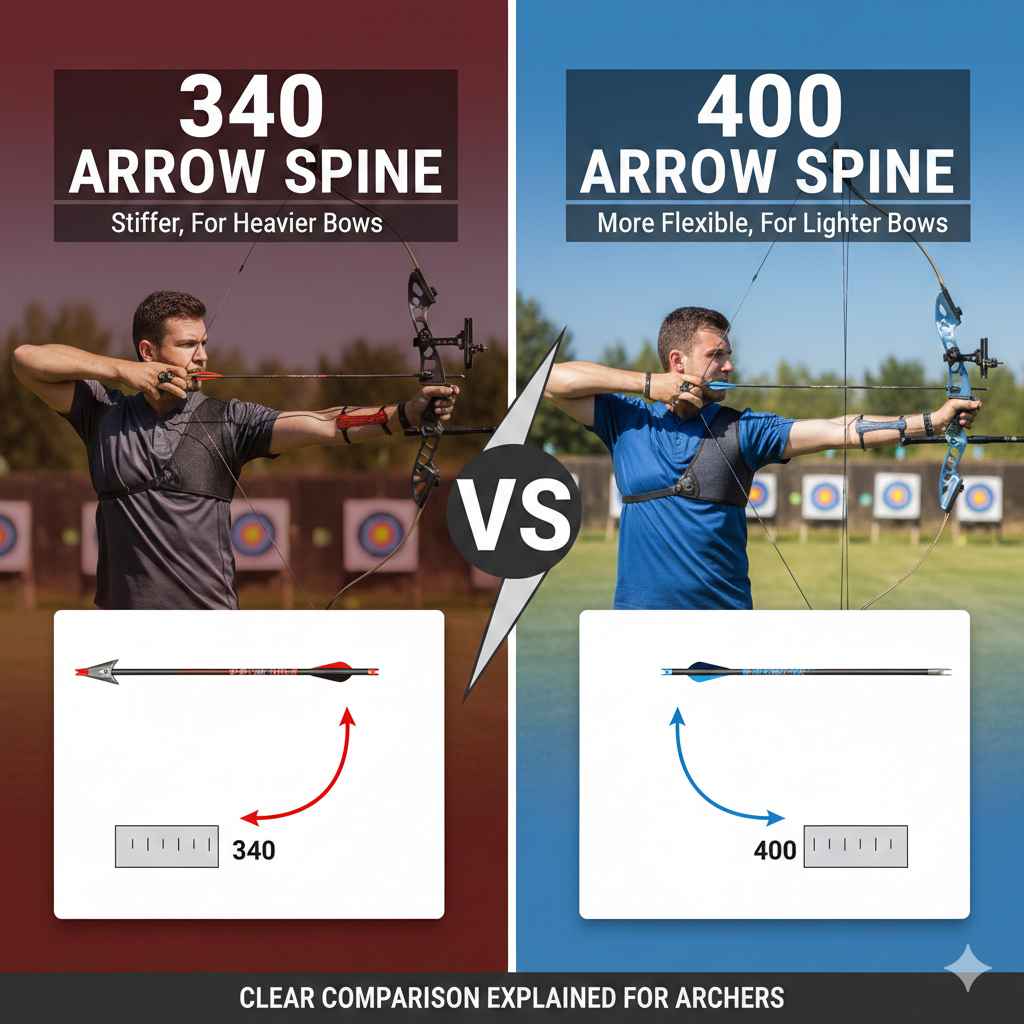
The numbers 340 and 400 refer to the arrow spine measurement. A lower number, like 340, indicates a stiffer arrow compared to a higher number, like 400. Choosing between these two spines comes down to matching your bow setup. Archers often choose one spine over the other based on their equipment and shooting style. Selecting the right spine leads to greater accuracy and makes the entire archery experience more pleasant.
Understanding the Measurement System
Arrow spine is usually measured in inches of deflection, with a 28-inch length of arrow and a 1.94-pound weight applied. A 340 spine arrow deflects .340 inches under that weight, while a 400 spine arrow deflects .400 inches. The lower the number, the stiffer the arrow. Understanding this system is key to selecting the appropriate arrow spine for your archery needs. Most arrow manufacturers offer spine charts to help you match your bow’s specifications.
| Feature | 340 Spine | 400 Spine |
|---|---|---|
| Stiffness | Stiffer | Weaker |
| Typically Used For | Higher draw weights, longer draw lengths | Lighter draw weights, shorter draw lengths |
| Ideal for | Experienced archers, target shooting | Beginners, recreational use |
When to Use 340 Spine
A 340 spine arrow is the option when you’re using a bow with a higher draw weight or draw length. These arrows are ideal for archers who have a powerful setup. The stiffer design helps handle the increased force and offers better stability in flight. Experienced archers looking for maximum accuracy often select the 340 spine for its ability to cut through wind and maintain a straight trajectory.
- Higher Draw Weights: If your bow has a draw weight of 60 pounds or more, a 340 spine is often recommended.
- Longer Draw Lengths: If your draw length is 29 inches or longer, a 340 spine might be the best option for your setup.
- Target Shooting: For competitive target shooting, the 340 spine is used because it provides the best stability and accuracy.
- Heavy Arrow Points: Using heavier points on the arrow can affect spine, so a 340 spine may be needed to balance the arrow’s characteristics.
When to Use 400 Spine
The 400 spine arrow is a solid choice for bows with lower draw weights and shorter draw lengths. These arrows are generally more forgiving, which can benefit beginners and archers developing their form. The 400 spine is a great starting point for those new to archery because it tends to be easier to tune. The increased flexibility can help absorb some errors in form.
- Lower Draw Weights: If your bow has a draw weight under 60 pounds, the 400 spine might be a better fit.
- Shorter Draw Lengths: If your draw length is less than 28 inches, a 400 spine is often a good starting point.
- Beginner Archers: The more flexible nature of the 400 spine makes them more forgiving of minor form errors.
- Recreational Shooting: For casual target practice or backyard shooting, the 400 spine is an excellent choice.
Choosing the Correct Arrow Spine for Your Setup
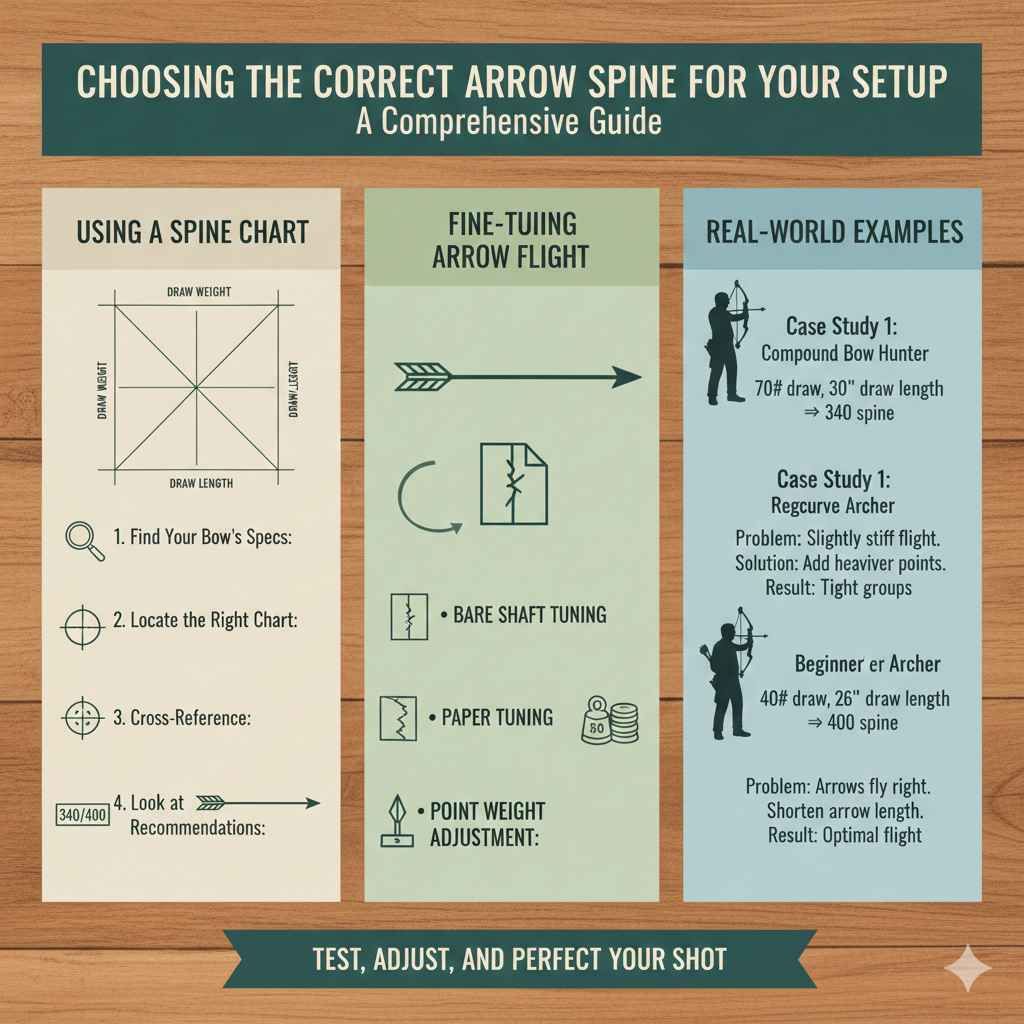
Selecting the right arrow spine involves careful consideration of several factors. Using a spine chart from your arrow manufacturer is a good starting point. These charts take your bow’s specifications into account and will provide a base recommendation. Fine-tuning your setup may be necessary to find the perfect arrow flight. Remember that testing and adjusting are key.
Using a Spine Chart
Most arrow manufacturers provide charts that show which spine is the right choice based on your bow’s specifications. These charts consider draw weight, draw length, and sometimes the type of bow you use. To use a spine chart, you will need to know your bow’s specifications. Always verify the information with the manufacturer’s recommendations. Referencing a spine chart is the best method to find a reasonable starting point.
- Find Your Bow’s Specs: Determine your bow’s draw weight and draw length.
- Locate the Right Chart: Get the chart from the arrow manufacturer whose arrows you plan to use.
- Cross-Reference: Find your draw weight and length on the chart.
- Look at Recommendations: The chart will suggest a spine size (340, 400, etc.)
Fine-Tuning Arrow Flight
After selecting an arrow spine based on your bow’s specifications, you may need to fine-tune your setup. This is often achieved through a process of shooting and making small adjustments. The goal is to get your arrows hitting the target consistently. Adjusting the point weight, arrow length, and even the fletchings can influence arrow flight. The correct spine will make the arrow’s flight a clean arc toward the target.
- Bare Shaft Tuning: Shoot arrows without fletchings (bare shafts) at a target. Observe the impact point to determine if the arrow is flying straight.
- Paper Tuning: Shoot arrows through paper to see how the arrow is flexing as it leaves the bow. Adjust the rest to get a clean tear in the paper.
- Field Testing: Shoot at a target at various distances to see how the arrows group. Make small adjustments and keep shooting.
- Point Weight Adjustment: Change the weight of the arrow points to affect the arrow’s spine.
Real-World Examples
Let’s look at some examples of how spine selection plays out in real-world archery situations. These cases highlight the importance of understanding the relationship between the bow and the arrow. Seeing these examples can give a more clear picture of how spine choice can impact performance.
- Case Study 1: Compound Bow Hunter: An experienced hunter with a 70-pound draw weight and a 30-inch draw length selects a 340 spine arrow. After initial testing, he finds that the arrows are slightly stiff. He can resolve the problem by adding heavier points to his arrows. This helps to weaken the arrow’s spine and results in tight groupings at 30 yards.
- Case Study 2: Beginner Recurve Archer: A beginner archer with a 40-pound recurve bow and a 26-inch draw length begins with 400 spine arrows. He finds that his arrows are grouping well, but his arrows tend to land a bit to the right (for a right-handed archer). The problem is likely due to the arrow being a bit stiff. By shortening the arrow length, he achieves optimal arrow flight.
Frequently Asked Questions
Question: How do I measure my draw length?
Answer: Stand with your arms out to the sides, like you’re making a “T”. Measure the distance from the tip of one middle finger to the tip of the other. Divide that number by 2.5. This provides an approximate draw length, but always confirm it with a professional.
Question: Can I use the same arrows for different bows?
Answer: Not always. The arrow spine and length must match your bow’s draw weight and draw length. Using the wrong arrow can damage your bow or cause injury.
Question: What if I’m between two spine sizes on the chart?
Answer: If you’re between two spine sizes, it’s usually better to choose the stiffer spine (the lower number). This can be softened with heavier points or longer arrow length. It is always best to be a little stiff, but your results may vary.
Question: How often should I replace my arrows?
Answer: Inspect your arrows before each shooting session. Look for cracks, splinters, or any other damage. If you see any damage, replace the arrow. Over time, arrows can become fatigued and are less likely to perform as designed.
Question: What’s the best way to store my arrows?
Answer: Store your arrows in a cool, dry place away from direct sunlight. Protect the fletchings from being bent or crushed. Arrow tubes or quivers are good options for storage.
Final Thoughts
Choosing between a 340 and 400 arrow spine comes down to matching your equipment and your shooting style. The 340 spine is designed for archers with heavier draw weights and longer draw lengths, providing a stiffer arrow that maintains trajectory. Conversely, the 400 spine, with its more flexible design, caters to archers with lighter draw weights and shorter draw lengths, making it ideal for beginners. To find the right fit for your bow, it’s key to consult a spine chart from the arrow manufacturer and consider your specific measurements. Always start with a baseline suggestion and then tune your arrow setup to enhance accuracy. Keep shooting and testing, and you’ll find the perfect match for your archery goals!