Arrow Spine 1000 vs 800: Choosing the Right Arrow Spine
Choosing the right arrow spine can be tricky, especially if you’re just starting archery. It’s common to feel a little lost when faced with terms like spine deflection and draw weight. Don’t worry, many archers find this part challenging! We’re going to break down Arrow Spine 1000 vs 800: Which to Choose, making it simple to pick the right arrows for your bow. We’ll explore the basics, the differences, and how to make the best decision for your shooting style. Let’s get started and clear up any confusion.

Linkboy Archery
Linkboy Archery Pure Carbon Arrows Spine 300…
- Straightness: +/- .003",ID6.2mm,more spine for you choose.Shaft made from high quality pure carbon
- Precision Carbon Archery Arrows- Made of premium precision material, the carbon hunting arrows will be durable and everlasting for…
- Removable Arrow Tip- The stainless steel arrow tips included is perfect for targeting practice and hunting. With removable design,…
As an Amazon Associate I earn from qualifying purchases.
What Is Arrow Spine and Why Does It Matter?
Arrow spine refers to the stiffness of an arrow. Imagine the arrow as a diving board; when you put weight on it, it bends. Arrow spine is the amount an arrow bends or flexes when a certain amount of weight (like the force from your bowstring) is applied. This is a very important concept. The correct spine ensures that the arrow flexes properly as it leaves the bow, allowing for a straight and accurate flight. If the spine is too stiff or too weak, the arrow won’t fly straight, and your shots will be inaccurate. Incorrect spine also reduces your overall efficiency.
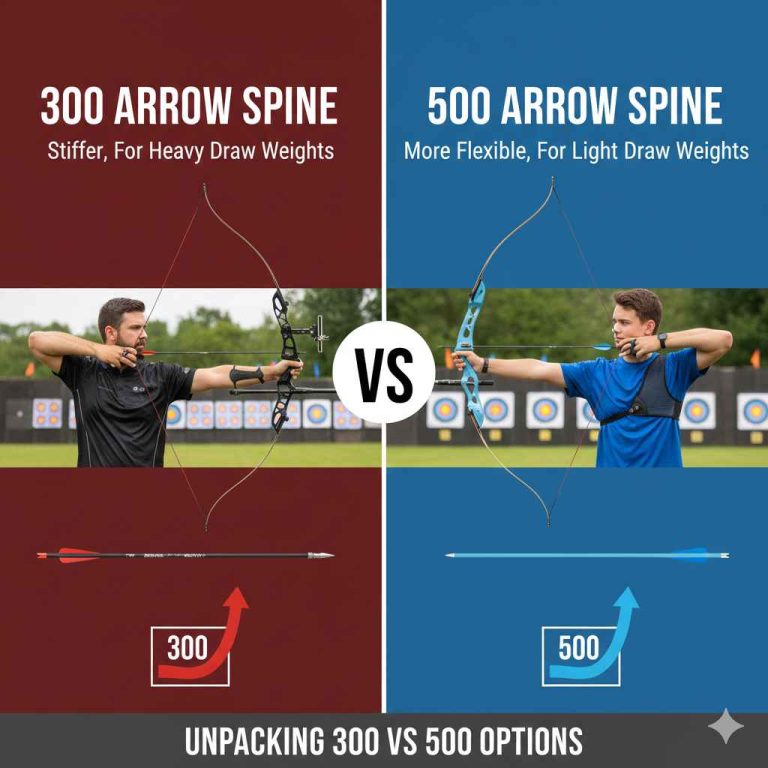
Different bows and shooting styles need different arrow spines. Bow weight, draw length, and the type of arrow point all influence the appropriate spine. The manufacturer typically assigns the spine number to the arrow itself. Generally, the lower the number, the stiffer the arrow; a 300 spine arrow is stiffer than a 500 spine arrow. The specific number you need depends on your bow and shooting setup. It is critical to select the proper spine to achieve good groupings.
The Science Behind Arrow Flex
The flex of an arrow matters because it impacts how the arrow behaves in flight. When the arrow is launched, the force from the bowstring causes it to flex. This flex needs to be balanced. If an arrow is too stiff, it won’t flex enough, and the arrow will fly to the left (for right-handed archers). If an arrow is too weak, it will flex too much and fly to the right (again, for right-handed archers). This is called the “archer’s paradox.” The arrow flexes around the riser of the bow and needs to recover and straighten out during flight to hit the target accurately. Understanding and selecting the correct spine helps to manage this flex effectively.
- Dynamic Spine: This is the spine of the arrow when it is in motion, during the shot. It considers all the factors affecting arrow flex. This is often the more crucial concept.
- Static Spine: The measure of an arrow’s stiffness when it’s not under any force. This is usually determined by the manufacturer and is a basic measurement of the arrow.
- Archer’s Paradox: This describes the arrow’s bend around the bow as it leaves. This is why the correct spine is so important.
- FOC (Front of Center): This is a calculation of the balance point of the arrow. Heavier points will shift the balance toward the front, which affects arrow flight.
Factors Influencing Arrow Spine Choice
A few aspects affect which arrow spine you need. The most important is your bow’s draw weight. Higher draw weights need stiffer spines. Other aspects include the draw length, the arrow’s total length, the weight of the arrow point, and the type of bow you have. For example, a compound bow, which has a higher force at the beginning of the draw, will need a stiffer arrow spine compared to a recurve bow with the same draw weight. Carefully consider each factor, as they all contribute to the arrow’s behavior during flight.
- Draw Weight: The heavier the draw weight of your bow, the stiffer the arrow spine you’ll require. This is because the bow will apply more force to the arrow upon release.
- Draw Length: A longer draw length usually necessitates a weaker (higher number) spine. As your draw length increases, so does the amount of force exerted on the arrow.
- Arrow Length: A longer arrow bends more than a shorter one, meaning it effectively has a weaker spine. Always measure the correct length.
- Arrow Point Weight: Heavier points weaken the effective spine of the arrow. Lighter points stiffen the spine. Always check.

Comparing Arrow Spine 1000 and 800
The difference between an Arrow Spine 1000 vs 800: Which to Choose comes down to stiffness. The lower the spine number, the stiffer the arrow. An 800 spine arrow is stiffer than a 1000 spine arrow. In archery, this difference impacts how the arrow flexes when released from the bow. It’s the key to getting the arrow to fly straight and hit the target accurately. The right choice ensures the arrow bends and recovers properly, aligning with the archer’s paradox and improving accuracy.
Choosing the right spine involves matching the arrow’s stiffness to your bow’s specifications and your shooting style. Incorrectly matched arrows will lead to inaccurate shots. An arrow with too weak a spine will bend too much and may fly wide, while an arrow with too stiff a spine will barely bend and could also miss the target. The goal is to get the perfect balance between arrow stiffness, bow power, and the archer’s technique.
Arrow Spine 1000: When to Use It
An arrow with a spine of 1000 is considered quite flexible. This flexibility is usually perfect for beginner bows with lighter draw weights. It’s an excellent choice for archers with a draw weight of about 20–30 pounds. This is suitable for target practice or starting archery. The flexibility of a 1000 spine arrow makes it easier to work with, especially for archers who are still developing their technique and the bow’s power. It is frequently recommended for recurve bows with a modest draw weight.
- Beginner Archers: It is ideal for those starting because it is more forgiving.
- Lighter Draw Weights: Usually best for bows with lower poundage.
- Recurve Bows: Common in recurve bows, especially for target shooting.
- Shorter Draw Lengths: Suits archers with a shorter draw length.
Arrow Spine 800: When to Use It
An 800 spine arrow is stiffer than a 1000 spine. It is a suitable option for archers who need a bit more strength and power in their shots. This spine is frequently chosen by archers with moderate draw weights. It can handle more force without excessive bending. If you’re using a recurve bow and have a draw weight between 30 and 40 pounds, this is an option. If you are also transitioning to compound bows, it might also be a suitable choice. With the right adjustments, these arrows can also be used in competitive situations.
- Archers with Moderate Experience: A little more experience is usually needed.
- Moderate Draw Weights: Suitable for bows between 30 and 40 pounds.
- Recurve and Some Compound Bows: Works well with many bows.
- Greater Distance: Good for longer shots.
Comparison Table: Arrow Spine 1000 vs 800
Here’s a comparison table to easily view the differences between an Arrow Spine 1000 and 800.
| Feature | Arrow Spine 1000 | Arrow Spine 800 |
|---|---|---|
| Stiffness | More flexible | Stiffer |
| Typical Draw Weight Range | 20-30 pounds | 30-40 pounds |
| Common Bow Types | Recurve bows | Recurve and some compound bows |
| Suitable for | Beginners, shorter draw lengths | More experienced archers, moderate draw lengths |
How to Select the Correct Arrow Spine
Determining the right arrow spine involves several steps. The key is to match your bow’s specifications with your shooting style and the arrow’s characteristics. Start with a bow scale, measure your draw length, consider the type of arrow points you’ll use, and consult arrow charts. These charts consider all the factors to suggest the right spine range for your setup. Careful selection ensures you achieve the most accurate and consistent results.
If you’re unsure, it is best to consult with an expert or use an arrow selection chart from the arrow manufacturer. If you want even more precision, get a spine testing tool. This helps to determine the arrow spine by physically testing the arrow. The combination of your bow, draw length, and arrow’s specifications ensures that your arrow behaves precisely as you want when it is in flight. Proper testing can significantly impact your performance.
Step-by-Step Selection Guide
- Measure Your Draw Weight: Use a bow scale to determine your bow’s draw weight.
- Measure Your Draw Length: Accurately measure your draw length, the distance from the bowstring to the grip’s pivot point.
- Consider Arrow Length: Cut the arrow shafts to the appropriate length.
- Choose Arrow Point Weight: Pick the weight of the arrow points you plan to use.
- Consult Arrow Charts: Refer to arrow charts provided by manufacturers.
Testing and Tuning Your Arrows
Once you have selected your arrows, test them out! This will help you get the best shots. Begin by shooting at a target at a reasonable distance, typically around 20 yards. Observe how your arrows hit the target. If the arrows are consistently hitting to the left, you may need a stiffer spine, or the opposite. Fine-tuning adjustments, such as modifying the arrow rest position or adding weight to the arrow points, can help to improve accuracy. The goal is to consistently group your arrows close to the center.
- Paper Tuning: This involves shooting an arrow through a paper to analyze its flight.
- Bare Shaft Tuning: This method involves shooting arrows without fletchings and seeing where they hit.
- Grouping Analysis: Observe how the arrows group together on the target.
- Adjustments: Make small adjustments to the bow and arrows to improve accuracy.
Real-World Examples: When Spine Matters
Let’s look at a few examples to see how spine selection affects real-world performance. First, consider a beginner archer using a recurve bow with a draw weight of 25 pounds. They begin with 800-spine arrows, and their shots consistently hit to the right. After switching to 1000-spine arrows, their shots start grouping much closer to the center, showing the importance of proper spine matching. This showcases the impact of selecting the right arrow for an improved shooting experience.
Now, let’s explore a scenario with a more experienced archer. This archer has a compound bow with a draw weight of 60 pounds. They start by using 1000-spine arrows, but their shots consistently fly to the left. After switching to 800-spine arrows, the shots begin grouping near the center. This example shows that even for more experienced archers, selecting the right arrow spine is key to maximizing accuracy.
Case Study 1: The Beginner’s Breakthrough
A new archer uses a recurve bow and struggles with consistency. After much trial and error, they use an arrow selection guide to see what they need. They’re using a low draw weight. Following the chart, they choose a 1000 spine arrow, making the shots much better. This is an example of what can happen when you use the right arrow for your bow.
Case Study 2: Experienced Archer’s Adjustment
A seasoned archer, using a compound bow, is struggling with a slight group to the left. They use a paper tuning process. The initial tests show a weak spine. They move to a stiffer arrow. With the adjustments, the arrow groups tightened and the scores went up. This shows how crucial it is to tune the bow, no matter the experience level.

Frequently Asked Questions
Question: Can I use different spine arrows on the same bow?
Answer: It depends on your setup. If you change your draw weight or other aspects, you might need to adjust your spine. Generally, you want to use the same spine for consistent shots.
Question: How do I know if my arrows are the right spine?
Answer: If you’re consistently grouping arrows in the center of the target, you’re on the right track. If you are hitting to the side, it’s a good idea to test a different spine.
Question: Can I adjust my bow to accommodate a different spine arrow?
Answer: Yes, you can. You can adjust the rest, nock point, and even change the weight of the arrow. These adjustments can help your arrows shoot straight.
Question: Is it okay to use pre-cut arrows, or should I cut my own?
Answer: Both work, but it’s important to know the correct arrow length for your draw. If the arrows are pre-cut, ensure they match your draw length or cut them to fit.
Question: What if I’m in between arrow spine sizes?
Answer: In most cases, it’s better to choose the stiffer spine. You can always adjust the arrow’s weight with different points to improve your shots.
Final Thoughts
Choosing between Arrow Spine 1000 vs 800: Which to Choose depends on your bow’s draw weight, your draw length, and experience level. Remember that an 800 spine arrow is stiffer than a 1000 spine arrow. The correct spine affects how your arrows fly and impact the target. Selecting the right spine leads to better accuracy and more enjoyable shooting experiences. If you’re starting, you probably want to begin with a more flexible arrow, and move to a stiffer spine as you build your draw weight. Pay attention to your groupings, and don’t be afraid to experiment a little. If you’re unsure, consult an expert or use an arrow selection chart for the best results. Happy shooting and have fun.
Related pick: Check today's price on Amazon