Are Point Charges Sources of Electric Fields: Proven Facts
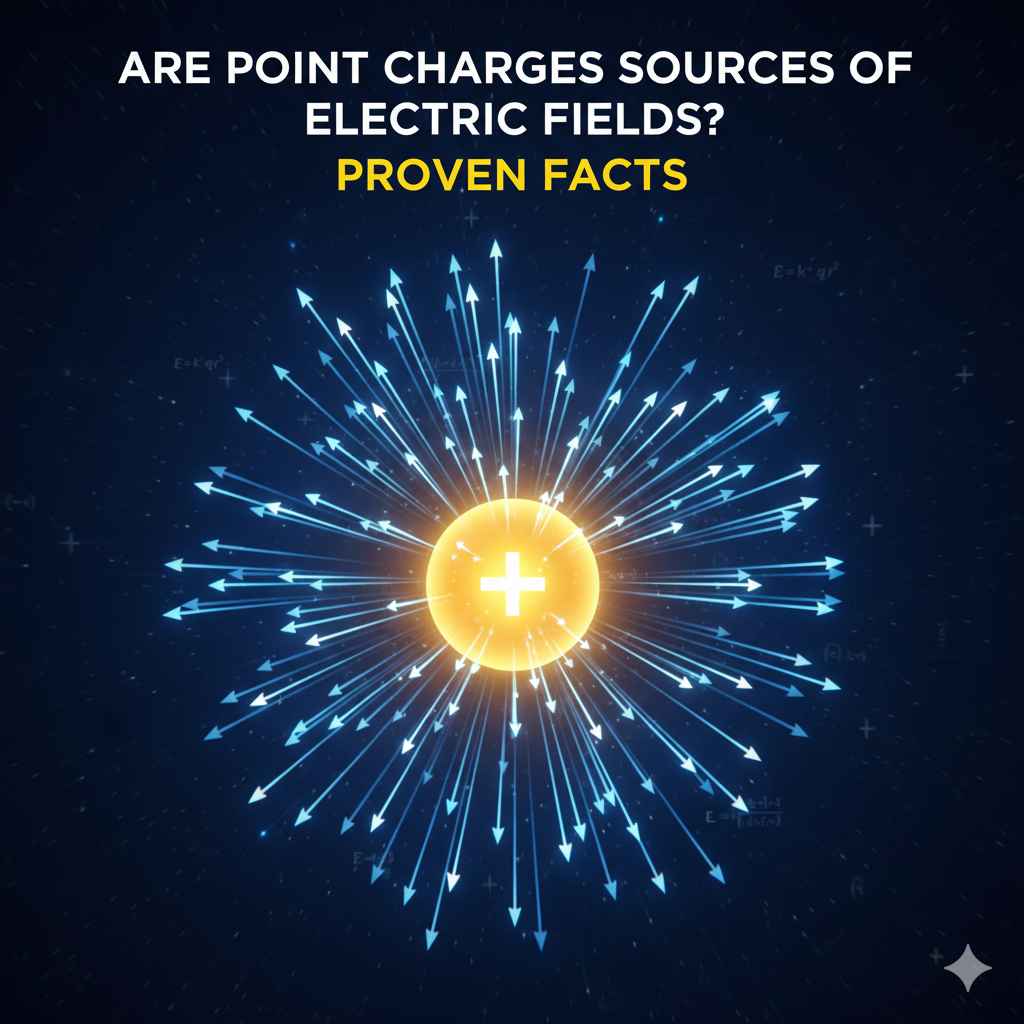
Yes, point charges are the fundamental sources of electric fields. A point charge creates an invisible field of influence in the space around it, which exerts a force on any other charge that enters it. This is a foundational principle of electromagnetism, proven by centuries of experiments and described by Coulomb’s Law.
Have you ever wondered what causes static shock or how your phone screen knows where you’re touching it? It all comes back to a simple, powerful idea: electric fields. Many people find this topic confusing, filled with complex math and strange terms. But it doesn’t have to be!
We are going to break it down together. Forget the jargon and the scary formulas for a moment. This guide will show you, step-by-step, why tiny things called point charges are the true source of these invisible fields. You’ll see how this simple fact explains so much about the world around us. Let’s get started!
Understanding electric fields starts with understanding their source. In the world of physics, the simplest source is a point charge. This guide will walk you through what point charges and electric fields are, how they are connected, and why this connection is one of the most important ideas in science.
What Exactly Is a Point Charge?
Before we dive deep, let’s clear up our main term. What is a “point charge”?
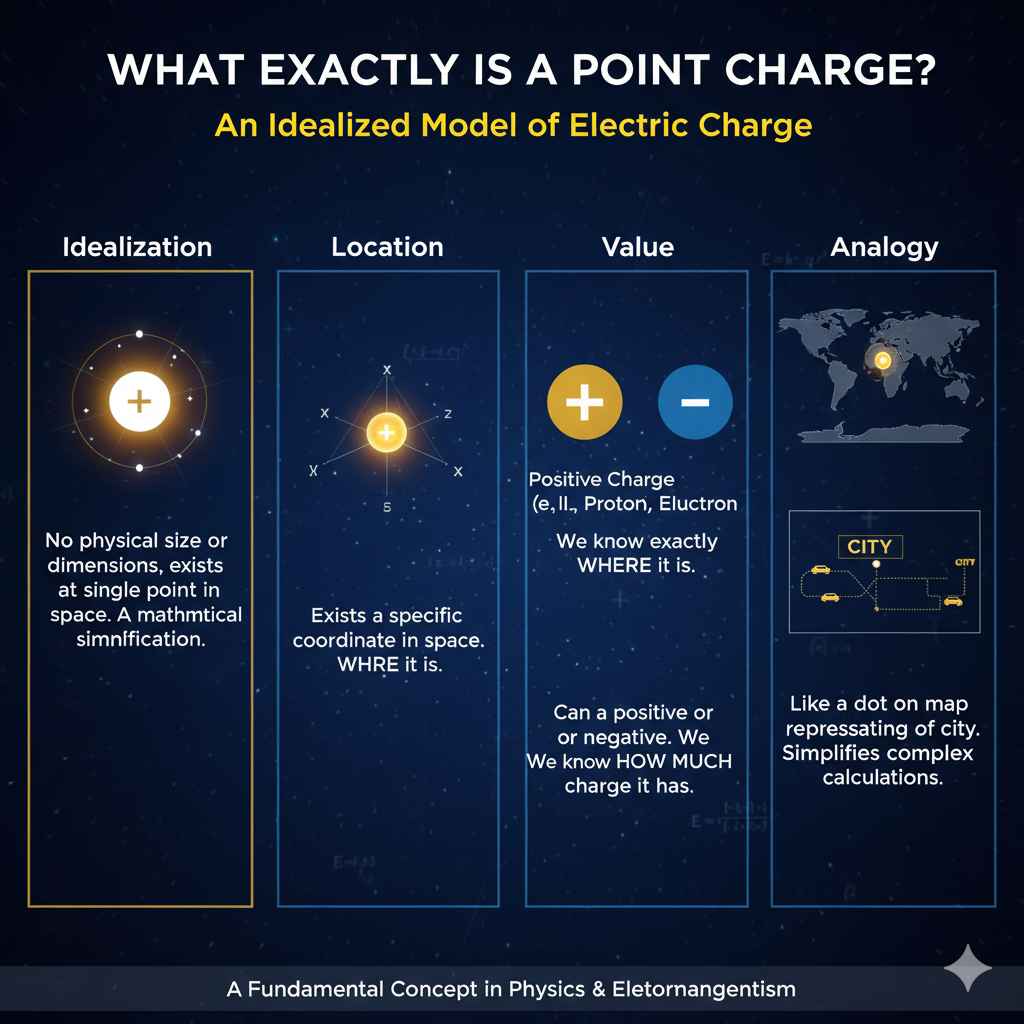
Imagine a tiny, microscopic ball that has an electric charge. Now, imagine that ball is so small it has no size at all—it exists at a single point in space. That’s a point charge!
Of course, in the real world, nothing has zero size. Even electrons, which are incredibly small, take up some space. So, a point charge is an ideal model. It’s a simplification that makes the math and the concepts much, much easier to understand. Physicists use it because it works incredibly well for describing the behavior of charged objects, especially when you are far away from them.
- It’s an Idealization: A point charge has electric charge but no dimensions (no length, width, or height).
- It Has a Location: It exists at a specific coordinate in space.
- It Has a Value: The charge can be positive (like a proton) or negative (like an electron).
Think of it like using a dot on a map to represent a whole city. The dot isn’t the city, but it’s a perfect model for figuring out distances and directions. A point charge is a dot of electricity.
Understanding the Electric Field
So, if a point charge is the source, what is it creating? It creates an electric field.
An electric field is an invisible field of influence that surrounds any charged object. You can’t see it or touch it, but it’s there. The best way to think about it is like gravity.
The Earth has a gravitational field all around it. You can’t see the field, but if you drop an apple, you see the effect—the apple is pulled toward the Earth. The gravitational field is what exerts that force.
An electric field works the same way:
- A point charge (let’s call it Charge A) creates an electric field in the space around it.
- If you bring another charge (Charge B) into that field, Charge B will feel a force.
- The field is the “middleman” that communicates the force from Charge A to Charge B.
This was a revolutionary idea from scientist Michael Faraday. Before him, people thought charges just magically “pushed” or “pulled” each other across empty space. Faraday said, “No, the charge changes the space around it, and that changed space—the field—is what exerts the force.”
How to Visualize an Electric Field
Since we can’t see them, scientists use “electric field lines” to draw pictures of these fields. These lines are a fantastic tool for understanding how a field behaves.
Here are the simple rules for drawing them:
- Direction Matters: Field lines always point away from positive charges and toward negative charges. Think of it as the path a tiny, positive “test” charge would take if you placed it in the field.
- Density Equals Strength: Where the lines are close together, the electric field is strong. Where they are spread far apart, the field is weak.
- Lines Never Cross: Field lines can never intersect. If they did, it would mean the force at that point would be in two different directions at once, which is impossible!
For a single positive point charge, the field lines radiate straight out in all directions, like the rays of the sun. For a single negative point charge, they point straight in, like water going down a drain.
The Proof: How We Know Point Charges Create Fields
This isn’t just a convenient theory; it’s a proven fact based on rigorous experiments and mathematical laws. The most important of these is Coulomb’s Law.
Coulomb’s Law: The Foundation
In the 1780s, French physicist Charles-Augustin de Coulomb performed a series of brilliant experiments. He showed that the force between two point charges depends on two things:
- The amount of charge: More charge means more force.
- The distance between them: The force gets weaker very quickly as the charges move apart.
His findings led to Coulomb’s Law, which is the mathematical description of this force. But this law also perfectly describes the strength of the electric field created by a single point charge. Essentially, the law confirms that a charge creates a field, and the strength of that field is what determines the force on another charge.
You can learn more about his experiments from educational resources like this page from the Encyclopedia Britannica.
The Simplified Math Behind the Field
You don’t need to be a math genius to understand the basics. The formula for the electric field (E) from a single point charge (q) is surprisingly simple. It tells us how strong the field is at a certain distance (r) from the charge.
The equation looks like this: E = k * q / r²
Let’s break down what each part means. It’s easier than it looks!
| Symbol | What It Means | Simple Explanation |
|---|---|---|
| E | Electric Field Strength | This is what we want to find. It tells us how strong the field’s influence is at a specific point. |
| k | Coulomb’s Constant | This is just a standard number that makes the units work out correctly. You can think of it as a conversion factor for electricity. |
| q | Charge of the Source | This is the amount of charge on the point charge creating the field. A bigger charge creates a stronger field. |
| r² | Distance Squared | This is the distance from the source charge, squared. The “squared” part is really important—it means if you double the distance, the field strength drops to one-fourth of what it was! |
This formula is powerful because it proves the concept. It shows that the field strength (E) depends directly on the source charge (q). No charge, no field. It also shows how the field gets weaker with distance, just like our field line drawings suggested.
Why Is This Concept So Important?
Okay, so point charges create electric fields. Why should you care? Because this simple idea is the key to understanding almost all modern technology.
Real-World Applications
The concept isn’t just for physics classrooms. It’s at the heart of countless technologies we use every day. The interaction between charges and fields makes our world run.
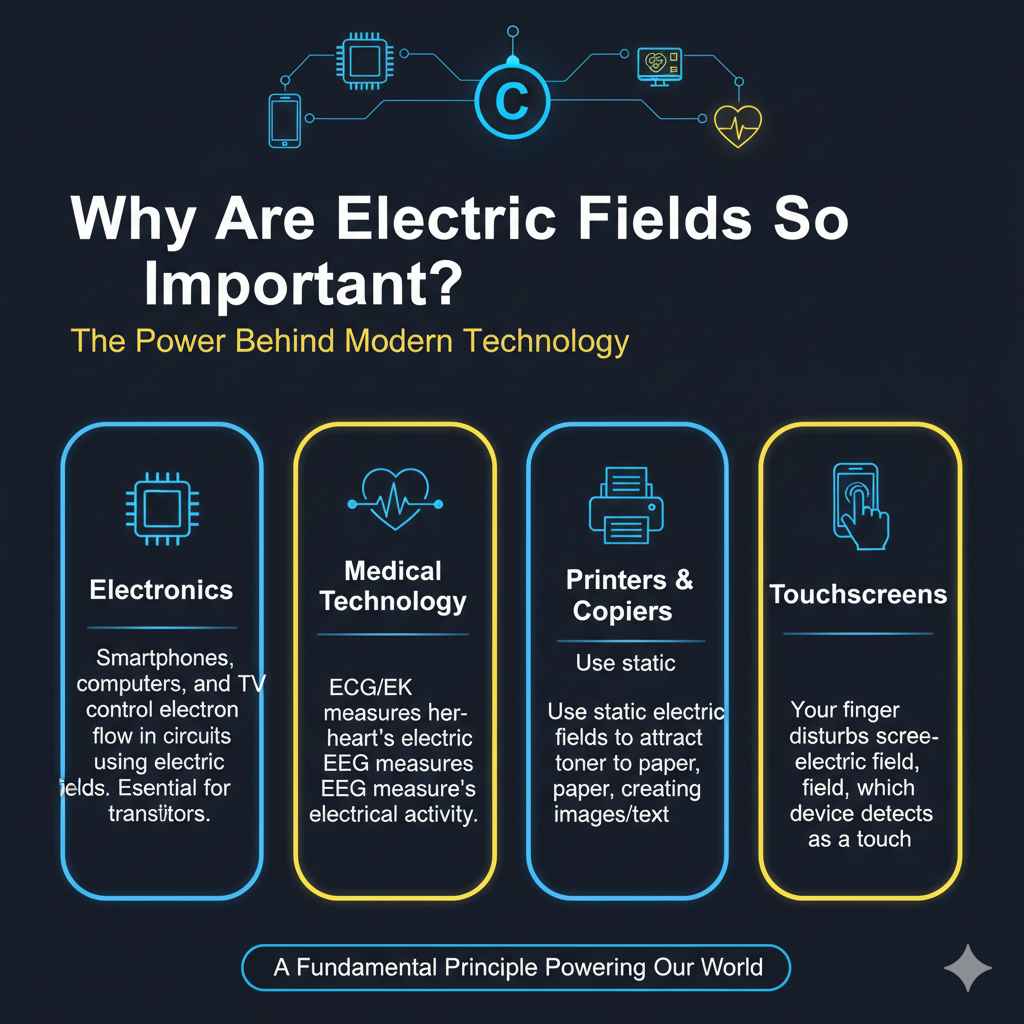
- Electronics: Your smartphone, computer, and TV all work by controlling the flow of electrons through circuits. This control is achieved by using electric fields to push and pull electrons exactly where they need to go inside tiny components like transistors.
- Medical Technology: An electrocardiogram (ECG or EKG) measures the electric fields generated by your heart to check its health. An electroencephalogram (EEG) does the same for the electrical activity in your brain.
- Photocopiers and Laser Printers: These devices use static electricity—which is all about electric fields from stationary charges—to attract toner (ink powder) to a drum and then transfer it onto paper in the shape of your image or text.
- Capacitive Touchscreens: Your finger conducts electricity. When you touch your phone screen, you disturb the screen’s weak electric field. The device’s processor detects the location of this disturbance and registers it as a touch.
Every time you send a text, watch TV, or even just see light (which is a traveling electromagnetic field!), you are witnessing the power of this fundamental principle.
From Point Charges to Real Objects
As we discussed, point charges are an ideal model. Real-world objects, like a metal sphere or a plastic rod, are made of trillions upon trillions of charges distributed throughout them. So how does our simple model help us here?
The beauty of physics is that we can use the point charge rule and apply it over and over. To find the electric field from a larger object, scientists use a technique called integration (a concept from calculus). They essentially do this:
- Pretend the large object is made up of an infinite number of tiny point charges.
- Calculate the tiny electric field created by each individual point charge.
- Add up all those tiny fields to get the total electric field of the object.
This shows just how fundamental the point charge concept is. It’s the basic building block for understanding the electric fields of all objects, no matter their size or shape. For more advanced reading, see how institutions like MIT OpenCourseWare explain the fields of continuous charge distributions.
Here’s a simple table to compare the model with reality:
| Feature | Ideal Point Charge (The Model) | Real Charged Object (Reality) |
|---|---|---|
| Size | Zero dimensions (exists at a single point). | Has a real size, shape, and volume. |
| Source of Field | A single, concentrated source of charge. | A collection of trillions of charges (protons and electrons) spread across the object. |
| Calculating the Field | Simple calculation using E = kq/r². | Complex calculation, often requiring calculus to sum the fields from all parts of the object. |
| When the Model Works Best | When calculating the field far away from the object. From a distance, any object looks like a point. | When you need to know the field very close to the object or inside it. |
Frequently Asked Questions (FAQ)
What is the difference between a point charge and a test charge?
A point charge is any charge that creates an electric field; it’s the source. A “test charge” is an imaginary, tiny positive charge we use to map out or measure the strength and direction of a field created by other charges. We pretend the test charge is so small that its own field doesn’t disturb the field we are trying to measure.
Do electric fields store energy?
Yes, they do! It takes energy to create an electric field, and that energy is stored in the field itself. This is a key concept in physics and is the principle behind devices called capacitors, which are designed to store energy in an electric field for later use in electronic circuits.
Can an electric field exist in a vacuum?
Absolutely. An electric field is a property of space itself, created by a charge. It does not need a medium like air or water to travel through. It can exist perfectly well in the empty vacuum of space, which is why the sun’s light (an electromagnetic wave) can reach us.
What happens if a positive and a negative point charge are near each other?
They create a combined electric field. The field lines will flow from the positive charge to the negative charge, creating a pattern called an electric dipole. The charges will feel a force of attraction, pulling them toward each other along these field lines.
Does a moving charge create an electric field?
Yes, a moving charge still has an electric field. However, a moving charge also creates something else: a magnetic field! This profound connection—that moving electric charges create magnetic fields—is the basis of electromagnetism and explains how motors, generators, and electromagnets work.
Is the electric field a real thing or just a math concept?
This is a deep question! For over a century, physicists have debated this. The modern view is that fields are physically real. They carry energy, momentum, and can travel through space as waves (like light). They are considered a fundamental component of the universe, not just a mathematical trick.
Why do electric fields get weaker with distance?
The field from a point charge spreads out in all three dimensions, like an expanding sphere. As the sphere gets bigger, the field’s influence has to cover a much larger surface area. This means its strength at any single point on that sphere becomes more diluted. The strength decreases with the square of the distance (the 1/r² rule) because the surface area of a sphere increases with the square of its radius.
Conclusion: The Simple Truth
So, are point charges sources of electric fields? The answer is an absolute and resounding yes. It’s not just a theory—it’s a proven fact that serves as the bedrock of our understanding of electricity and magnetism.
This single, elegant concept—that a charge alters the very fabric of the space around it—unlocks the secrets behind everything from the spark of static electricity on a dry day to the complex inner workings of a supercomputer. While the real world is filled with complex objects, they are all, at their core, just collections of these fundamental charges, each contributing its own tiny electric field to the whole.
By starting with the simple model of a point charge, we can build a complete and powerful understanding of one of nature’s most fundamental forces. It’s a beautiful example of how a simple idea can have a profound impact, powering the technology that shapes our modern world.