
Arrow Pointing Into Plane vs Out: An Easy Guide for Beginners
Figuring out the difference between the Arrow Pointing Into Plane vs Out: Easy Guide can seem tricky, especially when you’re just starting. Many people find it confusing because it involves subtle details and technical terms. But don’t worry! This guide will break it down into simple steps, making everything easier to grasp. We’ll show you exactly what to look for and how to use this knowledge. Let’s start by exploring the basics.
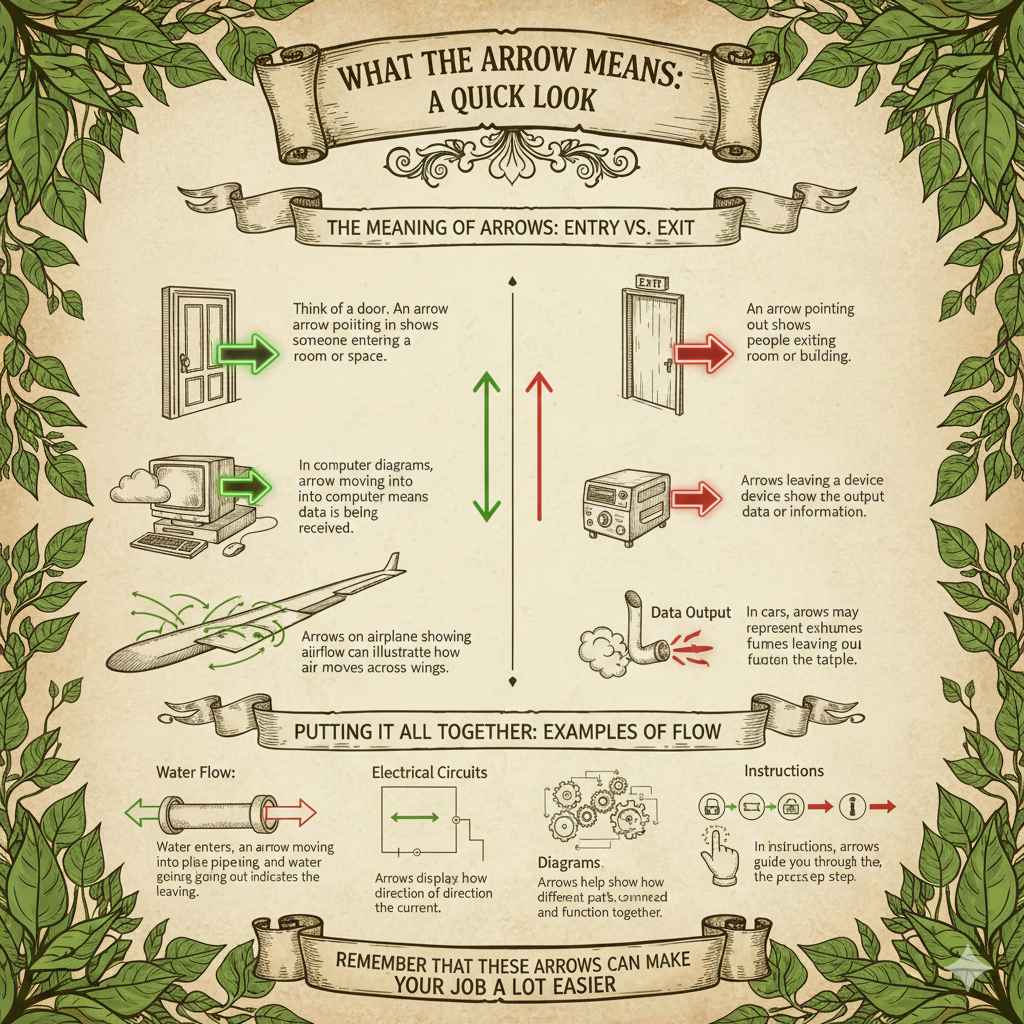
What the Arrow Means: A Quick Look
The direction of the arrow is your first clue. It shows the flow of something. In many areas, this could be information, power, or even air. When you see an arrow pointing into a plane, something is entering it. On the other hand, if the arrow points out, something is leaving. This basic concept helps to determine what is happening in a specific situation, but it’s important to understand the context to interpret the arrow correctly. Learning to interpret the flow is critical for a full comprehension.
Let’s find out more about the direction of the arrow and what it signifies.
The Meaning of Arrows: Entry vs. Exit
The most important thing to know is that an arrow showing an inward direction usually means something is coming into the object or area. This could be data going to a server, or even air flowing into a cabin. It’s often used in schematics and illustrations to show how systems interact. The arrows are important visual cues to keep in mind, and the context will provide meaning. This convention of using arrows to show entry is widely used across various fields.
- Entry Points: Think of a door. An arrow pointing in shows someone entering a room or space.
- Data Flow: In computer diagrams, an arrow moving into a computer means data is being received.
- Airflow: Arrows on an airplane showing airflow can illustrate how air moves across wings.
Conversely, an arrow moving outwards means something is leaving the space or object. This is essential for grasping the relationships among different elements within a structure. It’s a fundamental concept used in different fields, allowing you to follow the movement of whatever is being represented, whether it’s fluid, energy, or information.
- Exit Doors: An arrow pointing out shows people exiting a room or building.
- Data Output: Arrows leaving a device show the output of data or information.
- Engine Exhaust: In cars, arrows may represent exhaust fumes leaving the tailpipe.
Why Direction Matters
The direction of the arrow is critical. Think of it like a signpost. Without it, you wouldn’t know which way something is going. Wrongly interpreting an arrow’s direction can lead to huge errors. Understanding the visual language of arrows makes many things easier to understand, from basic diagrams to complex scientific models. The arrows are an easy tool for conveying complex ideas.
Consider the airflow. If you don’t correctly understand the direction of the airflow, it could lead to the plane not flying correctly. This is very serious. The right airflow helps keep the plane aloft.
- Diagrams: Arrows help show how different parts are connected and function together.
- Instructions: In instructions, arrows guide you through the process, step by step.
- Safety: Knowing which way a gas is flowing is a safety consideration, preventing explosions.
Putting It All Together: Examples of Flow
The power of these symbols is in their simplicity. They are intuitive and easily understood. Here are some simple scenarios to make the concepts clear:
- Water Flow: Imagine a pipe. An arrow moving into the pipe shows water entering, and an arrow going out indicates water leaving. The direction is the key.
- Electrical Circuits: In an electrical circuit, arrows display the direction of the current, showing from the positive to the negative terminal.
- Breathing: When you breathe in, an arrow moves towards your lungs. As you exhale, the arrow goes away from your lungs.
Using these visual cues is simple. Remember that these arrows can make your job a lot easier.
Where You’ll See Arrows and What They Indicate
Arrows are everywhere. They are a visual language used across many fields. From simple drawings to intricate technical diagrams, these arrows provide details. Getting used to what they mean in different settings is a simple way to increase your knowledge. The context is very important for proper interpretation.
Next, we’ll see how this principle plays out in different contexts.
Arrows in Plane Diagrams
In the context of planes, arrows are essential for explaining different systems. They might illustrate airflow over wings, direction of fuel flow to engines, or even the movement of passengers through the cabin. These arrows provide simple visual explanations. Different systems use arrows in different ways.
- Airflow over Wings: Arrows illustrate how the air moves over the wings, generating lift.
- Fuel Systems: Arrows depict the fuel’s journey from the tanks to the engine.
- Passenger Flow: Arrows illustrate the entrance and exit routes for people.
Arrows in Computer Diagrams
Computers also rely on arrows to describe how data moves through a system. They help users understand the input, processing, and output of information. Learning these arrows is essential for understanding how computers work.
- Data Input: Arrows show where data comes from (keyboard, mouse).
- Processing: Arrows indicate the transformations data goes through.
- Data Output: Arrows show where the processed data is sent (screen, printer).
Arrows in Mechanical Systems
Mechanical systems, such as engines and machines, use arrows to show the movement of fluids, gases, or parts. This makes the workings of complicated systems easier to interpret. They help visualize processes that would otherwise be hard to grasp.
- Engine Diagrams: Arrows show the intake and exhaust of gases.
- Fluid Systems: Arrows show how fluids move through pipes, like in a car’s cooling system.
- Gear Systems: Arrows can show the direction of rotation or movement of gears.
Breaking Down “Arrow Pointing Into Plane vs Out”
The phrase “Arrow Pointing Into Plane vs Out: Easy Guide” helps us get down to what you should be focused on. The arrow is your basic sign. Whether it’s showing something going into a plane or leaving it, each one has significance. The guide is focused on the visual details. When dealing with arrows, it is all about direction. Here is a breakdown of their meaning.
Let’s break down the important details of “Arrow Pointing Into Plane vs Out”.
Arrow Pointing In
An arrow that points into a plane suggests that something is entering the plane. Think about an airplane. This could represent many things. It could show the flow of air into the engines, the entry of passengers into the cabin, or even the flow of electricity into the plane’s systems. Knowing what is flowing into the plane is key. This information can influence many areas of the plane’s functionality.
- Air Intake: Arrows that show how air enters the engines for combustion.
- Passenger Boarding: Arrows that direct people through the doors and into seats.
- Power Supply: Arrows that show the path of electricity to power the plane’s components.
Arrow Pointing Out
Conversely, an arrow pointing out from a plane signifies something leaving. This could be the exhaust gases from the engines, the air expelled from the cabin through ventilation systems, or the radio waves sent out by the plane’s communication systems. Understanding these flows is important. The outflow can have large impacts, so the direction is important.
- Exhaust Gases: Arrows that show how the gases leave the engine.
- Airflow Out: Arrows that show the air exiting the plane’s cabin.
- Communication Signals: Arrows that show how radio waves transmit signals.
Contextual Examples
The context helps you understand the meaning of the arrow. The arrow’s direction is a great tool, but the setting matters. Here are some examples to make the concepts easier to understand.
- Engine Air Intake: An arrow entering the engine is the air intake.
- Exhaust: An arrow leaving the engine represents exhaust leaving the plane.
- Communication: An arrow coming out of an antenna shows the sending of radio signals.
Remembering the different contexts will help you with all the scenarios.
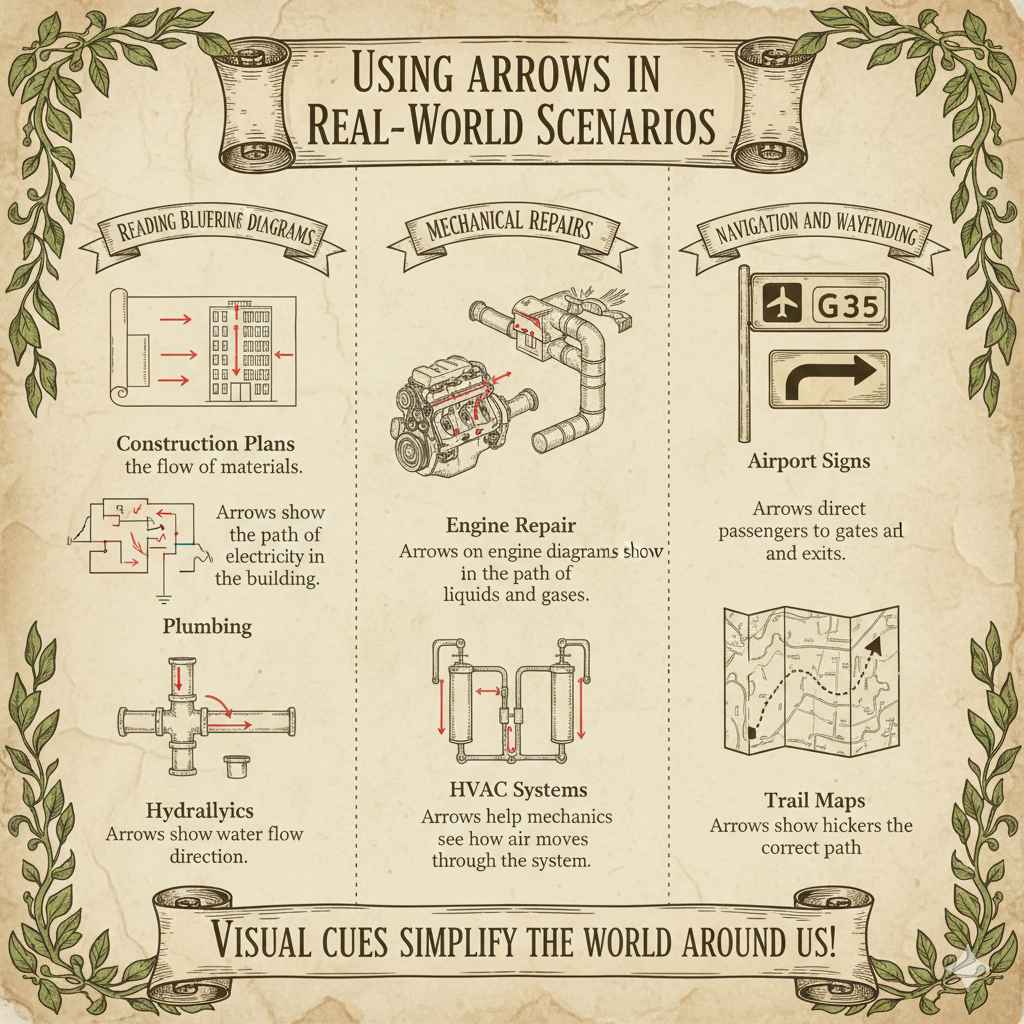
Using Arrows in Real-World Scenarios
Arrows aren’t just in pictures; they can be very important in real situations. Understanding arrows is helpful in many settings, from reading instructions to fixing machines. In many industries, such as engineering, the ability to read and interpret arrows is absolutely necessary.
Now, let’s explore some examples of arrows in action.
Reading Blueprints and Diagrams
Architects and engineers depend on arrows for their blueprints. Arrows show how different parts fit together. They also demonstrate how systems are set up. Learning this visual language is key for reading and using blueprints correctly. These help create structures and systems.
- Construction Plans: Arrows are used to show the flow of materials.
- Electrical Diagrams: Arrows show the path of electricity in a building.
- Plumbing: Arrows show water flow direction.
Mechanical Repairs
Mechanics use arrows to help them when repairing vehicles or other machines. This could be showing the direction of fluids in the engine or how components connect. Knowing how to read these arrows is very helpful when fixing complex machinery. Arrows can reduce the amount of guesswork.
- Engine Repair: Arrows on engine diagrams show the path of liquids and gases.
- HVAC systems: Arrows help mechanics see how air moves through the system.
- Hydraulics: Arrows on hydraulics show fluid direction.
Navigation and Wayfinding
Arrows are used on maps and signs to help people move around. They show direction, routes, and paths. These can be found at airports, train stations, and shopping centers. Arrows make it simple for people to go where they need to go. That makes a difference when you are in a crowded place.
- Airport Signs: Arrows direct passengers to gates and exits.
- Street Signs: Arrows indicate the direction of the road.
- Trail Maps: Arrows show hikers the correct path.
Frequently Asked Questions
Question: Why are arrows important?
Answer: Arrows are important because they show direction, flow, and relationships between different elements or components, simplifying complex information in various contexts.
Question: How do arrows relate to an airplane?
Answer: In relation to an airplane, arrows can represent many different things, such as the direction of air flowing over the wings for lift, the flow of fuel to the engines, or the movement of passengers.
Question: How can I learn to read arrows correctly?
Answer: Practice helps. Look at different diagrams and charts and see how the arrows are used. Consider the context, such as what system it relates to.
Question: Where are arrows commonly used?
Answer: Arrows are commonly used in many fields, including blueprints, mechanical diagrams, computer schematics, instruction manuals, maps, and signs.
Question: What’s the main function of arrows in a diagram?
Answer: The primary job of arrows is to display how things connect or move, such as showing direction or flow.
Final Thoughts
Mastering the “Arrow Pointing Into Plane vs Out: Easy Guide” is a very useful skill. Remembering what arrows represent can make things much easier. When something is entering, the arrow points in; when it’s exiting, the arrow points out. They are used in countless fields to show how things work or move. From blueprints to websites, the basic idea of the arrow’s function stays the same. The use of arrows can help you understand many complicated diagrams.
Keep an eye out for arrows in your day-to-day life. The more you explore, the easier it gets. You will begin to learn the meaning and significance of arrows. This simple skill can make a big difference in how you see the world!