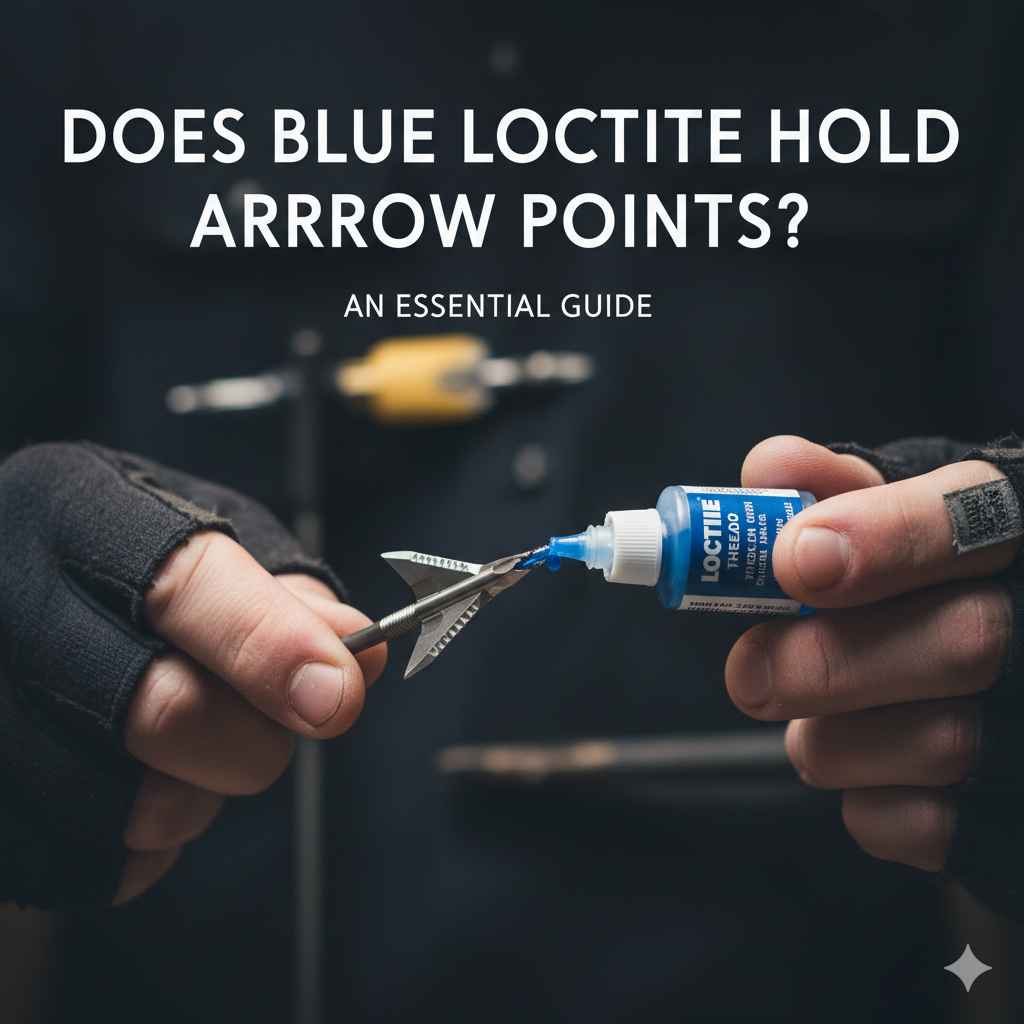
Does Blue Loctite Hold Arrow Points in Place Securely
Yes, Blue Loctite is an excellent and reliable choice for holding arrow points. It’s a medium-strength threadlocker that prevents points from vibrating loose from repeated shooting. Unlike hot melt glue, it provides a more durable, semi-permanent hold that is still removable with a bit of heat, making it a favorite for many archers.
Welcome, fellow archers! My name is Salman Arfeen, and I’m here to help you navigate the world of archery with confidence. Today, we’re tackling a common question that can make a huge difference in your shooting consistency: how do you keep your arrow points from coming loose?
There’s nothing more frustrating than finishing a great round of practice only to find a few of your field points have loosened or, worse, stayed behind in the target. It’s a small problem that can cause big headaches, affecting your arrow’s flight and your overall accuracy. You might have heard people mention using Loctite, but maybe you’re not sure which one to use or how to do it.
Don’t worry. In this guide, I’ll walk you through everything you need to know about using Blue Loctite on your arrow points. We’ll cover what it is, why it works so well, and provide a simple, step-by-step process to get it right every time. Let’s make sure your gear is as reliable as your aim!
What Exactly Is Blue Loctite?
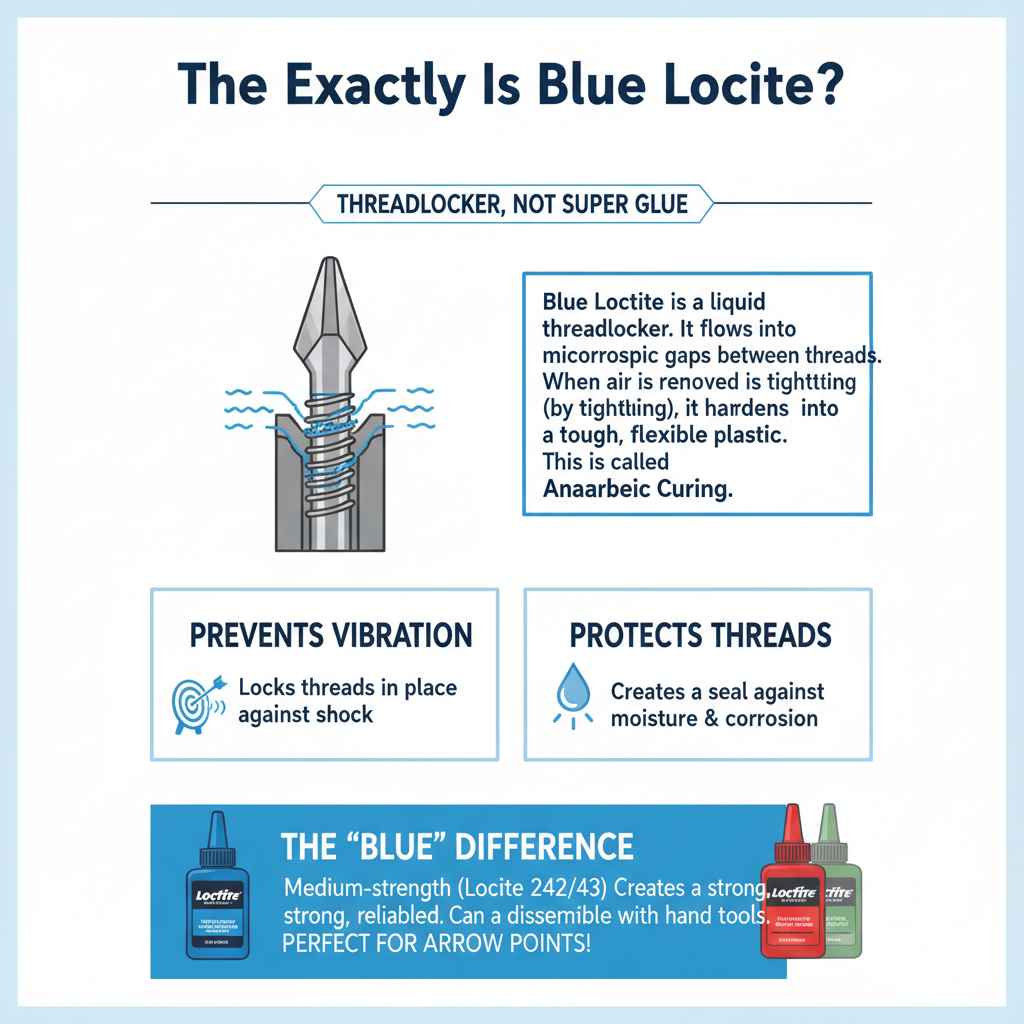
Before we start applying it to our arrows, let’s understand what Blue Loctite actually is. You might think of it as a type of super glue, but it’s quite different. Loctite is a brand name for a product called a threadlocker. Its job isn’t to bond two surfaces together like glue, but to lock threaded metal fasteners (like your arrow points and inserts) in place.
Think of it like this: when you screw your arrow point into the insert, there are microscopic gaps between the threads. Blue Loctite is a liquid that flows into these tiny gaps. The magic happens when you cut off the air supply by tightening the point. Without air, this liquid hardens into a tough, flexible plastic. This process is called anaerobic curing.
This hardened plastic does two things:
- It prevents the threads from vibrating loose from the shock of the arrow hitting a target.
- It creates a seal that protects the threads from moisture and corrosion.
The “Blue” part is important. Loctite comes in different colors, each indicating a different strength. Blue Loctite (specifically products like Loctite 242 or 243) is considered medium-strength. This means it creates a strong, reliable hold but can still be disassembled later with standard hand tools and a little effort. This makes it perfect for arrow points, which you might want to change or remove someday.
Why Do Arrow Points Come Loose in the First Place?
Understanding the “why” helps appreciate the solution. Your arrow points loosen for one primary reason: vibration. When you shoot an arrow, it undergoes a massive amount of force and flex. Upon impact with the target, a powerful shockwave travels back up the arrow shaft.
This repeated cycle of vibration and impact slowly but surely works on the threads of your arrow point. Each shot can cause the point to turn just a tiny fraction of a degree. Over a dozen shots, this can be enough to make the point feel loose to the touch. If you don’t check them regularly, they can unscrew completely and get lost in the target or the field.
This is especially common with:
- New arrows: The threads on new points and inserts haven’t settled yet.
- High-poundage bows: More power means more vibration and a harder impact.
- Hard targets: Hitting a dense foam or worn-out target sends more shock back into the arrow.
Using a threadlocker like Blue Loctite fills the gaps and absorbs these vibrations, keeping your points tight and secure, shot after shot.
Step-by-Step Guide: How to Use Blue Loctite on Arrow Points
Ready to secure your points for good? The process is incredibly simple. Follow these steps carefully, and you’ll have perfectly secured arrow points that fly true and stay put.
What You’ll Need:
- Your arrows and field points (or broadheads)
- A bottle of Blue Loctite Threadlocker (242 or 243)
- Rubbing alcohol or a degreaser
- Cotton swabs or a small clean rag
- Paper towels
The Process: A Simple 6-Step Method
Clean the Threads Thoroughly: This is the most important step for a strong bond. Any oil, dirt, or grease on the threads will prevent the Loctite from curing properly. Pour a small amount of rubbing alcohol onto a cotton swab or rag and carefully clean the threads on your arrow point and inside the arrow insert. Let them air dry completely for a minute or two.
Apply a Small Drop of Loctite: A little goes a long way! You don’t need to coat the entire thread. Hold your arrow point facing up and apply just one small drop of Blue Loctite onto the male threads. Applying it to the point instead of the insert prevents you from accidentally using too much and having it ooze down the arrow shaft.
Screw the Point In: Immediately screw the point into the arrow insert. Hand-tighten it until it feels snug. You don’t need to use a tool or apply excessive force. The Loctite will do the holding, not the torque. Just make sure it’s fully seated against the insert.
Wipe Away Any Excess: If a small amount of blue liquid squeezes out, simply wipe it away with a clean paper towel. If you leave it, it will just make a mess and won’t contribute to the bond, as it will be exposed to air and won’t cure.
Let It Cure (Be Patient!): This is another critical step. Blue Loctite needs time to harden. While it may set partially in about 10-20 minutes, it requires a full 24 hours to reach its maximum strength. Set your arrows aside and resist the urge to shoot them during this time. Shooting them too early will break the forming bond, and your points will come loose.
Check Your Work: After 24 hours, your points should be rock solid. Give one a gentle twist to confirm. Now you’re ready to head to the range with confidence, knowing your equipment is secure.
Blue Loctite vs. Hot Melt Glue: Which Is Right for You?
For decades, the go-to adhesive for arrow points has been hot melt glue. It’s fast, easy, and gets the job done. So why would you choose Blue Loctite instead? Both have their place, and the best choice depends on your needs as an archer.
Hot melt glue is a thermoplastic adhesive. You heat it until it becomes liquid, apply it, and it solidifies as it cools, usually in under a minute. It’s incredibly convenient for archers who are constantly tuning their arrows, changing point weights, or need to make quick repairs at the range.
Blue Loctite offers a more robust, semi-permanent solution. It’s not affected by heat (like a hot day or a car trunk), and it provides a stronger bond that is far more resistant to the vibrations of repeated shots.
Here is a table to help you decide:
| Feature | Blue Loctite | Hot Melt Glue |
|---|---|---|
| Bond Strength | Medium (Vibration-proof) | Low to Medium (Can vibrate loose) |
| Curing Time | 24 hours for full cure | Less than 1 minute |
| Removability | Easy with gentle heat and pliers | Very easy with gentle heat |
| Heat Resistance | High (Stable in hot weather) | Low (Can soften in a hot car or sun) |
| Best For | Long-term setups, hunting broadheads, archers wanting maximum reliability. | Beginners, frequent point swapping, tuning, and quick field repairs. |
If you are a competitive archer or a bowhunter who needs absolute certainty that your broadheads won’t shift or vibrate loose, Blue Loctite is the superior choice. If you are a beginner or a hobbyist who enjoys tinkering with your setup, hot melt glue offers flexibility that is hard to beat.
When Should You NOT Use Blue Loctite?
While Blue Loctite is a fantastic tool, it’s not the perfect solution for every situation. There are a few scenarios where using it might be more trouble than it’s worth:
- During Arrow Tuning: If you are still figuring out the right point weight for your arrows (e.g., trying 100-grain vs. 125-grain points), you’ll be swapping points frequently. The 24-hour cure time of Loctite makes this process impossibly slow. Stick with hot melt glue until you’ve found your perfect setup.
- If You Lack Patience: If you know you won’t be able to wait the full 24 hours for the Loctite to cure, don’t use it. An improperly cured bond is useless and will fail.
- On Glued-in Inserts You Might Remove: Some arrow setups use inserts that are also glued in. If you plan to remove these inserts later, adding Loctite to the point creates another layer of complexity. Removing a Loctite-secured point requires heat, which could also soften the glue holding the insert, causing it to come loose as well.
How to Safely Remove a Point Secured with Blue Loctite
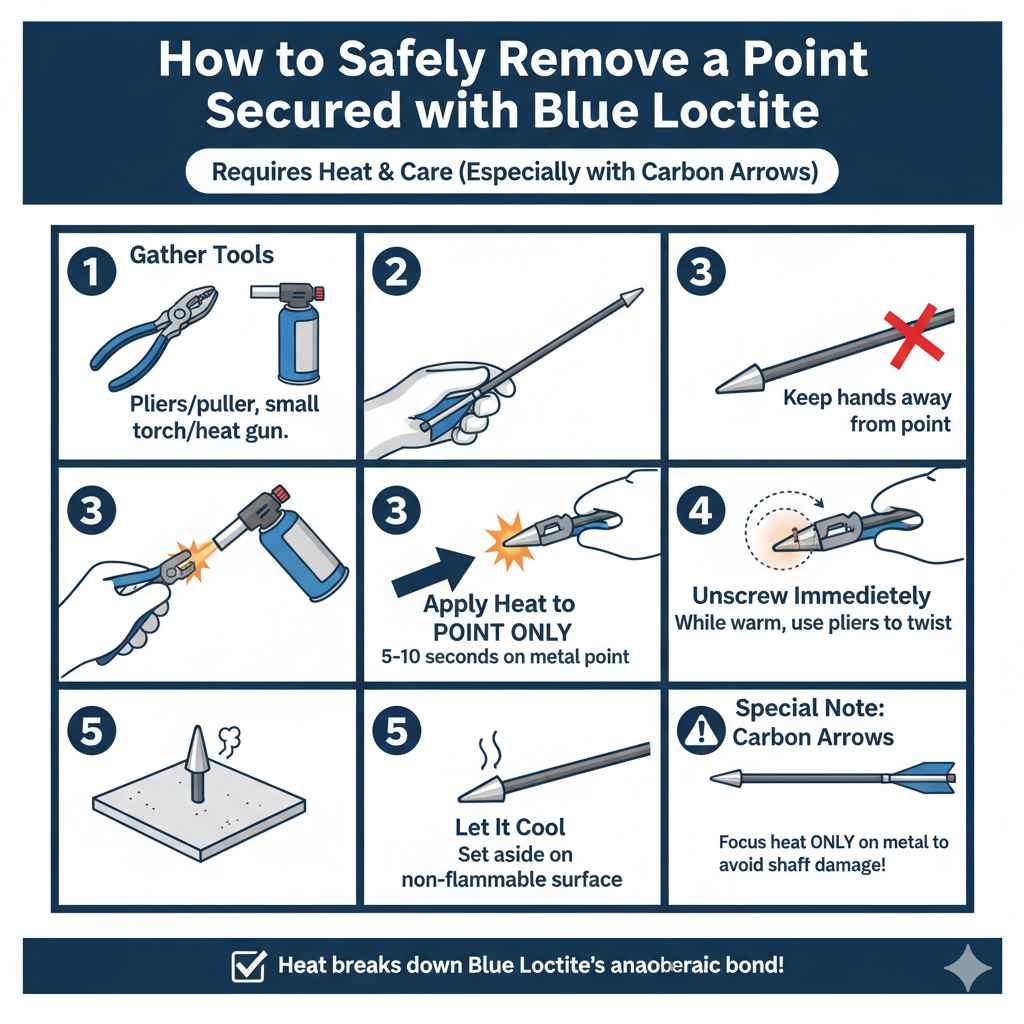
So, you’ve used Blue Loctite, and now you need to remove a point to replace it or install a broadhead. No problem! The process is simple, but it requires a bit of heat and care, especially with carbon arrows.
The anaerobic polymer in Blue Loctite breaks down at temperatures above 300°F (150°C). Our goal is to heat the metal point and insert just enough to soften the Loctite without transferring damaging heat to the arrow shaft itself.
Tools Needed:
- A pair of pliers or an arrow point puller
- A small butane torch, heat gun, or even the flame from a gas stove
Removal Steps:
Hold the Arrow Securely: Hold the arrow shaft firmly, keeping your hands several inches away from the point.
Apply Heat to the POINT ONLY: This is crucial. Use your heat source to heat the metal field point, not the carbon shaft. Keep the flame or hot air moving over the point for about 5-10 seconds. You don’t need to make it red hot; you just need to get it warm enough to break the Loctite bond. The heat will travel from the point to the insert threads.
Unscrew Immediately: While the point is still warm, use your pliers to grip it firmly and unscrew it from the insert. It should break free with moderate force. If it doesn’t, apply a few more seconds of heat and try again.
Let It Cool: Set the point aside on a non-flammable surface to cool down completely before handling it.
A special note on carbon arrows: Carbon fiber is held together with resin, which can be damaged by excessive heat. Always keep the heat focused on the metal components to avoid compromising the structural integrity of your arrow shaft. For more information on how heat affects polymer composites, resources like Penn State’s materials science program offer deep insights into the subject.
Choosing the Right Loctite: A Quick Comparison
When you go to the store, you’ll see a rainbow of Loctite products. Using the wrong one can lead to permanently bonded points or bonds that fail. Here’s a simple breakdown to ensure you grab the right bottle.
| Loctite Type | Color | Strength | Use Case for Archery |
|---|---|---|---|
| Loctite 242 / 243 | Blue | Medium | Ideal for arrow points and broadheads. Secure but removable with tools/heat. |
| Loctite 222 | Purple | Low | Good for small set screws on sights or rests. Too weak for arrow points. |
| Loctite 262 / 271 | Red | High / Permanent | Do NOT use for arrow points. Requires extreme heat (500°F+) for removal, which will destroy a carbon arrow. |
| Loctite 290 | Green | Medium (Wicking) | Not ideal. Designed to seep into already-assembled threads. |
For our purposes, always stick with Blue Loctite. The official product information from its manufacturer, Henkel, confirms that Loctite 243 is an oil-tolerant, medium-strength threadlocker, making it perfect for this application.
Frequently Asked Questions (FAQ)
1. What’s the difference between Blue and Red Loctite?
The main difference is strength. Blue Loctite is medium-strength and designed to be removable with hand tools. Red Loctite is high-strength and considered permanent; it requires extreme heat and force to break the bond and should not be used on arrow points.
2. How long does Blue Loctite take to fully cure on arrow points?
For maximum strength, you must let Blue Loctite cure for a full 24 hours. While it will begin to set in under an hour, shooting the arrow before it’s fully cured will likely break the bond.
3. Will Blue Loctite damage my carbon arrows?
The Loctite liquid itself is perfectly safe for carbon arrow shafts. However, the heat required to remove a Loctite-secured point can damage a carbon arrow if you are not careful. Always apply heat only to the metal point, not the shaft.
4. Is Blue Loctite better than hot melt glue for arrow points?
It depends on your needs. Loctite provides a stronger, more reliable, and vibration-proof hold, making it better for hunting or competition setups. Hot melt is faster and easier to reverse, making it better for tuning, practice, and archers who frequently change point weights.
5. How much Blue Loctite should I use on each arrow point?
Just one small drop is all you need. Place it on the threads of the point before screwing it into the insert. Using too much is wasteful and can create a mess inside your arrow shaft.
6. Can I use Blue Loctite to secure my hunting broadheads?
Absolutely! Blue Loctite is an excellent choice for broadheads. It prevents them from vibrating loose in your quiver or on the shot, ensuring they are perfectly aligned and secure when it matters most. Just be sure to align your blades with your fletching before letting the Loctite cure.
7. What happens if I shoot my arrows before the 24-hour cure time is up?
If you shoot the arrows too soon, the impact will shatter the partially-cured bond. The Loctite will not re-harden, and your arrow point will likely come loose just as it would without any adhesive at all.
Conclusion: Building Confidence in Your Equipment
Loose arrow points are a small detail, but in archery, the small details make all the difference. A rattling point can ruin a shot, damage an arrow, or simply chip away at your confidence. By taking a few extra minutes to properly secure your points with Blue Loctite, you are investing in reliability and consistency.
You now have the knowledge to choose between Blue Loctite and hot melt, apply it like a pro, and safely remove it when needed. This simple skill will give you one less thing to worry about at the range or in the field, allowing you to focus on what truly matters: your form, your aim, and the pure enjoyment of sending an arrow perfectly to its mark.
So build your arrows, let that Loctite cure, and go shoot with the confidence that your gear is as solid as your passion for archery. Happy shooting!