

Figuring out what the Arrow Pointing Left vs Right: What It Means can be tricky when you’re just starting. Don’t worry, it’s simpler than you might think! This post will break down the basics in a way that’s easy to grasp. We’ll explore the different meanings and show you how to easily recognize them. We’re going to make sure you fully get it.
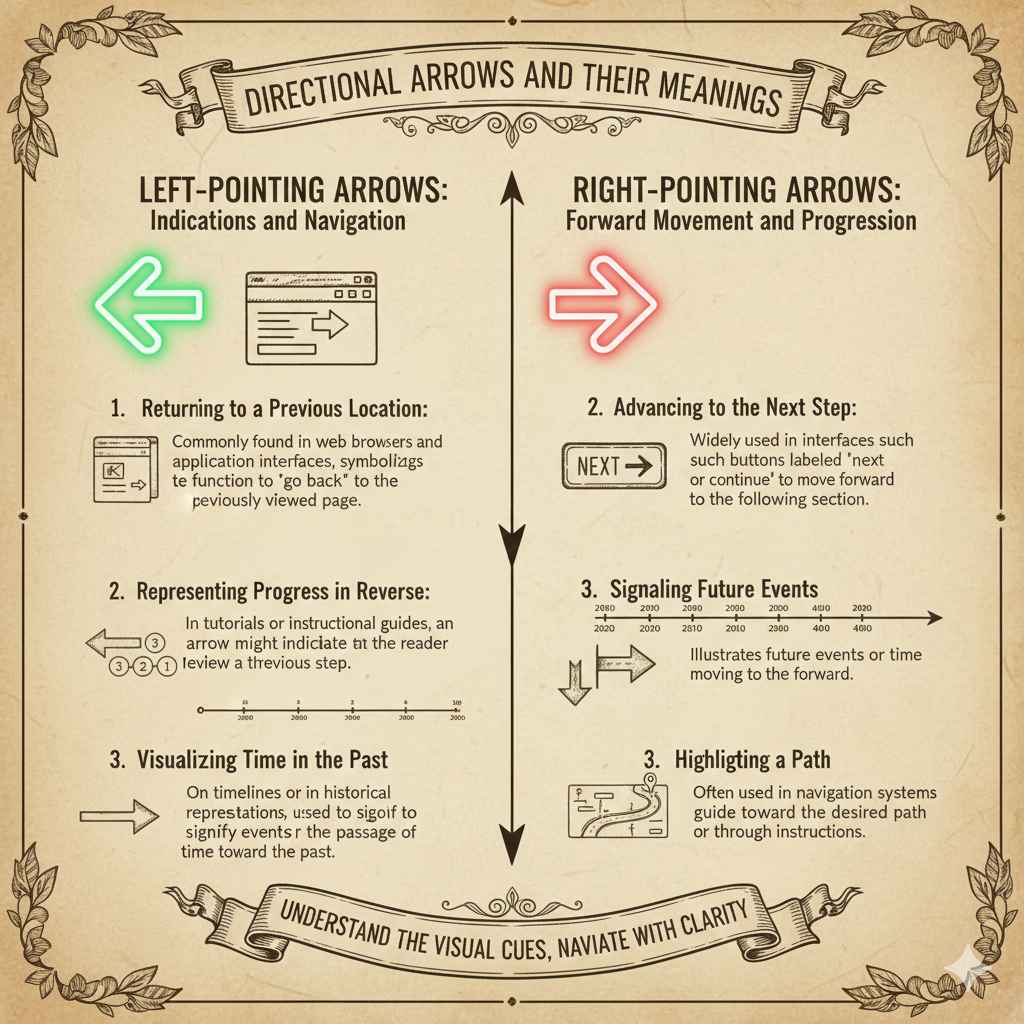
Directional Arrows and Their Meanings
Directional arrows are everywhere, from road signs to website designs. They are visual cues that help guide our attention and actions. While the concept of an arrow seems simple, the specific direction it points has a significant impact on its meaning. In this section, we’ll examine how these seemingly simple symbols communicate critical information, providing clarity for how we interact with our surroundings.
Left-Pointing Arrows: Indications and Navigation
A left-pointing arrow typically directs us to move towards the opposite direction or the start of something. On a road sign, it could signal a curve in the road. On a website, it might lead you to go back to a previous page. These arrows can also indicate the beginning of a sequence or chronological order. They are generally used to guide a user backward or to a point of origin. Left-pointing arrows are essential for providing context and ensuring a smooth, user-friendly experience, whether in a physical or digital setting. They tell us “go back,” “return,” or “retrace your steps”.
- Returning to a Previous Location: Left-pointing arrows are commonly found in web browsers and application interfaces, symbolizing the function to “go back” to the previously viewed page or screen. Clicking this arrow allows a user to revisit information without having to manually retrace their navigation path.
- Representing Progress in Reverse: In tutorials or instructional guides, a left-pointing arrow might indicate that the reader should review a previous step or piece of information. This is used when the process necessitates reviewing earlier parts of the task.
- Visualizing Time in the Past: On timelines or in historical representations, the left-pointing arrow can be used to signify earlier events or the passage of time toward the past. This provides a visual cue for chronological order.
Right-Pointing Arrows: Forward Movement and Progression
Right-pointing arrows generally guide us forward or indicate progression. On a road sign, a right-pointing arrow might indicate a turn or the direction of a lane. On a website, it often symbolizes “next” or “continue.” These arrows guide our attention to what comes next, indicating the flow of information or process. They often mean “go ahead,” “proceed,” or “advance.” This allows for smooth interaction, whether you are driving, following instructions, or looking at digital content.
- Advancing to the Next Step: Right-pointing arrows are widely used in interfaces such as buttons labeled “next” or “continue.” When someone clicks these, they can move forward to the following section, slide, or phase in a process.
- Signaling Future Events: In a timeline, a right-pointing arrow might illustrate future events or time moving forward. This gives the user context on the passage of time.
- Highlighting a Path: These arrows are often used in navigation systems to guide a driver toward the desired path. They also help a user navigate through a series of instructions or steps.
Context Matters: Applying Directional Arrows
The interpretation of an arrow’s direction depends heavily on the context in which it appears. An arrow on a road sign has a specific meaning dictated by traffic regulations. An arrow on a website has a different meaning determined by user interface design. This section will discuss a few different scenarios and how the use of the arrow changes the way they are interpreted and how they are used.
Traffic and Road Signs
In traffic, arrows are essential for managing the flow of vehicles and pedestrians. These signs direct drivers on where to go, allowing for smooth and safe movement. The arrows help drivers anticipate turns, lane changes, and any potential hazards.
- Right-Pointing Arrow: This might show a turn or direct traffic to remain in a specific lane, which is commonly seen on a highway to keep traffic flow going smoothly.
- Left-Pointing Arrow: This shows a turn or a merge. This signals drivers to prepare to turn or merge into the lane. This ensures the safety of all drivers and reduces the chance of accidents.
- Straight Arrows: These direct traffic to keep going straight through an intersection. This helps to prevent accidents and keeps traffic moving.
Web Design and User Interfaces
Web design uses directional arrows to help people easily navigate through websites. They provide visual cues that guide users to important links, actions, and content, helping to improve user experience.
- “Back” Arrows: These are typically left-pointing arrows that allow users to go back to the previous page. This is a basic feature for websites and apps.
- “Next” and “Forward” Arrows: Right-pointing arrows are used to proceed through a series of steps or content, such as a slideshow or an online form.
- Menu Navigation: Arrows can indicate the ability to expand or collapse menu items. A down arrow (↓) often signifies a menu that can be expanded, while an up arrow (↑) indicates a collapsed menu.
Cultural Interpretations of Directional Arrows
Besides the straightforward meanings, the use of arrows can differ across different cultures and contexts. Some cultures might use symbols differently than others. It’s essential to understand that arrow direction can be affected by the culture, design style, and user expectations.
Arrow Meaning in Different Cultures
Different cultures may assign different values and meanings to the direction of arrows, even if the primary usage is the same. Recognizing this diversity is critical, especially when designing for an audience from multiple backgrounds.
- Western Cultures: In Western cultures, the left-to-right reading direction influences the standard usage of arrows. Right-pointing arrows usually represent progress.
- Eastern Cultures: Cultures that read from right to left, like Arabic or Hebrew, can influence the direction of arrows to show the direction of their writing. This impacts design choices to increase readability.
- Symbolic Meanings: Some arrows may hold symbolic meanings beyond navigation, such as representing hope, power, or direction. For example, a downward-pointing arrow might show a decrease or downfall.
Design Styles and Preferences
Design styles can also influence how arrows are used. Some may be more minimal or elaborate. Choosing the right design can impact user understanding and engagement.
- Minimalist Design: Simple arrows are often favored. This style prioritizes function, making interfaces cleaner and easier to use.
- Illustrative Design: Illustrative arrows can be decorative and may convey certain themes or styles. This can make the user experience more engaging.
- User Preferences: User preferences influence arrow design. It’s helpful to consider user behavior. For instance, testing different arrow designs can help determine which is the clearest.
Arrows in Different Fields
Directional arrows are useful in a wide variety of areas, from education to architecture. Different fields use arrows in many ways to convey information and direct users. They give clear guidance across many systems, helping to simplify communication and operations.
Education and Learning
Arrows are used in education to help clarify procedures and concepts. They help students easily visualize the order, relationships, and processes. They can also enhance the learning experience by providing clear instructions.
- Flowcharts: Arrows in flowcharts are used to show the sequence of steps, decisions, and outcomes in a process. This helps students to visualize complex procedures.
- Diagrams: Arrows in diagrams highlight the relationships among components or the flow of information. This is useful for clarifying concepts in science, mathematics, and other subjects.
- Step-by-Step Instructions: In tutorials and guides, arrows can guide students through instructions. These arrows help students follow the steps and achieve the goal.
Architecture and Design
Architects use arrows to show how a person can move through a space and how to interact with the building’s design. Arrows play a critical role in navigation, accessibility, and the general user experience. They give important information about how a building works.
- Floor Plans: Arrows can be used to indicate entrances, exits, and the flow of movement. This allows people to quickly understand the layout of a space.
- Signage: Signage uses arrows to direct people to particular locations. Clear and consistent use of arrows ensures effective navigation.
- Accessibility: Arrows are used to indicate accessible routes, ramps, and other features. This increases the usability of buildings for people with disabilities.
Visual Design and Arrow Placement
The way arrows are placed and designed can affect how they are understood. Designers must consider things like how colors, shapes, and positions relate to the message being communicated. Proper design makes sure the user experience is smooth and effective.
Color, Shape, and Style
The look of an arrow can change its meaning and how it is interpreted. Careful consideration of color, shape, and style helps make the arrows clear and easy to understand.
- Color: Color can draw attention and give an emotional impact. For instance, a red arrow may show danger or warning, while a green arrow may show approval or success.
- Shape: Shape can also influence how people view the arrow. Arrowheads with sharp angles may indicate a direct action, while rounded arrows can show a softer approach.
- Style: The style of an arrow must fit the overall design. Whether it’s minimalist or detailed, the style should complement the overall design.
Positioning and Alignment
How an arrow is positioned in relation to other elements is very important. This impacts how easily users understand the message. Proper positioning keeps the design visually appealing and easy to grasp.
- Placement Next to Text: Arrows placed next to the text clearly shows where you want someone to go. Positioning the arrow close to the relevant text is helpful.
- Alignment with Elements: Aligning arrows with other elements helps create a visually balanced design. Proper alignment makes the design look good.
- Using White Space: Using white space around arrows gives them prominence. This helps to avoid visual clutter and make the arrows stand out.
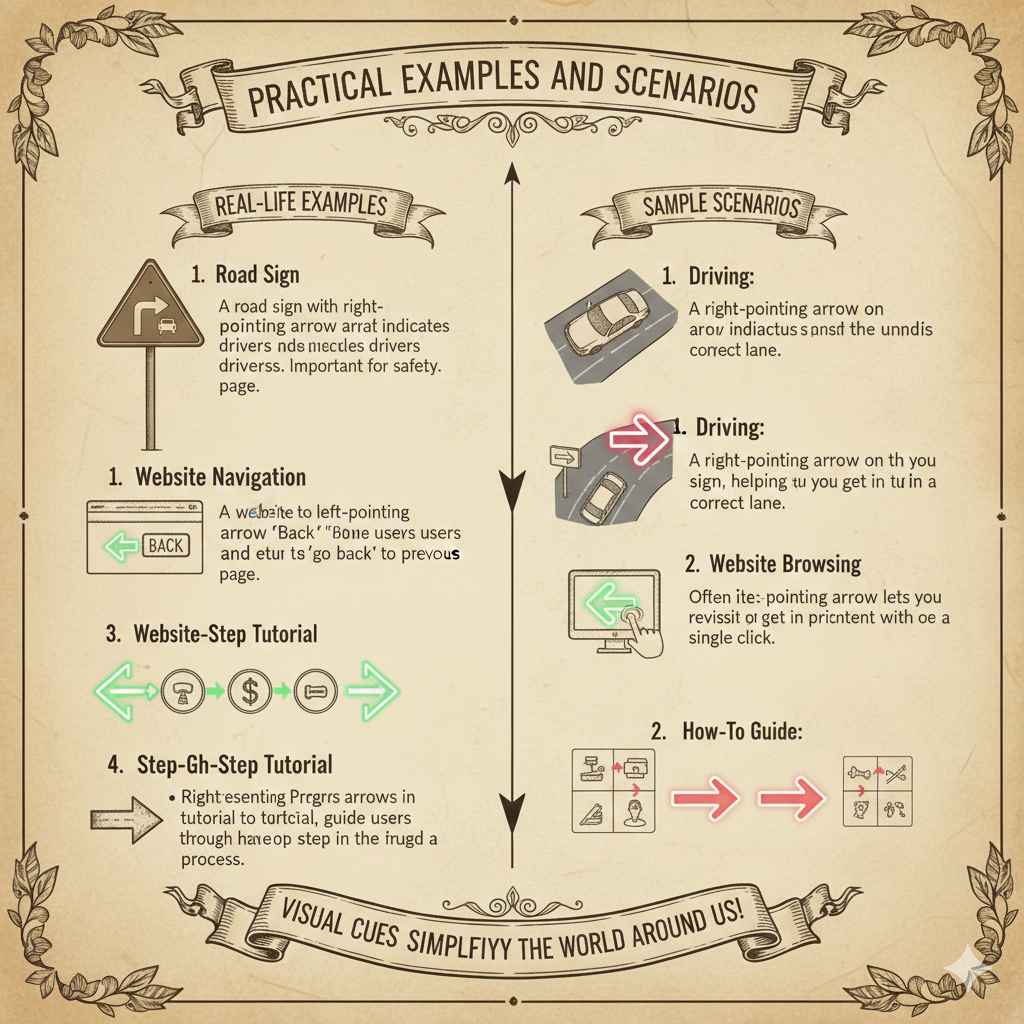
Practical Examples and Scenarios
Understanding the application of directional arrows helps to grasp how they help in many situations. Examining these examples and scenarios can provide a good overview of their impact.
Real-Life Examples
A road sign with a right-pointing arrow at an upcoming intersection indicates that drivers should turn right. This is important for safety and traffic management.
On a website, a left-pointing arrow labeled “Back” allows users to return to a previous page, allowing for easy navigation. This is a basic feature for websites.
In a step-by-step tutorial, right-pointing arrows direct users to move through the procedure, helping to clarify each step of the process. This keeps users engaged.
Sample Scenarios
Imagine you’re driving. You see a sign with a right-pointing arrow indicating a turn. You know you have to get into the right lane to follow that direction. This quick understanding prevents accidents.
You are looking at a website. You see a left-pointing arrow to return to a previous page. This simple click allows you to view the prior content.
In a how-to guide, right-pointing arrows show the steps for a task. Each click brings you to the next step.
Frequently Asked Questions
Question: Why are arrows used so often?
Answer: Arrows are commonly used because they are easy to understand and can quickly show direction, which is helpful in many situations like navigation, user interfaces, and instructional materials.
Question: What do different arrow styles mean?
Answer: Various arrow styles like solid, dashed, or even animated can change the impact of the arrows. Style affects the visual impact and the message the arrow is trying to convey.
Question: How are arrows used in UI/UX design?
Answer: Arrows are used in UI/UX design to provide direction. They provide clear visual cues for interactions like “back”, “next”, or expanding menu options.
Question: What do arrows symbolize in different cultures?
Answer: Some cultures read from left to right while others read right to left, which can impact how arrows are used. They can also represent ideas such as progress or returning.
Question: How can I make sure people understand my arrows?
Answer: Use common directional cues, keep the design simple, and test different designs with your audience. Consider your target audience’s cultural background.
Final Thoughts
The Arrow Pointing Left vs Right: What It Means is more than just about a simple direction; it’s a critical tool for giving information and guiding action. From the direction of traffic signs to a web browser, these symbols are crucial to how we navigate the world around us. By understanding what left-pointing arrows and right-pointing arrows stand for, we can decode the information in our environment and interact more effectively with any system. They are the keys to a good user experience.
As you encounter directional arrows in your everyday life, pay attention to the context and how the arrows communicate. This will improve your ability to understand and get your information quicker and easier. So the next time you see an arrow, remember its power to indicate direction and simplify your daily interactions. By improving your awareness and understanding of these visual cues, you are on your way to effective communication.