
Figuring out a Deer Hunting Scope Reticle: BDC vs Plex Explained can be tricky for beginners. There are a lot of terms and concepts to learn, and it can feel like a whole new language. Don’t worry, we’re here to help! We’ll break down the differences between BDC and Plex reticles in simple terms, step-by-step. Get ready to explore the basics and boost your shooting confidence. Let’s get started!
Choosing the Right Deer Hunting Scope Reticle
Selecting the correct reticle for your deer hunting scope is a critical decision. It directly impacts your accuracy and success in the field. There are various types, each with its own advantages. Some are simple, while others are more complex. This guide will focus on two common types: BDC and Plex. We’ll explore their features to help you determine which reticle best suits your hunting style and the distances you typically shoot. Making the right choice will improve your chances of a clean and ethical shot.
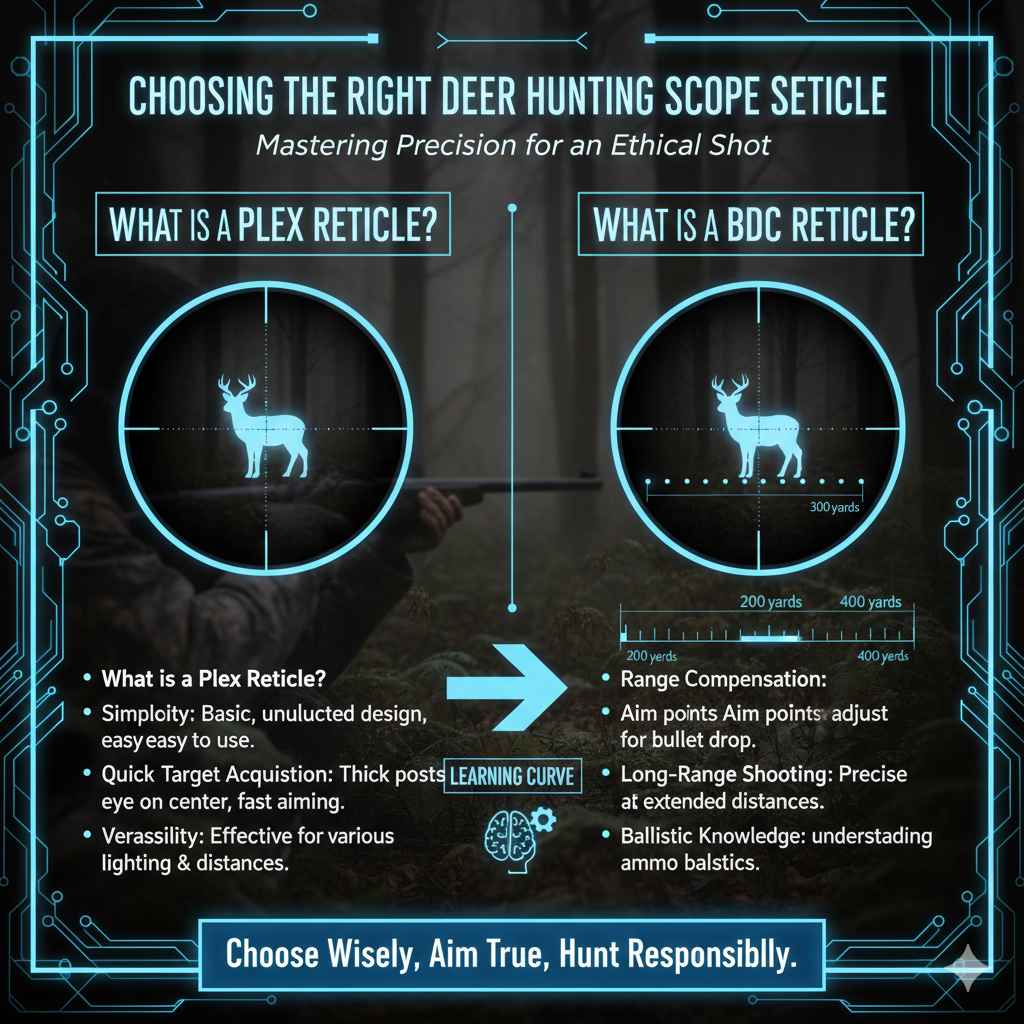
What is a Plex Reticle?
The Plex reticle is one of the simplest and most common reticle designs. It features a thick outer perimeter that tapers to a fine crosshair in the center. This design provides a clear sight picture, particularly in low-light conditions. The thick outer posts draw your eye to the center, making it easy to quickly acquire your target. Plex reticles are known for their user-friendliness and are often found in scopes for all skill levels. Because of their simplicity, they work well for general hunting situations where shots are taken at varying distances. The Plex reticle’s straightforward design makes it an excellent choice for hunters who prefer a clean and uncluttered view.
- Simplicity: The Plex reticle has a basic design with thick posts and a fine crosshair. This is easy to learn and use.
- Quick Target Acquisition: The thick outer posts of the Plex reticle help draw your eye to the center. This lets you quickly find and aim at your target.
- Versatility: Plex reticles work well in various hunting environments. They are good for different distances and light conditions.
What is a BDC Reticle?
BDC, or Bullet Drop Compensating, reticles are more advanced. They have additional aiming points below the main crosshair. These points are designed to help you compensate for bullet drop at longer ranges. The specific design of a BDC reticle can vary, but typically it includes dots or hash marks that you use to aim higher than your target. This allows you to account for gravity’s effect on the bullet’s trajectory. BDC reticles require some practice. They need you to know the ballistics of your specific ammunition. They are often a great choice for hunters who take shots at longer ranges. They are more complex than Plex reticles but can significantly improve your accuracy.
- Range Compensation: BDC reticles have extra aiming points. These help you adjust your shot for bullet drop at different distances.
- Long-Range Shooting: BDC reticles work well for shots taken at longer ranges. They allow for more precise aiming.
- Ballistic Knowledge: Using a BDC reticle requires some knowledge of your rifle’s ballistics. You need to know how far your bullet drops at different distances.
Understanding Bullet Drop and Trajectory
To use either a BDC or Plex reticle effectively, you must understand bullet drop and trajectory. Bullet drop refers to the downward curve a bullet experiences as it travels downrange. Gravity constantly pulls the bullet toward the ground, causing it to drop below its initial flight path. Trajectory is the path the bullet takes through the air. Many factors affect the trajectory, including the bullet’s weight, muzzle velocity, and environmental conditions such as wind.
Knowing how these factors influence bullet drop will help you adjust your aim, regardless of your chosen reticle. This understanding is key to making accurate shots at varying distances, whether you use a Plex reticle and adjust your hold or a BDC reticle.
Factors Affecting Bullet Drop
Several things affect how much a bullet drops over distance. Knowing these factors is key to accurate shooting. The bullet’s weight plays a big role; heavier bullets drop faster than lighter ones. Muzzle velocity, or how fast the bullet leaves the barrel, is another key factor. Higher velocity means less bullet drop over the same distance. The shape of the bullet also makes a difference, as aerodynamic bullets experience less drag.
Environmental conditions, such as wind and air density, have impacts too. Wind can push the bullet sideways, and changes in air density affect its trajectory. All of these factors come into play when selecting the right reticle and compensating for bullet drop.
- Bullet Weight: Heavier bullets tend to drop more quickly than lighter bullets.
- Muzzle Velocity: Higher muzzle velocity results in less bullet drop over a given distance.
- Bullet Shape: Aerodynamic bullets experience less drag and therefore, less bullet drop.
Calculating and Compensating for Bullet Drop
Calculating and compensating for bullet drop is critical for accurate shooting. With a Plex reticle, this typically involves estimating the distance and holding above the target. For BDC reticles, it means using the pre-marked aiming points. You can use ballistic calculators to help you calculate bullet drop at different distances. These tools take into account your rifle’s specifics and the type of ammunition you are using.
You’ll need to know the muzzle velocity, bullet weight, and ballistic coefficient. Practice at different ranges is essential to learn how your bullet performs. Also, it allows you to see how your chosen reticle works. This training helps you refine your shooting skills and increases your chances of a successful hunt.
- Use Ballistic Calculators: Enter your rifle and ammunition details into a ballistic calculator. This will show you the bullet drop at various distances.
- Practice at Different Ranges: Shoot at different distances to see how much your bullet drops. This helps you understand how to adjust your aim.
- Use a Rangefinder: Use a rangefinder to accurately measure the distance to your target. This allows you to make the proper adjustments.
BDC vs Plex Reticle Performance in the Field
The performance of BDC and Plex reticles in the field differs, depending on your shooting needs and preferences. Plex reticles excel in quick target acquisition and versatility. Their simplicity makes them great for close- to mid-range shots, and they work well in varying light conditions. Their simplicity is perfect for beginners and those who want a straightforward aiming system. BDC reticles are better for longer-range shooting, offering precise compensation for bullet drop. BDC reticles are most useful when you know the distances and the ballistics of your specific load. The best choice depends on how you hunt and the types of shots you take.
Advantages of Plex Reticles in Deer Hunting
Plex reticles have many advantages for deer hunting. Their simple design makes them quick and easy to use, especially in stressful situations. The thick outer posts help you quickly acquire the target. This is useful when the deer is moving. Plex reticles are effective in various lighting conditions. They work well from dawn to dusk. They are less complex. This makes them good for all hunters, from those with experience to beginners. Many prefer the clean, uncluttered sight picture that Plex reticles offer. Because of their adaptability and simple design, Plex reticles are a great choice for many hunters.
- Quick Target Acquisition: The Plex reticle’s design lets you quickly find and aim at your target.
- Versatility in Light Conditions: Plex reticles work well in various light conditions, including low-light situations.
- Ease of Use: The simple design of the Plex reticle is easy to learn and use.
Advantages of BDC Reticles in Deer Hunting
BDC reticles have clear advantages for longer-range deer hunting. They provide extra aiming points for bullet drop compensation. This makes it easier to hit targets at different distances. BDC reticles are great for hunters who often take shots beyond 200 yards. They help you make more precise shots. While they take more practice, the ability to compensate for bullet drop with precision is a big benefit. BDC reticles help you increase your accuracy, especially on longer shots. This increases the chances of a successful and ethical hunt. They are useful for situations where you can estimate or measure the distance.
- Long-Range Accuracy: BDC reticles are very good for improving accuracy at longer ranges.
- Bullet Drop Compensation: BDC reticles give you aiming points to compensate for bullet drop, giving more accurate shots.
- Precision Shooting: BDC reticles let you make precise shots at various distances.
Choosing the Right Reticle for Your Hunting Style
Choosing the correct reticle for your hunting style is key to improving your success. Consider the terrain where you hunt and the average shooting distances you take. If you hunt in thick brush where shots are generally close, a Plex reticle’s simplicity and quick target acquisition will be useful. If you hunt in open areas where shots are longer, a BDC reticle may be more beneficial. Also, consider the time of day you typically hunt. A Plex reticle’s design can be very beneficial in low-light conditions. You’ll also want to practice with the reticle you choose. Take the time to become comfortable with how it works and learn the bullet drop. Knowing your gear well and practicing will increase your accuracy and your confidence in the field.
Determining Your Typical Shooting Distances
Determining your typical shooting distances will help you choose the right reticle. Think about the areas you hunt and the usual ranges you shoot. If most of your shots are under 200 yards, a Plex reticle may be enough. It will provide quick target acquisition without the need for complex adjustments. If you often take shots beyond 200 yards, a BDC reticle might be better. It will let you compensate for bullet drop, improving your accuracy. You might want to use a rangefinder to measure distances in your hunting areas. Knowing your typical shooting distances is key to picking the correct reticle for your hunting needs.
- Short-Range Hunting (Under 200 Yards): A Plex reticle is often adequate.
- Mid-Range Hunting (200-300 Yards): Both Plex and BDC reticles can be effective. Consider the need for bullet drop compensation.
- Long-Range Hunting (Over 300 Yards): A BDC reticle is generally preferred for its bullet drop compensation features.
Considering Light Conditions and Terrain
Light conditions and the terrain where you hunt can influence your reticle choice. If you often hunt in low-light conditions, such as dawn or dusk, a Plex reticle’s design can be advantageous. The thick posts help your eye quickly find the center. In dense forests, where shots are often taken at close range, the Plex reticle’s simplicity works well. In open terrain where you have clear views, you can use either type. If shots are long, a BDC reticle will give you the edge. Choose a reticle that works well in the light conditions and terrain of your hunting areas. This will increase your chances of a clean and effective shot.
- Low-Light Hunting: A Plex reticle can be useful because of its clear view and design.
- Dense Terrain: In heavy brush, quick target acquisition with a Plex reticle is key.
- Open Terrain: Either a Plex or BDC reticle can work well, depending on your shot distances.
Additional Scope Features to Consider
Besides the reticle type, other scope features are important for deer hunting. Magnification affects how close you can see your target. A scope with adjustable magnification can be great, letting you zoom in for longer shots or zoom out for closer ones. The scope’s objective lens diameter (the front lens) affects how much light it lets in. Larger lenses give a brighter image, particularly in low-light conditions. The scope’s eye relief, or the distance your eye should be from the scope, is also key. A long eye relief helps prevent injury from recoil. Taking all these things into consideration will help you choose the scope that best fits your hunting needs.
Magnification Power and Objective Lens Size
Magnification power and objective lens size are key features. Magnification refers to how much a scope makes the target appear closer. Higher magnification is useful for long-range shots. Lower magnification works better for closer shots or quick target acquisition. Objective lens size (measured in millimeters) affects how much light the scope lets in. A larger objective lens gathers more light, making the image brighter. This is very useful in low-light situations. Consider your shooting distances and hunting environment when choosing these features. If you hunt in dense areas or in low-light situations, a scope with a larger objective lens is best.
- Magnification Power: Choose magnification based on your typical shooting distances.
- Objective Lens Size: Larger objective lenses gather more light, which is useful in low-light conditions.
- Versatility: Scopes with adjustable magnification can work in various situations.
Eye Relief and Scope Durability
Eye relief is the distance your eye should be from the scope’s eyepiece. Having proper eye relief prevents injury from the recoil of your rifle. If your eye is too close to the scope, it could get hit during recoil. When choosing a scope, ensure it has enough eye relief for your rifle’s caliber. The durability of the scope is also a major factor. The scope needs to withstand the harsh conditions of hunting, including impacts, changes in weather, and temperature swings. Look for scopes made from high-quality materials, with waterproof and fog-proof features. The scope must work reliably in all conditions.
- Eye Relief: Proper eye relief protects your eye from recoil.
- Scope Durability: Choose a durable scope that can withstand the rigors of hunting.
- Waterproof and Fog-Proof: Essential features for hunting in various weather conditions.
Comparing BDC and Plex Reticle Options
You may want to compare BDC and Plex reticle scopes to make the best choice. Consider what features each type offers. Plex reticles excel in simplicity and ease of use. They are good for close- and mid-range shots. BDC reticles provide more advanced features. They offer bullet drop compensation, which helps improve accuracy at longer ranges. The best option depends on your hunting style, typical shooting distances, and the conditions of the hunt. Take the time to research different models and brands. Compare prices, features, and user reviews. You’ll be better prepared to select the scope that meets your needs.
| Feature | Plex Reticle | BDC Reticle |
|---|---|---|
| Simplicity | Very simple, easy to use | More complex, requires practice |
| Target Acquisition | Quick and easy, even in low light | Requires understanding and practice |
| Effective Range | Close to mid-range | Mid to long-range |
| Bullet Drop Compensation | Requires holdover estimation | Built-in aiming points |
| Best For | Beginners, close-range hunting | Experienced hunters, long-range shooting |

Frequently Asked Questions
Question: What is a reticle?
Answer: A reticle is the aiming pattern inside a scope. It helps the hunter aim at their target.
Question: What’s the main difference between BDC and Plex reticles?
Answer: Plex reticles have a simple crosshair, while BDC reticles have extra aiming points for bullet drop compensation.
Question: Which reticle is best for beginners?
Answer: Plex reticles are typically better for beginners because they’re easier to use and understand.
Question: How do BDC reticles help with long-range shots?
Answer: BDC reticles have built-in aiming points. They allow for accurate shots at varying distances.
Question: Can I use a BDC reticle without knowing my bullet’s ballistics?
Answer: It’s best to know your bullet’s ballistics when using a BDC reticle. This will ensure you’re making accurate adjustments.
Final Thoughts
Choosing between a BDC and Plex reticle depends on your hunting style and the kinds of shots you take. The Plex reticle is known for its simplicity and is a great choice for various shooting conditions, especially at shorter to mid-range distances. The BDC reticle offers precision and bullet drop compensation, providing an advantage at longer ranges. You should also consider your typical shooting distances and the terrain. Practice with your chosen reticle to improve your skills. Remember, the right reticle is the one that best helps you aim and improves your success in the field. Careful thought and practice are key. Happy hunting!