Do Armed Guards Get Paid More Than Unarmed Guards? (Salary Breakdown)
Yes, armed guards are paid significantly more than unarmed guards. This pay difference reflects the increased risk, extensive training, specialized licensing, and higher level of responsibility required to carry a firearm on duty. The wage gap can range from a few dollars to over ten dollars more per hour, depending on the location, client, and specific job duties.
If you are thinking about a career in security, one of the first questions you might ask is about pay. It’s a practical question, and the answer can help you decide your career path. Many people wonder if going through the extra training to become an armed guard is worth it financially. The difference in duties between an armed and unarmed guard is huge, and so is the pay.
The Core Difference: Why Pay Varies So Much
The main reason armed guards earn more comes down to two simple words: risk and responsibility. While both armed and unarmed guards work to protect people and property, the presence of a firearm introduces a much higher level of potential danger and legal liability. An unarmed guard’s primary tools are observation, communication, and their physical presence. Their job is to deter, report, and assist.
An armed guard, however, is trained and authorized to use lethal force as a last resort. This responsibility is immense. They are trusted to make split-second, life-or-death decisions. This requires a completely different mindset, extensive training in firearms handling and use-of-force laws, and a thorough psychological screening. Employers and their insurance companies take on far more liability when they hire an armed guard, and that higher risk translates directly into higher pay for the officer who shoulders it.

A Look at the Numbers: Armed vs Unarmed Guard Pay
While exact figures change based on many factors, there is a clear and consistent pay gap between armed and unarmed security positions. Unarmed guards typically work in lower-risk environments like office lobbies, retail stores, or schools, focusing on access control and monitoring. Armed guards are often needed in high-risk locations such as banks, government buildings, armored transport, or protecting valuable assets.
The national average reflects this difference clearly. According to the U.S. Bureau of Labor Statistics, the field of security is stable, but pay can vary widely. Data from various job sites consistently shows armed guards earning a premium. Let’s look at a general comparison.
| Role | Average Hourly Wage (Low-End) | Average Hourly Wage (High-End) | Key Responsibilities |
|---|---|---|---|
| Unarmed Security Guard | $14.00 | $22.00 | Observe, patrol, report incidents, control access, provide customer service. |
| Armed Security Guard | $18.00 | $35.00+ | All unarmed duties plus carry and potentially use a firearm, protect against active threats, handle high-risk situations. |
As you can see, even on the low end, armed guards start at a higher pay rate. On the high end, specialized armed roles can command wages comparable to some law enforcement positions.
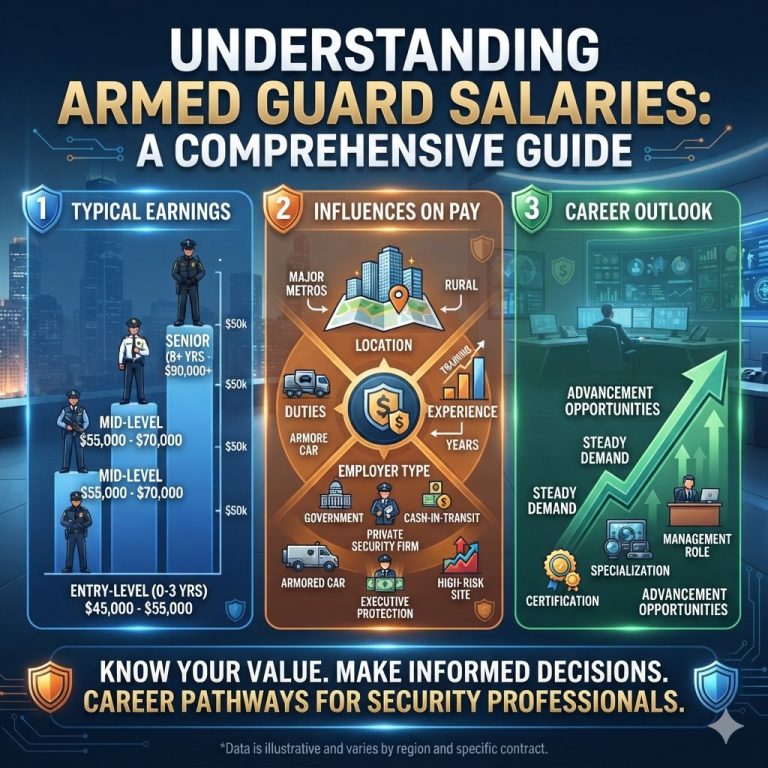
Key Factors That Influence Security Guard Salaries
The title “armed” or “unarmed” is just the starting point. Several other factors play a huge role in determining how much a security guard can earn. Understanding these will give you a clearer picture of your potential income.
1. Training and Certification Requirements
The journey to becoming an armed guard is far more demanding than for an unarmed one. This extensive training is a primary reason for the higher pay.
- Unarmed Guard Training: This usually involves a basic security course that can last from 8 to 40 hours. It covers topics like legal powers and limitations, observation techniques, emergency procedures, and report writing. A state-issued “guard card” is often the result.
- Armed Guard Training: In addition to the unarmed training, armed guards must complete comprehensive firearms courses. This includes classroom instruction on use-of-force laws and firearm safety, plus extensive hands-on training at a shooting range. They must prove proficiency by passing a difficult shooting qualification, often on a recurring basis (e.g., quarterly or annually).
States have strict licensing requirements for armed guards, which often include in-depth FBI background checks, psychological evaluations, and drug screenings. This higher barrier to entry means fewer qualified candidates are available, driving up wages.
2. Level of Risk and Responsibility
Pay is almost always tied to the level of risk involved in a job. An unarmed guard at a quiet corporate campus faces very different potential threats than an armed guard protecting a bank or a jewelry store.
- Low-Risk Sites: These include places like gated communities, front desks, or construction sites after hours. The primary role is presence and deterrence. Pay is typically on the lower end of the scale.
- High-Risk Sites: Banks, federal facilities, cash-in-transit services, and executive protection details are all high-risk. The guard is not just a deterrent but an active line of defense against serious criminal threats. The responsibility is enormous, and the pay reflects this reality.
3. Location, Location, Location
Where you work matters just as much as what you do. A security guard in a major city with a high cost of living will earn much more than a guard in a small, rural town. Some states also have more stringent regulations for security guards, which can lead to higher wages.
For example, states like California and New York have very detailed and costly licensing processes for armed guards, and the pay scales there are generally higher to match. Let’s look at an illustrative table of how wages might differ across the country.
| Location | Average Unarmed Pay (Hourly) | Average Armed Pay (Hourly) |
|---|---|---|
| Los Angeles, CA | $18 – $23 | $22 – $30 |
| New York, NY | $19 – $25 | $24 – $35 |
| Houston, TX | $15 – $20 | $18 – $26 |
| Rural Ohio | $14 – $17 | $17 – $22 |
Note: These are estimates for illustrative purposes and can vary.
4. Type of Employer and Client
Who you work for also has a major impact on your paycheck. The security industry is diverse, with employers ranging from massive multinational corporations to small, local agencies.
- Contract vs. In-House: Some guards are hired directly by the company they protect (in-house), while others work for a security contractor that provides services to various clients. In-house positions, especially at large corporations, often offer better pay and benefits.
- Government Contracts: Working security for a government facility, whether federal, state, or local, is often one of the highest-paying jobs. These positions usually require security clearances and extensive background checks, and the pay is typically excellent.
- Private Clients: High-net-worth individuals or corporations seeking executive protection pay top dollar for highly skilled, discreet, and experienced armed guards. These specialized roles are at the peak of the pay scale.
5. Experience and Specialization
Like any profession, experience counts. A rookie guard just out of training will earn less than a seasoned veteran with a decade of experience and a spotless record. Over time, you build a reputation for reliability and professionalism that employers are willing to pay for.
Furthermore, specializations can significantly increase your earnings. Skills in areas like executive protection, loss prevention investigations, or crisis management make you a more valuable asset. Some guards also gain certifications in first aid, CPR, or defensive tactics, all of which can boost their resume and their pay rate.
Is Becoming an Armed Guard Worth the Extra Pay?
Now for the big question: Is it worth it? The higher salary is tempting, but it’s crucial to weigh the pros and cons carefully before committing to this demanding career path.
The Pros of Being an Armed Guard
- Higher Earning Potential: This is the most obvious benefit. The pay is consistently better, providing a more comfortable living and better financial security.
- More Career Opportunities: An armed guard license opens doors to more prestigious and interesting jobs, including government contracts, executive protection, and specialized security roles.
- Greater Respect and Authority: While not always the case, armed guards are often perceived as having more authority, which can be helpful in de-escalating situations.
- Advanced Skill Set: The training you receive makes you highly skilled in situational awareness, crisis response, and self-defense, which are valuable skills in any aspect of life.
The Cons and Considerations
- Significant Personal Risk: You are more likely to be targeted in a violent encounter. Your job is to move toward danger when others are running away.
- Intense Psychological Pressure: The constant state of readiness and the knowledge that you may have to use lethal force can be mentally and emotionally taxing. Stress and burnout are real risks.
- Extreme Legal and Civil Liability: If you ever have to discharge your firearm, you will face intense scrutiny from law enforcement, your employer, and potentially the legal system. A single mistake can have life-altering consequences.
- Rigorous and Ongoing Training: Your license and skills require constant upkeep. You must regularly re-qualify with your firearm and stay current on laws and company policies, often on your own time and dime.
How to Transition from Unarmed to Armed Security
If you have weighed the options and decided that an armed position is the right path for you, there is a clear process to follow. Here are the typical steps to make the transition.
- Check Your State’s Requirements: The first step is to research the specific laws in your state. Every state has different rules for armed guards. Visit the website for your state’s licensing body (often called the Department of Public Safety or Bureau of Security and Investigative Services) to get an official checklist.
- Gain Experience as an Unarmed Guard: Most reputable security companies will not hire a brand-new guard for an armed position. Working as an unarmed guard for at least a year or two proves your reliability, professionalism, and ability to handle the basics of the job.
- Complete the Required Firearms Training: Enroll in a state-certified firearms training course for security guards. This is not the same as a basic concealed carry class. It is a professional course that covers safety, marksmanship, use of force, and legal issues specific to private security.
- Pass All Background Checks and Licensing Exams: You will undergo a thorough background check by both the state and the FBI. You must have a clean criminal record. After completing your training, you will need to pass a written exam and a shooting qualification test to receive your armed guard license.
- Update Your Resume and Apply for Armed Positions: Once you have your armed license in hand, update your resume to highlight your new certification and training. Start applying for armed security jobs with your current employer or other companies. Your experience as an unarmed guard combined with your new license will make you a strong candidate.

Frequently Asked Questions (FAQ)
How much more do armed guards make per hour?
On average, armed guards earn between $4 and $10 more per hour than their unarmed counterparts. In high-demand areas or specialized roles, this gap can be even wider. The extra pay compensates for the advanced training, higher risk, and greater responsibility.
Is it hard to become an armed guard?
It is more challenging than becoming an unarmed guard. The process involves more extensive training, passing a difficult firearms qualification, and undergoing a rigorous background check, including an FBI screening. It requires a serious commitment, a clean record, and a responsible mindset.
Do I need prior military or police experience?
No, prior experience is not always required, but it is highly valued by employers and can help you secure a better-paying position faster. Many former military and law enforcement personnel transition into armed security careers because their skills are directly transferable.
What kind of training is required for an armed guard?
Training typically includes everything an unarmed guard learns, plus comprehensive firearms training. This covers firearm safety, mechanics, marksmanship under stress, and state-specific laws on the use of deadly force. Guards must also pass a shooting proficiency test and often take annual refresher courses.
Are armed guard jobs more dangerous?
Yes, inherently they are. Armed guards are often placed in environments where there is a known or higher potential for violent crime. The presence of a firearm can also make the guard a target. However, proper training is designed to mitigate these risks and prepare guards to handle threats safely and effectively.
Can I use my own gun as an armed guard?
This depends entirely on the security company’s policy and state law. Some companies issue firearms to their guards to ensure uniformity and proper maintenance. Others may allow you to use your own personal weapon, provided it meets specific caliber and model requirements and you qualify with it.
Do all security jobs require a “guard card”?
In most states, yes. A “guard card” is a basic license proving you have completed the minimum required training to work as a security guard. An armed guard license is a separate, additional certification that is much more difficult to obtain.
Conclusion
So, do armed guards get paid more than unarmed guards? The answer is a clear and resounding yes. The higher pay is not just for carrying a piece of equipment; it’s compensation for a vastly different job with far greater risks, more demanding training, and a profound level of responsibility. The armed guard is not just an observer but a dedicated protector trained to use lethal force if necessary.
Choosing between an unarmed and armed security career is a major decision. While the financial rewards of an armed position are attractive, they come with significant challenges and pressures. It requires a deep commitment to ongoing training, a calm and professional demeanor under stress, and a complete understanding of the legal and moral weight of your duties. For the right person, it can be a rewarding and well-compensated career. For others, a role as a professional unarmed guard offers a stable and important job without the added burdens. By understanding the differences, you can choose the path that best fits your skills, temperament, and career goals.