Do You Hunt With the Quiver On? Advantages and Disadvantages
Deciding if you should choose to use a quiver while hunting can be a tricky decision for new hunters. Some hunters find it convenient, while others believe it can hinder their movement. This post helps you explore Do You Hunt With the Quiver On? Pros and Cons. You will learn the advantages and disadvantages. Don’t worry, we’ll break it down into simple, easy-to-follow steps. We will discuss everything you need to make an informed decision and what to consider when deciding to use your quiver or not.
Choosing to Carry Your Arrows


The decision to carry arrows on your bow is a common one for archers. There are different types of quivers and various ways to carry them. For hunters, the choice significantly impacts how they move through the woods, how quickly they can respond to opportunities, and how comfortable they feel. Let’s explore the choices that impact arrow carrying and how to select the best option for your hunting style.
Types of Quivers
When selecting your quiver, many different types are available. These options vary in terms of arrow storage, ease of access, and how they attach to your equipment. You might discover some are better suited for specific hunting scenarios or individual preferences. The perfect quiver will make the most sense for you and your hunting style. Here are a few options to consider, each with unique features.
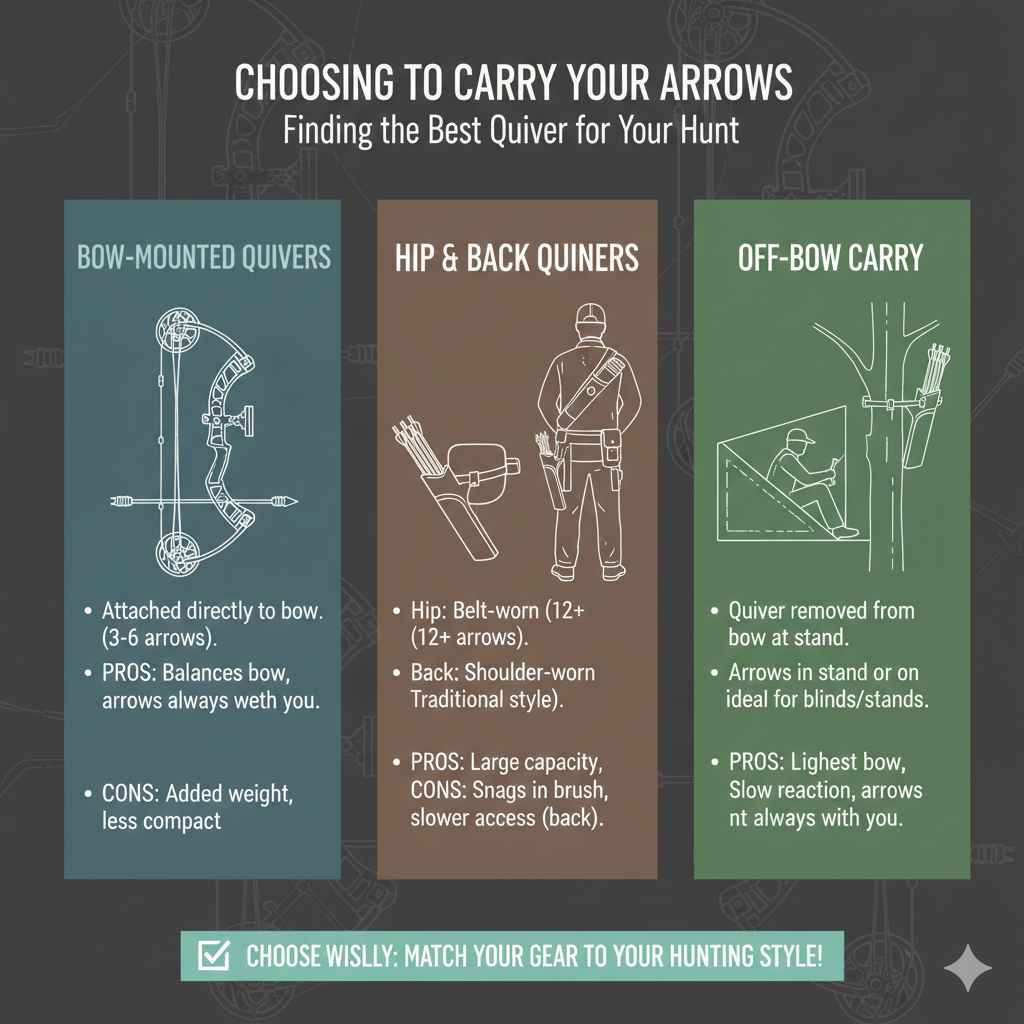
Bow-Mounted Quivers: These are attached directly to the bow, either on the riser or the limb. They keep your arrows close at hand and are generally considered convenient.
Bow-mounted quivers provide quick access to arrows. They typically hold between three and six arrows, depending on the model. Some bow-mounted quivers feature arrow grippers designed to hold arrows securely. These quivers can also help balance the bow, which can be beneficial when aiming. However, they can add weight to the bow and make it slightly less compact, which might be a concern when maneuvering through dense brush.
Hip Quivers: Hip quivers are worn on your side, often using a belt or a clip. They offer a great arrow capacity and are easy to reach. This can be great if you expect to be taking a lot of shots.
Hip quivers are favored by target archers and some hunters. They usually hold a dozen arrows or more. They are easily accessible and do not attach to the bow, which can be advantageous if you prefer a lighter bow. They are also useful when using a compound bow with an attached sight and stabilizer. The main drawback is that they can be cumbersome while moving through brush and may require adjustments to prevent snagging on clothing or equipment.
Back Quivers: These quivers are worn on the back and are mostly associated with traditional archery. They provide good arrow capacity and keep arrows out of the way.
Back quivers provide easy access to your arrows and a large carrying capacity. They are often associated with traditional archery styles but can be used with any bow. Back quivers hold more arrows than bow-mounted options, allowing for plenty of extra shots. Back quivers can present challenges, especially while hunting in thick woods. They also require some practice to quickly draw an arrow without looking.
Off-Bow Quivers: Many hunters opt to remove their quiver from the bow once they are in their hunting spot. Some use a separate quiver stand or set their arrows on the ground near them.
Off-bow quivers can range from simple arrow stands to more sophisticated designs. They offer a solution to the weight and bulk of a quiver on the bow. Many hunters and archers find this option beneficial for long periods of hunting from a fixed position, such as a ground blind or tree stand. The key is always to ensure the arrows are easily accessible. One disadvantage is that it can slow down your reaction time in an emergency situation.
Advantages of a Bow-Mounted Quiver
Choosing to use a bow-mounted quiver offers several clear advantages for hunters. The convenience and benefits can significantly enhance your hunting experience. The decision can depend on the environment you hunt in, the type of bow you use, and your overall hunting strategy. Here are some key advantages to consider when choosing to use a bow-mounted quiver.
Increased Efficiency and Speed
Having a quiver attached to your bow can make for faster follow-up shots. It is much easier to grab an arrow when it is mounted on your bow. This can make the difference between getting a second shot or missing an opportunity. Time is often very important when hunting. Being quick on the draw allows you to take advantage of moments as they happen. This could be the difference between success and failure on a hunt.
Quick Access: Arrows are always within reach, allowing for fast follow-up shots. You do not have to move your hand far to nock an arrow. This is especially helpful when a second shot is needed quickly.
Having your arrows readily available can reduce the time it takes to prepare for another shot. The time saved can be helpful when dealing with a moving target or in situations where multiple shots are needed. The bow-mounted quiver ensures your arrows are always where you expect them to be. This is a very common choice for hunters.
Reduced Movement: You don’t have to reach for a separate quiver, keeping your movements to a minimum. Staying still is very important in the field. Every movement you make can scare off your target. The less you move, the better.
The ability to remain still and reduce unnecessary movement can increase your odds of a successful hunt. The bow-mounted quiver allows you to manage your arrows without making any unnecessary movements. This makes you more discreet, especially when waiting for an animal to present a shot.
Convenience: The quiver is always with you, eliminating the need to search for arrows. This is very important when stalking, or if you need to take a quick shot.
The bow-mounted quiver is attached to your bow. You will always have access to your arrows whenever your bow is in hand. This convenience can be very useful if you often move from one hunting spot to another. It helps you stay organized. It simplifies the setup process. This is especially useful in fast-paced hunting situations.
Enhanced Balance and Stability
A bow-mounted quiver can provide extra weight to the bow. This can improve the balance and stability of your bow, which helps you aim more accurately. Many hunters like the way their bow feels with a quiver attached. This will have a direct impact on your shooting accuracy. Many archers find this extra weight helps them to shoot better, especially in challenging conditions. Here are a few things to consider.
Improved Balance: The added weight can make the bow more balanced and easier to hold steady. This is especially true for compound bows. The quiver can counterbalance the weight of the sight and other accessories.
A well-balanced bow is easier to hold steady on target, which improves your accuracy, especially at longer distances. The bow-mounted quiver contributes to this balance. It can make shooting in windy conditions easier. It also improves your overall shooting experience.
Reduced Movement: Having the quiver attached can minimize unnecessary movements. This means you will stay still and reduce the chance of scaring off your target.
By keeping your arrows close to the bow, you reduce the amount of movement needed to retrieve an arrow. This can be especially important in situations where stealth is key, such as when spot-and-stalk hunting or waiting in a blind. Every movement can spook your target.
Steady Aiming: The added weight can help reduce bow vibration during the shot. This can lead to tighter groupings. This will lead to more accurate shots on game.
The extra weight from the quiver can help to stabilize the bow. This can be very useful in windy conditions. The added stability will make you a more consistent shooter. This can lead to increased confidence in the field.
Disadvantages of a Bow-Mounted Quiver
While bow-mounted quivers have several advantages, they also have some disadvantages. Deciding whether or not to carry your arrows on your bow is a personal choice. Your decision will depend on your hunting style, your preferred terrain, and your comfort level. You must decide whether these disadvantages outweigh the convenience and benefits. Let’s delve into some of the downsides of using a bow-mounted quiver.
Increased Bulk and Weight
Adding a quiver to your bow increases the overall weight and bulk. This can impact maneuverability and how easy it is to carry. The added weight and bulk can be a real issue. Here are some of the things you may experience. This is one of the main reasons why hunters may choose to remove their quiver.
Added Weight: The combined weight of the quiver and arrows can cause fatigue on longer hunts. Bow hunting involves a lot of walking.
The extra weight will become very obvious on a long day of hunting. This can be especially true if you are hiking through rugged terrain. Reducing the weight can help you stay alert and focused on the hunt.
Reduced Maneuverability: A bow-mounted quiver makes it harder to move through dense brush. Hunting often involves squeezing through tight spots, and this can be an issue.
In certain hunting environments, like thick forests or heavily wooded areas, the extra bulk of the quiver can make it difficult to navigate. This will affect your ability to move silently, increasing the risk of getting caught on branches and other obstructions. This may also cause you to lose your balance.
Potential for Snagging: The quiver can snag on branches and other objects. This will certainly cause noise and movement that could scare off game.
The possibility of the quiver snagging on branches or other objects is a valid concern. It may interfere with your shooting form. This is especially true when drawing your bow or releasing an arrow. A snagged quiver can also distract you. It might interfere with taking a quick shot at an approaching animal.
Noise and Obstruction
Quivers attached to the bow have the potential to make noise, which can be an issue when you are trying to remain undetected. They can also create obstruction issues. You may find that it takes more effort to remain concealed. Here are some of the reasons why you might want to avoid using a bow-mounted quiver.
Noise: A quiver can produce noise. It’s often the arrows rattling against the quiver or the quiver bumping against other gear.
Noise is a critical factor in bow hunting, as animals can quickly detect sounds and react. Any sound produced by the quiver will increase your chances of being spotted. Keeping your setup as quiet as possible is important for a successful hunt.
Interference with Shooting: The quiver can sometimes obstruct your view or affect your draw. This is especially true when shooting uphill or downhill.
The placement of the quiver can affect your line of sight. Make sure it does not interfere with your ability to aim and shoot accurately. The quiver can be located in a spot that impacts your bow-hand positioning or arrow flight. You will need to take this into consideration before each shot.
Reduced Visibility: The quiver can obstruct your view, which can be a problem if you are hunting from a blind. It can impact your ability to quickly scan your surroundings.
In low-light conditions, or when hunting in dense cover, the quiver could potentially reduce your visibility. The quiver’s position could partially block your view. This would be true when watching for game or when taking aim. Always try to pick the best placement for your quiver.
Alternative Arrow Carrying Methods
You have other options besides carrying your arrows on your bow. There are many ways to manage your arrows in the field. Every method has its pros and cons. Understanding these alternatives will help you select the best method for your hunting style. Here are a few additional methods that you can choose to use.
Hip Quivers
Hip quivers are commonly used by target archers and some bowhunters. The quiver is worn on the hip, providing an accessible way to carry arrows without adding weight to the bow. Hip quivers are a good option for certain hunting scenarios. They provide a balance between convenience and ease of movement. Here are some of the reasons why hip quivers are a good idea.
Easy Access: Arrows are readily available and within arm’s reach. You can easily grab an arrow when you need one.
The positioning of a hip quiver makes it easy to retrieve arrows quickly, which is helpful for fast follow-up shots or for multiple targets. Your arrows are always readily accessible.
Arrow Capacity: Hip quivers can hold a large number of arrows, allowing you to carry more arrows. This is very helpful if you plan on taking several shots.
Hip quivers often accommodate more arrows than bow-mounted quivers. This provides flexibility, especially for hunters who prefer to carry extra arrows or for those expecting multiple shot opportunities.
Weight Distribution: The weight of the arrows is distributed on your hip, which can be more comfortable. This is true, especially on long walks.
Distributing the weight on your hip reduces the strain on your arms and shoulders, making it easier to carry your equipment for extended periods. This can reduce fatigue, which helps you stay focused during your hunt.
Back Quivers
Back quivers, a traditional option, offer a simple way to carry multiple arrows. This option is popular among traditional archers. They are ideal for quick access and the ability to hold a large number of arrows. The design also allows for easy movement in the field. Here’s a look at what to expect from back quivers.
High Capacity: Back quivers hold more arrows than most other types. This is great for hunters who anticipate needing multiple shots.
The back quiver is often used in situations where several arrows might be needed in a short period. This can be helpful if you plan to shoot multiple rounds or if you are hunting in a location where shots are more frequent.
Unobstructed View: The quiver is positioned on the back, keeping arrows out of your line of sight. This allows for a clear view.
Having arrows positioned on the back ensures your view is unobstructed. This feature is particularly useful when hunting in dense cover, where visibility is already limited. This will help you take the shot.
Freedom of Movement: The back quiver does not attach to your bow. This can increase your flexibility. This will help you move through the woods.
The design allows for freedom of movement and keeps the bow light. This is particularly advantageous when hunting in environments where agility and quick maneuvering are needed. This also allows you to move quicker.
Off-Bow Quivers and Stands
Off-bow quivers or stands are a common choice for hunters. These options involve removing the quiver from the bow and using a separate system to store arrows. This approach aims to reduce weight and bulk while still keeping arrows accessible. The design can make hunting very comfortable. Here’s how it works.
Reduced Weight: Removing the quiver from the bow makes the bow lighter. This is very helpful when stalking game.
The primary advantage of this method is the reduction in weight and bulk. This is especially helpful during long periods of carrying the bow. This is useful for hunters who hike long distances or prefer a lighter bow for comfort.
Quiet Operation: Removing the quiver removes the potential for noise. This will help you remain undetected.
This method eliminates the chance of arrows rattling against the quiver. This will increase your chances of getting a shot. The approach can also reduce the possibility of the quiver snagging on brush.
Stationary Hunting: This method works best when hunting from a fixed position, such as a ground blind. This allows for quick access to your arrows.
It can be very useful for hunters who spend extended periods in a stand. It is helpful when focusing on a specific shooting lane or location. It offers a convenient solution for keeping your arrows within easy reach.
Deciding to Keep Your Quiver On
The final decision of whether or not to hunt with your quiver on rests on you. The right choice often depends on your specific hunting style and the environment you are hunting in. Consider the advantages, disadvantages, and alternative carrying methods. Taking all these factors into account will help you select the best approach. Here is how to make the best decision.
Assessing Your Hunting Style
Evaluating your hunting style is a vital step in deciding whether to use a bow-mounted quiver. Your preferred hunting method can have a huge impact on your gear selection. Whether you are a spot-and-stalk hunter or a treestand hunter, your hunting style will help guide your decision. Here are some of the things you need to consider.
Spot-and-Stalk Hunters: This style requires moving through different types of terrain. Weight and maneuverability are key.
Spot-and-stalk hunting involves covering ground, often in challenging conditions. Hunters should consider whether the added weight and bulk of a bow-mounted quiver will hinder their movement. Alternatively, hip quivers or off-bow solutions might be more appropriate. Your style will impact your gear choices.
Treestand Hunters: Hunting from a treestand usually involves less movement. This means you can focus more on shot placement and stealth.
Treestand hunters typically have a more static setup. The main focus is on being ready for a shot. The convenience of a bow-mounted quiver might be very helpful. Alternatively, an off-bow quiver could also work. Always consider the terrain, weather, and distance.
Ground Blind Hunters: Ground blind hunting offers a similar dynamic to treestand hunting. Hunters will be shooting at close range.
Ground blind hunting offers a concealed location. Hunters will often have limited space. An off-bow quiver system can provide quick access to arrows. The setup reduces the amount of movement in tight spaces. You can also minimize noise.
Considering the Hunting Environment
The hunting environment you choose will have a great impact on your quiver choice. You should choose gear that will make you successful. The environment often dictates what is best to wear or use. Consider the terrain, the type of cover, and the weather conditions when deciding on your quiver setup. This will help you increase your chances of success. Here are some of the things you need to consider.
Dense Forests: In dense forests, the bulk of a bow-mounted quiver can be an issue. You will need to consider maneuverability, where every movement and sound can spook game.
In densely wooded areas, where you are moving through thick brush, the added bulk and the potential for snagging the quiver on branches can be a significant drawback. In this setting, the off-bow options may be the best choice. This will also give you better maneuverability in tight spots.
Open Fields: Hunting in open fields may not be much of an issue. Weight and balance are the key factors here. If you have to take shots at a distance, a bow-mounted quiver could be useful.
In open fields, where visibility is greater, the added weight and the benefits of quick access might be favorable. The main concern here is distance. Always focus on a clear shot.
Mountainous Terrain: In mountainous terrain, weight and stability become even more crucial. You will want to make sure you have a comfortable setup.
Hunting in mountainous terrain is very physically demanding. Hunters should consider the added weight of a bow-mounted quiver. They need to consider the impact on maneuverability, and the potential effect on balance. These factors can be especially important in a challenging environment.
Practicing with Your Setup
You must practice with the setup you plan to use in the field. Getting used to your gear will prepare you for a hunt. Practice will give you the chance to make adjustments. It will allow you to fine-tune your approach for maximum performance and comfort. Be sure to consider these points while you practice.
Accuracy: Make sure you can shoot accurately with your quiver on.
The goal of archery is to put the arrow where you want it. Practice shooting with your quiver on to make sure your accuracy is not affected. This is very important. Always be sure to test your setup.
Speed: Practice how quickly you can get a second arrow out and ready to fire.
Practice drawing, nocking, and shooting arrows with your bow-mounted quiver. This practice will help you be able to reload quickly. It’s an important skill.
Comfort: Make sure you are comfortable with your setup. You will be walking and hunting for many hours.
Practice in the conditions you expect to hunt in. You must decide whether it’s comfortable to carry a bow with your quiver attached for extended periods. This step helps make sure you are confident in your setup.
Many bow hunters find they have a preference on the equipment they use. They choose what feels best and gives them the most success in the field. You should try different options, and always practice with your gear.
| Feature | Bow-Mounted Quiver | Hip Quiver | Off-Bow Quiver |
|---|---|---|---|
| Speed | Fast | Moderate | Slow |
| Maneuverability | Moderate | Good | Excellent |
| Weight | Added | Added | Less |
| Noise | Potential | Less | Minimized |

Frequently Asked Questions
Question: Is it easier to reload with a bow-mounted quiver?
Answer: Yes, bow-mounted quivers generally offer the easiest access for quick reloading since arrows are always right at your fingertips.
Question: Do hip quivers provide a lot of arrow capacity?
Answer: Yes, hip quivers typically can hold many arrows. They are a great choice if you expect to take a lot of shots.
Question: Can bow-mounted quivers be noisy?
Answer: Yes, sometimes bow-mounted quivers can produce noise, especially if arrows rattle against the quiver body or other gear.
Question: Should I always hunt with a bow-mounted quiver?
Answer: No, the choice depends on your hunting style, environment, and personal preference. Some hunters choose to hunt without their quiver on.
Question: Are back quivers only for traditional bows?
Answer: While commonly used with traditional bows, back quivers can be used with any bow type, offering a different way to carry arrows.
Final Thoughts
So, should you hunt with the quiver on? The best answer is: it depends! There are many factors at play. The right choice is based on what makes you comfortable and successful. The bow-mounted quiver offers easy access to your arrows and can improve balance. However, it adds weight and might make moving through dense cover difficult. On the other hand, a hip quiver keeps arrows accessible and the bow lighter, while the off-bow options eliminate weight and noise. Choose the option that fits your hunting style and the environment. You might find that the best method changes depending on the situation! So, get out there, practice with your gear, and find the perfect setup for you. Happy hunting!