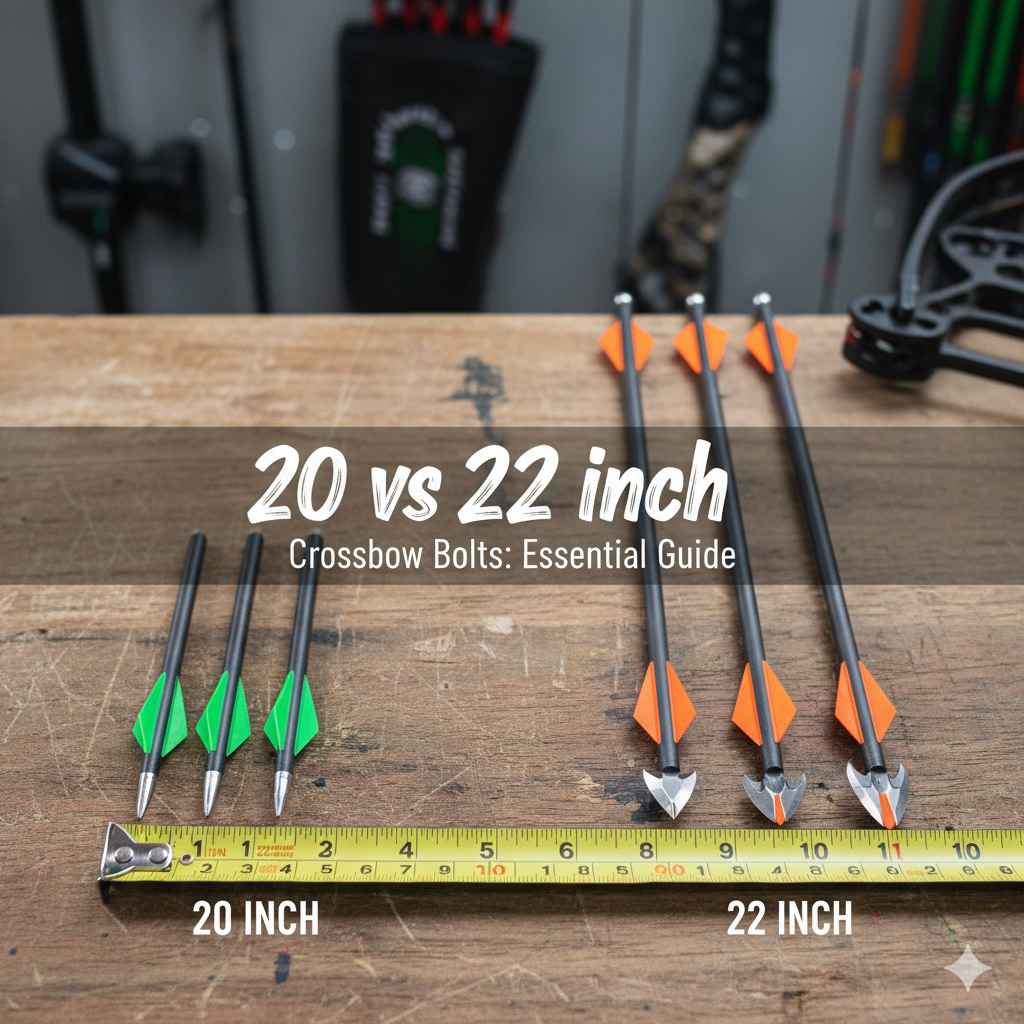
20 vs 22 inch Crossbow Bolts: The right choice depends on your crossbow’s power, your shooting distance, and safety. For most beginners, matching the length to your manufacturer’s recommendation is key. Generally, 22-inch bolts offer more momentum for faster, longer shots, while 20-inch bolts suit shorter, lighter crossbows better.
Welcome, new archer! Choosing the right arrows—or bolts, as we call them for crossbows—can feel overwhelming. You look at the options, and suddenly, 20 inches and 22 inches sound like a huge difference. Don’t worry! This is one of the most common questions we hear from folks just starting out. Getting the right bolt length is critical for safety and hitting your target. We are going to break down what these sizes mean for your crossbow, ensuring you feel confident about your next purchase. Let’s make this simple and get you shooting straight!
Why Bolt Length Matters More Than You Think
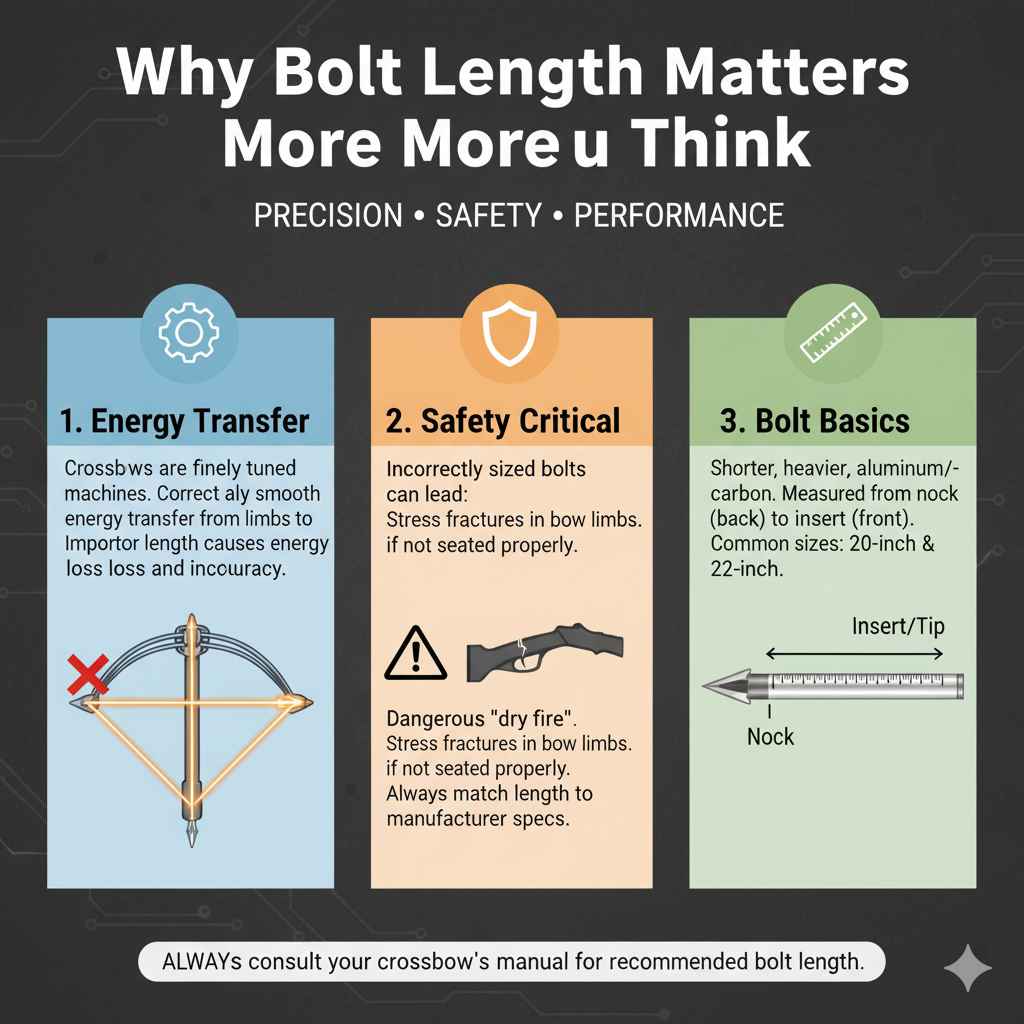
In archery, everything must match perfectly. Think of your crossbow like a finely tuned machine. The power stored in the limbs (the arms of the bow) needs to transfer its energy smoothly into the bolt. If the bolt is too short or too long, that energy transfer fails.
This isn’t just about accuracy; it’s about safety. An improperly sized bolt can cause stress fractures in the limbs or even lead to a dangerous dry fire if it doesn’t seat correctly.
Understanding the Basics of Crossbow Bolts
Crossbow bolts are designed differently than traditional arrows. They are shorter, heavier, and often made of aluminum or carbon. They have a standard diameter, but the length is the primary variable you choose.
When measuring bolts, you measure from the back end (the nock) to the front end (where the tip screws in). This measurement is what determines the 20-inch or 22-inch classification.
The 20-Inch Crossbow Bolt Profile
The 20-inch bolt is a very popular choice, especially for hunters and recreational shooters who use mid-to-high-powered crossbows.
When to Choose a 20-Inch Bolt
If your crossbow is rated in the 300 to 375 feet-per-second (FPS) range, a 20-inch bolt is often the sweet spot recommended by the manufacturer.
Here are the main advantages of sticking with 20-inch bolts:
- Maneuverability: They are slightly lighter and easier to handle, which can help newer shooters achieve a faster, smoother release.
- Compatibility: Many entry-level and mid-range crossbow packages come standard with 20-inch bolts because they balance well with the draw weight.
- Better Flight Path (Sometimes): For shorter shooting distances (under 40 yards), the shorter length can sometimes result in a slightly stiffer spine requirement, leading to less wobble during flight.
Spine Stiffness and the 20-Inch Choice
Spine stiffness refers to how much an arrow bends when force is applied. This is crucial. A very powerful crossbow (high FPS) exerts huge force. If the bolt is too flexible (too weak a spine) for that power, it can flex excessively mid-flight, leading to poor accuracy or even breaking.
For a 20-inch bolt, you generally need a stiffer spine rating (a lower number, like .300 or .340) compared to what you might need for a 22-inch bolt of the same weight, simply because there is less length to naturally flex.
The 22-Inch Crossbow Bolt Profile
The 22-inch bolt steps up in length, offering increased surface area and generally more momentum when it leaves the rail.
Who Needs a 22-Inch Bolt?
These longer bolts are usually reserved for high-performance crossbows, often those shooting faster than 400 FPS, or for hunters who expect to take shots past 60 yards.
The benefits of going longer include:
- Momentum and Knockdown Power: More mass traveling at speed translates to better energy retention downrange, which is vital for ethical hunting.
- Spine Flexibility: Longer bolts can handle higher draw weights with a slightly less stiff spine because the added length allows for more controlled flex during launch.
- Rail Fit: On very large or powerful crossbows, a 22-inch bolt may simply fit better onto the firing rail without interference from the stock or scope mounts.
The Critical Role of Crossbow Compatibility
Here is the single most important rule for beginners: Always check your crossbow owner’s manual.
No matter what an online forum says, your crossbow manufacturer knows exactly what length and spine rating are engineered to work safely with their specific model. Using the wrong length can void your warranty and, more importantly, create a dangerous situation.
How Manufacturers Determine Length
Manufacturers design their crossbows around specific components:
- The Cocking Mechanism: The length must allow the string to draw back fully without bottoming out the bolt against the trigger housing or trigger mechanism.
- The Rail Length: The bolt needs enough rail space to rest securely for a straight launch. If it hangs off the back, it can misalign.
- The Cam Timing: The point where the cams (the wheels on the limb ends) release the string is timed to maximize efficiency with a certain bolt length.
If your manual says “Use 20-inch bolts only,” using 22-inch bolts risks the back end of the bolt hitting the trigger components upon release. This can cause catastrophic failure of the bolt and potentially damage the crossbow.
Comparison: 20 vs 22 Inch Crossbow Bolts
To make the choice clearer, let’s compare the key physical and performance factors side-by-side.
| Feature | 20-Inch Crossbow Bolt | 22-Inch Crossbow Bolt |
|---|---|---|
| Ideal Crossbow Speed (FPS) | 300 – 375 FPS | 375+ FPS (Often required) |
| Momentum/Weight | Slightly lighter overall | Slightly heavier overall (more mass) |
| Downrange Energy | Excellent for typical hunting distances (under 50 yards) | Superior energy retention at longer distances |
| Spine Requirement | Often requires a slightly stiffer spine for the same weight. | Can use a slightly less stiff spine due to added length. |
| Handling | Easier to handle/store for some users. | Can feel unwieldy on shorter crossbows. |
Momentum and Kinetic Energy: A Simple Look
When we talk about power, we talk about kinetic energy (KE). Kinetic energy is what drives the broadhead through the target.
A longer bolt (like the 22-inch) that has the exact same weight as a 20-inch bolt will travel slightly slower because it has more surface area to create drag. However, most people who upgrade to 22-inch bolts are using crossbows that are inherently faster and more powerful.
The key takeaway for beginners is this: Longer bolts usually carry more total mass, and that mass helps maintain high kinetic energy even after traveling a longer distance.
For casual target practice at 30 yards, the difference is negligible. For ethical hunting, especially in areas where shots might stretch out, the extra stability and mass of a 22-inch bolt (if compatible) can be beneficial. Always consult resources like those from reputable archery safety organizations, such as the Archery Safety Organization, regarding ethical equipment choices for hunting.
How to Check If Your Bolt Is Too Short or Too Long
Even if you buy the recommended length, you need to visually confirm the fit before you ever pull the trigger.
The Safe Clearance Test
This test ensures that the bolt clears the trigger mechanism perfectly. This must be done safely, without dry firing!
- Unload the Crossbow: Ensure the crossbow is completely uncocked and safe.
- Seat the Bolt: Place the recommended bolt length (e.g., 20-inch) onto the rail, pushing it forward until the nock is perfectly seated against the drawn string (as if it were cocked).
- Check the Rear: Look at the back end of the bolt. There should be at least a quarter-inch (about 6mm) of clear space between the back of the bolt (where the nock is) and any part of the crossbow housing or trigger assembly.
- Test the Longer Bolt (If Considering): If you are thinking about using a 22-inch bolt, seat it gently against the string. If the bolt butts up against the trigger housing or any moving part, it is too long and unsafe to use.
If a 22-inch bolt fits safely where a 20-inch bolt also fits safely, you then move on to checking spine stiffness based on your crossbow’s draw weight.
The Spine Stiffness Connection: Not Just Length
You cannot talk about 20 vs 22 inches without discussing spine stiffness. Spine rating is a measure of the bolt’s resistance to bending. A lower spine number means a stiffer bolt.
Why Spine Matters for Beginners
Using a bolt that is too flexible (too weak a spine) for your crossbow’s power is the leading cause of poor accuracy and potential breakage when shooting fast crossbows.
Too Flexible (Weak Spine): The bolt wobbles excessively as it leaves the rail, causing the point of impact to move erratically.
Too Stiff (Strong Spine): The bolt doesn’t flex enough during launch, leading to vibration and vibration, often resulting in less consistent grouping.
General Spine Guidelines for 20 and 22-Inch Bolts
While you must check your manual, here is a very general starting point for common hunting crossbow weights:
| Crossbow Speed (FPS) | Recommended Spine for 20-Inch Bolt | Recommended Spine for 22-Inch Bolt |
|---|---|---|
| Under 350 FPS | .350 or higher (more flexible) | .400 or higher (most flexible) |
| 350 – 400 FPS | .340 to .300 (stiffer) | .350 to .320 |
| Over 400 FPS | .300 or lower (very stiff) | .300 or lower (very stiff) |
Remember, the weight of the bolt (measured in grains per inch) also plays a role. A heavier 20-inch bolt might require a stiffer spine than a lighter 20-inch bolt.
Practical Considerations for the Hobbyist
As a beginner or hobbyist, your priorities might differ slightly from a competitive 3D shooter or a dedicated big-game hunter. Let’s focus on what makes things easiest for you right now.
Cost and Availability
20-inch bolts are often slightly more common in general sporting goods stores simply because they fit the widest variety of mid-range crossbows. This means they might occasionally be cheaper or easier to find when you run out quickly during a range session.
However, the price difference between a high-quality 20-inch carbon bolt and a high-quality 22-inch carbon bolt is usually minimal. Don’t let a few dollars sway you if the length isn’t correct for your specific weapon.
Storage and Transport
If you have a very compact or takedown crossbow, the shorter 20-inch bolts are easier to pack into small cases or transport in the field. If you are shooting from a fixed location, like a backyard range, this is less of a concern.
The Beginner Recommendation: Keep It Simple
For your first year or two in archery, my strongest advice is this: Stick to the manufacturer’s recommendation.
If your crossbow came packaged with 20-inch bolts, buy 20-inch bolts that match the spine recommendation. If it came with 22-inch bolts, use 22-inch bolts. Once you have hundreds of rounds downrange and understand exactly how your bow performs across different weather conditions and distances, then you can start experimenting safely with slightly different spine weights or lengths if the manual allows.
Common Mistakes to Avoid When Choosing Length
Learning what not to do is just as important as knowing what to do! Here are the pitfalls many new crossbow shooters fall into regarding bolt length.
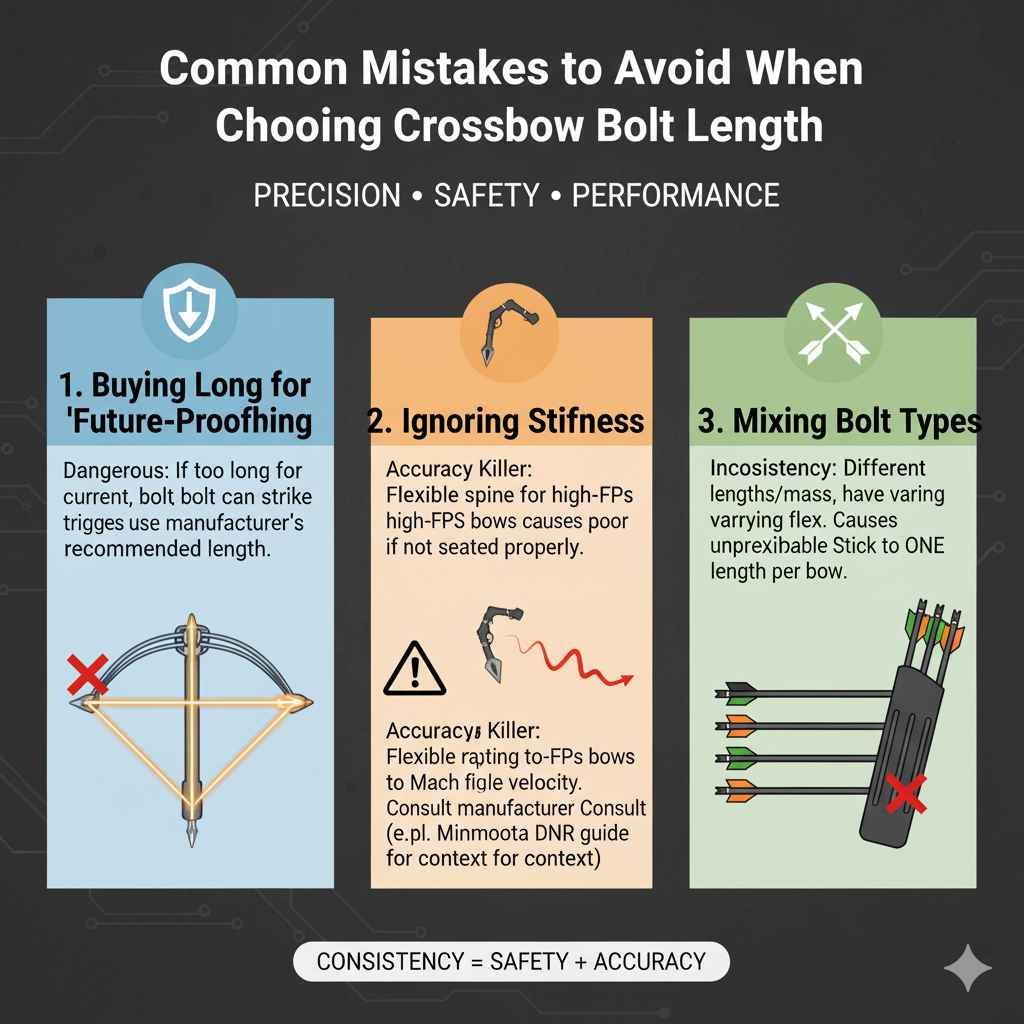
Mistake 1: Buying Long for “Future-Proofing”
Some beginners buy 22-inch bolts thinking, “My next crossbow will be faster, so I’ll buy the longer ones now.”
This is dangerous. If a 22-inch bolt is too long for your current, lower-powered bow, it can strike the trigger assembly. If you are unsure, always err on the side of the shorter, recommended length.
Mistake 2: Ignoring Spine Stiffness
This is the biggest accuracy killer. You might find a great deal on a set of 20-inch carbon bolts, but if they are significantly too flexible for your 420 FPS bow, they will shoot terribly, regardless of the length being “correct.” Always match the spine to the bow’s velocity, as outlined in the manufacturer’s documentation. For more depth on equipment calibration, reliable resources like the Minnesota DNR’s guide on crossbow use often provide excellent safety context for hunters.
Mistake 3: Mixing Bolt Types
Never mix 20-inch and 22-inch bolts in the same quiver, or worse, try to use them interchangeably on the same crossbow unless explicitly approved by the manufacturer for both lengths. The slight difference in mass and the resulting change in spine flex will make your shots inconsistent. Choose one length and stick to it entirely for a specific bow.
Frequently Asked Questions for Beginners
Q1: Can I use 22-inch bolts on a crossbow that recommends 20-inch bolts?
A: Generally, no. If the manufacturer specifies 20 inches, using 22 inches risks the rear of the bolt colliding with the trigger mechanism upon firing, which is very dangerous. Always follow the manual.
Q2: Is a 22-inch bolt always more accurate than a 20-inch bolt?
A: No. Accuracy depends on the bolt spine matching the crossbow’s speed. A perfectly matched 20-inch bolt will always be more accurate than a poorly matched 22-inch bolt.
Q3: What is spine stiffness in simple terms?
Spine stiffness refers to how much a crossbow bolt bends when force is applied during the shot. When the string releases, the bolt experiences strong pressure and flexes slightly before stabilizing in flight. A stiffer spine (lower number) bends less and works better with powerful crossbows, while a more flexible spine (higher number) bends more and suits lower-powered crossbows.
Using the correct spine helps bolts fly straighter, group better, and avoid breaking under pressure.
Q4: Do longer crossbow bolts fly farther?
Not always. A 22-inch bolt may carry more momentum, but distance depends on several factors such as bolt weight, crossbow speed (FPS), and proper spine matching. In many cases, a well-matched 20-inch bolt can be just as accurate and effective at typical shooting distances.
Q5: Which bolt length is best for beginners?
For beginners, the best bolt length is the one recommended by the crossbow manufacturer. Most starter and mid-range crossbows commonly use 20-inch bolts, making them a safe and practical starting point. Once you gain more experience, you can experiment with different bolt weights or lengths if your crossbow allows it.
Conclusion
Choosing between 20-inch and 22-inch crossbow bolts mainly comes down to compatibility with your crossbow and your shooting goals. While 22-inch bolts can offer slightly more momentum and stability for high-powered crossbows, 20-inch bolts are widely used because they balance accuracy, handling, and availability.
The most important rule is simple: always follow your crossbow manufacturer’s recommendations for bolt length and spine. When your equipment is properly matched, you will enjoy safer shooting, better accuracy, and a more consistent archery experience whether you are practicing at the range or preparing for advanced shooting situations.