Are Rainbows Actually Circles? Discover the Science Behind the Arc
Rainbows are one of nature’s most beautiful sights. Many people see them as arcs in the sky, colorful and perfect after rain. But have you ever wondered if rainbows are actually circles? This question seems simple, but the answer is more interesting than most expect.
To understand it fully, we need to look at how rainbows form, what our eyes see, and the science behind the shape. By the end of this article, you’ll know why rainbows look like arcs, and whether they are really circles.
How Rainbows Form
To answer if rainbows are circles, we first need to understand how they form. Rainbows happen when sunlight interacts with water droplets in the atmosphere. This process involves three steps:
- Refraction: When sunlight enters a water droplet, it bends (refracts).
- Reflection: The light reflects inside the droplet.
- Dispersion: As the light exits, it bends again and splits into colors.
Each droplet acts like a tiny prism. The result is the spread of colors, red, orange, yellow, green, blue, indigo, and violet. The angle at which light exits the droplet is important. Most rainbow light leaves at about 42 degrees from the direction opposite the sun.
Why Rainbows Have A Shape
The rainbow’s shape is not random. The angle of 42 degrees creates a pattern. If you draw lines from your eye to all droplets at this angle, they form a circle around a point called the “anti-solar point.” This is the spot in the sky directly opposite the sun.
But on the ground, we usually see only part of the circle. The earth blocks the bottom, so we see an arc. The center of the rainbow’s circle is always at the anti-solar point, often below the horizon.
Are Rainbows Actually Circles?
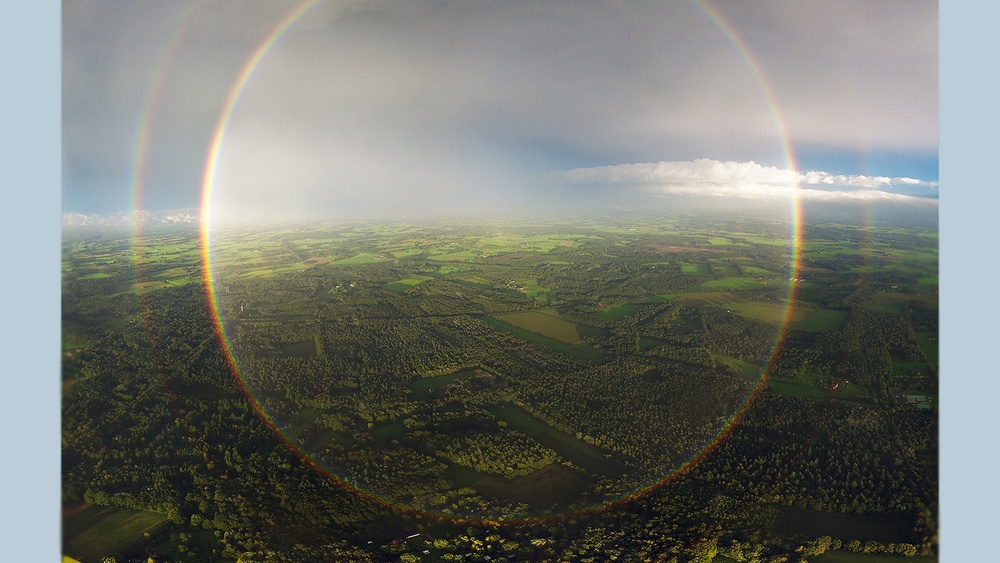
Now, let’s get to the main question. The science tells us that rainbows are circles. The shape comes from the physics of light and droplets. The 42-degree angle forms a circular pattern around the anti-solar point. Every droplet at this angle sends colored light to your eyes. If nothing blocked your view, you would see a full circle.
Why We See Only Arcs
Most people see rainbows as arcs. The reason is simple: the ground gets in the way. When standing on earth, the horizon cuts off the bottom part of the circle. Only the top is visible. This is why rainbows look like arches in the sky.
But the circle is always there. If you were up high, like in an airplane or at the top of a tall mountain, you might see a full circle rainbow. These are rare, but pilots and passengers sometimes report them.
Comparing Arc And Circle Rainbows
Here’s a comparison to clarify the difference:
| Feature | Arc Rainbow | Circle Rainbow |
|---|---|---|
| Visibility | Seen from ground level | Seen from high places or sky |
| Shape | Partial arc (usually top half) | Full circle |
| Frequency | Common | Rare |
| Angle | Still centered at anti-solar point | Same, but circle not blocked |
The Anti-solar Point: Rainbow’s Center
The anti-solar point is the center of the rainbow’s circle. It’s always directly opposite the sun from your viewpoint. To find it, imagine a line from the sun through your head and out the back. Where this line meets the sky is the anti-solar point.
Every water droplet at a 42-degree angle from this point can send colored light to your eyes. This is why the rainbow forms a circle around it. The height of the sun changes the position of the anti-solar point and the shape of the rainbow you see.
Example: Sun’s Position And Rainbow Shape
If the sun is low in the sky, the anti-solar point is high, and the arc looks taller. If the sun is high, the rainbow is lower and may be barely visible.
Seeing Full Circle Rainbows
Full circle rainbows are not impossible to see. In fact, they are seen often from airplanes or tall buildings. When nothing blocks your view, the entire circle appears. Some waterfalls and fountains also create conditions for full circle rainbows, especially when sunlight and mist are just right.
Real Sightings
Many pilots have reported seeing full circle rainbows. Photographs taken from planes often show the complete ring. Tourists at tall waterfalls like Victoria Falls sometimes see full circle rainbows in the mist.
Pro Tip:
If you want to see a full circle rainbow, try to find a place with a wide view below you, like a mountain, bridge, or tall building. Early mornings or late afternoons are best, when the sun is low.
Double Rainbows And Other Shapes
Sometimes, you see double rainbows, two arcs, one outside the other. The outer, fainter rainbow comes from a double reflection inside the droplet. Its colors are reversed. Both rainbows form circles, but again, the ground blocks the lower parts.
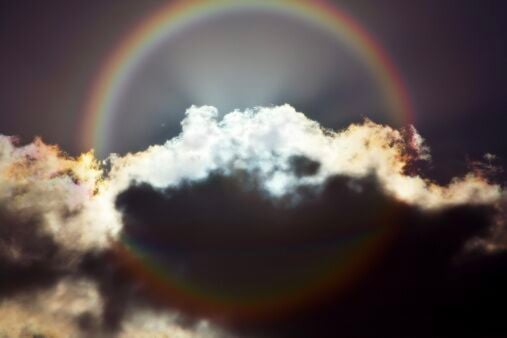
Other shapes are possible. Fogbows are similar but appear white and less colorful, often in mist or fog. Haloes look like circles but come from ice crystals, not water droplets.
Data Table: Rainbow Types And Features
| Type | Shape | Color Pattern | Common Conditions |
|---|---|---|---|
| Primary Rainbow | Arc or circle | Red outside, violet inside | Rain and sunlight |
| Double Rainbow | Two concentric arcs/circles | Second is reversed colors | Heavy rain and sunlight |
| Fogbow | Arc or full circle | White or pale colors | Mist or fog |
| Halo | Full circle | White or light colors | Ice crystals, not water droplets |
The Science Behind Rainbow Circles
Rainbows are circles because of the laws of optics and geometry. Each droplet bends and splits light at a precise angle. The collection of all droplets at the correct angle forms the circle. Your eye is the center of this circle, with the anti-solar point as the geometric reference.
Geometry Of Rainbow Formation
The circle’s radius is set by the angle (about 42 degrees for red). If you imagine a sphere around your head, the rainbow forms a ring on this sphere. The colors are layered, with red on the outside and violet inside.
The thickness of the rainbow comes from the range of angles for each color.
Non-obvious Insight
Many beginners think the rainbow is a flat arc. Actually, it’s a three-dimensional cone. The cone’s tip is at your eye, and the base is the circle in the sky. Every droplet along this cone sends light to your eye at the perfect angle.

Credit: www.reddit.com
Why Rainbows Are Not Always Visible
Rainbows require specific conditions:
- Sunlight must be present.
- Rain or mist must be in the opposite direction.
- The sun must be low enough for the anti-solar point to be above the horizon.
If any of these are missing, you won’t see a rainbow. Sometimes, rainbows appear faint or disappear quickly. This is because the light conditions change or the water droplets evaporate.
Experience-based Guide
When I tested watching for rainbows after a storm, I noticed the clearest ones appeared when the sun was just above the horizon. The lower the sun, the higher the rainbow arc. Sometimes, after heavy rain, I saw double rainbows, but never the full circle from the ground.
From a plane, however, the full circle was visible, confirming the science.
Rainbow Myths And Misconceptions
Many myths surround rainbows. One common idea is that there’s a pot of gold at the end. But since rainbows are circles, there’s no end or beginning, just a continuous loop. Another myth is that you can reach a rainbow. In reality, the rainbow moves as you move. It’s a result of light and geometry, not a physical object.
Some believe rainbows are rare. But they can happen often if conditions are right. Rainbows are not only in the sky, sprinklers, fountains, and mist can produce them.
Comparison Table: Rainbow Myths Vs. Science
| Myth | Science |
|---|---|
| Rainbows are arcs | Rainbows are circles, arcs are visible from ground |
| Pot of gold at end | No end or start, just a circle |
| Can touch a rainbow | Not a physical object, just light |
| Rainbows are rare | Common under right conditions |
Credit: www.wdrb.com
Photography And Rainbows
Photographers often try to capture rainbows. The challenge is that rainbows depend on the angle of light. To photograph a full circle rainbow, you need a high vantage point and wide-angle lens. Many famous photos come from airplanes or mountain tops.
Tips For Capturing Rainbows
- Use a polarizing filter to enhance colors.
- Stand with the sun behind you.
- Look for mist or water droplets in the air.
- Try early morning or late afternoon for the highest arcs.
Rainbows In Culture And History
Rainbows have inspired stories and symbols in many cultures. In ancient Greece, rainbows were seen as paths of gods. In Norse mythology, the rainbow bridge connected earth to heaven. Native Americans saw rainbows as signs of hope.
The science behind rainbows was first explained by Isaac Newton in the 17th century. Newton showed how light splits into colors, proving rainbows are circles formed by optics.
Modern Understanding
Today, scientists use rainbows to study atmosphere and weather. Rainbows can indicate the size of water droplets and the purity of air. Meteorologists use them to understand rain patterns.
Practical Uses Of Rainbow Science
Rainbow science is not just beautiful, it’s useful. Scientists use similar optical principles for:
- Measuring droplet size in clouds
- Studying pollution in the atmosphere
- Creating optical devices like prisms and lenses
The study of rainbows helps in weather prediction and climate research. For example, the brightness and width of a rainbow can indicate the size of raindrops. This information is useful for meteorologists.
Common Mistakes When Learning About Rainbows
Beginners often make mistakes about rainbows:
- Thinking rainbows are flat arcs
- Believing you can walk to a rainbow
- Assuming rainbows always appear after rain
- Forgetting that rainbows are circles, not lines
If you want to see more rainbows, remember to look for sunlight and water droplets. Try to find a high place for a better view.
Real-life Examples Of Full Circle Rainbows
Pilots often see full circle rainbows. For instance, a pilot flying over a rainstorm may see the entire circle from above. Tourists at tall waterfalls like Niagara Falls sometimes catch full circle rainbows in the mist. Even some photographers have managed to capture the full circle from tall towers.
Example:
A famous photograph from a plane over the Alps shows a complete circle rainbow, with mountains visible below. This proves rainbows are circles, not just arcs.
The Physics: Why Circles?
The physics behind rainbows is precise. Light enters a droplet, bends, reflects, and exits at a specific angle. The collection of all droplets at this angle forms the circle. The circle’s radius depends on the color, red is widest, violet is narrowest.
Each person sees their own rainbow. The droplets sending light to your eye are different from those for someone else. This makes every rainbow unique.

Credit: medium.com
Advanced Rainbow Phenomena
There are more advanced rainbow effects:
- Supernumerary rainbows: Faint, extra bands inside the main rainbow, caused by small droplets and wave interference.
- Reflection rainbows: Seen over water, where sunlight reflects off the surface.
- Reflected rainbows: Rainbows reflected in lakes or ponds.
These effects add complexity to rainbow circles. But the main shape remains a circle, centered at the anti-solar point.
Frequently Asked Questions
What Is A Supernumerary Rainbow?
A supernumerary rainbow is a faint, extra set of colored bands inside the main rainbow. It appears due to interference of light waves in very small water droplets. The bands are closer together and less vivid than the main rainbow’s colors.
Can You See A Rainbow At Night?
Yes, but it’s rare. Moonbows are rainbows created by moonlight instead of sunlight. They usually appear white because the light is dim. You need a bright, full moon and water droplets in the air to see a moonbow.
Why Do Some Rainbows Look Brighter Than Others?
The brightness of a rainbow depends on the size and number of water droplets, the strength of sunlight, and how clear the air is. Larger droplets and stronger sunlight create brighter rainbows. Clean air without pollution also helps.
Is It Possible For Two People To See Different Rainbows At The Same Time?
Yes. Each person sees their own rainbow. The droplets sending light to one person are different from those for another person, even if they are standing side by side. This is because the angle and position of each person’s eye are unique.
Are Rainbows Ever Seen From Space?
Rainbows are not visible from space because there are no water droplets in space and sunlight is not refracted in the same way. However, astronauts sometimes see other optical effects, like halos, but not rainbows as we see them on earth.
Rainbows are truly fascinating. The science shows that they are circles, shaped by the rules of light and geometry. We usually see arcs because the ground blocks our view, but the full circle