
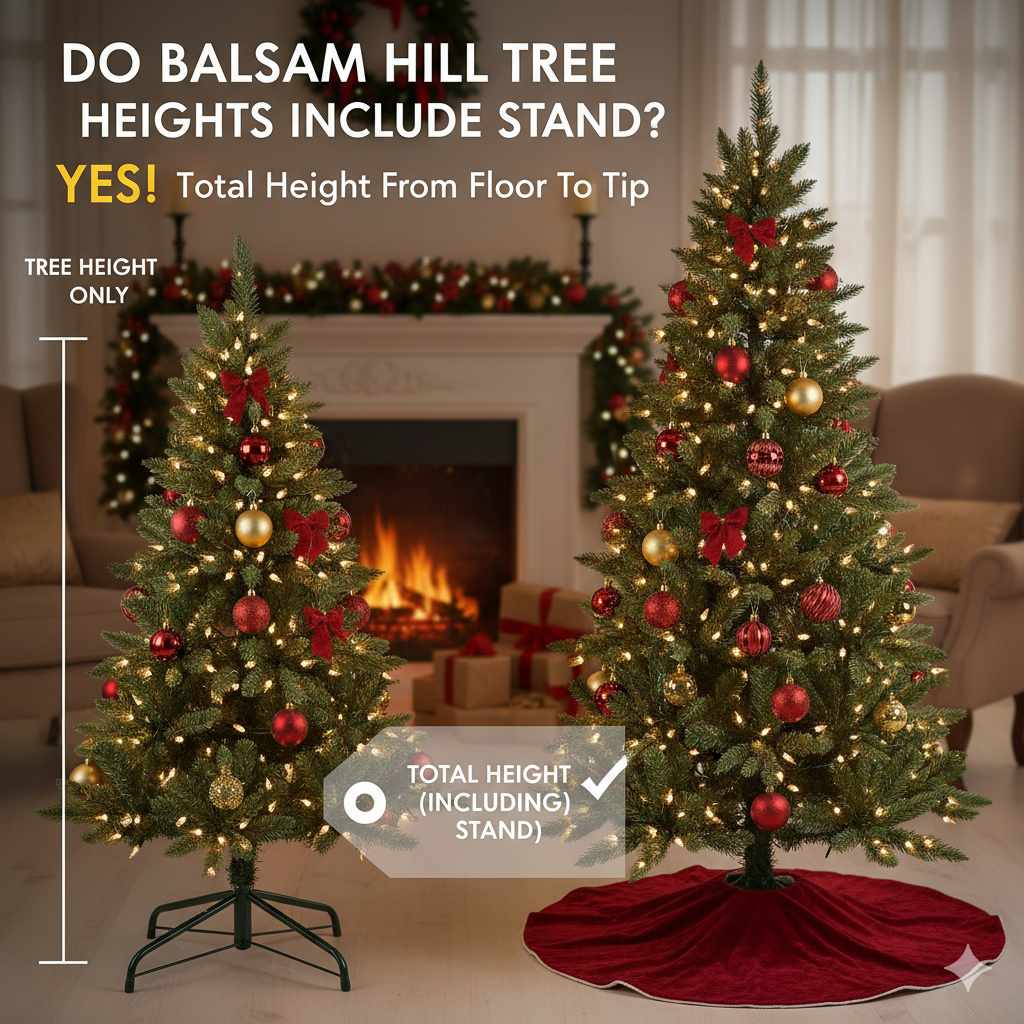
Yes, Balsam Hill tree heights absolutely include the height of the metal stand. When you purchase a tree advertised as 7.5 feet, that measurement is taken from the floor—meaning the stand is accounted for—all the way up to the very top, unadorned tip (the central spire). This is critical information for planning your ceiling clearance and ensuring you have enough space for your desired tree topper.
Shopping for the perfect artificial Christmas tree can be exciting, but it quickly turns frustrating when you try to figure out the sizing. You see that beautiful 9-foot tree, but then a question pops into your head: Does that height include the stand? It’s a common confusion, and honestly, a small miscalculation here can lead to a big headache—like a tree that scrapes your ceiling!
Just like when we learn how to properly draw a bow, getting the fundamentals right is the key to success. In this guide, we’re going to simplify the exact way Balsam Hill measures its trees. We’ll walk through exactly what’s included in the total height, how to measure your space accurately, and make sure your new tree fits perfectly without touching the rafters. Let’s get you ready for a confident purchase!
The Simple Answer: Sizing Your Balsam Hill Tree
When you are investing in a premium artificial tree like those from Balsam Hill, you need to trust the numbers. Fortunately, Balsam Hill follows a standard, all-inclusive measurement process.
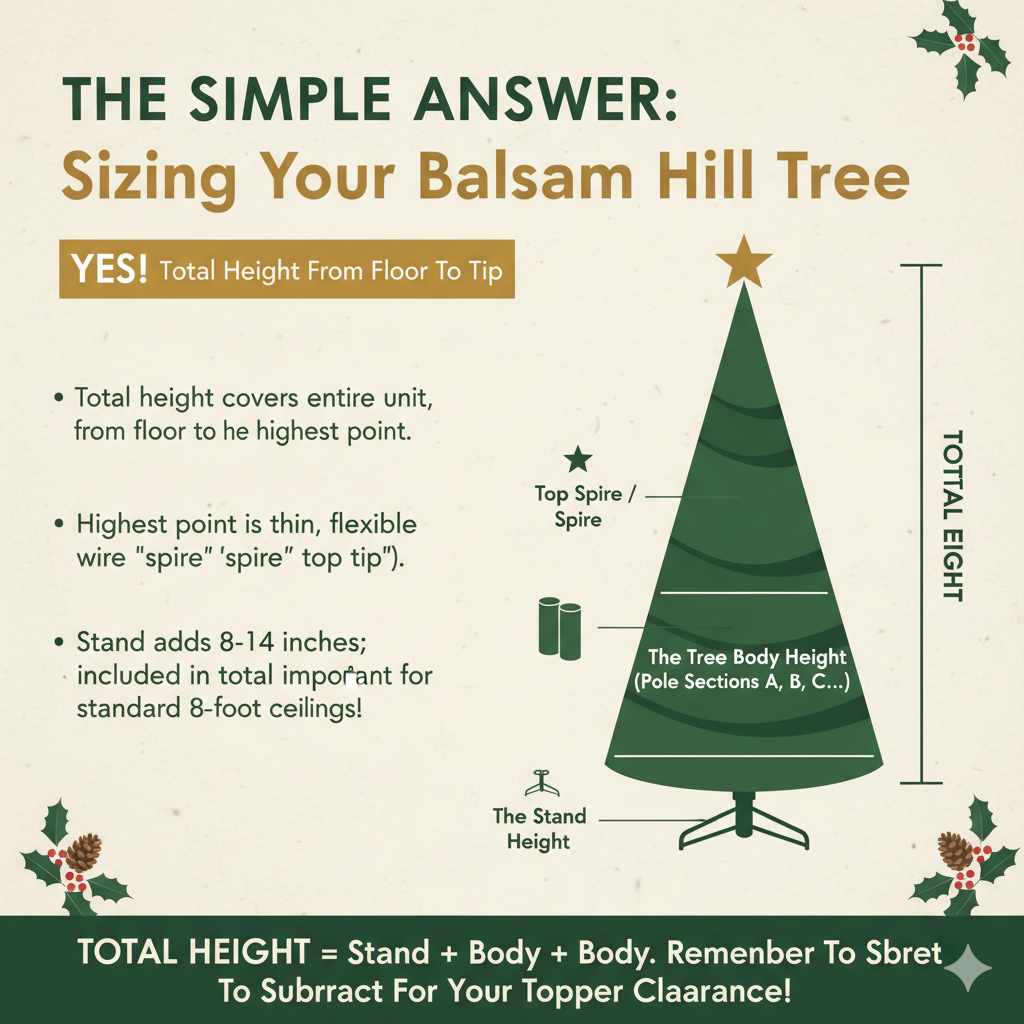
The reported height covers the entire unit, from the point where the stand rests on the floor to the highest point of the tree. This highest point is usually the thin, flexible vertical wire called the “spire” or “top tip” where you would attach a star or angel.
Why is this inclusion so important? Because the metal stand itself adds significant height, often between 8 to 14 inches, depending on the tree’s overall size. If that stand wasn’t included, a 7-foot tree could suddenly become 8 feet 2 inches tall, making it unusable in a standard 8-foot ceiling room.
Breaking Down the Three Parts of the Total Height
To really understand the measurement, it helps to see the tree height as three distinct components stacked together:
- The Stand Height: This is the distance from the floor to the base socket where the bottom pole section is inserted. This measurement is rigid and non-negotiable.
- The Tree Body Height: This is the combined length of all the pole sections (A, B, C, etc.) inserted into each other. This forms the bulk of the tree’s height.
- The Top Spire/Tip: This is the very last bit of vertical pole or wire extending past the topmost branches. This is the official endpoint of the measurement.
When Balsam Hill states a height, they have calculated 1 + 2 + 3 perfectly. You don’t need to add anything extra, but you do need to subtract for your topper clearance.
Understanding Balsam Hill’s Measurement Philosophy (The Breakdown)
The goal of any high-quality vendor is to make sure you know exactly what you are getting. Balsam Hill’s measurement practice is designed for consumer clarity, ensuring that you can pick a tree confidently based on the finished floor-to-tip height.
The Role of the Tree Stand Size
The stand is not a standard one-size-fits-all component. As the tree gets taller and wider, the stand must also increase in size, weight, and footprint to provide proper balance and stability. This means a 6-foot tree stand will be significantly shorter than a stand designed for a 12-foot tree.
Generally, for trees between 6.5 feet and 9 feet, the stand adds approximately 10 to 14 inches to the overall height. While this height is included in the total measurement, knowing the stand’s contribution helps you visualize the tree’s base position relative to your lowest branches. This matters for placing gifts underneath.
| Advertised Tree Height | Approximate Stand Height Contribution (Included in Total) | Typical Stand Footprint Diameter |
|---|---|---|
| 4.5 ft – 5.5 ft | 6 to 8 inches | 18 to 22 inches |
| 6.5 ft – 7.5 ft | 10 to 12 inches | 24 to 30 inches |
| 8.0 ft – 9.0 ft | 12 to 14 inches | 32 to 36 inches |
| 10 ft – 12 ft+ | 14 to 18 inches | 38 to 48 inches |
Remember, these are averages. Always check the specific dimensions listed on the product page for the exact model you are interested in, as stand dimensions can vary slightly between tree styles (e.g., narrow vs. full).
Why Does the Stand Matter for Your Ceiling?
When you are setting up your tree, the distance between the very top tip and the ceiling is called the “clearance.” If you have a standard American home, your ceiling is likely 8 feet (96 inches). If you have a slightly newer home, you might have 9-foot ceilings (108 inches).
Here’s the simple rule to remember:
Always aim for a clearance of at least 6 to 12 inches between the tree tip and the ceiling, especially if you plan to use a tree topper.
If you purchase a 7.5-foot (90-inch) tree for an 8-foot (96-inch) room, you only have 6 inches of clearance left. That’s enough for a small star, but a large, ornate angel or multi-point star might be too tall. Since the stand is already included in that 90 inches, you need to focus on what happens after the assembly.
For safety, you also want a few inches of air gap. Pushing the tree right up against the ceiling can be a fire hazard, especially if the lighting wiring is poorly maintained or if the ceiling surface is highly flammable. The National Fire Protection Association (NFPA) always recommends generous spacing around holiday decorations.
Step-by-Step: How to Measure Your Space Correctly
Before you click “buy,” you need to treat your space measurement like sighting in an arrow—precise and focused. Don’t rely on guesswork!
Step 1: Measure Your Ceiling Height
Use a sturdy tape measure and measure from the floor straight up to the ceiling in the exact spot where you plan to place the tree. Do this in the center of the room, not just against the wall, as floors and ceilings can be uneven.
Step 2: Determine Your Minimum Clearance Requirement
Decide how tall your tree topper is.
- Small Star/Simple Topper: Budget 6 inches.
- Large Angel/Intricate Star: Budget 10 to 12 inches.
- No Topper: Budget 4 to 6 inches just for breathing room and safety.
Subtract this clearance requirement from your total ceiling height. This resulting number is the ABSOLUTE maximum height your tree can be.
Example:
Ceiling Height: 96 inches (8 feet)
Required Topper/Safety Clearance: -10 inches
Maximum Tree Height: 86 inches (7 feet 2 inches)
In this scenario, a Balsam Hill 7.5-foot tree (90 inches) would be too tall! You would need to choose a 7-foot tree (84 inches) or possibly a 6.5-foot tree.
Step 3: Measure the Tree Diameter (Width)
Don’t just measure height; width is equally important! Balsam Hill provides the maximum diameter for all its trees (measured across the widest point of the fully fluffed bottom layer).
- Measure the space where the tree will sit. Do you have a corner? A narrow entryway?
- Ensure the diameter of the tree leaves at least 18–24 inches of walking path clear around the tree, especially in high-traffic areas.
If you have limited width, look for Balsam Hill’s “Slim” or “Pencil” styles, which are specifically designed to fit into smaller areas while maintaining a good height.
Stand Height Comparison: Standard vs. Rolling Stands
While most Balsam Hill trees come with a standard folding metal stand, some advanced models or larger trees might utilize different stand technologies, which could impact the final height slightly. However, in all cases, the advertised height accounts for the stand provided.
Standard Folding Metal Stands
These are the most common type. They fold flat for storage and lock into an X-shape when assembled. They typically lift the tree base 10–14 inches off the floor, depending on the tree size.
Rolling Stands (Optional or Included with Large Trees)
For very large trees (12 feet and up) or if purchased separately for convenience, rolling stands add mobility. These often include locking wheels and a slightly more robust framework.
The height of a rolling stand is often identical or only negligibly (less than 1 inch) taller than the standard stationary stand for the same tree. Since they must fit the tree pole, the central socket height remains consistent. The advantage here is ease of movement, not a change in final height.
Choosing the Right Tree Height for Different Ceiling Types
Matching the tree to the ceiling is an art form. You want the tree to look grand and full without overwhelming the room.
For Standard 8-Foot Ceilings (96 Inches)
This is the most common ceiling height. You MUST be careful here.
- Ideal Tree Height: 6.5 feet to 7 feet.
- A 7-foot tree (84 inches) leaves 12 inches of clearance, which is perfect for most toppers and provides an excellent sense of scale.
- Avoid 7.5-foot trees (90 inches) unless you skip a topper entirely or use one that is extremely flat (under 6 inches tall).
For 9-Foot Ceilings (108 Inches)
Nine-foot ceilings offer much more flexibility, allowing you to choose a grander tree without worry.
- Ideal Tree Height: 7.5 feet to 8.5 feet.
- A 7.5-foot tree leaves 18 inches of clearance.
- An 8.5-foot tree leaves 18 inches of clearance.
- You can comfortably use a large, elaborate topper.
For 10-Foot Ceilings (120 Inches) and Above
When you have 10-foot or vaulted ceilings, you can truly maximize the impact of your tree. An undersized tree can look dwarfed in a large space.
- Ideal Tree Height: 9 feet to 10 feet.
- A 9-foot tree (108 inches) in a 10-foot room leaves 12 inches of generous clearance.
- If you have very high ceilings (14 feet+), consider 12-foot trees to achieve the best visual balance.
Matching your ceiling height to the scale of your furniture and the tree creates harmony, just like choosing the right arrow spine for your bow setup. It makes everything perform better. For more information on achieving the right scale in interior design, check out resources like Architectural Digest’s guides on scale and proportion.
Common Sizing Mistakes and How to Avoid Them
We all make mistakes when we’re learning a new skill or making a big purchase. Here are the most common sizing errors buyers make, and how you can sidestep them:
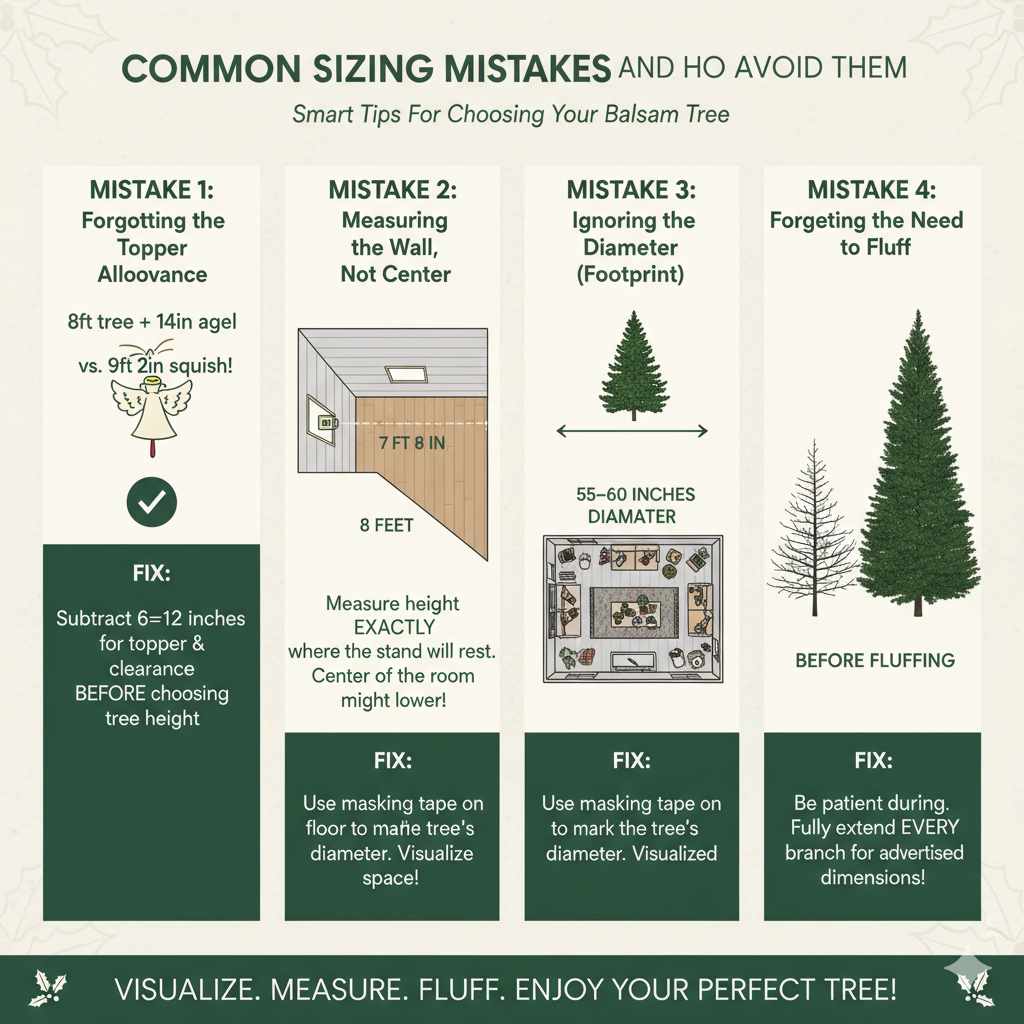
Mistake 1: Forgetting the Topper Allowance
As discussed, this is the number one error. You buy an 8-foot tree for a 9-foot room, thinking you have a foot to spare, only to realize your favorite angel takes up 14 inches and gets squashed.
Fix: Always subtract the minimum 6–12 inches for the topper and safety clearance before looking at tree sizes.
Mistake 2: Measuring the Wall, Not the Center
If you have an older home, floors and ceilings can bow or slope. You might measure 8 feet at the edge of the room, but the center where the tree stands could be slightly lower.
Fix: Measure the height exactly where the stand will rest, and measure again in the center of that spot.
Mistake 3: Ignoring the Diameter (Footprint)
A full 7.5-foot tree can easily have a diameter of 55 to 60 inches (nearly 5 feet wide!). This can overwhelm a small living area, even if the height fits.
Fix: Use masking tape on the floor to mark the diameter listed for your preferred tree model. This visual aid shows you exactly how much floor space the tree will consume.
Mistake 4: Forgetting the Need to Fluff
When Balsam Hill provides the dimensions, those are based on a fully fluffed and shaped tree. This takes time, often an hour or more for large trees. If you don’t take the time to spread the branches out horizontally, the tree might look thinner but might also appear slightly shorter or narrower than advertised until it’s properly manipulated.
Fix: Be patient and dedicated during assembly. Fully extend every branch to achieve the true advertised dimensions.
Frequently Asked Questions (FAQ)
Q1: Does Balsam Hill measure to the tip of the highest branch or the spire?
A: Balsam Hill measures to the very tip of the central wire or pole, known as the spire. The highest branches will sit slightly below this point. This spire is what you use to attach your tree topper.
Q2: If I use a tree skirt, does that add to the height?
A: No, a traditional tree skirt wraps around the stand on the floor and does not affect the tree’s height measurement, as it doesn’t lift the stand off the ground. Similarly, placing gifts underneath does not change the height.
Q3: What if I want my tree on a platform or riser?
A: If you choose to elevate your tree by placing the stand on a box, crate, or decorative planter, you must manually add the height of that riser to the total advertised tree height. In this case, you are changing the floor level for the stand.
Q4: Are the tree heights the same for pre-lit and unlit models?
A: Yes, the physical structure (pole sections, stand, and branch tips) is identical regardless of whether the tree comes with integrated lighting or not. The height measurement remains consistent.
Q5: How much space do I need around the tree?
A: Besides the vertical clearance (6–12 inches), you should aim for at least 18–24 inches of clear space horizontally between the widest part of the tree (the diameter) and any walls or furniture. This ensures safe passage and allows the tree to look fully displayed.
Q6: How can I make sure the stand is level?
A: Before inserting the first pole section, ensure the stand is fully opened, locked into place (if applicable), and sitting flat on the floor. Use a small level tool across the top of the stand socket to check if it’s perfectly horizontal, especially if you have an uneven floor surface.
Q7: Do the Flip Tree models measure the same way?
A: Yes, Balsam Hill’s innovative Flip Trees are also measured from the floor, including the stand base, up to the top spire when fully assembled. The folding mechanism does not change the final height measurement.
Conclusion: Confidently Choosing Your Perfect Height
Just like mastering the anchor point in archery, understanding your measurements is the fundamental skill here. The good news is that when you purchase a Balsam Hill tree, the height listed is the final, ready-to-display height, stand included. You don’t have to worry about adding hidden inches!
Your job now is simple: Measure your space accurately, subtract the necessary clearance for your beautiful topper, and then shop confidently for a tree that fits your designated maximum height. By taking these precise steps, you eliminate the guesswork and guarantee that your stunning new artificial tree will be the perfect centerpiece without any risk of ceiling scrapes. Happy decorating!