
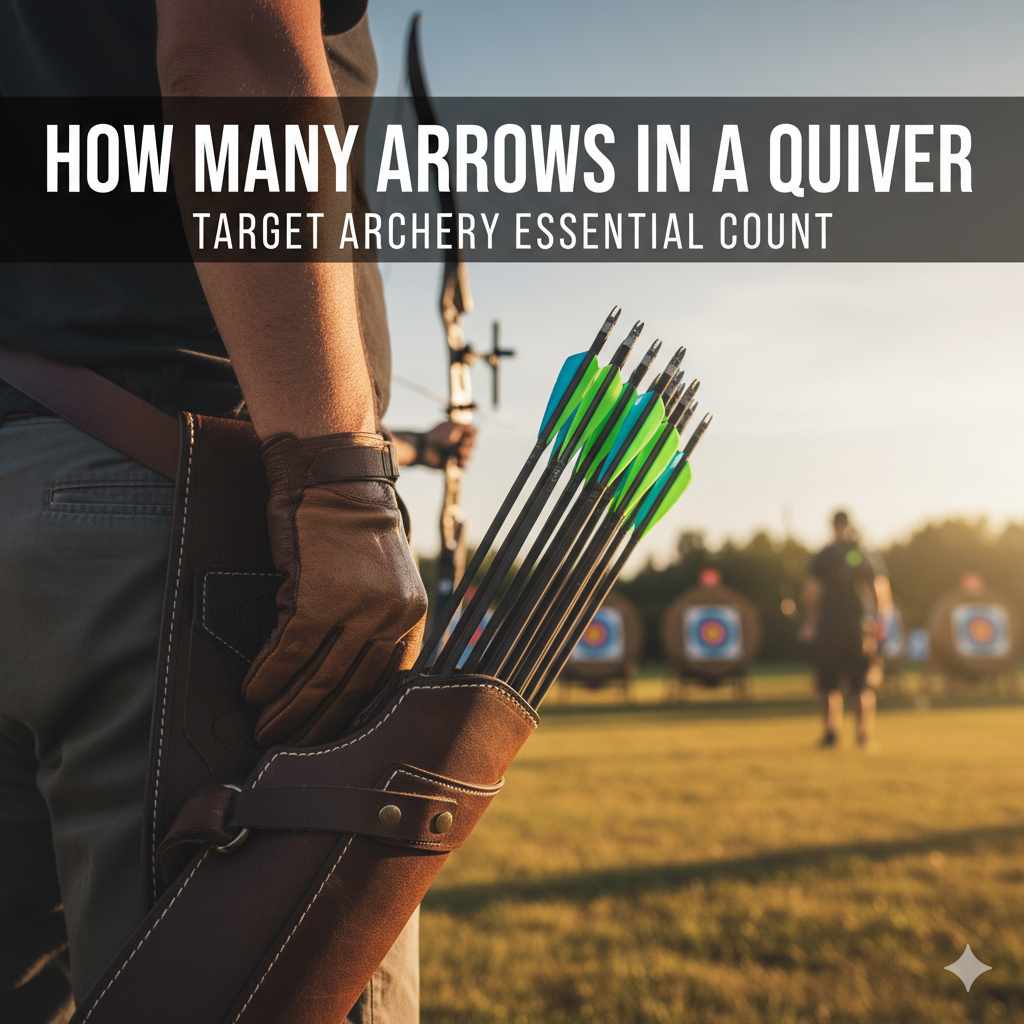
For most target archery, carry 6 to 8 arrows in your quiver. This standard count provides enough arrows for a typical round (called an “end”) of 3 or 6 shots, plus 2 to 3 spares in case of damage or a miss. This keeps your quiver light and ensures you are prepared for both practice and competition.
Welcome to the wonderful world of archery! As you get your gear together, you’ve probably looked at your new quiver and wondered, “Okay, how many arrows am I actually supposed to put in here?” It’s a great question, and one every new archer asks. It feels like it should be simple, but you see some archers with a handful of arrows and others with a quiver packed full.
Don’t worry, this isn’t a complicated puzzle. Getting your arrow count right is all about being prepared without weighing yourself down. It’s a small detail that makes a big difference in your comfort and focus on the shooting line. In this guide, I’ll walk you through the simple rules of thumb for practice and competition, so you can step up to shoot with confidence, knowing you have exactly what you need.
The Simple Starting Point: The “End Plus Spares” Rule
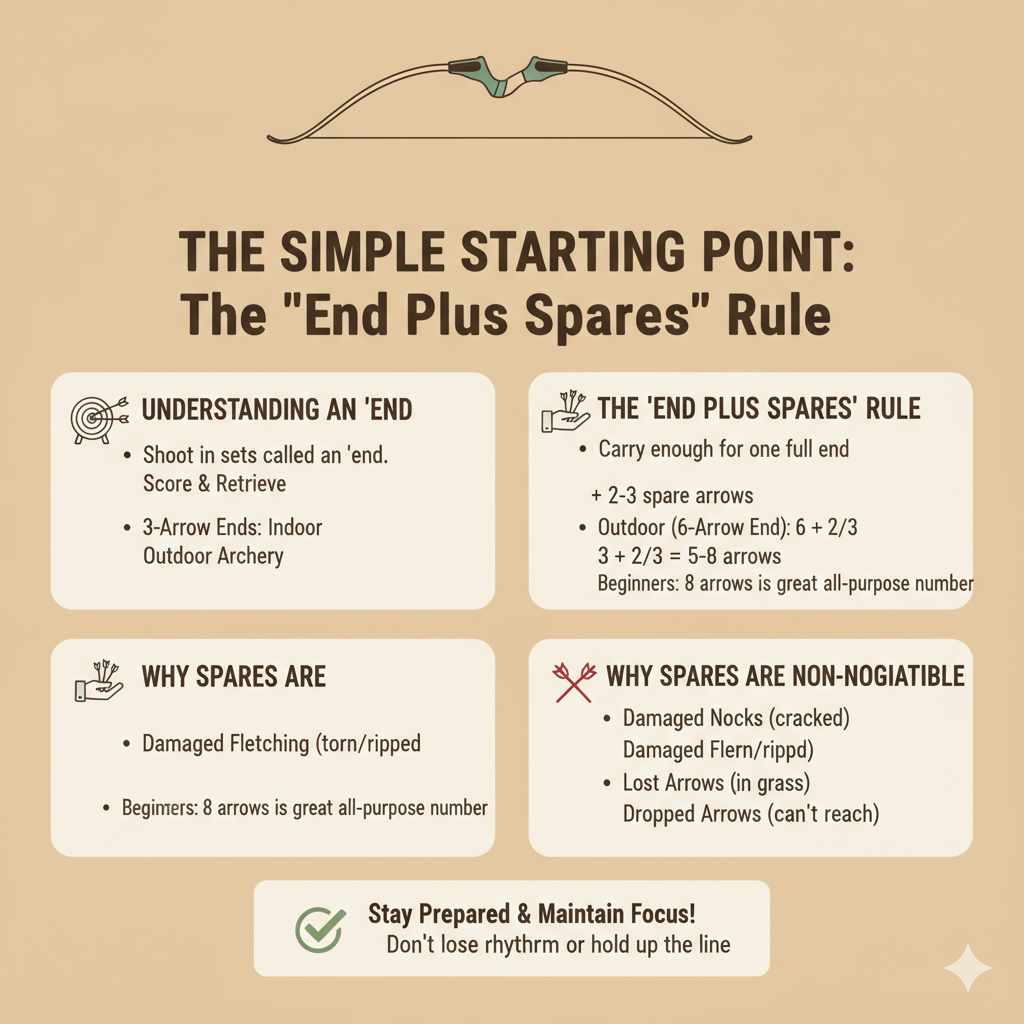
In archery, you don’t just shoot arrows one after another endlessly. You shoot in sets called an “end.” After everyone on the line has shot their end, all archers go to the target to score and retrieve their arrows. Understanding this is the key to knowing how many arrows to carry.
The most common end formats are:
- 3-Arrow Ends: Very common in indoor archery competitions.
- 6-Arrow Ends: The standard for most outdoor target archery competitions.
This leads us to a simple, effective rule: carry enough arrows for one full end, plus two or three spares.
Let’s break that down:
- For Outdoor Archery (6-Arrow End): You will need 6 arrows for your scoring end. Add 2-3 spares, and your ideal quiver count is 8 or 9 arrows.
- For Indoor Archery (3-Arrow End): You will need 3 arrows for your scoring end. Add 2-3 spares, and your ideal count is 5 or 6 arrows.
For a beginner who practices both indoors and outdoors, starting with a total of 8 arrows in your quiver is a fantastic all-purpose number. It covers you for the most demanding scenario (a 6-arrow end) while providing a couple of essential backup arrows.
Why Spares Are Non-Negotiable
You might be thinking, “Why do I need spares if I’m just practicing?” Spares are your safety net. Here’s why they are so important, even from day one:
- Damaged Nocks: A “Robin Hood” (splitting one arrow with another) is cool to see, but it destroys an arrow. More commonly, a nock (the plastic bit that clips onto the string) can crack or break.
- Damaged Fletching (Vanes): The plastic or feather vanes on your arrow can get torn or ripped off, which will affect its flight.
- Lost Arrows: It happens! Especially when shooting outdoors at longer distances, an arrow can miss the target butt completely and hide in the grass.
- Dropped Arrows: In a competition, if you drop an arrow and can’t reach it from the shooting line, you may need another one to complete your end.
Having a spare means you can quickly swap out a damaged arrow without losing your rhythm or holding up the shooting line. It’s all about staying prepared and keeping your focus on your shot, not on your equipment.
Why Carrying Too Many Arrows Can Hurt Your Shooting
If spares are good, then more spares must be better, right? Not exactly. Loading up your quiver with a dozen or more arrows is a common beginner mistake that can actually make shooting more difficult. Here’s why less is often more.
The Problem of Weight and Balance
Arrows, especially modern carbon or aluminum arrows, feel light individually. But put 12, 15, or even 20 of them together, and the weight adds up. A heavy quiver, especially a hip quiver, can be surprisingly burdensome.
- It Pulls on Your Body: The constant weight on your hip can subtly affect your posture and balance. Over a long practice session or a full day at a tournament, this can lead to fatigue and inconsistent form.
- It Creates Unwanted Movement: A heavy, bulky quiver can swing or shift as you move, creating a minor distraction that pulls your focus away from your shot sequence. The goal is to be as still and stable as possible, and a cumbersome quiver works against that.
The “Mental Clutter” Effect
Archery is a mental game. Your goal on the shooting line is to have a clear, quiet mind focused on one thing: executing a perfect shot. A quiver overflowing with arrows can create “mental clutter.”
Instead of calmly pulling your next arrow, you might find yourself fumbling through a tight bunch of them. The slight rattle and noise can be just enough of a distraction to break your concentration. A clean, organized quiver with just the right number of arrows allows for a smooth, automatic motion, keeping your mind on your form.
How Your Arrow Count Changes for Different Situations
While 6-8 arrows is a great general rule, the optimal number can change depending on what you’re doing. As you progress, you’ll learn to adapt your quiver count to the specific event or practice session. The official rules for many tournaments can be found in the World Archery Rulebook, which sets the standards for events like the Olympics.
Arrow Count for Competitions
In a competition, you must have enough arrows to complete an end, plus spares in case of equipment failure. Running out of usable arrows during an end can mean losing points. Here’s a table to help you prepare for common target archery rounds:
| Competition Type | Arrows per End | Typical Total Arrows Shot | Recommended Quiver Count |
|---|---|---|---|
| Standard Indoor Round (e.g., 18-meter WA Round) | 3 | 60 | 5-6 (3 for the end + 2-3 spares) |
| Standard Outdoor Round (e.g., 70-meter WA Round) | 6 | 72 | 8-9 (6 for the end + 2-3 spares) |
| Field Archery | 3 or 4 (Varies) | Varies | 6-7 (4 for the end + 2-3 spares) |
| Your First Local Tournament | Usually 3 or 6 | 30-60 | 8 is a safe, all-purpose number |
Arrow Count for Practice Sessions
Practice is more flexible. Your arrow count should serve the goal of your session. You don’t always need to shoot a full 6-arrow end to have a productive practice.
- Working on Form (Blank Bale): When shooting at a close-range target with your eyes closed to focus purely on physical form, you might only need 2 or 3 arrows. The goal isn’t grouping, but repetition.
- Grouping Drills: When you’re trying to get the tightest group possible, shooting a full end of 6 arrows is perfect. This simulates competition pressure and shows you how your group develops over several shots.
- Endurance Training: If you’re preparing for a long tournament, you might practice by shooting multiple ends back-to-back. Having 8-12 arrows can be useful here so you don’t have to walk to the target as often. However, it’s still best to shoot in sets of 6 to maintain good habits.
Building Your First Set of Arrows: A Practical Guide
Now that you know how many arrows to carry, let’s talk about building your collection. You can’t just buy any arrows and throw them in your quiver. For good results, your arrows need to be consistent.
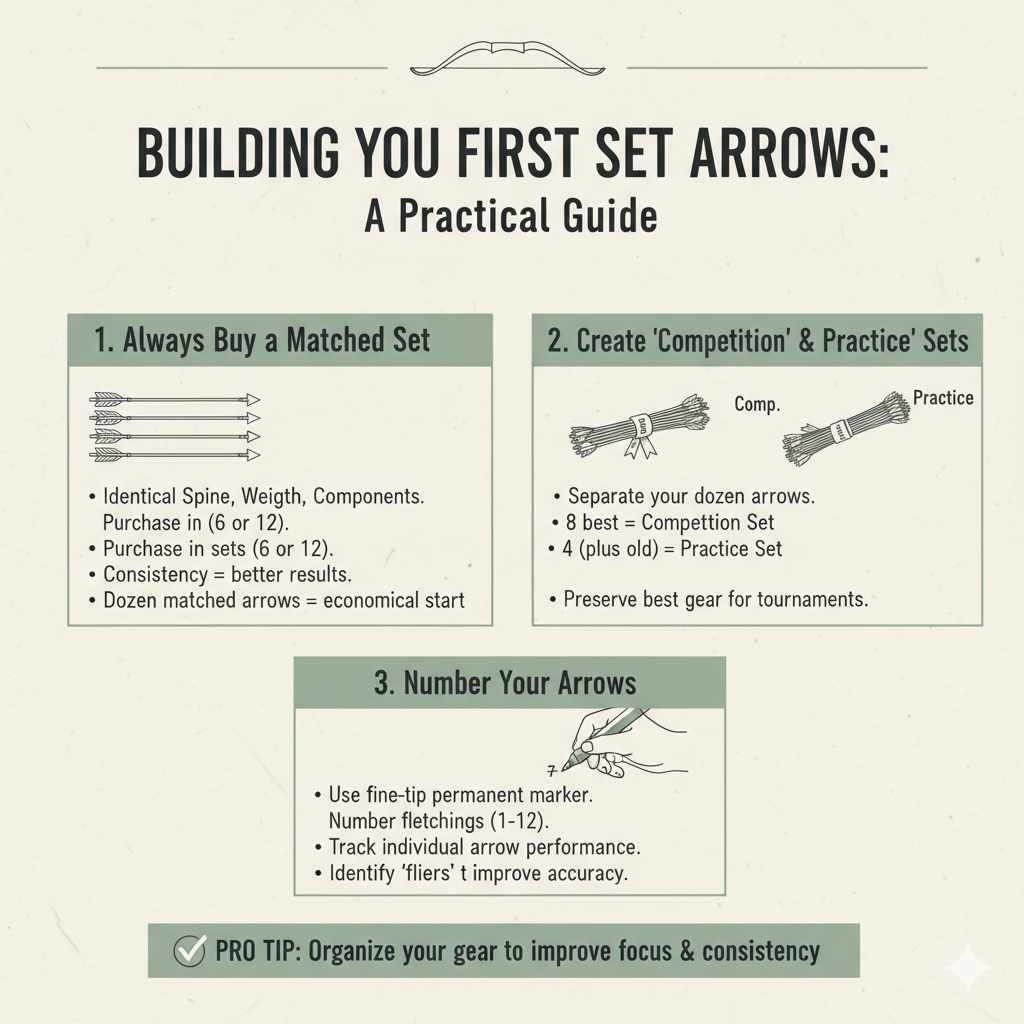
1. Always Buy a Matched Set
Arrows are best purchased in matched sets, typically a half-dozen (6) or a full dozen (12). This is incredibly important. Arrows in a matched set are manufactured to be as identical as possible in:
- Spine: The stiffness of the arrow shaft. Mismatched spines will cause arrows to hit in different places.
- Weight: Even a tiny difference in weight can affect an arrow’s trajectory over longer distances.
- Length: All your arrows should be cut to the exact same length, based on your specific draw length.
- Components: They should all have the same nocks, inserts, points, and fletchings.
For a beginner, buying a dozen matched arrows is the most economical and effective way to start. This gives you plenty of arrows for a full quiver and enough extras to replace any that get lost or broken.
2. Create a “Competition Set” and a “Practice Set”
Once you have your dozen arrows, it’s a great habit to separate them. Designate the 8 straightest, most perfect arrows as your “competition set.” Use the remaining 4 (and any older arrows) as your “practice set.
Why do this? Your practice arrows will take a lot of wear and tear. They’ll hit other arrows, miss the target, and get banged up. By saving your best arrows for tournaments, you ensure that you are shooting with the most consistent and reliable equipment when it counts the most. This little bit of organization can make a big difference in your scores.
3. Number Your Arrows
This is a pro tip that even beginners can use. Take a fine-tip permanent marker and put a small number (1 through 12) on one of the fletchings of each arrow. Now, you can track the performance of each individual arrow.
When you shoot a group, if you notice that arrow #7 always seems to hit a little to the left, you’ve identified a problem. That arrow might have a slight bend, a damaged fletching, or some other invisible flaw. By numbering them, you can identify and weed out these “fliers,” leading to more consistent groups and higher scores. It’s a simple, free way to improve your accuracy.
Here’s how to do it effectively:
- Choose a specific vane/fletching on each arrow to place the number. The “cock” vane (the one that points away from the bow) is a great choice.
- Use a waterproof, fine-tipped pen.
- After shooting a group, note where each numbered arrow landed. A small notepad can help.
- If an arrow consistently lands outside your main group, inspect it for damage. If you can’t find any, set it aside for practice only.
Frequently Asked Questions (FAQ)
1. How many arrows come in a standard set when you buy them?
Arrows are most commonly sold in sets of 6 or 12 (a dozen). Buying a dozen is often more cost-effective and is the recommended starting point for a new archer. This gives you a full quiver’s worth for competition and several extras for practice or replacements.
2. Do my spare arrows need to be identical to my main ones?
Yes, absolutely. For your scores to be consistent, every arrow you shoot in a competition must be identical. A spare arrow should have the same length, spine, weight, point, nock, and fletchings as the rest of your set. Mixing and matching different types of arrows will lead to unpredictable results.
3. Is it okay to practice with just 3 arrows?
Yes, practicing with just 3 arrows is a great way to work on your form and consistency. It forces you to walk to the target more often, which gives you a short mental break between ends and helps prevent fatigue. It’s an excellent method for building a strong foundation.
4. What happens if I run out of usable arrows in a competition?
According to official rules, if you cannot complete an end due to equipment failure (e.g., you’ve damaged all your arrows), you will have to score the arrows you did shoot and miss the remaining shots. This is why carrying a couple of reliable spares is so critical—it’s cheap insurance against lost points.
5. Do I need a different number of arrows for indoor vs. outdoor archery?
Generally, yes. For indoor archery, where ends are 3 arrows, carrying 5-6 arrows is plenty. For outdoor archery, where ends are 6 arrows, you’ll want to carry 8-9 arrows to be safe. Having an all-purpose set of 8 in your quiver is a simple way to be prepared for both.
6. How should I carry my spare arrows?
Your spare arrows should be carried in your quiver right alongside your main arrows. A good quiver has separate tubes or compartments, which you can use to organize your arrows. Some archers like to keep their main “end” arrows in one tube and their spares in another for quick access.
7. Can I mix arrows from different brands in my quiver?
You should never do this for serious shooting or competition. Even if two arrows from different brands have the same “spine” number, their manufacturing processes are different, leading to variations in weight and performance. Always shoot with a single, matched set of arrows for the best accuracy.
Conclusion: Find Your Perfect Count and Focus on the Shot
So, how many arrows should you have in your quiver? The simple answer is to start with 6 to 8. This provides enough for a standard outdoor end plus a couple of essential spares, keeping you prepared for almost any situation without weighing you down.
As you spend more time on the range, you’ll get a feel for what works best for you. You might prefer a lighter quiver for practice or add an extra spare for a big tournament. The key is to be intentional. Don’t just stuff your quiver full because it has space.
Remember, archery is about consistency and focus. By optimizing this small piece of your setup, you remove a potential distraction and allow yourself to concentrate on what truly matters: your form, your breathing, and sending that perfect shot right into the middle of the target. Now, grab your arrows, head to the range, and enjoy the beautiful flight of the arrow.