How Far Is the Target in Competition Archery? 70m to 18m
Competition archery target distances vary by discipline: Olympic recurve shoots 70 meters outdoors, compound bows typically shoot 50 meters, and both drop to 18 meters for indoor rounds. Field and 3D archery can be even shorter, sometimes just 5 meters on a varied course. This guide breaks down the exact distance and target size for every major format so you know what to expect.

- QI HUO JU -
- QI HUO JU - Archery Foam…
- Material: Archery target uses 40° EVA foam material which is high-density and durable. Light weight and easy to carry. Ideal arche…
- Selection Succestion: Suitable for 10-30lbs bows. For 30-50lbs bows, we recommended to purchase 2PCS to make them together with gl…
- Portable Design: Soft EVA material with good cushioning and shock absorption,you can hit the target easily and harmless to the arr…
As an Amazon Associate I earn from qualifying purchases.
Understanding Competition Archery Distances
When you watch archery on TV or see it at a local event, you might notice archers shooting at targets that seem to be at very different distances. This is because “competition archery” itself is a broad term covering several different styles of shooting, each with its own rules and, importantly, its own target distances.
The distance to the target is a crucial factor. It dictates the type of equipment used, the aiming techniques, and the level of precision required. For a beginner, understanding these distances helps in several ways:
Setting Realistic Practice Goals: You can tailor your practice sessions to mimic competition scenarios.
Appreciating the Skill: Knowing the distances gives you a greater appreciation for the incredible accuracy archers display.
Choosing the Right Discipline: If you’re thinking of competing, this information helps you decide which style of archery might suit you best.
Let’s dive into the most common competition archery disciplines and their standard target distances.
Olympic Recurve Archery (Outdoor)
This is perhaps the most recognized form of archery, especially from the Olympic Games. When archers are vying for Olympic medals, they are shooting the Olympic Recurve discipline.
The Standard Distance: The official distance for Olympic Recurve is 70 meters (approximately 76.6 yards). This is a significant distance, demanding immense focus, consistent technique, and a perfectly tuned bow.
The Target Face: The target face is quite large, measuring 122 cm (about 4 feet) in diameter. It’s divided into 10 rings, with the center “10” ring being only 12.2 cm (about 4.8 inches) across – roughly the size of a small pie plate! The gold rings are the innermost scoring zones, followed by red, blue, black, and white.
Why 70 Meters? This distance is chosen to test archery in its purest form. It requires archers to account for arrow drop (the arrow naturally falls as it travels), wind, and their own physical and mental control. It’s a true test of skill and consistency.
For more information on the rules and distances of Olympic Archery, the Official Olympic Games Archery page is an excellent resource.
Target Archery (Indoor)
Indoor archery offers a different challenge, primarily by removing the unpredictable element of wind and reducing the distance. This allows archers to focus purely on their form, equipment consistency, and precision aiming.
The Standard Distance: The most common indoor competition distance is 18 meters (approximately 19.7 yards). This is a much shorter distance, often shot in large halls or gymnasiums.
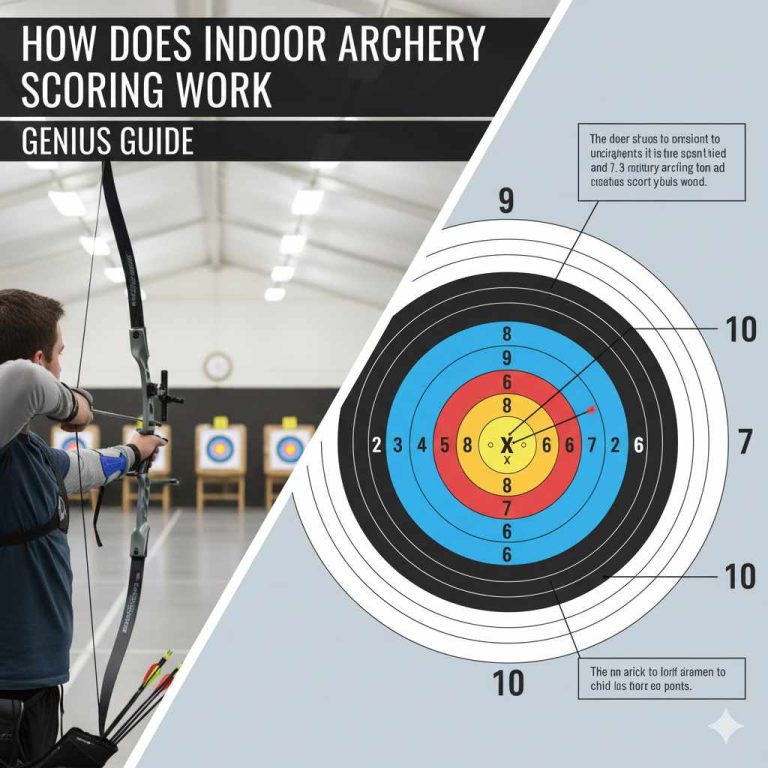
The Target Face: For indoor archery at 18 meters, a smaller target face is used. The standard size is 40 cm (about 15.7 inches) in diameter. Even though the distance is shorter, the scoring zones are smaller, requiring extreme accuracy to hit the center. The “10” ring is often just 2 cm (less than an inch) in diameter!
Variations: While 18 meters is standard, some indoor competitions, particularly for compound archers, might shoot at slightly different distances or use different target face sizes depending on the specific tournament rules.
Field Archery
Field archery takes archers into a more natural, outdoor setting, often through woods or across varied terrain. It’s designed to simulate hunting scenarios and tests an archer’s ability to shoot from different angles and uneven ground.
Varying Distances: Unlike the fixed distances of Olympic or indoor target archery, field archery features a “course” of multiple marked targets with varying archer-to-target distances. These can range from very short distances (as close as 5 meters) to much longer ones, sometimes up to 60 meters (about 65.6 yards).
Target Features: The target faces in field archery are typically smaller and have fewer scoring zones than Olympic targets. They are often black and white, with a 5-ring scoring system.
The Challenge: Part of the challenge in field archery is judging the distances accurately yourself, as many courses are “unmarked,” meaning you don’t see the exact distance printed on the stake. Archers must estimate the distance based on visual cues.
3D Archery
3D archery is a dynamic and exciting discipline that further simulates hunting. Archers shoot at life-sized 3D foam targets shaped like animals.
Simulated Ranges: Similar to field archery, 3D courses involve shooting at targets at various, often unmarked, distances. The goal is to hit vital organ zones on the animal target.
Distance Estimation: A key skill here is distance judgment, as there’s no fixed distance for each target. Archers must rely on their experience and observation skills to estimate how far away the animal target is. The distances can vary greatly, often replicating real-world hunting scenarios, potentially ranging from 5 yards to 70 yards (and beyond for advanced classes).
Equipment: While recurve and traditional bows are used, compound bows are also very popular in 3D archery, often in separate categories.
World Archery Federation (WA) Benchmarks
The World Archery Federation (WA) is the international governing body for archery and sets many of the standards for international competitions. Understanding their rules provides a clear benchmark for many competitive disciplines.
Here’s a look at some common WA distances:
| Discipline | Target Distance (Meters) | Target Face Size (cm) | Notes |
|---|---|---|---|
| Outdoor Recurve | 70 | 122 | Olympic standard; includes scoring ends of 6 arrows. |
| Indoor Recurve/Barebow | 18 | 40 | Standard indoor distance. Smaller face means higher precision needed. |
| Compound (Outdoor) | 50 | 80 | Outdoor compound distance. Different from Olympic recurve. |
| Compound (Indoor) | 18 | 40 | Common indoor compound distance. |
| Youth Archery | Varies | Varies | Distances shorter than adult classes, scaled for age and experience. |
Table Source: Based on typical World Archery Federation (WA) rules. Specific regulations can vary by event and federation.
These benchmarks highlight how different disciplines require varied skill sets and equipment tuning precisely because of the distance.

Why Do Target Distances Vary So Much?
The significant variation in target distances across different archery disciplines isn’t arbitrary. It’s designed to:
1. Test Different Skills: A 70-meter shot requires perfect arrow trajectory compensation, wind reading, and equipment tuning. An 18-meter indoor shot demands absolute precision and consistency in form and equipment because the arrow’s flight path is much shorter and more predictable, making even tiny errors highly visible. Field and 3D archery test an archer’s ability to adapt to variable terrain, angles, and distance estimation.
2. Accommodate Different Equipment: Different bow types are suited to different distances. For example, compound bows, with their release aids and advanced sights, are very capable of accurate shooting at longer distances like 70m or even further, but they also excel at the precise, shorter ranges indoors. Recurve bows, particularly those used in the Olympics (Olympic Recurve), are designed for long-range accuracy without the assistance of mechanical devices.
3. Enhance Spectator Appeal and Athlete Engagement: Shorter indoor distances can make the action more visible and intense for spectators, highlighting the archer’s accuracy in a confined space. Longer outdoor distances create a sense of epic scale and test an archer’s mastery over natural elements.
4. Simulate Real-World Scenarios: Field and 3D archery are specifically designed to mimic shooting in hunting situations where distances are rarely consistent and terrain is uneven.
Factors Affecting Arrow Flight and Practical Distances
Beyond the officially stated competition distances, several factors influence how an arrow actually flies and what archers must consider:
Arrow Drop (Trajectory): This is the archer’s constant battle! Gravity pulls every arrow towards the earth from the moment it leaves the bow. The faster and heavier the arrow, and the more powerful the bow, the less pronounced the drop will be over a given distance. Archers use sights with adjustable pins or markings to compensate for this drop.
Wind: Even a slight breeze can push an arrow off course, especially at longer distances. Professional archers are skilled at reading wind conditions and making micro-adjustments to their aim.
Equipment Tuning: The consistency of an archer’s equipment is paramount. This includes the bow’s draw weight, tiller (the balance of the limbs), arrow spine (stiffness), fletching (the stabilizing fins), and the archer’s release. A well-tuned setup ensures the arrow leaves the bow cleanly and flies straight.
Archer’s Form: This is arguably the most critical factor. Consistent body posture, anchor points, drawing sequence, and release are essential for hitting the same spot repeatedly. Even slight variations can lead to misses.
Archer’s Eye: What the archer sees is what they aim at. Optical illusions, distance perception, and the ability to focus on the tiny target face from afar are all part of the challenge.
Olympic Recurve vs. Compound: Distances and Differences
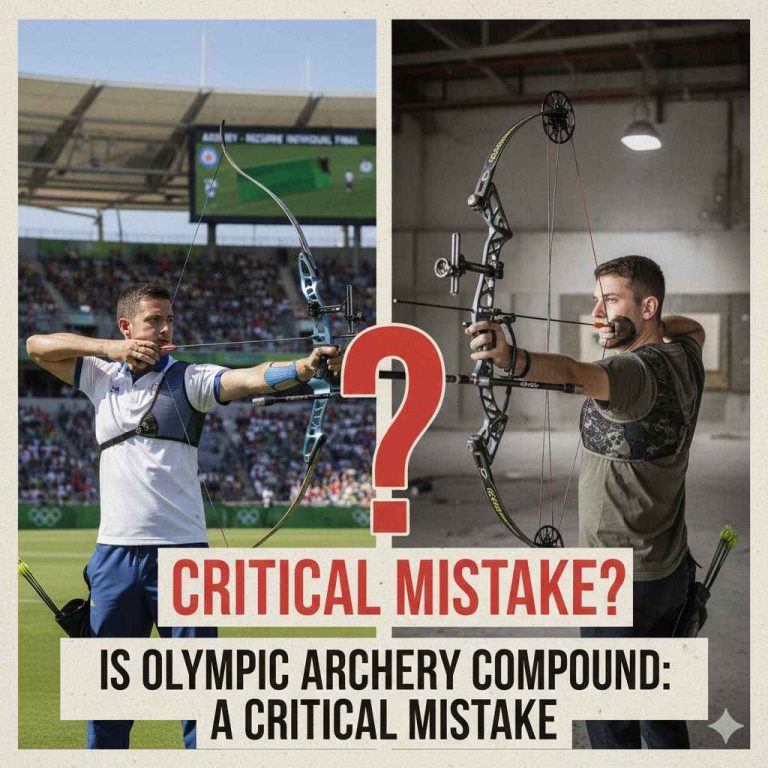
While both are prominent in competition, Olympic Recurve and Compound archery often have different standard distances and unique characteristics, especially in how they are shot.
Olympic Recurve
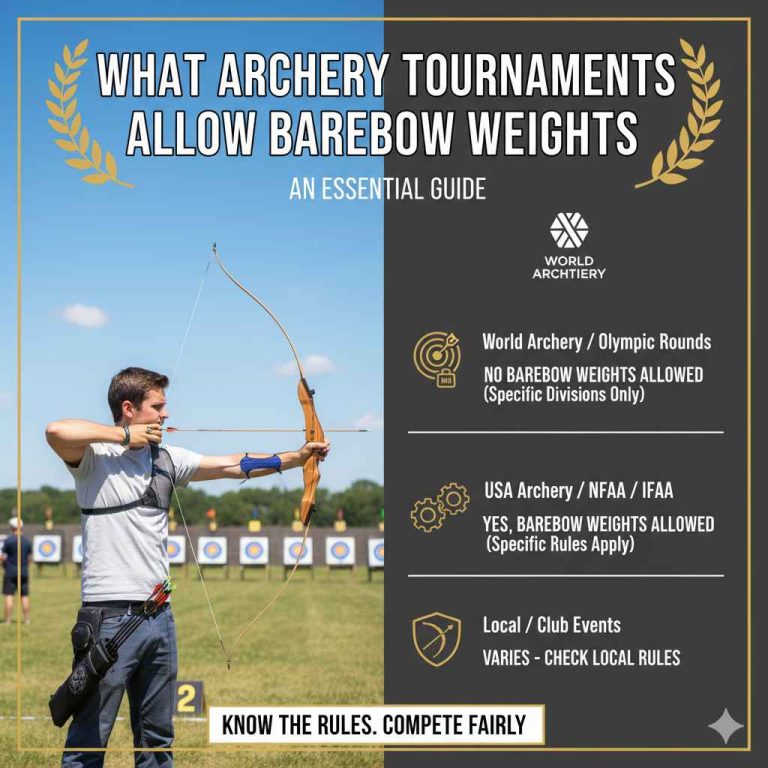
Equipment: Uses a recurve bow with minimal accessories. “Barebow” is a subset where even fewer accessories are allowed (no sights, stabilizers, etc.).
Focus: Emphasizes the archer’s physical strength and consistent manual technique.
Standard Outdoor Distance: 70 meters.
Standard Indoor Distance: 18 meters.
Compound Archery
Equipment: Features a bow with a system of cams and wheels that significantly reduce the holding weight after the draw. Usually includes advanced sights, stabilizers, and a mechanical release aid.
Focus: Emphasizes precision, equipment technology, and the consistent use of a release aid. The reduced holding weight allows archers to hold their aim steady more easily, often for longer periods.
Standard Outdoor Distance: Typically 50 meters for World Archery sanctioned events. However, many professional compound leagues and tournaments, especially in North America, may shoot at 70 meters for outdoor events, similar to Olympic Recurve, but often with the smaller target faces.
Standard Indoor Distance: 18 meters is common, often with the same 40cm target face as recurve, but sometimes smaller variations or different rankings.
The differences in equipment and the resulting shooting mechanics mean that even at the same distance, the technique and the feel of shooting can be quite distinct between Olympic Recurve and Compound archery.
Common Archery Disciplines and Their Target Distances Overview
Let’s consolidate the information on different archery disciplines and their common target distances into a clear table for quick reference. This will help solidify your understanding of where the targets are typically placed in various competitive settings.
| Archery Discipline | Typical Environment | Primary Bow Type | Key Distance(s) | Target Face Size (cm) | Notes |
|---|---|---|---|---|---|
| Olympic Recurve | Outdoor | Recurve | 70 meters | 122 | The ultimate test of skill in the Olympic Games. |
| Indoor Target Archery | Indoor | Recurve, Compound | 18 meters | 40 | Focuses on extreme accuracy without environmental variables like wind. |
| Field Archery | Outdoor (natural) | Recurve, Compound, etc. | Variable (5m to 60m+, often unmarked) | Smaller, 5-ring | Simulates hunting in varied terrain; tests distance judgment. |
| 3D Archery | Outdoor (natural) | Recurve, Compound, etc. | Variable (5 yards to 70+ yards, unmarked) | Life-sized animal | Highly realistic hunting simulation using 3D animal targets; strong emphasis on distance estimation. |
| World Archery Outdoor | Outdoor | Recurve, Compound | Recurve: 70m; Compound: 50m (or sometimes 70m) | Varies (e.g., 122cm, 80cm) | Official international standards set by World Archery. Compound has a different standard outdoor distance than recurve. |
| Youth Archery | Indoor/Outdoor | Various | Shorter than adult equivalents, varies by age | Varies | Scaled distances for younger archers to ensure success and development. For example, explore youth archery programs for USA Archery. |
| Barebow Archery | Outdoor/Indoor | Recurve | 70m (Outdoor), 18m (Indoor) | 122cm (Outdoor), 40cm (Indoor) | A discipline where minimal equipment is allowed, testing fundamental archery skills. |
This table provides a snapshot, and some disciplines might have sub-categories or specific tournament rules that introduce slight variations. However, these are the most commonly encountered distances.
What About Practice and Beginner Distances?
As a beginner, you won’t start shooting at Olympic distances right away – and that’s perfectly fine! Most archery ranges and clubs have clear starting points to build your skills safely and effectively.
Initial Practice: Many indoor ranges start beginners at very close distances, sometimes just
5–10 yards (about 4.5–9 meters). This allows you to focus entirely on your stance, grip, draw, and release without worrying about arrow drop or missing the target entirely.
Progressive Distances: As you become more comfortable and consistent, your coach or range instructor will guide you to progressively longer distances. This might involve moving to 20 yards (about 18 meters), then perhaps 30 yards (about 27 meters), and so on.
Mimicking Competition: Once you’re comfortable with the distances, you can start practicing at ranges that mimic the competitions you’re interested in. If you want to try Olympic Recurve, practicing at 70 meters is essential, even if it’s just for a few arrows each session. If indoor competition is your goal, consistent practice at 18 meters is key.
The key is gradual progression. Trying to shoot too far too soon can lead to frustration and the development of bad habits. Building a solid foundation at closer ranges will pay dividends as you move to more challenging distances.

Frequently Asked Questions (FAQs) About Competition Archery Distances
Here are some common questions beginners have about how far targets are in competition archery:
Q1: Is 70 meters the only distance for Olympic archery?
A1: For the Olympic Games and most major international outdoor recurve competitions, 70 meters is the standard distance. However, indoor archery events for recurve and compound bows are typically at 18 meters.
Q2: Why do compound archers often shoot at different outdoor distances than recurve archers?
A2: While compound archers can shoot very accurately at 70 meters, World Archery’s standard outdoor distance for compound is 50 meters. This distinction is primarily due to the technological differences in equipment, like sights and release aids, which allow compound bows to be highly effective at shorter, more precise ranges compared to the manual precision required by Olympic recurve at 70 meters. Many professional leagues, however, do opt for 70m rounds for compound as well.
Q3: What’s the shortest distance in a common archery competition?
A3: In field archery and 3D archery, distances can be very short, sometimes as close as 5 meters (or about 5 yards), particularly on courses with varied terrain and uphill/downhill shots. Indoor archery at 18 meters is also relatively short.
Q4: Do I need to know the exact distance to the target?
A4: In Olympic-style target archery (outdoor and indoor), the distance is fixed for the competition, and archers use sights calibrated for those distances. In field archery and 3D archery, you often need to estimate the distance yourself, which is a skill that develops with practice.
Related pick: Check today's price on Amazon