Is a Field Goal Worth 1 Point? Football Scoring Explained
Kicking a field goal is one of the most recognizable moments in American football. When the kicker lines up, the ball is snapped, and the crowd holds its breath, everyone knows what’s at stake: points on the board. But how many points is a field goal actually worth? Is it ever just 1 point? For newcomers to football, or fans from countries with different sports traditions, this can be confusing. The answer is not as simple as it seems, especially when you consider different types of football, rule changes over time, and even similar plays in other sports. Let’s clear up the confusion around field goals, points, and why this question keeps coming up.
What Is A Field Goal?
A field goal in American football is a scoring play where the kicker tries to kick the ball through the opponent’s goalposts. This usually happens on fourth down, when the offense doesn’t think it can score a touchdown or get a first down. The goal is to earn points without risking a turnover.
How A Field Goal Works
The team lines up in a special formation. The ball is snapped to a holder, who places it on the ground. The kicker then tries to kick the ball through the uprights and above the crossbar. If successful, the team earns points.
Field goals can be attempted from almost anywhere on the field, but they’re usually tried from within 50 yards of the goalposts. The longer the attempt, the harder it is to make.
Field Goal Attempts And Strategies
Teams often decide between going for a field goal or trying for a touchdown based on the situation. Coaches consider:
- Distance to the goalposts
- The kicker’s range
- The score and time left in the game
Sometimes, a coach might “fake” a field goal and try a trick play. But most of the time, a field goal attempt is a straightforward kick.
How Many Points Is A Field Goal Worth In Football?
In most forms of American football today, a field goal is worth 3 points. This is true in the NFL, college football, and high school football. The value of a field goal has been stable for decades.
Here’s a quick comparison of how different football scores add up:
| Scoring Play | Points |
|---|---|
| Touchdown | 6 |
| Field Goal | 3 |
| Extra Point Kick (PAT) | 1 |
| Two-Point Conversion | 2 |
| Safety | 2 |
As you can see, a field goal is not worth 1 point. It’s always 3 points, unless we’re talking about extra point kicks, which are sometimes confused with field goals.
Why The Confusion About 1 Point?
Many people mistake the extra point kick (sometimes called the “point after touchdown” or PAT) for a field goal. After a team scores a touchdown, they get one try to kick the ball through the uprights from a short distance. This kick is worth 1 point, but it’s not called a field goal. It’s an extra point attempt.
Credit: www.chegg.com
The Difference Between A Field Goal And An Extra Point
Understanding the difference is key. Both plays involve kicking the ball through the uprights, but they are not the same thing.
Field Goal
- Can be tried any time during a team’s offensive possession
- Usually attempted on fourth down
- Worth 3 points
- Distance can vary widely
Extra Point (pat)
- Only happens after a touchdown
- Kicked from a set distance (in the NFL, the 15-yard line, making it a 33-yard attempt)
- Worth 1 point
- Not called a field goal
Here’s a side-by-side view for clarity:
| Play Type | When Attempted | Points Awarded | Where Ball is Placed |
|---|---|---|---|
| Field Goal | Any offensive down | 3 | Where play ends |
| Extra Point | After touchdown | 1 | 15-yard line (NFL) |
Pro Tip: If you see a team lining up to kick after a touchdown, that’s almost always an extra point try, not a field goal.
Field Goals In Other Forms Of Football
The word “football” means different things around the world. In soccer (association football), “field goal” isn’t a term at all. In rugby and Canadian football, the rules are similar but not identical. Let’s look at some key differences.
Canadian Football
In the Canadian Football League (CFL), a field goal is also worth 3 points. But there’s a unique scoring play called the “rouge” or “single,” which is worth 1 point. The rouge is awarded if the kicking team sends the ball into the end zone and the receiving team doesn’t return it out. This sometimes causes confusion for fans used to American football.
Arena Football
In Arena Football, field goals are also 3 points. But because the field is smaller and the goalposts are narrower, it’s much harder to make them. There’s also an optional “drop-kicked” field goal, which is worth 4 points, but this is rare.
Rugby
In rugby, a “drop goal” is worth 3 points. The rules and style of play are very different, but the idea of kicking for points is similar.
Australian Rules Football
Here, kicking the ball between the two tall middle posts (a “goal”) is worth 6 points. Kicking it between a middle and outer post (“behind”) is worth 1 point.
The History Of Field Goal Scoring
The value of the field goal has not always been 3 points. In the early days of American football, the rules were very different.
Early Football Scoring
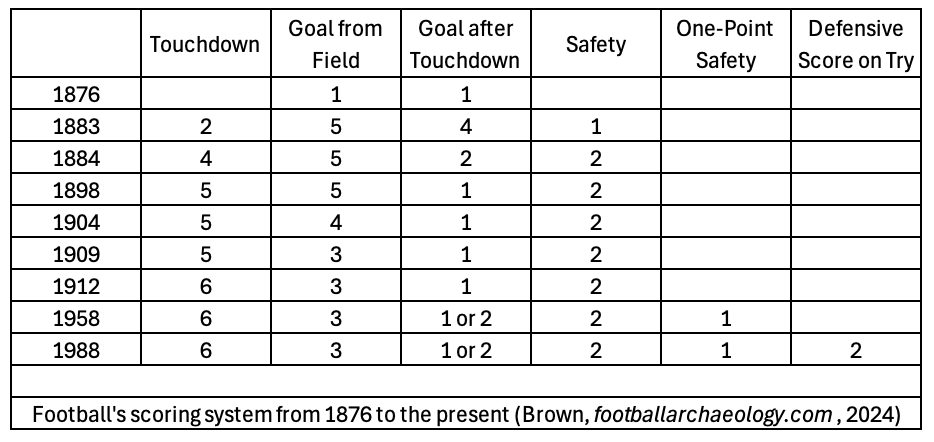
In the late 1800s and early 1900s, a field goal could be worth as many as 5 points. Over time, the value was lowered to balance the game and reward touchdowns more.
| Year | Field Goal Value |
|---|---|
| 1883 | 5 points |
| 1904 | 4 points |
| 1909 – present | 3 points |
The reason for these changes was to encourage more exciting play. As touchdowns became easier to score, the field goal’s value dropped.
Modern Changes
While the value of the field goal hasn’t changed since 1909, the rules around extra points and two-point conversions have evolved. The NFL moved the extra point kick back in 2015 to make it more challenging, but it remains worth 1 point.
Example: In the 2015 NFL season, kickers missed 71 extra point attempts, up from just 8 the year before. This change made extra points less automatic but did not affect the field goal’s value.
When Is A Field Goal Worth 1 Point?
The simple answer: in standard American football, never. The field goal is always 3 points. However, there are rare situations and other sports where a kicked play can be worth 1 point. Let’s explore these edge cases.
The 1-point Safety
The 1-point safety is one of football’s rarest plays. It can only occur during a two-point conversion or extra point attempt when the defending team somehow ends up with possession and retreats into their own end zone. If they are tackled there, the offense is awarded 1 point. This has happened only a handful of times at the college level, and never in the NFL.
Canadian Football’s “single” Point
As mentioned earlier, in the CFL, a team can score a single point (rouge) on certain kicking plays, including missed field goals, if the ball is not returned out of the end zone. This is often confused with a field goal worth 1 point, but it’s a different rule.
Arena Football Drop Kick
If a kicker uses a drop kick for a field goal in Arena Football, it’s worth 4 points. But a drop-kicked extra point is worth 2 points. There is no field goal worth 1 point.
Credit: www.footballarchaeology.com
Why Does This Myth Persist?
You may still hear people say, “A field goal is worth 1 point,” especially if they’re new to football or mixing up terms. Here’s why this mistake is common:
- Visual similarity: Both field goals and extra points look similar, a kicked ball through the uprights.
- Terminology confusion: People often call any kick through the goalposts a field goal.
- Different football codes: In some sports, a kicked score can be worth 1 point, leading to mix-ups.
- Video games and pop culture: Sometimes, rules are simplified or misrepresented.
In my experience, even experienced fans mix up the terms when the conversation shifts between NFL, college, and Canadian football.
The Importance Of Each Point Value
Understanding how many points a field goal is worth is more than trivia. It shapes game strategy, coaching decisions, and even the types of players a team hires.
Game Strategy
Coaches must decide whether to attempt a field goal, go for a touchdown, or punt. The 3-point value can be the difference between a win and a loss, especially in close games.
Player Specialization
NFL teams carry specialized kickers just for field goals and extra points. Their accuracy and range can win or lose games.
Scoring Balance
If field goals were worth 1 point, teams would rarely attempt them. The current 3-point value makes field goals a useful tool, but not as rewarding as touchdowns.
Examples: Field Goals That Changed Games
Some of the most famous moments in football history have come from field goals. These kicks have decided championships and rewritten records.
Adam Vinatieri: Super Bowl Hero
Adam Vinatieri kicked game-winning field goals for the New England Patriots in both Super Bowl XXXVI and XXXVIII. Each time, the 3 points were the margin of victory.
Justin Tucker: Longest Field Goal
In 2026, Justin Tucker set the NFL record with a 66-yard field goal for the Baltimore Ravens to win the game as time expired. If that kick was worth only 1 point, it would not have had the same impact.
Pro Tip: Watch highlight reels of “walk-off” field goals to see how important these 3-point plays are to football drama.
Field Goal Success Rates And Impact
Field goals are not guaranteed points. Even the best kickers miss sometimes, especially from long distances.
Nfl Field Goal Success Rates
According to NFL statistics, the average success rate for field goals in recent years is around 85%. But this varies by distance:
- 20-29 yards: Over 95% success
- 30-39 yards: About 90%
- 40-49 yards: About 80%
- 50+ yards: Below 65%
This means coaches must consider risk vs. reward when deciding to attempt a field goal.
Missed Field Goals
A missed field goal can give the other team good field position. If field goals were only worth 1 point, the risk would rarely be worth it.
How Football Rules Are Made And Changed
The scoring system in football is not set in stone. The rules are reviewed and updated by committees of coaches, owners, and league officials. Big changes are rare, but tweaks do happen.
Who Decides The Points?
In the NFL, the Competition Committee reviews rules every year. Changes must be approved by team owners. College football rules are set by the NCAA Football Rules Committee. High school rules are managed by the National Federation of State High School Associations (NFHS).
If you want to see the official rules, the NFL publishes them every year on their website. For more on how rules are made, visit the NFL Football Operations page.
Myths And Misunderstandings
Because football has so many variations and a long history, misunderstandings are common. Here are a few I’ve heard:
- “All kicks are field goals.” Not true: Extra points and kickoffs are not field goals.
- “The field goal used to be worth 1 point.” Never in American football history has a standard field goal been just 1 point.
- “Canadian field goals are worth 1 point.” Also not true, CFL field goals are 3 points, but the single (rouge) is a different play.
Warning: Don’t rely on video games or movies for accurate football rules. Always check the current official rulebook for the league you’re watching.
How To Spot A Field Goal In A Game
For beginners, it can be hard to tell a field goal from other types of kicks. Here’s how to spot the difference:
- Look for the scoreboard: If a team adds 3 points (not 1), it was a field goal.
- Watch when the kick happens: Field goals are usually tried on fourth down, not after a touchdown.
- Formation: The holder kneels down 7, 8 yards behind the line for a field goal. Extra points use a similar setup, but only after touchdowns.
If you’re still unsure, listen to the announcer or check the official game summary after.
Football Around The World: Other Kicking Rules
Football’s cousins, rugby, Australian rules, and Canadian football, all have their own ways of scoring with kicks. Here are a few comparisons:
| Sport | Kicking Play | Points |
|---|---|---|
| American Football | Field Goal | 3 |
| Canadian Football | Field Goal | 3 |
| Canadian Football | Rouge (Single) | 1 |
| Rugby Union | Drop Goal | 3 |
| Australian Rules | Behind | 1 |
This variety adds to the confusion, but it’s also part of the beauty of sports.

Credit: www.toledoblade.com
Why Point Values Matter For Fans And Bettors
If you like to predict games or make friendly bets, knowing the true value of a field goal is essential. A common betting line is “will there be more field goals or touchdowns? ” or “by how many points will a team win?
” If you think