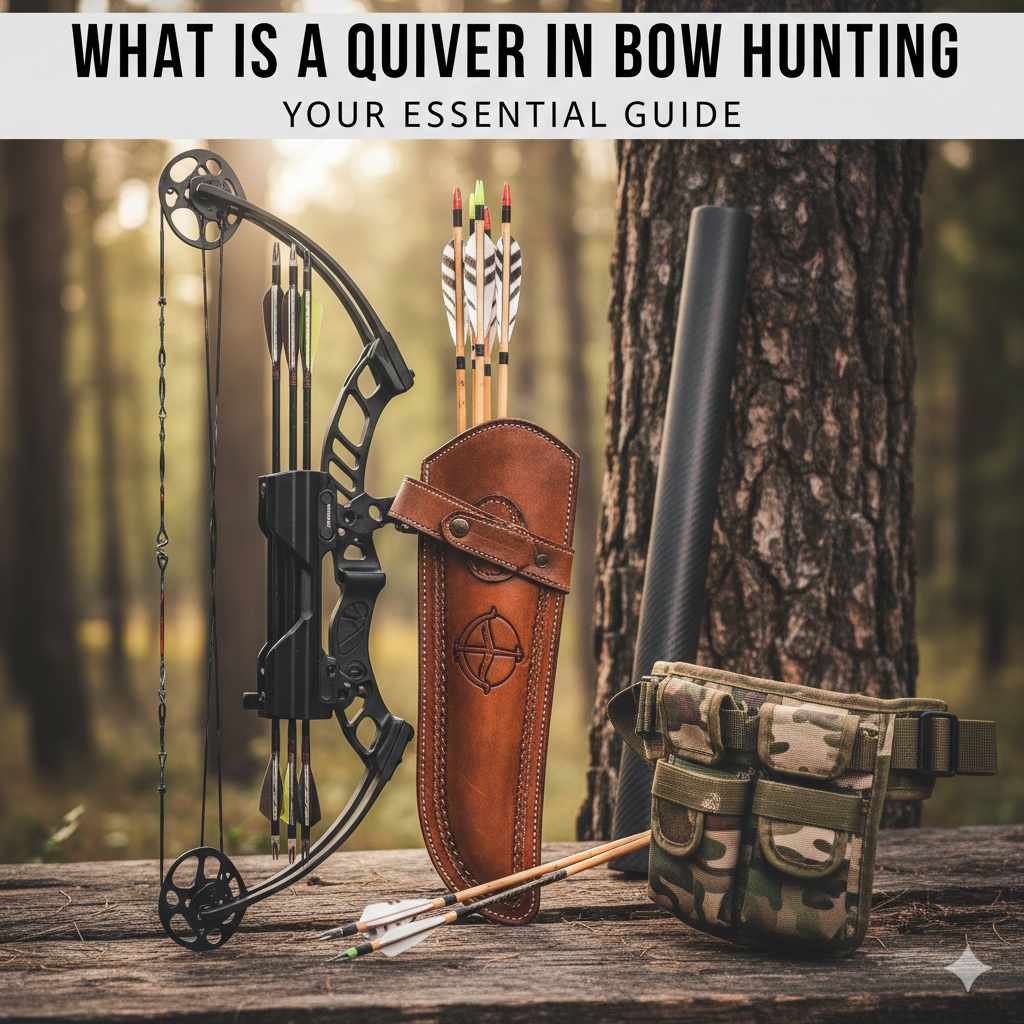
A quiver is an essential piece of bow hunting gear designed to safely hold your arrows. It keeps arrows secure, accessible, and protected, allowing you to move quietly and draw your next shot quickly and efficiently. Quivers ensure your razor-sharp broadheads are covered, preventing accidents and keeping them ready for action.
Hello, I’m Salman Arfeen. Welcome to your guide to understanding one of the most important but often overlooked pieces of your archery setup. If you’re new to bow hunting, you might see a quiver as just a simple arrow holder. But it’s so much more than that. A good quiver is your trusted partner in the field, keeping you safe, silent, and ready.
Choosing the right one can feel confusing with all the different styles and options available. Don’t worry! We’re going to break it all down in a simple, easy-to-follow way. By the end of this guide, you’ll know exactly what a quiver is, why you need one, and how to pick the perfect one for your hunting adventures.
What Exactly Is a Quiver?
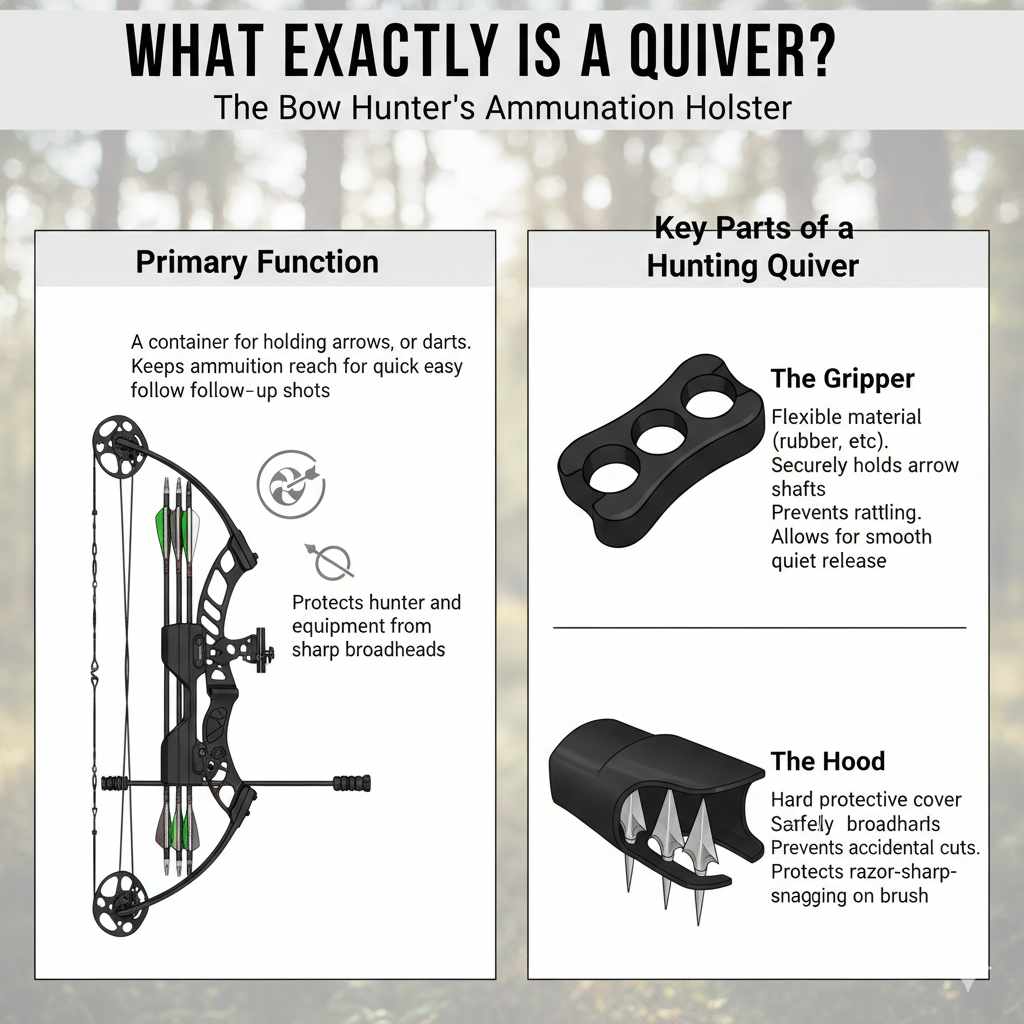
At its core, a quiver is a container for holding arrows, bolts (for crossbows), or darts. For bow hunters, its role is critical. Think of it as a holster for your ammunition. Its primary job is to keep your arrows within easy reach for a quick follow-up shot while also protecting you and your equipment. Modern hunting quivers are designed with specific features to meet the demands of the field.
A hunting quiver has two main parts:
- The Gripper: This section, usually made of flexible rubber or a similar material, securely holds the arrow shafts. It’s designed to grip them tightly enough so they don’t fall out or rattle, but allow for a smooth, quiet release when you need to draw an arrow.
- The Hood: This is a hard, protective cover at the top of the quiver. Its most important job is to safely encase the sharp broadheads of your hunting arrows. This prevents accidental cuts, protects the razor-sharp edges from getting dull, and keeps them from snagging on brush.
Why a Quiver Is a Non-Negotiable Piece of Gear
You might be tempted to just stick an arrow in your pocket or lean it against a tree, but that’s both unsafe and impractical. A quality quiver offers four key benefits that will make your time in the woods more successful and enjoyable.
1. Safety First, Always
Hunting broadheads are incredibly sharp—as they should be. Carrying them exposed is a serious safety hazard. A small trip or slip could lead to a severe injury for you or a hunting partner. The hood on a quiver completely covers these sharp points, making it the only safe way to transport your arrows in the field. The Hunter-Ed bowhunting safety rules emphasize keeping broadheads covered until you are ready to shoot, and a quiver is the tool designed for that purpose.
2. Quick and Easy Access
Opportunities in bow hunting can appear and disappear in seconds. Fumbling for an arrow is not an option when a buck steps into your shooting lane. A quiver positions your arrows in a consistent, predictable spot, allowing you to grab and nock a second arrow by feel, often without taking your eyes off the target. This muscle memory is crucial for making a quick, ethical follow-up shot if needed.
3. Ultimate Arrow Protection
Your arrows are a precise piece of equipment. The fletchings (feathers or vanes) are delicate and essential for stable arrow flight. If they get bent, crushed, or wet, your accuracy will suffer. A quiver keeps your fletchings protected from being damaged by branches, rain, or being jostled around. The hood also protects your broadheads from dirt, dings, and moisture, ensuring they are in perfect condition when it matters most.
4. Stealth and Silence
Noise is the enemy of a bow hunter. The slightest unnatural sound, like arrows clanking together, can alert an animal to your presence. Quivers are designed to prevent this. The grippers hold each arrow separately and securely, eliminating rattling. This allows you to move through the woods with confidence, knowing your gear won’t give you away.
The Different Types of Quivers for Bow Hunting
Quivers come in several styles, each with its own set of pros and cons. The best one for you depends on your bow, your hunting style, and your personal preference. Let’s explore the most common types.
1. Bow-Mounted Quivers
This is by far the most popular style for modern compound bow hunters. As the name suggests, this quiver attaches directly to the riser (the handle section) of your bow. They are typically compact and hold between 3 and 8 arrows.
- Pros: Your arrows are always with your bow, making it a single, grab-and-go unit. They offer extremely fast access for a follow-up shot. Many modern designs are lightweight and detachable.
- Cons: They add weight and bulk directly to your bow, which can affect balance and increase fatigue over a long day. Some hunters find they make the bow more susceptible to catching wind.
2. Hip Quivers (or Belt Quivers)
Hip quivers attach to your belt and rest on your hip. They are a classic design and remain popular, especially with traditional archers and those who hunt from a stationary position like a tree stand or ground blind.
- Pros: They take the weight off your bow, which many shooters prefer for better balance and aiming. They are generally easy to access while sitting or standing.
- Cons: They can be noisy if you’re stalking through thick brush, as arrows can snag on branches. The movement of the quiver while walking can also be a distraction for some hunters.
3. Back Quivers
The back quiver is the iconic style you see in movies like Robin Hood. It’s a tube or pouch worn over the shoulder, carrying the arrows on your back. While popular in traditional archery, it has some drawbacks for modern bow hunting.
- Pros: They can hold a large number of arrows and keep your bow and hips completely clear of extra gear.
- Cons: Reaching for an arrow can involve a large, conspicuous movement that can spook game. Arrows can rattle and are more exposed to the elements. They are particularly difficult to use when wearing a backpack or hunting in dense woods.
4. Thigh Quivers (or Leg Quivers)
A less common but very effective option, the thigh quiver straps around your upper leg. It combines some of the benefits of a hip quiver with a more secure and out-of-the-way profile.
- Pros: Keeps arrows accessible but lower down, reducing the chance of snagging on branches. It doesn’t interfere with a backpack and keeps the weight off your bow.
- Cons: Can feel awkward to walk with until you get used to it. The selection is more limited compared to other types.
Quiver Type Comparison at a Glance
Here’s a simple table to help you compare the main quiver styles.
| Quiver Type | Best For | Accessibility | Stealth (Quietness) | Bow Balance Impact |
|---|---|---|---|---|
| Bow-Mounted | Spot-and-stalk, fast-paced hunting | Excellent | Excellent | High |
| Hip Quiver | Tree stand, ground blind, target practice | Very Good | Good | None |
| Back Quiver | Traditional archery, open terrain | Fair | Fair | None |
| Thigh Quiver | Hunters who wear backpacks or hunt in thick cover | Good | Very Good | None |
How to Choose the Right Quiver for You
Now that you know the options, how do you pick the one that’s right for your needs? Consider these four factors.
1. Your Primary Hunting Style
How you hunt is the biggest factor. Your quiver should complement your strategy, not hinder it.
- Tree Stand or Ground Blind Hunting: If you’re mostly stationary, a hip quiver is an excellent choice. You can take it off and hang it on a hook for silent, easy access. Some bow-mounted quivers are also detachable, allowing you to remove them from your bow once you’re settled in.
- Spot-and-Stalk Hunting: If you’re on the move, a bow-mounted or a thigh quiver is often best. A bow-mounted quiver ensures your arrows are ready at a moment’s notice. A thigh quiver keeps them secure and out of the way of brush without weighing down your bow.
2. Your Bow Type
The bow you shoot also influences your choice. Most compound bows are designed with pre-drilled holes to accept a bow-mounted quiver. However, traditional recurve bows and longbows typically do not have these, making a hip or back quiver a more natural fit. Some companies make strap-on bow quivers for traditional bows, which can be a great compromise.
3. Arrow Capacity
How many arrows do you need to carry? Most bow-mounted quivers hold between 3 and 6 arrows. For most hunting situations, 4 or 5 arrows are plenty—one for your primary shot, a couple for follow-ups, and maybe one tipped with a small-game head. If you plan on doing a “blast hunt” for small game or just like having more arrows, a hip or back quiver with a larger capacity might be better.
4. Material, Durability, and Noise
Look for a quiver made from high-quality, durable materials. The hood should be rigid enough to protect you from broadheads, and the gripper should be made of a long-lasting material that won’t get brittle in the cold. Most importantly, ensure the design is quiet. Look for features like rubberized coatings on the hood to dampen sound and grippers that hold arrows tightly to prevent any rattling.
Matching Quiver to Hunting Style
This table can help you make a quick decision based on your hunting method.
| Hunting Style | Primary Recommendation | Secondary Option |
|---|---|---|
| Tree Stand / Blind | Hip Quiver | Detachable Bow-Mounted Quiver |
| Spot-and-Stalk (Mountains) | Bow-Mounted Quiver | Thigh Quiver |
| Still-Hunting (Thick Woods) | Thigh Quiver | Compact Bow-Mounted Quiver |
| Traditional Archery | Hip Quiver or Back Quiver | Strap-On Bow Quiver |
How to Use Your Quiver Safely and Effectively
Once you’ve chosen your quiver, it’s important to set it up and use it correctly.
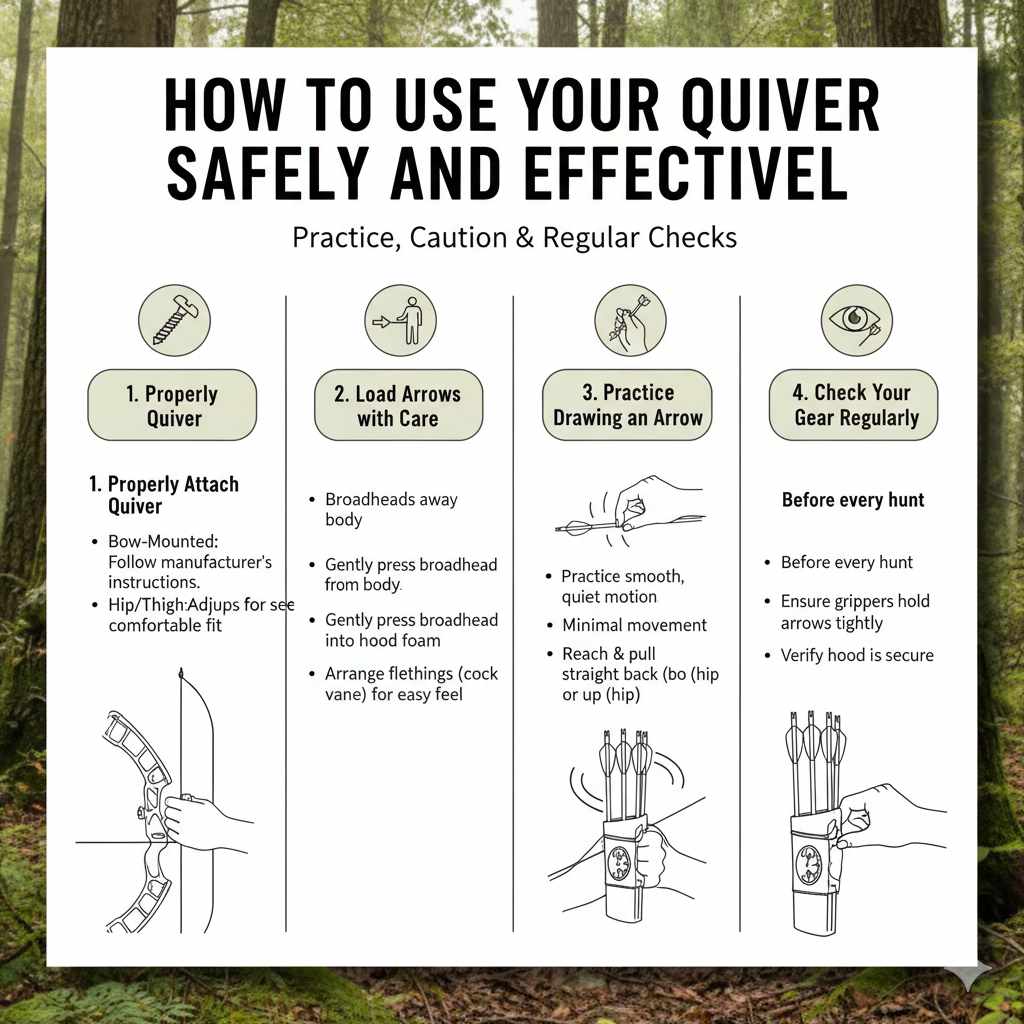
- Properly Attach Your Quiver: If you have a bow-mounted quiver, follow the manufacturer’s instructions to attach it securely to your bow’s riser. Make sure all screws are tight so it doesn’t vibrate loose. For hip or thigh quivers, adjust the straps so it sits comfortably and securely without shifting as you walk.
- Load Arrows with Care: Always load your arrows with the broadheads pointing away from your body. Carefully slide the shaft into the gripper, then gently but firmly press the broadhead into the foam or rubber insert inside the hood. Make sure the blades are fully covered. Arrange your arrows so the fletchings don’t touch or bend each other. Many hunters place their arrows with the “cock vane” (the odd-colored fletching) facing a certain way so they can nock the arrow by feel.
- Practice Drawing an Arrow: Practice removing an arrow from your quiver smoothly and quietly. You should be able to do this with minimal movement. With a bow-mounted quiver, reach up with your release hand, grip the arrow just below the nock, and pull it straight back and out of the gripper. With a hip quiver, reach down and pull the arrow up and out. Practice until the motion becomes second nature.
- Check Your Gear Regularly: Before every hunt, give your quiver a quick inspection. Ensure the grippers are holding the arrows tightly and that the hood is secure. A loose arrow can be noisy and dangerous.
Quiver Maintenance and Care
Your quiver is a simple but vital tool, and a little care goes a long way. After a hunt, especially in wet or muddy conditions, wipe it down with a damp cloth. Check the foam insert in the hood for excessive wear and tear from your broadheads; most are replaceable. Store your quiver in a cool, dry place away from direct sunlight, which can degrade the rubber and plastic components over time.
Frequently Asked Questions (FAQ)
1. How many arrows should I carry in my quiver for hunting?
For most deer or elk hunts, 4 to 5 arrows are sufficient. This gives you one for the initial shot, a couple for potential follow-ups, and a spare. Carrying more adds unnecessary weight. Some hunters carry one arrow with a small game head for opportunistic shots.
2. Does a bow-mounted quiver affect my bow’s balance and accuracy?
Yes, it can. Adding weight to one side of the bow can introduce a slight torque or lean during your shot. However, most modern bows and quivers are designed to minimize this effect. It’s crucial to practice shooting with your quiver attached and full of arrows, as this is how you’ll be shooting in the field. You may need to adjust your sight or use a stabilizer to counteract the weight.
3. Can I use the same quiver for practice and hunting?
Absolutely! In fact, it’s highly recommended. Practicing with the exact same setup you hunt with—including your quiver filled with arrows—builds consistency and muscle memory. The only difference is that you’ll use field points for practice and broadheads for hunting.
4. What’s the difference between a field quiver and a hunting quiver?
A field quiver is designed for target archery. Arrows often point backward to be more out of the way for walking and pulling arrows from targets. They usually don’t have a protective hood because they are only used with field points, not sharp broadheads. A hunting quiver is built for stealth and safety, with a hood to cover broadheads and grippers to prevent noise.
5. Are back quivers a good choice for modern bow hunting?
While iconic, back quivers are generally not ideal for most modern hunting scenarios. They can be noisy, snag on branches, and require a lot of movement to draw an arrow. They are best suited for traditional archers shooting in open country.
6. How do I stop my arrows from rattling in the quiver?
If your arrows are rattling, first check that you are using the correct size gripper for your arrow shafts. Most quivers come with adjustable or replaceable grippers. Ensure arrows are pushed firmly into both the gripper and the hood. Some quivers feature a secondary gripper for added stability. If rattling persists, you can try adding small pieces of felt or rubber to contact points.
7. Is a one-piece or a two-piece bow-mounted quiver better?
This is a matter of preference. A one-piece quiver is more common and is easily detachable. A two-piece quiver mounts the gripper and hood separately on the bow, spreading the contact points farther apart. Many archers feel this provides a more secure, vibration-free fit, but it is not quickly removable.
Conclusion: Your Quiver Is Your Partner in the Field
A quiver is far more than just a bucket for your arrows. It is an essential tool for safety, stealth, and success in bow hunting. It protects you from your razor-sharp broadheads, protects your arrows from damage, and gives you the fast, quiet access you need when the moment of truth arrives.
By understanding the different types and considering your personal hunting style, you can confidently choose a quiver that feels like a natural extension of your gear. Remember to practice with it regularly so that reaching for an arrow becomes an effortless, subconscious motion. The right quiver won’t just carry your arrows—it will carry you one step closer to a successful and enjoyable hunt.
Happy hunting, and shoot straight!