Arrow Spine for Low-Pound Recurve Bows: What to Know
Simply put, arrow spine is the stiffness of an arrow shaft, and selecting the correct spine is critical for low-pound recurve bows to ensure arrows fly straight and hit the target accurately. The wrong spine leads to erratic flight and reduced performance.
Key Takeaways
- Arrow spine refers to the stiffness of an arrow shaft, a crucial factor for accuracy, especially with low-pound recurve bows.
- Correct spine allows arrows to flex appropriately around the riser during the shot, a phenomenon known as ‘tuning’.
- Factors like draw weight, draw length, arrow length, and point weight significantly influence the required arrow spine.
- Using an arrow that is too stiff or too flexible will result in poor arrow flight, reduced accuracy, and potential damage.
- Consulting spine charts or seeking advice from experienced archers or pro shops is highly recommended for proper selection.
What is Arrow Spine and Why Does It Matter for Recurves?
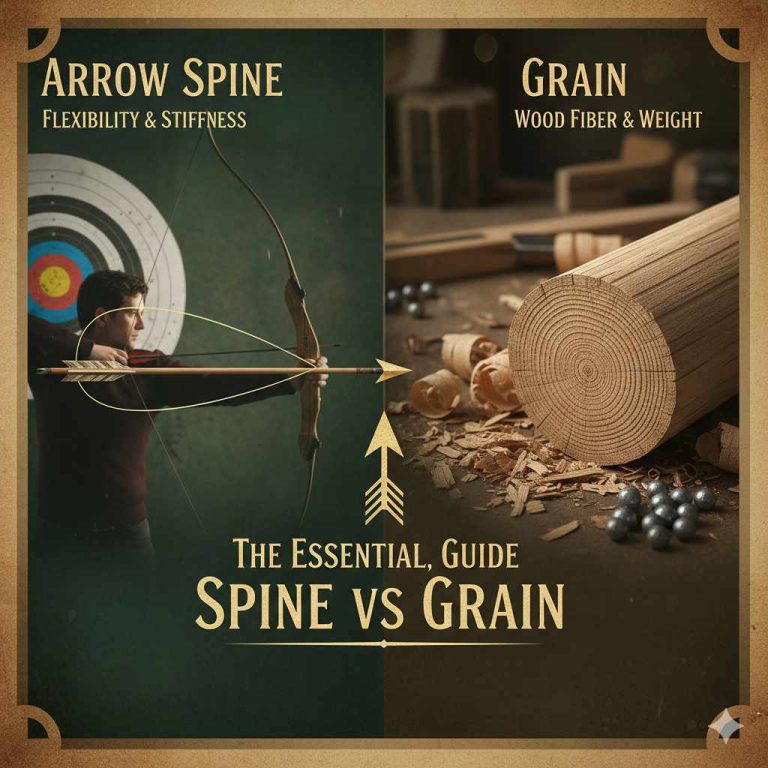
Arrow spine is essentially a measure of an arrow’s resistance to bending. It’s typically expressed as a numerical value, where a higher number indicates a stiffer shaft and a lower number indicates a more flexible shaft. This stiffness is determined by the arrow’s material, diameter, wall thickness, and length.
For any bow, but especially for recurve bows, the arrow must flex correctly as it leaves the bow. This controlled bending, known as ‘archer’s paradox’, allows the arrow to momentarily curve around the bow’s riser before straightening out in flight. If the arrow’s spine is not matched to the bow’s characteristics, this flexing will be exaggerated or insufficient, leading to erratic flight paths and poor accuracy.
For low-poundage recurves, which often have less powerful energy transfer, even small imperfections in arrow flight can have a significant impact on the shot’s outcome.
The consequence of an incorrectly spined arrow is often seen as wobbling, fishtailing, or an unpredictable trajectory. This makes consistent shooting impossible. An arrow that is too stiff for the bow will resist bending too much, potentially pushing away from the riser and causing it to fly erratically.
Conversely, an arrow that is too flexible will over-bend, often hitting the riser or ‘porpoising’ in flight. Both scenarios are detrimental to accuracy.
- Stiffness vs. Flexibility: Spine values indicate how much an arrow bends under a specific load.
- Archer’s Paradox: The controlled flex of an arrow around the riser is essential for straight flight.
- Impact on Accuracy: Incorrect spine directly translates to inconsistent arrow grouping and reduced precision.
- Energy Transfer: Properly spined arrows efficiently transfer the bow’s energy for better penetration and trajectory.
- Beginner Friendliness: For low-pound recurves, correct spine is paramount for building confidence and good habits.
- Bow Health: Extremely ill-spined arrows can cause undue stress on the bow, potentially leading to damage over time.
How Draw Weight and Draw Length Influence Spine Choice
The primary factors dictating the required arrow spine are the bow’s draw weight and the archer’s draw length. A heavier draw weight requires a stiffer arrow (higher spine value) to resist bending, while a lighter draw weight necessitates a more flexible arrow (lower spine value). This is because the amount of force pushing the arrow off the string changes with draw weight.
Draw length plays a critical role because it determines how much of the arrow shaft is supported by the bow and the archer’s hand. When you draw the bowstring back, the arrow is essentially a cantilever beam. The longer the unsupported portion of the arrow (i.e., the longer your draw length), the more it will bend.
Therefore, for a given draw weight, a longer draw length will require a stiffer arrow (higher spine) to compensate for the increased leverage and potential for flex. Conversely, a shorter draw length might allow for a more flexible arrow (lower spine).
For low-poundage recurves, the interplay of these two factors is often simpler than with high-poundage compound bows, but still crucial. A 30-pound recurve with a 28-inch draw length will need a different spine than a 30-pound recurve with a 25-inch draw length. Understanding this relationship is the first step in narrowing down your options.
Factors Affecting Spine Selection
- Draw Weight: Higher draw weight = stiffer arrow needed.
- Draw Length: Longer draw length = stiffer arrow needed.
- Arrow Length: Longer arrows are more flexible; shorter arrows are stiffer.
- Point Weight: Heavier points increase arrow flex; lighter points decrease it.
| Draw Weight (lbs) | Draw Length (inches) | General Spine Recommendation (Low Pound Recurve) |
|---|---|---|
| 20-25 lbs | 20-25 inches | Approx. 400-500 spine |
| 25-30 lbs | 25-28 inches | Approx. 350-450 spine |
| 30-35 lbs | 27-29 inches | Approx. 300-400 spine |
This table provides a general guideline; always consult specific manufacturer charts for precise recommendations. Point weights can also shift these requirements.
Understanding Arrow Length and Point Weight Effects
Beyond draw weight and length, the physical dimensions of the arrow itself play a significant role in its spine characteristics. The length of the arrow shaft directly impacts its stiffness. A longer arrow is inherently more flexible than a shorter one made from the same material and diameter.
This is because the longer shaft has more leverage against the bending force.
When cutting arrows to your desired length, you are effectively changing their spine. Cutting an arrow shorter makes it stiffer, increasing its spine value. Cutting an arrow longer makes it more flexible, decreasing its spine value.
This is a critical tuning adjustment. For example, if your arrows are flying slightly stiff (hitting left for a right-handed shooter, or exhibiting ‘tail wag’), you might be able to tune them by cutting them a bit shorter to increase their flexibility. Conversely, if they are too flexible (hitting right for a right-handed shooter), you might need to start with longer shafts or arrows with a higher initial spine.
The weight of the arrow’s point (broadhead or field point) also affects how the arrow behaves out of the bow. A heavier point adds more mass to the front of the arrow, influencing its flex. A heavier point makes the arrow behave as if it were more flexible, while a lighter point makes it behave as if it were stiffer.
This is because the heavier point adds more downward force and momentum to the front of the arrow, assisting in the flex around the riser. Therefore, if you’re experimenting with different point weights, you might need to adjust your arrow spine accordingly. Typically, a difference of 50 grains in point weight can necessitate a change in spine.
- Arrow Length: Shorter arrows are stiffer; longer arrows are more flexible.
- Cutting to Tune: Adjusting arrow length is a common method for fine-tuning spine.
- Point Weight Impact: Heavier points make arrows act more flexible.
- Lighter Points: Lighter points make arrows act stiffer.
- Grains of Difference: A 50-grain difference in point weight can require a spine adjustment.
- Consistent Length: Always cut arrows to a consistent length for predictable tuning.
Types of Arrow Shafts and Their Spine Characteristics
Arrow shafts come in various materials, each with distinct properties that affect their spine, durability, and weight. The most common materials for archery arrows include wood, aluminum, carbon, and composite (a blend of carbon and other materials). Understanding these materials will help you choose shafts that can accommodate the spine requirements for your low-poundage recurve.
Wood arrows are traditional and offer a classic aesthetic. Their spine can vary significantly even within the same species of wood. They are generally less durable and more prone to environmental factors like humidity.
Aluminum arrows are known for their consistency and are often favored for their straightness. They are available in a wide range of spine values, offering a good balance of performance and cost. Carbon arrows are lightweight, durable, and offer excellent straightness and consistency.
They are very popular for modern archery due to their strength and ability to be manufactured with precise spine values.
Composite arrows, often a blend of carbon and fiberglass or other materials, aim to combine the best properties of each. They can be designed for specific flex patterns and durability. For low-poundage recurves, carbon or aluminum shafts are generally recommended due to their predictability and availability in the lower spine ranges typically needed.
Wood can be an option for traditionalists, but requires more careful selection and handling to ensure consistent spine and durability.
| Shaft Material | Spine Characteristics | Pros | Cons |
|---|---|---|---|
| Wood | Variable, can be inconsistent | Traditional feel, affordable | Durability, consistency, susceptible to weather |
| Aluminum | Consistent, good range of spines | Straightness, good value, predictable | Can dent, less durable than carbon |
| Carbon | Highly consistent, available in wide range of spines | Lightweight, very durable, consistent | Can be more expensive, risk of shattering on impact |
| Composite | Engineered for specific flex and durability | Blends strengths of materials, often durable | Can be heavier, more complex manufacturing |
Carbon and aluminum shafts are generally the most practical and recommended choices for achieving consistent spine performance on recurve bows.
How to Read an Arrow Spine Chart
Arrow spine charts are invaluable tools provided by arrow manufacturers to help you select the correct shaft stiffness for your bow setup. These charts typically list various combinations of draw weight, draw length, and sometimes point weight, and then recommend a specific spine value for each scenario. Understanding how to interpret these charts is key to making an informed decision.
Most charts will have columns for the bow’s draw weight, your draw length, and the recommended arrow spine. You’ll find your draw weight and draw length, and then follow across to see the suggested spine. For example, if you have a 30 lb recurve and a 27-inch draw length, the chart might indicate a recommended spine of 400.
Remember that these charts are usually based on a standard point weight (often 100 or 125 grains). If you plan to use significantly heavier or lighter points, you may need to make adjustments, often moving to a slightly stiffer arrow for heavier points and a more flexible arrow for lighter points.
It’s important to note that different manufacturers may use slightly different spine rating systems or have variations in their charts. Therefore, it’s always best to consult the chart specific to the brand of arrows you are considering. If you are between two spine values, it’s often advisable to start with the stiffer arrow (higher spine number) as it’s generally easier to tune a slightly stiff arrow than a very flexible one.
- Manufacturer Specifics: Always use the chart for the brand you are buying.
- Draw Weight & Length: These are your primary inputs.
- Recommended Spine Value: The number tells you the required stiffness.
- Point Weight Adjustment: Heavier points often require stiffer arrows, and vice-versa.
- “In-Between” Spine: If you fall between two values, the stiffer option is often safer.
- Consult Experts: If unsure, ask a pro shop or experienced archer.
Tuning Your Arrows for Optimal Flight
Once you have selected arrows with a spine that is generally appropriate for your low-poundage recurve, the process of ‘tuning’ begins. Tuning is the fine-tuning process to ensure your arrows fly perfectly straight. This is often achieved through small adjustments to the arrows themselves or the bow’s setup.
The most common method of tuning involves observing how the arrow impacts the target and making adjustments based on that observation. For a right-handed shooter with a right-handed bow, an arrow that hits to the left of the intended point of aim typically indicates the arrow is too stiff. Conversely, if the arrow hits to the right, it’s likely too flexible.
These adjustments can be made by changing arrow length, point weight, or tiller adjustments on the bow (though tiller is a more advanced bow tuning aspect). On many modern recurve risers, you can also adjust the ‘arrow rest’ or ‘strike plate’ position, which can influence arrow flight dynamics.
Another aspect of tuning is ensuring your nocks are properly aligned with your fletching and that your fletching is intact and correctly applied. Even minor imperfections in fletching can cause an arrow to stabilize poorly in flight. Experimentation is key, and sometimes a paper tear test can provide very clear indications of arrow flight issues.
This involves shooting an arrow through a sheet of paper stretched tautly in front of the target to see how the arrow passes through it. A clean, straight tear indicates good flight.
Common Tuning Adjustments
- Paper Tear Test: Shoot through paper to diagnose straightness.
- Arrow Point Impact: Left impact = too stiff; Right impact = too flexible (for RH shooter).
- Adjusting Point Weight: Swap points for lighter/heavier ones.
- Adjusting Arrow Length: Cutting arrows shorter makes them stiffer; longer makes them more flexible.
- Rest/Plate Tuning: Minor adjustments to the arrow rest or strike plate can help.
- Fletching Inspection: Ensure all vanes/feathers are properly affixed and straight.
Frequently Asked Questions
What is the standard arrow spine for a 30lb recurve bow?
For a 30lb recurve bow, the standard arrow spine recommendation typically falls between 350 and 450. However, this can vary significantly based on your draw length and the specific arrow brand and material you choose. Always consult the manufacturer’s spine chart for the most accurate guidance.
Can I use arrows for a compound bow on my recurve bow?
It’s generally not recommended to use arrows specifically designed for compound bows on a recurve bow without careful consideration. Compound bows often shoot at higher speeds and have different energy profiles. While an arrow with the correct spine might work, the overall arrow construction, weight, and dynamic spine characteristics could be mismatched, leading to suboptimal performance or potential damage.
How important is arrow spine for beginner archers?
Arrow spine is critically important for beginner archers. Using correctly spined arrows makes learning to shoot much easier, as the arrows will fly more consistently. This builds confidence and helps beginners develop proper shooting form without the added challenge of correcting erratic arrow flight caused by poorly matched equipment.
What happens if my arrow spine is too stiff?
If your arrow spine is too stiff for your bow, the arrow will not flex enough around the riser. This often results in the arrow hitting the riser on its way out, or pushing away from the riser, causing it to fly erratically, often to the left for a right-handed shooter. Accuracy will be severely compromised, and the shot might feel ‘hard’ or jarring.
Can I combine different spined arrows in my quiver?
No, you should never mix arrows of different spine values in your quiver when shooting from the same bow. Each arrow needs to perform consistently. Mixing spines will lead to inconsistent arrow flight, making it impossible to achieve good groups on target and hindering your ability to diagnose tuning issues effectively.
Final Thoughts
Choosing the correct arrow spine is a fundamental aspect of successful archery, especially when using low-poundage recurve bows. It directly impacts accuracy, consistency, and the overall enjoyment of shooting. By understanding how draw weight, draw length, arrow length, and point weight interact with arrow stiffness, you can make informed decisions using spine charts and expert advice.
Properly spined and tuned arrows are the foundation for tight groups and a rewarding archery experience.