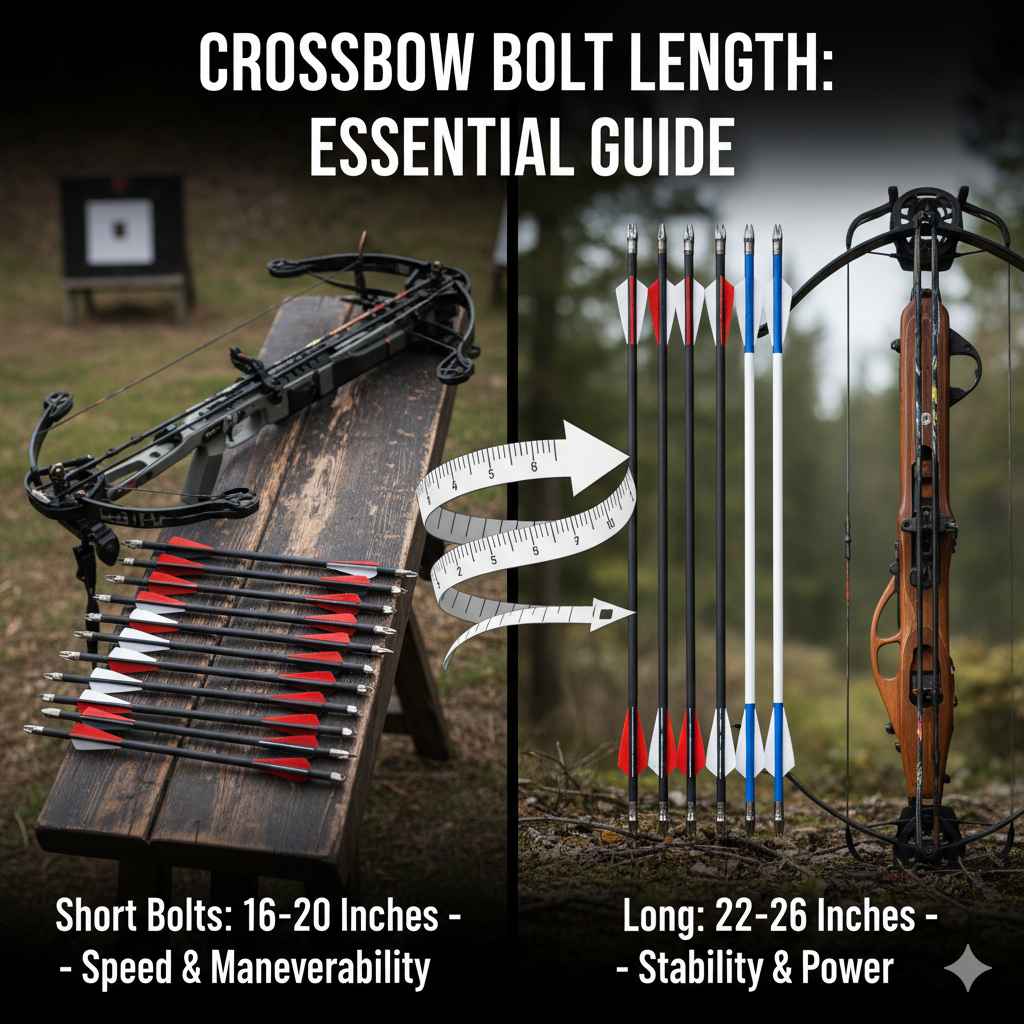
The difference in crossbow bolt length is crucial for safety and accuracy. Always match your bolt length precisely to your crossbow’s draw length—usually measured from the string at full draw to the foot of the rail. Too short is dangerous; too long will misalign your shot.
Welcome to the world of archery! It is exciting to get set up with a new crossbow, but sometimes the sheer amount of equipment choices can feel overwhelming. One area that trips up many new shooters is bolt length. Choosing the wrong length is not just a small mistake; it can seriously affect your accuracy and, more importantly, your safety. Don’t worry; figuring out the right size is easier than you think once you know the key measurements. We will break down exactly why bolt length matters and give you simple steps to find the perfect fit for your setup. Let’s make sure your first shots are safe, straight, and fun!
Why Crossbow Bolt Length is Non-Negotiable for Accuracy and Safety
As a beginner, you might think any bolt that fits into the rail will work. However, the length of your crossbow bolt (or arrow) is arguably the most critical specification after the draw weight itself. This isn’t just about hitting the target; it’s fundamental physics regarding how the energy transfers from the bow to the projectile.
The Science of Full Draw and Bolt Support
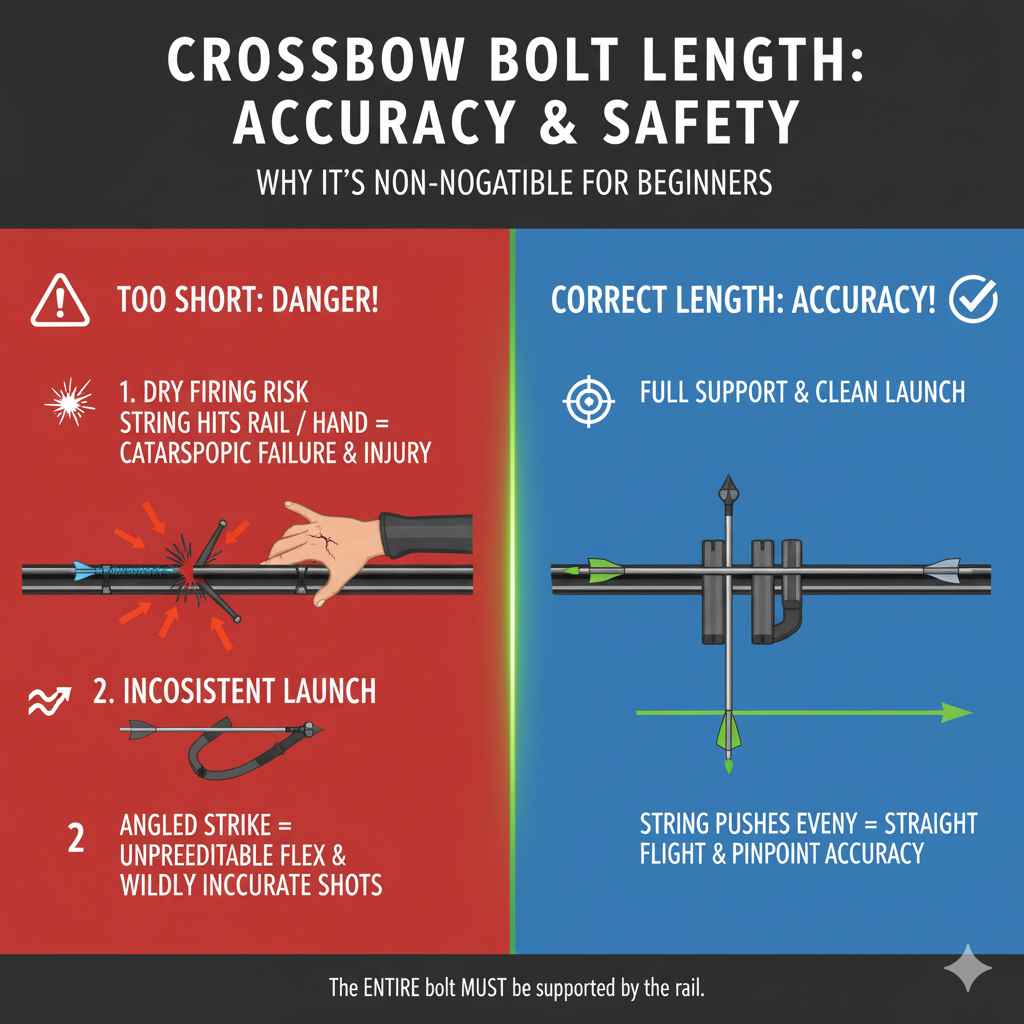
When you draw back a crossbow, the string moves until it hits the holding point. At this moment, the crossbow has stored the maximum amount of energy. For a bolt to fly straight and true, the entire body of the bolt needs to be fully supported by the crossbow’s barrel or rail from the front (where the string pushes it) all the way back to the rear (where the string hooks it).
If a bolt is too short, two major problems occur:
- Dry Firing Risk: The string can physically slap the front of the rail or even contact the user’s hand or the crossbow’s riser, causing a catastrophic failure known as a dry fire. A dry fire releases the stored energy without an arrow, which can destroy your crossbow and cause serious injury.
- Inconsistent Launch: The string will strike the nock (the rear slot of the bolt) at an angle or without full support, causing the bolt to flex unpredictably. This leads to wildly inaccurate shots.
If a bolt is too long, it might physically stick out past the foot of the rail, making it impossible to seat properly or potentially rubbing against the stock, causing drag and slowing down your shot unnecessarily.
Understanding the Key Measurement: Draw Length vs. Bolt Length
The most common confusion arises from mixing up the crossbow’s draw length with the required bolt length. These two measurements are directly related but are not measured the same way.
What is Crossbow Draw Length?
For a compound bow, draw length is measured from the pivot point of the grip to the string at full draw. For a crossbow, the measurement is simpler and more standardized:
Crossbow Draw Length (or Power Stroke): This is the distance the string travels from its resting position until it is fully cocked and ready to fire. This distance determines how much energy the crossbow stores.
How to Measure Your Bolt Length Requirement
The correct bolt length is determined by the crossbow’s draw length plus a safety margin. You need a bolt that is long enough to sit securely on the rail while the string is fully drawn back.
Here is the golden rule for beginners:
- The minimum bolt length must be equal to the crossbow’s draw length plus 1 to 1.5 inches.
This extra inch or inch and a half ensures that the nock is securely seated on the string and the entire body of the bolt remains supported by the rail through the firing sequence. If you are unsure of your crossbow’s official draw length, you can measure it:
- Cock the crossbow safely.
- Measure the distance from the string (where it meets the center of the bolt) straight back to the front end (foot) of the rail or barrel.
- Add 1.5 inches to this measurement. This is your minimum safe bolt length.
Safety Tip: Always lean towards the longer side if you are slightly unsure, as a bolt that is too short poses a much greater safety risk than one that is slightly too long (provided the too-long bolt doesn’t interfere with the foregrip).
Common Crossbow Bolt Sizes and Naming Conventions
Crossbow bolts are typically categorized by two primary measurements: length (in inches) and diameter (in millimeters or fractions of an inch).
Length Standards
Most modern crossbow bolts fall into common length ranges because manufacturers design their bows around these standards. Common bolt lengths you will see include:
- 16 inches
- 18 inches
- 20 inches (Most common for modern hunting crossbows)
- 22 inches
- 24 inches (Often used for very powerful, high-draw-weight crossbows)
Diameter Matters Too (But Length is First)
While we are focusing on length, remember that the bolt diameter (often referred to as the “shaft spine”) must also match your crossbow. The common diameters are:
- Standard/Micro Diameter: Usually around 0.308 inches (or 20/64ths of an inch). These are lighter and faster.
- Full Diameter: Usually around 0.345 inches (or 22/64ths of an inch). These are sturdier.
If the diameter is too small for your string groove, the bolt might wobble. If it’s too large, it won’t seat properly. Always check your crossbow manual for the recommended diameter before purchasing.
Step-by-Step Guide: Finding Your Perfect Bolt Length
Let’s walk through the process of confirming the right length for your specific crossbow. This is a straightforward process that requires only a measuring tape and your cocked crossbow.
Step 1: Identify Your Crossbow’s Specifications
Check the owner’s manual first. Most modern crossbows explicitly state the required bolt length (e.g., “Requires 20-inch bolts”). This is the fastest and most reliable method.
Step 2: Manually Measure the Draw Length (If Manual is Missing)
If you cannot find the manual, perform the measurement we discussed earlier:
- Safely cock the crossbow.
- Use a rigid tape measure or ruler.
- Measure from the center of the string (where it touches the bolt nock point) to the very front tip of the rail where the bolt rests. Record this number (e.g., 18 inches).
Step 3: Calculate the Minimum Safe Bolt Length
Add your safety margin to the measurement from Step 2.
Calculation Example: If your measured draw length is 18 inches, the minimum safe bolt length is 18 + 1.5 = 19.5 inches.
Step 4: Select the Nearest Standard Bolt Size
Since bolts are sold in set lengths (like 18”, 20”, 22”), you must choose the next standard size up from your calculated minimum.
- In the example above (minimum 19.5”), you would purchase 20-inch bolts.
Step 5: Verify Fit (The Practical Test)
Once you receive the bolts, perform a final safety check before shooting:
- Load one bolt onto the rail.
- Carefully draw the string back until it latches securely into the cocking mechanism.
- Examine the bolt. The nock should be firmly seated against the string, and the front end of the bolt should rest securely on the rail without hanging over.
If the bolt is too long and interferes with your scope mount or foregrip, it needs to be trimmed down carefully (see trimming section below). If it is too short, do not shoot it; replace it immediately with a longer size.
Impact of Bolt Length on Speed and Energy Transfer
While safety is paramount, length also influences performance. Generally, for a given crossbow, a longer bolt will be slightly slower but offer better spine consistency, while a shorter bolt will be slightly faster but might be less stable in flight if it’s near the minimum requirement.
The Trade-Off: Speed vs. Stability
This relationship is deeply tied to the bolt’s “spine” (stiffness), but for beginners, keep this simple:
- Shorter Bolts (Closer to Minimum): Faster velocity, but require a stiffer spine to prevent flexing excessively upon release.
- Longer Bolts (With Safety Margin): Slightly slower velocity because the bolt has more mass to push over the same distance, but generally offer more surface area for support, leading to a more stable flight path, especially with lower-poundage bows.
For target practice and ethical hunting, most modern crossbows designed for 20-inch bolts perform optimally with bolts that utilize that full length to maximize stability.
When Is Trimming a Bolt Necessary?
If you purchase a standard length bolt (e.g., 22 inches) for a crossbow that only requires 20 inches, you will need to trim the back end (the nock end) to ensure the bolt seats correctly without interfering with the scope or cocking mechanism.
Tools Needed for Safe Trimming
Trimming carbon or aluminum bolts requires specific tools to maintain structural integrity. Using the wrong tool can cause the bolt to splinter or fail mid-flight.
| Tool Required | Purpose | Beginner Caution |
|---|---|---|
| Precision Carbon Arrow/Bolt Saw | Provides a perfectly square, clean cut without splintering the shaft material. | Essential for carbon bolts; do not use standard hacksaws. |
| Deburring Tool or Sandpaper (Fine Grit) | Smooths the cut edge to ensure the nock seats perfectly straight. | Crucial for preventing string catch or wobbling. |
| Digital Calipers (Optional but Recommended) | To measure the cut precisely against your required final length. | Ensures accuracy when trimming multiple bolts identically. |
The Trimming Process (Use Extreme Caution)
If trimming is necessary, always follow these guidelines:
- Measure and mark the exact final length required on the bolt.
- Use a specialized bolt cutting jig or a miter box to ensure your saw cut is perfectly perpendicular (90 degrees) to the shaft. A non-square cut drastically reduces accuracy.
- Cut slowly and steadily. Carbon dust can be irritating, so wear appropriate personal protective equipment (PPE), including safety glasses and a dust mask.
- Once cut, use the deburring tool to clean the inside and outside edges of the freshly cut end.
- Reinstall the nock and dry-fit the bolt into your crossbow to confirm the fit is perfect.
Expert Advice: If you are uncomfortable cutting bolts, many specialty archery shops offer precision cutting and fletching services for a small fee. For beginners, buying the correct length bolt the first time is always the safest bet.
Factors That Influence Bolt Length Selection Beyond Draw Length
While the crossbow’s draw length dictates the minimum requirement, a few other equipment choices might make you opt for a slightly longer bolt.
1. Nock Style
Different nocks take up different amounts of space at the rear of the bolt:
- Standard Semi-Round Nock: Sits flush and requires standard measurement.
- Flat Nock: Sits very flat against the string groove.
- Deep V-Nock: Sits deeper into the string.
If your nock is very deep, it slightly reduces the required travel distance, potentially allowing you to use a slightly shorter bolt, but always prioritize the safety margin over shaving off a few millimeters.
2. Scope Placement and Foregrip Clearance
If you have a large scope mounted very far forward, a very short bolt might collide with the scope mount when the string pushes it forward upon firing. Conversely, if your foregrip is bulky, an overly long bolt might press against it, causing drag.
Always ensure the bolt travels freely from the cocked position to the forward resting position without hitting any external part of the crossbow.
3. Bolt Material (Aluminum vs. Carbon)
Carbon bolts tend to be slightly lighter than aluminum bolts of the same diameter. Because of this weight difference, you might sometimes need a slightly longer carbon bolt compared to an aluminum bolt to achieve the same spine stiffness rating for a high-poundage bow. However, for a beginner sticking to standard equipment, this difference is negligible; focus on the measured length first.
Crossbow Bolt Spine and Its Relationship to Length
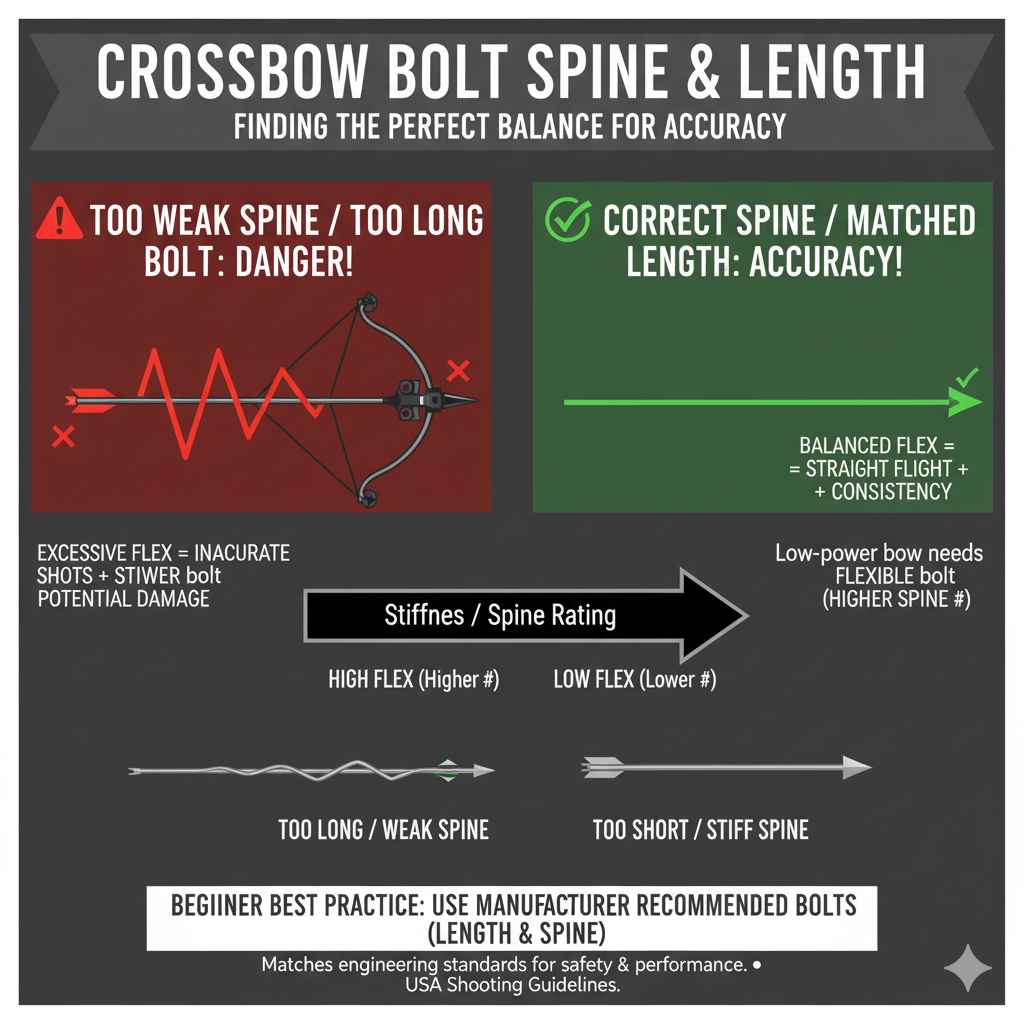
When you buy bolts, you will often see a “Spine Rating” (e.g., 400 spine, 340 spine). Spine refers to the stiffness of the shaft. Think of it like a bridge—a very stiff bridge can support more weight without bending too much.
A powerful crossbow (high draw weight) needs a stiffer bolt (lower spine number) so it doesn’t bend excessively when released, which ruins accuracy. A lighter crossbow needs a less stiff bolt (higher spine number).
The Connection to Length: If you use a bolt that is too long for the draw weight, it tends to flex too much (it acts like a weaker spine). If you use a bolt that is too short, it is generally too stiff and can be dangerous if the string hits the rail.
For a beginner, the best practice is to buy bolts recommended by the crossbow manufacturer that match the required length and spine rating for your specific model. This ensures the system is balanced, as detailed by engineering standards, such as those referenced by sporting goods safety organizations like the USA Shooting organization, which heavily influences small arms and projectile safety.
Quick Comparison Table: Too Short vs. Too Long
Understanding the consequences of choosing the wrong length is the best way to motivate you to measure correctly!
| Bolt Condition | Primary Risk | Effect on Shooting | Action Required |
|---|---|---|---|
| Too Short (Danger Zone) | Catastrophic Crossbow Failure (Dry Fire) and Injury | Severe accuracy loss; string slap on the rail. | Immediately replace with a longer bolt (add 1–1.5 inches). |
| Perfect Length (Supported) | Optimal Safety and Energy Transfer | Consistent flight, maximum energy transfer, repeatable accuracy. | Use for all shooting. |
| Too Long (Interfering) | Friction, Slowed Velocity, Inconsistent Release | Bolt drags on the stock or foregrip; potential nock misalignment. | Trim the rear end carefully using a specialized saw. |
Frequently Asked Questions (FAQ) for New Crossbow Owners
Q1: Can I use a shorter bolt if my crossbow has a very heavy draw weight?
A: No. Never use a bolt shorter than the calculated minimum draw length plus the safety margin (usually 1 to 1.5 inches). Heavy draw weights increase the risk of the string striking the rail or your hand if the bolt is too short. Safety always comes first.
Q2: If I buy 22-inch bolts but only need 20-inch, is it safe to trim them?
A: Yes, if you trim them correctly. You must use a dedicated carbon bolt cutter or saw to ensure a perfectly square cut at the nock end. If the cut is crooked, the bolt will not fly straight. If you are unsure, buy the 20-inch size instead.
Q3: How do I measure the draw length if I can’t safely cock the bow?
A: If you cannot safely cock the bow (perhaps due to high draw weight), you must find the manufacturer’s specifications online or in the manual. If that fails, take the uncocked bow to a certified archery pro shop. They can measure the power stroke accurately using specialized tools and advise on the correct bolt length for you.
Q4: Does the length of my bolt affect how far my crossbow shoots?
A: Yes, bolt length can influence both distance and accuracy. A bolt that is too short may not receive full energy from the string and can create unstable flight, reducing effective range. On the other hand, an excessively long bolt may create extra friction along the rail, slowing it down slightly. The correct bolt length ensures optimal energy transfer, allowing the crossbow to shoot at its intended speed and maintain consistent accuracy at longer distances.
Q5: What is the most common bolt length used in modern crossbows?
A: The most common bolt length for modern crossbows is 20 inches. Many manufacturers design their crossbows around this standard size because it provides a good balance of stability, weight, and speed. However, some compact crossbows may use 16-inch or 18-inch bolts, while larger or high-power models sometimes use 22-inch bolts. Always follow the length recommended in your crossbow’s manual to ensure safe and reliable performance.
Conclusion
Choosing the correct crossbow bolt length is one of the most important steps in setting up your crossbow properly. The right length ensures the bolt remains fully supported on the rail, allowing safe energy transfer from the string to the projectile. Using a bolt that is too short can lead to dangerous dry-fire situations, while a bolt that is too long may cause drag or alignment issues.
The safest approach is simple: measure your crossbow’s draw length and add a safety margin of about 1 to 1.5 inches, then select the nearest standard bolt size available. Most shooters will find that standard 20-inch bolts work perfectly for many modern crossbows, but verifying your manufacturer’s recommendation is always the best practice.
By understanding how bolt length works and taking the time to measure correctly, you will improve accuracy, safety, and overall shooting performance. With the proper setup in place, you can focus on what really matters—developing your skills and enjoying the exciting world of archery with confidence. 🎯