How Do 3D Archery Tournaments Work: Essential Guide
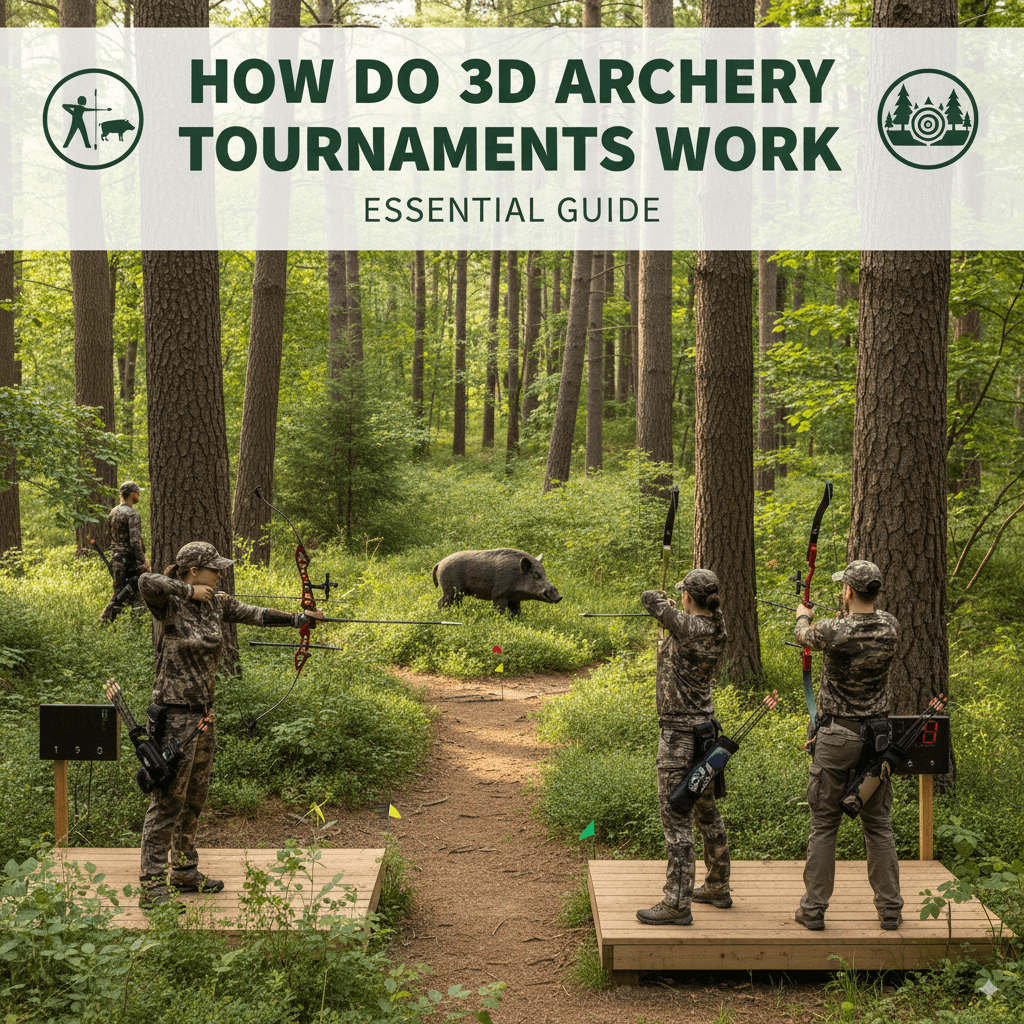
3D archery tournaments involve shooting at life-size animal targets placed at varying, unknown distances on a course. Archers aim for vital zones on the targets to score points, with the highest score winning. It’s a fun, challenging way to test your archery skills in a realistic hunting-like environment. For more on this, see our guide on Do Extra Points Count As Field Goals In Prizepicks.

SAS
SAS Archery Essential Accessory Upgrade Combo -…
- Bow sight: 5 pin bow sight, 0.029" fiber, with sight light and level
- Arrow rest: brush capture arrow rest, left and right handed
- Stabilizer: rubber stabilizer, 3.5 inches, 4.6 ounces
As an Amazon Associate I earn from qualifying purchases.
Stepping into your first 3D archery tournament can feel a bit mysterious. You see archers with their bows, aiming at targets that look like animals scattered throughout a wooded course. It’s exciting, but you might wonder, “How does this all work?” Don’t worry, it’s more straightforward than it seems! Many beginners feel the same way, wondering about the rules, scoring, and the general flow of the event. This guide is here to break it all down for you. We’ll walk through exactly what happens on tournament day, from signing up to the final score. Get ready to feel confident and ready for your first 3D archery experience!
Understanding the 3D Archery Course
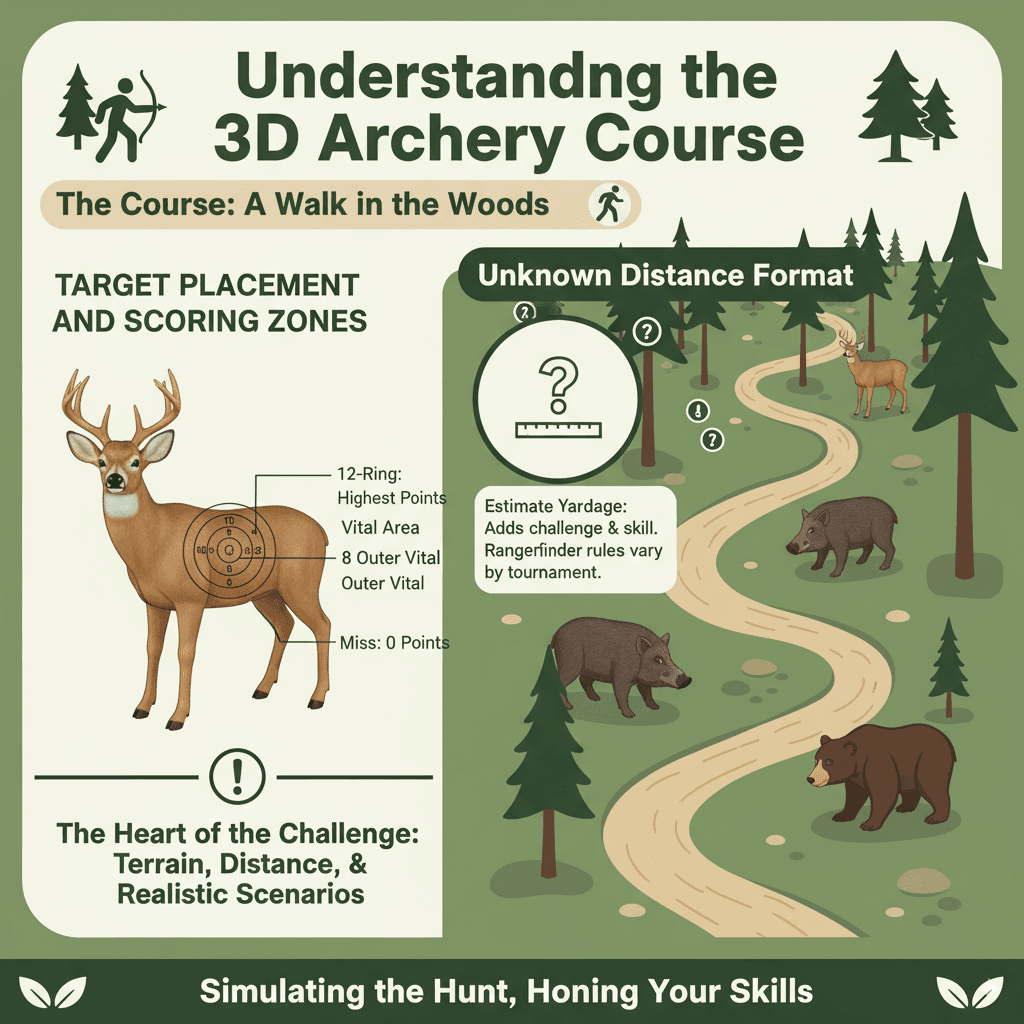
The heart of any 3D archery tournament is the course itself. Imagine a walking trail through woods or fields, dotted with life-size targets shaped like animals. These aren’t just any targets; they are strategically placed at different distances, often making you guess how far away they are. This element of unknown distance is a key part of the challenge and fun.
Each tournament course will have a set number of targets, typically ranging from 10 to 20. As you walk from one target to the next, you’ll encounter varied terrain. You might be shooting uphill, downhill, from a standing position, or sometimes from a designated shooting lane. The course designers aim to simulate real hunting scenarios, making it a fantastic way to practice your skills.
Target Placement and Scoring Zones
The targets, which are 3D foam replicas of animals like deer, wild boar, or even bears, have specific scoring rings. These rings are usually marked on the target and are designed to represent the vital organs of the animal. Hitting closer to the center, the “bullseye” or “12-ring,” earns you more points.
Here’s a common breakdown of scoring zones:
- 12-Ring: This is the innermost ring, often representing a heart or lung shot. It typically scores the highest points.
- 10-Ring: This ring surrounds the 12-ring and represents a good, solid hit in the vital area.
- 8-Ring: This outer ring still counts as a vital hit but scores fewer points.
- Miss: If you hit outside the scoring rings or miss the target entirely, you score zero points for that shot.
The exact scoring can vary slightly between different organizations (like the Archery Shooters Association (ASA) or the International Bowhunters Association (IBAA)), but the general principle of aiming for vital zones remains constant.
Unknown Distance Format
One of the most exciting aspects of 3D archery is shooting at unknown distances. Unlike known-distance targets where the range is clearly marked, here you have to estimate the yardage. This is a crucial skill that many hunters develop.
Before shooting at a target, archers are usually given a chance to estimate the distance. Some tournaments allow the use of rangefinders, while others are “rangefinder-optional” or “rangefinder-prohibited.” Always check the specific rules for the tournament you’re entering.
This unknown distance adds a layer of strategy and skill. Experience and practice help you become better at judging distances, which directly impacts your score. It’s a practical skill that translates directly to bowhunting situations.
How a 3D Archery Tournament Day Unfolds
A tournament day is usually a well-organized event. Here’s a typical flow of what you can expect:
Registration and Check-in
When you arrive, your first stop will be the registration area. Here, you’ll usually need to provide your name, pay any entry fees, and sometimes present your membership card if one is required by the organizing body. You’ll typically be assigned a shooting class based on your equipment (e.g., hunting class, open class, traditional class) and a starting stake number.
What to bring for registration:
- Identification
- Payment for entry fee
- Membership card (if applicable)
- Your bow and arrows
It’s a good idea to arrive at least 30-60 minutes before the official start time to allow plenty of time for registration and to get your equipment ready without feeling rushed.
Equipment Check
For sanctioned tournaments, there might be an equipment check. This ensures your bow and arrows comply with the rules of the class you’re shooting in. For example, there might be limits on bow draw weight, arrow diameter, or the types of sights allowed. This is more common in competitive classes. For beginner or fun shoots, this might be less stringent.
The goal is to ensure fair competition. If you’re unsure about your equipment meeting the rules, it’s always best to ask the tournament organizers beforehand or during registration.
The Course Walk
Once you’re registered and ready, you’ll usually be directed to your starting stake. Depending on the tournament format, you might shoot as an individual, or you might be grouped with other archers. If you’re grouped, you’ll wait for your group to be called to the first target.
The course walk is the journey between targets. It’s a chance to enjoy the scenery, chat with fellow archers, and prepare mentally for the next shot. Remember to handle your bow safely during the walk; keep it un-cocked if it’s a compound bow, and always be aware of your surroundings and other people.
Shooting the Targets
When you reach a target, your group will typically proceed in assigned shooting order. One archer shoots, while the others wait their turn, observing safety protocols. It’s considered polite to watch others shoot and offer encouragement.
At each target, you’ll see the animal target and a stake or marker designating where archers must shoot from. As mentioned, the distance to the target is usually unknown.
The shooting process at each target generally involves:
- Assessing the Target: Identify the scoring zones on the target.
- Estimating Distance: Take time to estimate how far away the target is. If rangefinders are allowed, use yours accordingly.
- Drawing and Aiming: Nock an arrow, draw your bow, aim carefully, and release.
- Observing the Shot: Watch where your arrow hits.
- Scoring: Once all participants in your group have shot, a designated scorer (or everyone in the group agrees) will determine the score for each arrow based on the scoring rings.
Arrows are usually retrieved after all archers in the group have shot at that target, or sometimes after everyone has shot at a few targets to keep the pace moving.
Scoring and Scorecards
Each archer is typically given a scorecard. It’s your responsibility to keep track of your shots and scores for each target. After shooting, you’ll mark down the score for each arrow on your scorecard. Some tournaments may assign a scorekeeper to your group, but it’s always wise to keep your own record or double-check.
The scorecard will have spaces for each target number and the scores from your arrows. For example, if you shoot one arrow per target, you’ll record one score per target. If you shoot multiple arrows at a target (less common in standard tournaments but possible in practice rounds), you’ll record each score.
Table: Sample Scorecard Entry
| Target # | Arrow 1 Score | Arrow 2 Score (if applicable) | Total Score |
|---|---|---|---|
| 1 | 10 | – | 10 |
| 2 | 8 | – | 8 |
| 3 | 12 | – | 12 |
After you’ve finished all the targets, you turn in your scorecard at the designated area. This is where scores are tallied. Be sure you’ve filled out your scorecard completely and accurately before submitting it.
Finalizing Scores and Awards
Tournament organizers will collect all scorecards and tally the results. Scores are usually posted publicly, either on a board or online. This is a moment of anticipation, seeing how you and others stacked up.
Awards ceremonies typically follow once all scores are verified. Prizes are usually given to the top finishers in each class. Even if you don’t win, participating is a rewarding experience, and you get to see the top scores achieved!
Types of 3D Archery Classes
To ensure fair competition, 3D archery tournaments often break participants into different classes based on the equipment they use. This means a beginner with a basic hunting setup shouldn’t be competing directly against a pro with a highly specialized tournament bow.
Here are some common classes you might encounter:
Beginner Classes (e.g., Young Adult, Novelty, Hunter)
These classes are designed for those who are new to the sport or use simpler equipment. They often have fewer equipment restrictions, allowing archers to use their everyday hunting bows or even rental equipment. The focus here is on participation and learning. Scores might be less critical than simply completing the course.
Known Distance Classes
In these classes, the distance to the target is clearly marked, often with numbered stakes indicating the yardage. This removes the challenge of distance estimation and allows archers to focus purely on their shooting form and accuracy.
Limited Hunter Classes
These classes often allow a basic scope on the bow sight but might have limitations on magnification. They are designed to mimic a more realistic hunting scenario than some of the high-tech classes.
Open Classes (e.g., Pro, Open Release, Open Tac)
These are typically for experienced archers with highly specialized and often expensive equipment. They usually have very few restrictions on sights, stabilizers, and other accessories. These individuals are often competing for prize money.
Traditional Classes
For archers using traditional archery equipment, such as recurve or longbows, often without advanced sights or stabilizers. This class celebrates classic archery techniques.
Table: Equipment Considerations by Class (General Guidelines)
| Class Type | Typical Equipment Allowed (Examples) | Focus |
|---|---|---|
| Beginner/Novelty | Any functional bow, basic sights allowed. Rangefinders often permitted. | Participation, learning, fun. |
| Limited Hunter | Bow sights with limited magnification or pins, stabilizers. No rangefinders. | Realistic hunting simulation. |
| Open/Pro | Highly specialized bows, advanced sights (often with magnification), stabilizers, release aids. | Peak performance, competition. |
| Traditional | Recurve or longbow (no sights or basic sights), wood arrows. | Classic archery skills. |
Always check the specific rules for the tournament you are attending, as class definitions can vary between organizations and events. Joining a beginner class for your first few tournaments is a great way to get comfortable.
Essential Tips for Your First 3D Tournament
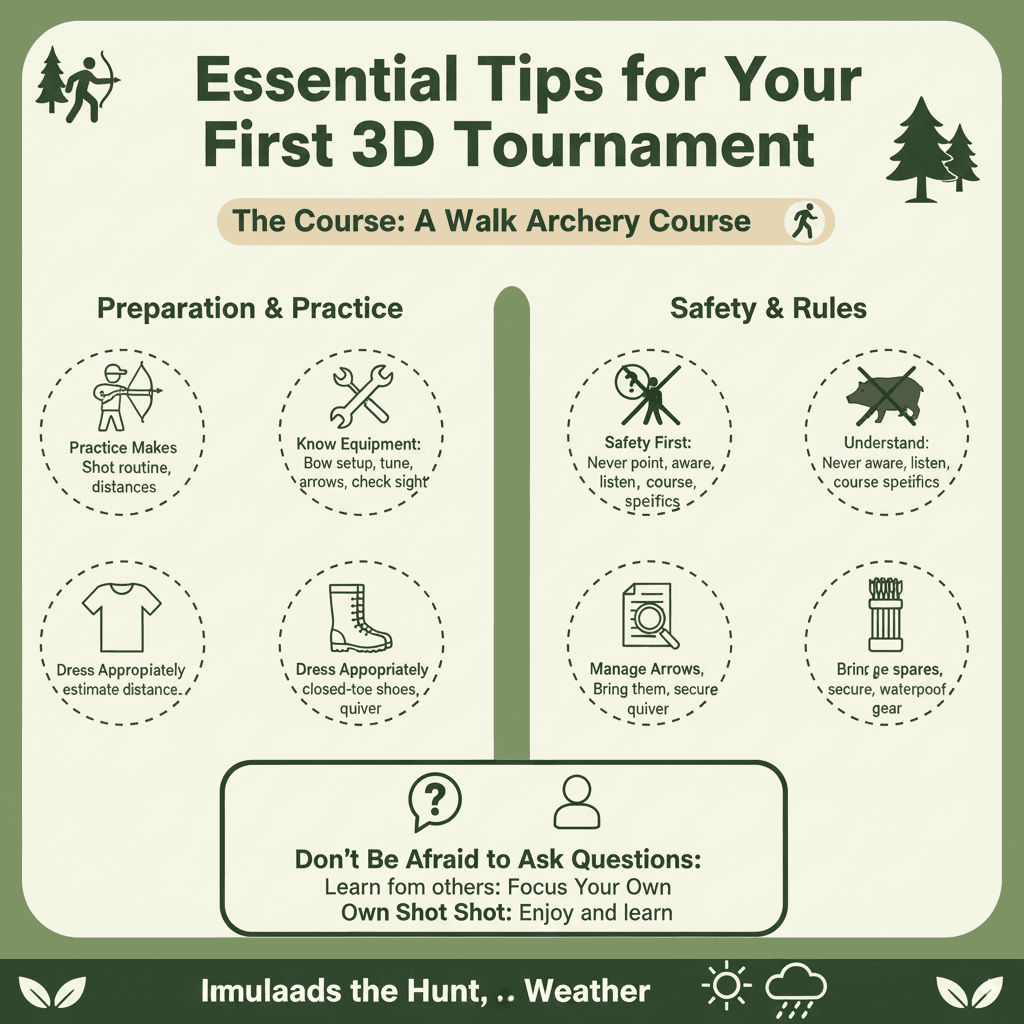
Your first 3D tournament is an adventure! To make it enjoyable and successful, here are a few essential tips:
Practice Makes Perfect (and Predictable)
Before the tournament, spend time practicing. Shoot at different distances, even if you’re just using markings on a range. Practice estimating distances. More importantly, practice your shot routine – from drawing the bow to holding and releasing consistently. The more comfortable you are with your bow and your mechanics, the better you’ll perform under tournament pressure.
Know Your Equipment
Ensure your bow is properly set up and tuned. Check your arrows for any damage (cracked nocks, bent shafts). Make sure your sight is set correctly for the distances you anticipate. Familiarity breeds confidence. If you use a release aid, make sure it’s functioning smoothly.
Dress Appropriately
You’ll be walking outdoors, so dress for the weather. Comfortable, durable clothing is key. Layers are often a good idea. You might need a hat to shield your eyes from the sun or a rain jacket. Many archers wear a quiver on their hip or a back quiver. Closed-toe shoes are essential for safety on uneven terrain.
Safety First, Always
Archery is safe when rules are followed. Here are critical safety reminders:
- Never point your bow at anyone.
- Never nock an arrow unless you are at the shooting stake and it’s your turn.
- Always be aware of your surroundings. Check for other people before you draw or shoot.
- Unload your bow when walking between targets if required, or follow your bow manufacturer’s safety guidelines for safe transport.
- Listen to tournament officials and range officers.
The USA Archery website offers comprehensive safety guidelines that are applicable to all forms of archery.
Understand the Rules
Before the tournament, try to read the rules for the specific event or organization. Knowing about rangefinder usage, scoring increments, and any course-specific rules will prevent confusion and potential penalties.
Manage Your Arrows
Bring enough arrows! It’s common for beginners to lose an arrow, either by shooting it poorly or if it gets stuck in a target. Missing an arrow means you can’t score on any subsequent targets where multiple arrows might be required, or simply lose scoring potential. Having spares is crucial. A quiver that holds your arrows securely is a must.
Don’t Be Afraid to Ask Questions
Tournament organizers and experienced archers are usually happy to help beginners. If you’re unsure about a rule, a scoring procedure, or how to proceed at a target, ask! It’s better to ask than to make a mistake.
Focus on Your Own Shot
It’s easy to get caught up comparing yourself to others, especially in your first tournament. Remember, the goal is to improve and enjoy yourself. Focus on your own shooting process, analyze your performance, and learn from each shot. Celebrate your hits and take lessons from your misses.
Be Ready for the Weather
Outdoor tournaments mean you’re exposed to the elements. Sunscreen, a hat, and plenty of water are essential, especially on hot days. If rain is in the forecast, a waterproof jacket and maybe even a cover for your bow are wise. Wet conditions can affect your grip and your equipment.
Frequently Asked Questions (FAQ) About 3D Archery Tournaments
Here are some common questions beginners have:
Q1: What is the difference between 3D archery and target archery?
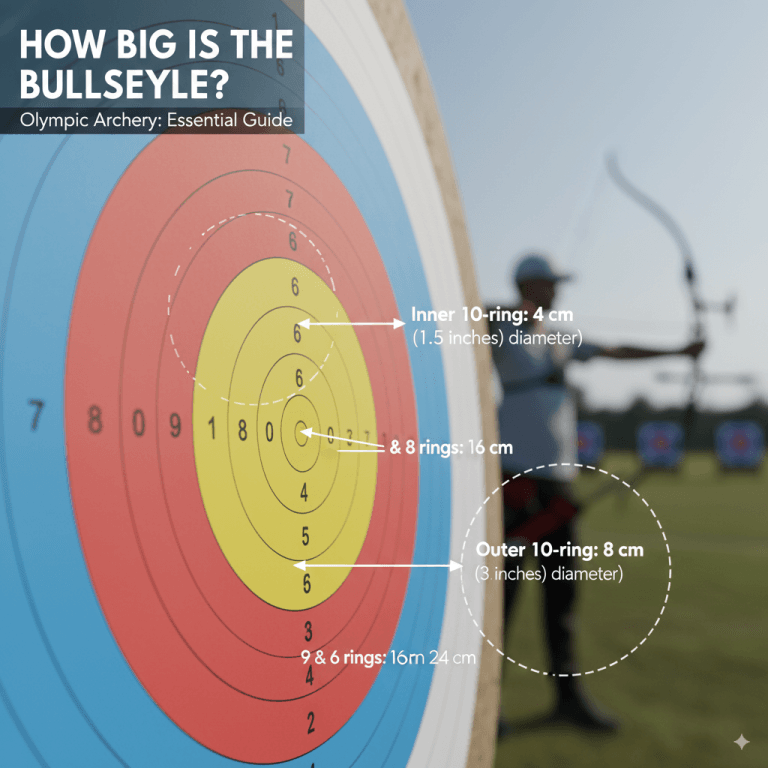
A: Target archery typically involves shooting at flat, circular bullseye targets at known distances, often on a field range. 3D archery uses life-size animal-shaped targets placed at unknown distances on a woodland or field course, simulating hunting scenarios.
Q2: Do I need a rangefinder?
A: It depends on the tournament class. Many beginner and hunter classes allow rangefinders, which help you determine the exact distance to the target. However, some classes are “rangefinder-prohibited” or “rangefinder-optional,” requiring you to estimate distances based on skill and experience.
Q3: How many arrows do I shoot per target?
A: In most standard 3D tournaments, you shoot one arrow per target. This is to keep the pace of the event moving and to make scoring simpler. Always check the specific rules for the tournament you are attending.
Q4: What if my arrow breaks or I lose it?
A: If an arrow breaks or gets lost, you will score zero for that target if you only brought one arrow. It’s why bringing several spare arrows (at least 6-12) is highly recommended. If you have multiple arrows, you might be able to use a spare if permitted by the rules, but often you just forfeit scoring for that target.
Related pick: Check today's price on Amazon