How Do Hunting Laser Rangefinders Work: Essential Guide
Hunting laser rangefinders work by emitting a laser beam towards a target and timing how long it takes for the reflected beam to return. This time, combined with the speed of light, accurately calculates the distance to your target, helping you make precise shots in the field. For more on this, see our guide on How Do You Spell Bows.
Picking the right distance in hunting is super important, right? Whether you’re using a bow or a rifle, knowing exactly how far away that trophy buck is makes all the difference for a clean, ethical shot. Guessing can lead to wounded game, which is something we all want to avoid. That’s where a hunting laser rangefinder comes in – it’s like having a superpower for measuring distance! But how does this little gadget actually do its magic? You might be curious about the technology inside. Don’t worry, it’s simpler than you think! We’ll break down exactly how these devices work in easy-to-understand terms. Get ready to understand your rangefinder better than ever!
Deconstructing the Magic: How Do Hunting Laser Rangefinders Work?
At its heart, a hunting laser rangefinder is a sophisticated but straightforward piece of technology designed to give you pinpoint distance measurements. It’s built using a few key components that work together seamlessly to tell you exactly how far away your target is. Think of it as a super-fast, highly accurate echo-location system, but using light instead of sound.
The Core Components: Laser, Sensor, and Timer
Every good hunting laser rangefinder relies on three main parts:
- The Laser Emitter: This is the part that sends out a rapid pulse of invisible infrared light. You can’t see it, but it’s there!
- The Optical Receiver (Sensor): This component is designed to detect the laser light after it bounces off your target.
- The Digital Timing Circuit: This is the brain of the operation. It precisely measures the time between the laser pulse being sent out and when the reflected pulse returns.
The Science Behind the Distance: Time of Flight (ToF)
The fundamental principle behind how hunting laser rangefinders work is called the “Time of Flight” (ToF) measurement. Here’s a simplified breakdown:
- Sending the Pulse: When you press the button on your rangefinder, it fires a very short, concentrated pulse of laser light towards the object you’re aiming at – be it a deer, a tree, or a distant ridge.
- The Bounce: This laser pulse travels at an incredible speed (the speed of light!) until it hits your target. Some of that light will bounce back towards the rangefinder.
- Receiving the Echo: The optical receiver inside your rangefinder catches this faint reflected light.
- Measuring the Time: The digital timing circuit measures the exact duration between the moment the laser was sent and the moment the reflection was received. This is usually measured in nanoseconds (billionths of a second!).
- The Calculation: Since the speed of light is a known constant (approximately 299,792 kilometers per second or 186,282 miles per second), the rangefinder can easily calculate the distance. The formula is simple:Distance = (Speed of Light × Time of Flight) / 2
We divide by two because the laser pulse has to travel to the target and then back to the rangefinder. So, the time measured is for the round trip.
This entire process happens almost instantaneously, often in less than a second, giving you a digital readout of the distance displayed on the screen.

Beyond the Basics: Factors Affecting Rangefinder Performance
While the core technology is simple, several factors can influence how well your hunting laser rangefinder performs in real-world hunting scenarios. Understanding these will help you get the most accurate readings possible.
1. Target Material and Reflectivity
The surface of your target plays a significant role.
- Highly Reflective Surfaces: Materials like a deer’s hide, especially if it’s lighter colored or angled correctly, reflect laser light very well. This usually results in strong, clear readings.
- Dark or Absorbing Surfaces: Dark colors absorb more light, meaning less light bounces back to the rangefinder. This can make it harder to get a reading.
- “Soft” Targets: Objects that are not solid or have a lot of texture can scatter the laser beam, making the reflected signal weaker and less precise.
2. Environmental Conditions
The weather can be a rangefinder’s best friend or its worst enemy.
- Rain, Fog, and Snow: These conditions can scatter the laser beam, significantly reducing its effective range and accuracy. The particles in the air can interfere with the laser’s path, making it harder to get a clean reflection.
- Dust and Haze: Similar to precipitation, airborne dust or heavy haze can degrade the laser signal.
- Sunlight: While direct sunlight doesn’t usually affect the laser itself (as it’s infrared), bright light can sometimes make it harder to see the rangefinder’s display.
3. Rangefinder Specifications
Not all rangefinders are created equal. When choosing one, consider these:
- Maximum Range: How far can it measure? For bowhunting, 600 yards might be plenty; for long-range rifle hunting, you might need 1,000 yards or more.
- Accuracy: Most modern rangefinders are accurate to within +/- 1 yard.
- Angle Compensation: This is HUGE for bowhunters and steep terrain hunters. More on this below!
- Scanning Function: The ability to continuously measure distances as you pan across an area or track a moving target.
- Magnification: Many rangefinders have built-in binoculars, typically 4x, 6x, or 7x, which helps in clearly identifying and targeting your subject.
4. Obstructions
Line of sight is critical. If there’s anything between your rangefinder and your target – like tall grass, brush, tree branches, or even a fence – the laser pulse will hit those first. The rangefinder will then likely return the distance to the obstruction, not your actual target. This is why clear aiming at the target is essential. Some rangefinders have features to help differentiate targets from foreground objects, but a clear line of sight is always best.
The Game-Changer: Angle Compensation Technology
For many hunters, especially bowhunters or those who hunt in hilly or mountainous terrain, angle compensation is the most vital feature of a laser rangefinder. Let’s dive into why.
Why Angle Matters
When you’re aiming uphill or downhill, the horizontal distance to your target is significantly different from the actual line-of-distance your arrow or bullet will travel. This is crucial for ballistics and bow trajectory. Rifle shooters need to know the true distance for their ballistic compensations, and bowhunters must account for the drop of their arrow due to gravity. Shooting at a target 100 yards away angled steeply uphill is not the same as shooting at a target 100 yards away on flat ground.
How Angle Compensation Works
Rangefinders with angle compensation have a built-in inclinometer. This measures the angle of your shot relative to level ground. Once it has the line-of-sight distance and the angle, it uses a small internal processor and trigonometric calculations to determine the “equivalent horizontal distance” or “true horizontal distance.” This is the distance your arrow or bullet will actually travel horizontally.
Imagine standing on a hill, aiming down at a deer. Your rangefinder might say the direct line to the deer is 70 yards. However, the angle of your shot is -20 degrees (downhill). The rangefinder, using its inclinometer, will calculate that the true horizontal distance is closer to 65.7 yards. This is the number you’ll want to use for your scope’s aiming point or your bow’s sight.
For bowhunters, this is incredibly important, as even a few yards off can result in a missed shot or, worse, a wounded animal. Many modern rangefinders will display both the line-of-sight distance and the compensated distance, or they might have modes that directly show the compensated distance for archery or rifle shooting.
According to the BoHunter website, accurately judging distance is one of the most critical skills for an archer, and modern technology like angle-compensating rangefinders can significantly improve success rates.
Choosing the Right Rangefinder for Your Needs
With so many options on the market, selecting the best hunting laser rangefinder can feel a bit overwhelming. Here’s a guide to help you narrow it down based on how you hunt.
Key Features to Consider:
- Bowhunting: Look for angle compensation. Magnification of 6x is good for target acquisition. A maximum range of 400-600 yards is usually sufficient.
- Muzzleloader/Shotgun Hunting: Angle compensation is beneficial. A range of 300-500 yards is typically adequate.
- Rifle Hunting (Mid-Range): Angle compensation is highly recommended. Magnification of 6x or 7x. A range of 600-1000 yards is a good starting point.
- Long-Range Rifle Hunting: Maximum range is key (1000+ yards). Excellent angle compensation is essential. Higher magnification (7x+) might be preferred. Ballistic integration features can be a plus.
- General Purpose/All-Around: A good balance of range (600+ yards), accuracy, and robust angle compensation will serve most hunters well.
Table: Rangefinder Feature Comparison for Different Hunting Styles
| Hunting Style | Essential Features | Recommended Features | Typical Range Needed (yards) |
|---|---|---|---|
| Bowhunting | Angle Compensation, Clear Target Acquisition | 6x Magnification, Durable Build, Eye Relief | 400-600 |
| Muzzleloader/Shotgun | Angle Compensation, Compact Size | 4x-6x Magnification, Easy Read Display | 300-500 |
| Mid-Range Rifle | Angle Compensation, Accuracy (+/- 1 yard) | 6x-7x Magnification, Scanning Mode | 600-1000 |
| Long-Range Rifle | High Max Range, Advanced Angle Comp. | 7x+ Magnification, Ballistic Integration, Advanced Wind Compensation (if available) | 1000+ |
Popular Rangefinder Technologies and Brands
Many reputable brands offer excellent hunting laser rangefinders. Some of the most well-regarded include:
- Leupold: Known for their robust build quality and excellent optics. Their RX series is popular among hunters.
- Vortex: Offers a wide range of optics, including their impact-series rangefinders, which often feature advanced angle compensation and rugged designs.
- Bushnell: A long-standing name in optics, Bushnell provides reliable and often more budget-friendly rangefinders.
- Sig Sauer KILO: These are known for their speed and advanced features, often integrating with ballistic apps.
- Nikon (now focusing on other areas, but their past models are still good): Historically, Nikon produced excellent, user-friendly rangefinders.
When researching, look for reviews that specifically mention performance in conditions similar to where you hunt and how easy they are to use with gloves or in low light.
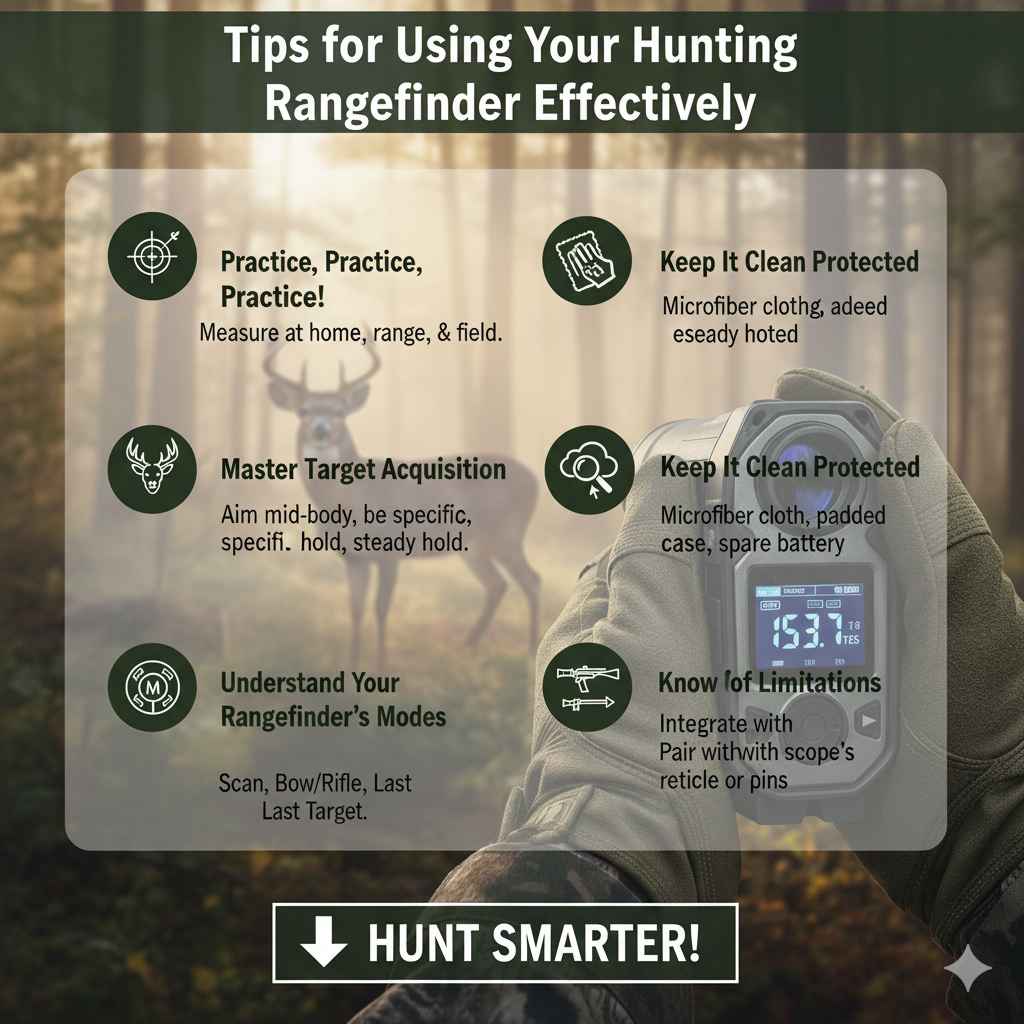
Tips for Using Your Hunting Laser Rangefinder Effectively
Getting a rangefinder is only half the battle; knowing how to use it to its full potential in the field is where the real skill comes in. Here are some practical tips to make sure you’re getting reliable readings and shots.
1. Practice, Practice, Practice!
Don’t wait until opening day to start using your rangefinder. Spend time practicing with it in various situations:
- At home, measure distances to familiar objects in your yard.
- At the shooting range, measure targets at known distances to verify your rangefinder’s accuracy and get a feel for how it performs.
- In familiar hunting areas, practice ranging different terrain features and potential shooting lanes.
2. Master Target Acquisition
Quickly and accurately finding your target is key. Use the magnification to positively identify what you are ranging.
- Aim for the Body: For animals, aim mid-body. This gives you the best chance for a solid reflection and is usually your desired aiming point.
- Be Specific: If you are ranging more than one object, be sure you are getting the reading for the intended target. Avoid ranging the ground in front of an animal or the tall grass beside it.
- Steady Aim: Hold the rangefinder as steady as possible. Tree limbs, shooting sticks, or leaning against a tree can help you achieve a stable hold.
3. Understand Your Rangefinder’s Modes
Many rangefinders have different modes:
- Scan Mode: Excellent for getting an idea of the distances in front of you or tracking moving targets. Hold the button down and sweep across your target area.
- Bow Mode/Archery Mode: This mode typically shows the angle-compensated distance.
- Rifle Mode: May show line-of-sight distance and angle, or have ballistic presets.
- Last Target Mode: Designed to ignore closer objects and prioritize the furthest reading, useful for penetrating light brush.
Always ensure you are in the correct mode for your setup (bow or rifle) and hunting situation before taking a critical shot.
4. Keep It Clean and Protected
Your rangefinder will live a rough life in the field. Protect it:
- Lens Cleaning: Use a microfiber cloth to keep the lenses clean. Dirt and smudges will degrade performance and clarity.
- Protection: A padded case or a neoprene cover will protect it from bumps, scratches, and the elements.
- Battery: Always carry a spare battery, especially on longer trips. A dead battery means a useless rangefinder.
5. Know Your Limitations
Even the best laser rangefinder has limitations. Be aware of where it might struggle:
- Light Conditions: If it’s getting dark, the laser’s effective range diminishes. Your ability to see the display also becomes a challenge.
- Weather: Heavy fog, rain, or snow will significantly impact range and accuracy.
- Steep Angles: While angle compensation helps, extremely steep angles beyond your rangefinder’s capability or your own comfort level might require a different approach or a different shot choice.
6. Integrate with Your Optics
For rifle hunters, understanding how your rangefinder’s data (especially if it offers ballistic solutions) pairs with your rifle scope’s reticle or turrets is vital. For bowhunters, translating the angle-compensated distance to your sight pins is the final step.
The American Hunter magazine often discusses how modern rangefinders are becoming more integrated with ballistic calculators, enhancing their utility for precision rifle shooters.
FAQ: Your Hunting Laser Rangefinder Questions Answered
Q1: What is the most important feature in a hunting laser rangefinder?
For most bowhunters and those in hilly terrain, angle compensation is the most critical feature. It accurately calculates the true horizontal distance, which is essential for making precise shots when shooting uphill or downhill. For long-range rifle hunters, maximum range and accuracy are paramount.
Q2: Can I use a rangefinder to measure through brush?
Generally, no. Laser rangefinders need a clear line of sight. If there are branches, leaves, or tall grass in the way, the rangefinder will measure the distance to the obstruction, not your actual target. Some rangefinders have a “last target” mode that tries to ignore closer objects, but it’s not foolproof. Aim for a clear shot at your target.
Q3: How accurate are hunting laser rangefinders?
Most modern hunting laser rangefinders are very accurate, typically to within +/- 1 yard up to their maximum advertised range. However, this accuracy can be affected by target material, reflectivity, beam diffusion from fog or rain, and the quality of the device itself.