How Is Arrow Spine Measured?
How arrow spine is measured is a crucial aspect of archery, directly impacting arrow flight and accuracy. Understanding this measurement helps archers select the right arrows for their bows, ensuring optimal performance and consistent shooting. This guide will break down the complex world of arrow spine, explaining what it is, how it’s measured, and why it matters for your archery success.
In short, arrow spine is a measure of an arrow’s stiffness, determined by how much it deflects under a specific load. It’s measured by the “spine tester” and is critical for matching arrows to a bow’s draw weight and length to ensure proper flight and accuracy. Correct spine ensures arrows fly true and group tightly.
Key Takeaways
- Arrow spine quantifies an arrow’s stiffness or resistance to bending.
- It’s measured using a spine tester, indicating deflection in inches under a specific weight.
- Correct arrow spine is essential for ensuring arrows fly straight and group tightly.
- Factors like bow draw weight, draw length, and arrow components influence the required spine.
- Understanding spine allows archers to achieve consistent accuracy and predictable arrow flight.
What is Arrow Spine?
Arrow spine refers to the stiffness of an arrow shaft. It’s not about how strong the arrow is in terms of resisting breakage, but rather how much it bends or deflects when a force is applied to it. Think of it like a ruler: a thin, flexible ruler bends easily, while a thick, rigid one resists bending.
An arrow’s spine is its resistance to this bending.
This property is paramount because an arrow must flex correctly as it leaves the bow. When the string is released, it imparts a strong forward impulse. The arrow, being a flexible object, will momentarily grip the bow’s rest or plunger before flying off.
If the arrow is too stiff or too weak for the bow’s power, it will oscillate erratically in flight, leading to poor accuracy.
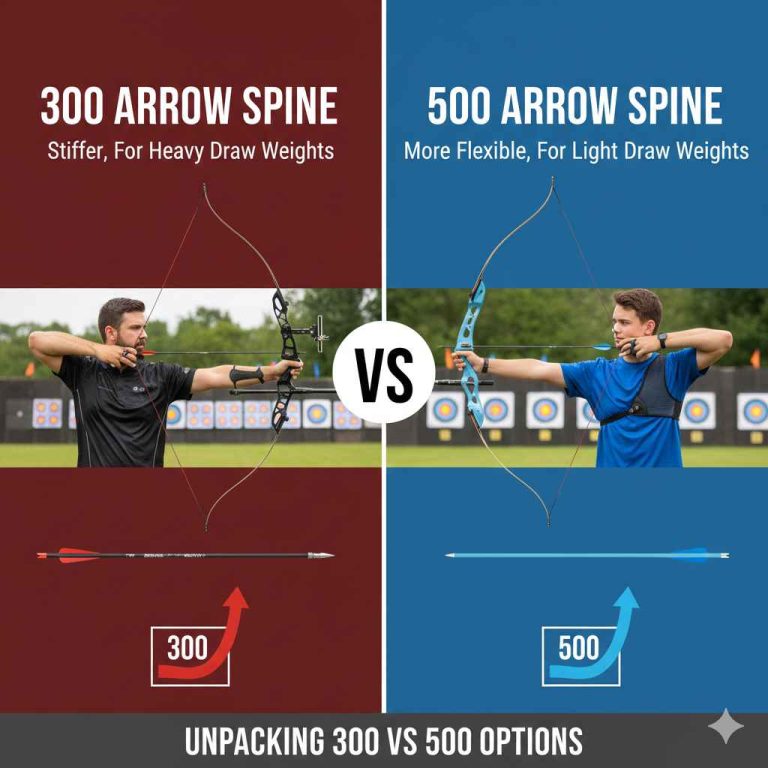
Manufacturers categorize arrows based on their spine rating. This rating is a standardized number that tells you how stiff the arrow shaft is. A higher number generally indicates a stiffer arrow, while a lower number suggests a more flexible shaft.
Choosing the correct spine is a balancing act, ensuring the arrow flexes just enough to clear the riser and shoot straight.
How is Arrow Spine Measured?
The standard method for measuring arrow spine involves a specialized tool called a spine tester. This device consists of a frame that holds the arrow horizontally, supported at two points 28 inches apart. A weight, typically 1.94 pounds (or 880 grams), is then hung from the center of the arrow shaft.
The amount the arrow deflects or bends under this specific load is the measurement of its spine.
The deflection is usually measured in thousandths of an inch. For example, an arrow that deflects 0.500 inches would have a spine rating of 500. This is the most common way arrow spine is expressed in the archery world.
However, it’s important to note that different manufacturers might use slightly different testing procedures or even different weight loads, which can lead to minor variations in spine ratings.
While the 28-inch standard and 1.94-pound weight are widely adopted, it’s wise to consult the specific manufacturer’s guidelines for their arrows. Some manufacturers might also provide a “dynamic spine” rating, which takes into account how the arrow behaves when shot from a specific bow. This dynamic spine is often a more accurate representation of an arrow’s flight characteristics.
The Spine Tester Process
- Setup: The spine tester is set up with its two support points precisely 28 inches apart.
- Arrow Placement: An arrow is placed horizontally across these two support points, ensuring it is balanced.
- Weight Application: A calibrated weight (typically 1.94 lbs) is carefully attached to the center of the arrow shaft.
- Deflection Measurement: The amount the arrow bends downward from its original horizontal plane is precisely measured. This deflection, in thousandths of an inch, is the arrow’s spine rating.
Why Arrow Spine Matters for Accuracy
The spine of an arrow is arguably the most critical factor influencing its in-flight performance and, consequently, your accuracy. When an arrow is shot, it doesn’t fly perfectly rigid. Instead, it needs to flex as it leaves the bowstring and passes over the arrow rest or plunger button.
This controlled flex, known as “porpoising” or “whip,” allows the arrow to momentarily grip the launcher, then spring away cleanly.
If an arrow is too stiff for the bow, it won’t bend enough to clear the rest or the bow’s riser. This improper flex causes the arrow to wobble violently as it travels towards the target, severely impacting accuracy. The arrow will likely hit to the left or right of your intended point of aim, with inconsistent results.
This is often referred to as an arrow having “too much spine” or being “overspined.”
Conversely, if an arrow is too flexible for the bow (an “under-spined” arrow), it will bend excessively. While it might clear the riser, it will also oscillate up and down, or side-to-side, in a pronounced manner. This leads to arrows hitting erratically high or low, or left and right.
The ideal scenario is an arrow that flexes just the right amount to fly true, exhibiting minimal wobble and consistent grouping. This is why matching the arrow spine to your bow’s specifications is non-negotiable for any archer seeking precision.
| Arrow Spine Condition | Effect on Flight | Likely Outcome |
|---|---|---|
| Over-spined (Too Stiff) | Insufficient flex to clear riser/rest. | Erratic left/right misses, tight groups but off-center. |
| Under-spined (Too Flexible) | Excessive flex, pronounced oscillation. | Inconsistent vertical or horizontal misses, wide groups. |
| Correctly Spined | Optimal flex for clean release and stable flight. | Accurate, tight groupings, predictable arrow flight. |
Matching your arrow spine to your bow’s specifications is fundamental for achieving consistent shot placement.
Factors Influencing Required Arrow Spine
Selecting the correct arrow spine isn’t just about a single number; it’s about how that number interacts with your specific archery setup. Several key factors come into play, and understanding them is crucial for making an informed choice. The primary variables are the bow’s draw weight and your personal draw length, but other components also play a significant role.
The bow’s draw weight is the force required to pull the string back to your full draw. A heavier draw weight means more energy is transferred to the arrow, requiring a stiffer arrow shaft to handle that energy without excessive flexing. Conversely, a lighter draw weight transfers less energy, necessitating a more flexible arrow.
Manufacturers provide spine charts that correlate bow draw weight with recommended arrow spine.
Your draw length is just as important. A longer draw length means the string travels a greater distance and accelerates the arrow for longer. This increased acceleration puts more force on the arrow, meaning a longer draw length typically requires a stiffer arrow (higher spine number) compared to a shorter draw length at the same draw weight.
The arrow needs to be stiff enough to resist bending from the longer, more powerful pull.
Key Influencing Factors:
- Bow Draw Weight: Higher draw weight demands stiffer arrows.
- Archer’s Draw Length: Longer draw lengths require stiffer arrows.
- Arrow Length: Longer arrows are inherently more flexible; shorter arrows are stiffer.
- Arrow Point Weight: Heavier points add forward mass, which effectively increases the arrow’s stiffness (making it act more like an over-spined arrow).
- Arrow Insert Type: Different insert materials and designs can subtly affect stiffness.
- String Material and Nocks: The speed and force imparted by the string, and the type of nock used, can influence dynamic spine.
Tip: When in doubt, always start with the manufacturer’s spine chart for your bow and consider using a slightly heavier arrow point than you initially think you need, as this can help “tune” an arrow that might be borderline.
Choosing the Right Arrow Spine
Selecting the correct arrow spine involves consulting charts, understanding your equipment, and sometimes, a bit of trial and error. The first step is to identify your bow’s peak draw weight and your actual draw length at full draw. These two pieces of information are the foundation for determining the appropriate spine range.
Once you have your draw weight and draw length, you can refer to the spine charts provided by arrow manufacturers. These charts typically show a range of draw weights and draw lengths, with corresponding recommended spine sizes. For instance, a bow set at 60 lbs with a 29-inch draw length might require a spine rating of 400, while the same bow at 30 inches might need a 350 spine.
It’s also essential to consider the weight of your arrow points. A heavier point will make an arrow fly as if it were stiffer. If your chosen arrow spine is borderline, using a heavier point can compensate and bring it into the correct dynamic spine range.
Conversely, a lighter point would make a borderline arrow fly as if it were more flexible.
A Step-by-Step Approach to Spine Selection:
- Determine Your Bow’s Specs: Note the peak draw weight (e.g., 60 lbs) and your true draw length (e.g., 29.5 inches).
- Consult Spine Charts: Find a reputable manufacturer’s spine chart. Locate your draw weight and draw length on the chart to find the recommended spine range.
- Consider Arrow Length: Remember that arrow length also affects spine. Longer arrows are more flexible. You’ll cut your arrows to length after selecting the spine.
- Factor in Point Weight: Note the weight of the broadheads or field points you intend to use. Heavier points (e.g., 125 grains) require stiffer arrows than lighter points (e.g., 100 grains).
- Make Your Selection: Choose an arrow spine that falls within the recommended range, adjusting for point weight and preferred arrow length.
- Test and Tune: Even with careful selection, some minor tuning might be necessary. Small adjustments to the arrow rest or plunger can fine-tune flight.
Important: Arrow length is critical. Always measure your draw length accurately. A common method is to measure from the nocking point on the string to the deepest part of your grip on the bow riser, then add 1.75 inches.
Dynamic Spine vs. Static Spine
When discussing arrow spine, you’ll encounter two main terms: static spine and dynamic spine. Static spine is the measurement taken when the arrow is at rest, under the controlled conditions of a spine tester, as described earlier. It’s a standardized, objective measure of the arrow shaft’s inherent stiffness.
Dynamic spine, on the other hand, is a much more practical and realistic measure of how the arrow behaves when it’s actually shot from your bow. It takes into account all the variables: the bow’s energy, the arrow’s weight and stiffness, the arrow’s length, the point weight, and how the arrow flexes and interacts with the bow during the shot cycle. Dynamic spine is what ultimately determines how an arrow flies.
An arrow might have a static spine rating that seems perfect according to a chart, but when shot, it might fly poorly. This indicates a mismatch in dynamic spine. Conversely, an arrow that’s slightly outside the “ideal” static spine range might fly perfectly because its dynamic spine is correctly matched to the bow.
This is why a full “tune” of your archery equipment is often necessary.
Understanding the Difference:
- Static Spine:
- Measured under controlled laboratory conditions.
- Standardized for comparison across different shafts.
- Reflects inherent stiffness of the shaft material.
- Provided by arrow manufacturers.
- Dynamic Spine:
- Observed behavior of the arrow during an actual shot.
- Influenced by bow, archer, and arrow components.
- Determines real-world flight characteristics and accuracy.
- Achieved through proper tuning.
Tuning Your Arrows for Optimal Flight
Once you’ve selected an arrow spine that falls within the recommended range for your bow, the next crucial step is tuning. Tuning is the process of making fine adjustments to your archery equipment to ensure your arrows are flying as straight and true as possible. This process focuses on achieving the correct dynamic spine and ensuring the arrow clears the bow cleanly.
A common method for tuning involves using a paper tuning jig or observing arrow flight directly. Paper tuning involves shooting an arrow through a piece of paper held taut a few feet in front of the bow. The way the paper tears indicates how the arrow is flying.
A clean, vertical tear suggests good flight, while horizontal tears indicate issues with spine or rest alignment. Adjustments are then made to the arrow rest or the bow’s center shot.
Another aspect of tuning is “bare shaft tuning,” where you shoot unfletched arrows. These arrows are more sensitive to imperfections in flight. Once bare shafts are flying straight, you then add fletching.
If the fletched arrows then fly erratically, it suggests an issue with the fletching or glue. This meticulous process ensures every arrow you shoot performs optimally.
Common Tuning Adjustments:
- Arrow Rest Adjustment: Fine-tuning the height and lateral position of the arrow rest.
- Bow’s Center Shot: Adjusting the outward or inward angle of the arrow rest to ensure the arrow passes through the center of the riser.
- Tiller Adjustment: Balancing the limb tension for consistent arrow launch.
- Nock Point/D-Loop Adjustment: Ensuring the arrow nocks onto the string at a consistent angle.
- Limiting Dynamic Spine: Sometimes, adding a heavier point or switching to a slightly stiffer arrow is the ultimate “tune.”
Warning: Never shoot an arrow that is significantly under-spined. An extremely flexible arrow, when shot from a powerful bow, can potentially break upon release, leading to injury to the archer or damage to the bow. Always err on the side of slightly stiffer if you’re unsure.
Factors Affecting Dynamic Spine
While static spine gives you a starting point, dynamic spine is the true measure of an arrow’s flight. Several factors influence how an arrow behaves dynamically as it leaves the bow. Understanding these elements helps in fine-tuning your setup for maximum accuracy.
The speed at which the arrow is launched is a major determinant. A faster arrow has less time to oscillate and needs to be stiffer to maintain its trajectory. This is why higher-speed bows often require stiffer arrows, even at the same draw weight and length, compared to slower bows.
The shape of the bow’s cam system also plays a role. Modern compound bows with aggressive cams store and release energy very rapidly. This sharp energy transfer can put more stress on the arrow, demanding a stiffer shaft to manage the impulse effectively.
Recurve bows, with their smoother power stroke, might allow for slightly more flexibility in arrow choice.
| Factor | Impact on Dynamic Spine | Consideration |
|---|---|---|
| Arrow Speed | Higher speed requires stiffer dynamic spine. | Fast bows need stiff arrows. |
| Bow Cam Type | Aggressive cams impart sharper energy; require stiffer arrows. | Consider the bow’s power delivery profile. |
| Arrow Length | Longer arrows are more flexible; shorter arrows are stiffer. | Adjust spine for your desired cut length. |
| Arrow Point Weight | Heavier points increase forward mass, increasing effective stiffness. | Can “stiffen up” a borderline arrow. |
| Fletching Size | Larger fletching can add drag, slightly affecting flight path. | Less of an impact on spine, but affects aerodynamics. |
These elements combine to create the dynamic spine, dictating how your arrow interacts with the bow and air during flight.
Frequently Asked Questions
What is a good arrow spine for a 50 lb recurve bow?
For a 50 lb recurve bow, the ideal spine will depend on your draw length and arrow point weight. Generally, you’ll be looking in the 400-500 spine range for typical draw lengths (28-30 inches) and standard point weights (100-125 grains). Always consult the manufacturer’s specific spine chart for your bow and arrow model.
Can I use an arrow with the wrong spine?
While you might be able to shoot an arrow with the wrong spine, it is not recommended. An over-spined arrow will likely fly erratically and hit off-center, impacting accuracy. An under-spined arrow can be dangerous if it breaks upon release.
Matching the correct spine is crucial for performance and safety.
How does arrow length affect spine?
Arrow length significantly affects spine. A longer arrow is inherently more flexible because the force is applied over a greater length, causing more deflection. Conversely, a shorter arrow is stiffer.
This is why spine charts take arrow length into account, and why you might need a stiffer spine for a longer arrow or a more flexible spine for a shorter arrow, all other factors being equal.
What is the difference between static spine and dynamic spine?
Static spine is the measured stiffness of an arrow shaft under controlled conditions (e.g., 1.94 lb weight on a 28-inch span). Dynamic spine is how the arrow behaves and flexes in real-time when shot from your specific bow. Dynamic spine is the more critical factor for actual arrow flight and accuracy.
How do I know if my arrows are properly spined?
The best way to tell if your arrows are properly spined is through shooting and tuning. Observe your arrow groups: if they are tight but consistently hitting off-center, it might indicate over-spining. If your groups are wide and erratic, it could suggest under-spining.
Paper tuning or walk-back tuning are excellent methods to diagnose and correct spine issues.
Final Thoughts
Understanding how arrow spine is measured and why it’s critical unlocks a new level of precision in archery. By correctly matching your arrow spine to your bow’s specifications, considering factors like draw length and point weight, and performing proper tuning, you ensure your arrows fly true. This attention to detail directly translates into tighter groups, increased confidence, and a more rewarding archery experience.