Reverse Draw vs Standard Crossbows: Key Differences
Reverse draw crossbows place the limbs closer to the shooter and usually give a shorter, quieter, more balanced bow. Standard crossbows are often simpler, wider, and cheaper; pick Reverse draw for tight blinds and premium hunting setups, standard crossbows for lower budgets and straightforward use. Choose wrong and you may end up with a bow that is too wide, too front-heavy, or harder to tune for your hunting style. This guide compares speed, balance, noise, size, price, and field fit so you can choose the right design.
| Factor | Reverse draw | standard crossbows | Winner |
|---|---|---|---|
| Speed potential | Longer power stroke can help arrow velocity and energy transfer. | Can still be fast, but usually has less stroke length to work with. | Reverse draw |
| Balance and feel | Often more balanced and less front-heavy. | More likely to feel front-heavy because of the forward limb layout. | Reverse draw |
| Cost | Usually higher priced, especially in feature-rich packages. | Generally less expensive. | standard crossbows |
| Maintenance | Can be more complex to service because of the layout and parts access. | Usually easier to maintain. | standard crossbows |
| Compact field use | Can be shorter overall and easier to manage in tight spaces. | Often longer and a little less forgiving in cramped setups. | Reverse draw |
| Noise and vibration | Some designs shoot quieter with less vibration. | Can be quiet enough, but often gives up a little in recoil feel and sound. | Reverse draw |
| Beginner friendliness | Good if the buyer wants premium handling and accepts more cost. | Better for a simple first setup and easier upkeep. | standard crossbows |
| Overall value | Best when the shooter will use the balance, compactness, and quieter shot. | Best when price and simple ownership matter most. | Tie |
How limb placement changes power stroke and balance
Reverse draw crossbows place the limbs toward the rear of the weapon, behind the riser, while standard crossbows keep the limbs at the front. That layout change is not cosmetic. It affects power stroke, balance, overall length, noise, and how the bow handles in the field.
The main practical difference is where the design puts its efficiency. A longer power stroke can help a bow send the arrow faster with efficient energy transfer, while a traditional forward-limb layout usually keeps the build simpler and cheaper. That makes the choice more about fit than fashion.
Reverse draw layout
Reverse draw designs can provide a longer power stroke than regular crossbows. They are also described as more balanced and comfortable to handle, and some are shorter overall than traditional models. That combination matters when the hunter wants a steadier hold without a long, nose-heavy platform.
Standard layout
Standard crossbows use the traditional forward limb layout. The appeal is straightforward: fewer moving parts, easier maintenance, and lower entry cost. For many buyers, that is the best trade if the bow will be used often but not pushed into specialized, tight-space hunting.
Are reverse draw crossbows faster than standard crossbows?
Often, yes, but not automatically. Reverse draw designs can use a longer power stroke, which usually helps arrow velocity, but speed still depends on draw weight, cam design, arrow mass, and how efficiently the bow transfers energy. Raw feet per second is only one part of the decision.
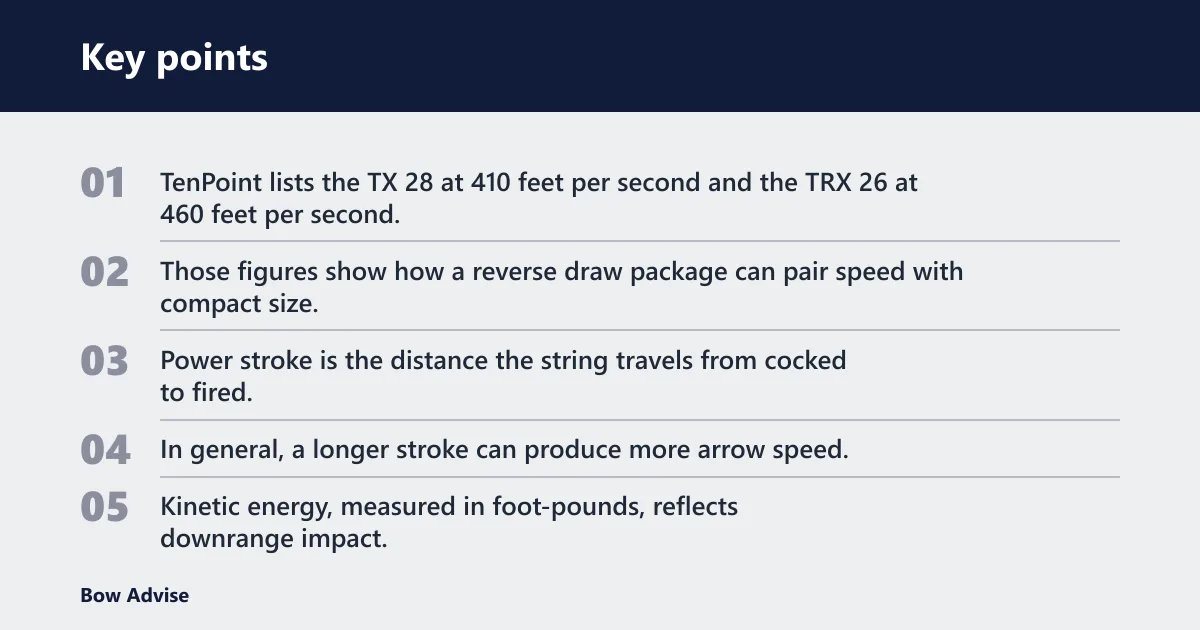
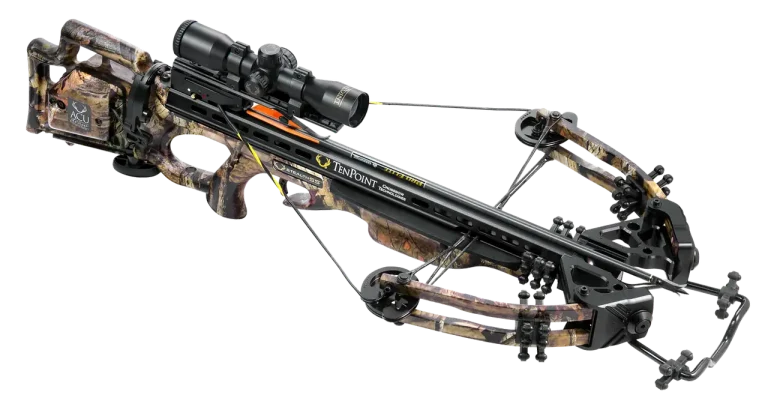
TenPoint lists the TX 28 at 410 feet per second and the TRX 26 at 460 feet per second, with the TRX 26 measuring 26.5 inches long. Those figures show how a reverse draw package can pair speed with compact size, but they do not make speed the only thing that matters for a buyer.
Power stroke, draw weight, and kinetic energy
Power stroke is the distance the string travels from cocked to fired. In general, a longer stroke can produce more arrow speed, and draw weight also affects cocking effort and performance. Kinetic energy, measured in foot-pounds, reflects downrange impact, so a fast bow is only useful if it carries enough energy for the shot distance and game. (Wikipedia)
TenPoint lists the TRX 26 at 193 foot-pounds of kinetic energy with 410-grain arrows. That number matters because speed alone can look better than it is if the arrow choice is poor or the bow is tuned for velocity instead of consistency.
Why speed numbers need context
A common first-timer mistake is chasing the highest feet-per-second number and ignoring the rest of the setup. A bow that is faster on paper may also be louder, more expensive, or harder to hold steady in a blind. In hunting, those trade-offs can matter more than a small speed gap.
Which crossbow is quieter, reverse draw or standard?
Reverse draw crossbows are often quieter and can feel smoother because some of the limb motion and vibration are spread differently through the platform. That does not mean every reverse draw bow is silent, or that every standard bow is loud. It means the layout can help reduce noise and vibration when the design is built well.
Noise and vibration matter because they affect follow-through, confidence, and how much the shot jars the bow in the hand. A quieter shot can be useful in close-cover hunting or when the setup is already limiting movement. Still, a well-tuned standard crossbow can be quiet enough for many hunters.
Recoil and follow-through
Do reverse draw crossbows have less recoil? Often they feel that way, because the balance and limb geometry can soften the shot. That said, recoil feel is not the same as absolute performance. Bolt weight, tune, and limb setup still shape how the shot lands in the hand.
Suppose a hunter is in a roughly 6-by-6-foot blind with a very quiet setup requirement. A reverse draw bow with a compact frame and reduced vibration may make the shot easier to manage than a heavier, more front-loaded option. If the blind is roomy and the budget is tight, a standard crossbow may still be the smarter buy.
Cost, maintenance, and cocking systems
Why are reverse draw crossbows more expensive? The design usually costs more in components and package pricing, and that higher price often tracks with the more complex layout and the performance features buyers expect. The guide describes standard crossbows as often less expensive and easier to maintain, which can matter if the bow will see regular use and occasional rough handling.
Cocking and de-cocking systems also change the buying decision. A good system can make a heavier bow easier to live with, improve safety, and reduce handling stress. Buyers should compare the whole package, not just the limbs and frame.
Maintenance and access
Is a standard crossbow easier to maintain than a reverse draw? Usually yes. The simpler forward-limb layout often means easier access for inspection and service, while reverse draw systems can require more attention to cable routing and parts access. That does not make reverse draw fragile; it just makes ownership more demanding.
Why price rises with reverse draw
Higher cost is not only about speed. Reverse draw packages often include more premium parts, tighter packaging, and features that appeal to hunters who want quieter shooting or a more balanced hold. Buyers who will not use those advantages may be paying for capability they never notice.
Crossbow comparison matrix
This matrix turns the design debate into a buying choice. The better option changes with the shooter, the hunting setup, and how much maintenance the owner is willing to handle.
| Buyer scenario | Better design | Why it wins | One caveat |
|---|---|---|---|
| Beginner | standard crossbows | Simpler build, easier maintenance, and usually lower cost make the first purchase less risky. | May feel more front-heavy than a reverse draw bow. |
| Budget buyer | standard crossbows | Generally less expensive, with fewer premium features baked into the package. | May give up some balance and quietness. |
| Treestand hunter | Reverse draw | Shorter overall length and better balance can help in a confined stand. | Check cocked length and rail clearance before buying. |
| Blind hunter | Reverse draw | Compact handling and a steadier feel help in tight blind windows. | Some blinds still make width more important than length. |
| Small-framed shooter | Reverse draw | More balanced feel can make the bow easier to hold and aim. | The cocking effort may still be substantial. |
| Quiet-hunt buyer | Reverse draw | Many designs shoot quieter with less vibration. | Quiet depends on setup, bolts, and tuning. |
| Accuracy-first buyer | Tie | Either design can shoot very well if the bow is tuned, the optic is solid, and the bolts are consistent. | Field accuracy depends more on setup than limb direction alone. |
| Maintenance-first buyer | standard crossbows | Generally easier to inspect, service, and keep simple over time. | Basic upkeep still matters on any crossbow. |
Beginner
Which design is better for beginners? Standard crossbows usually win because they are simpler, cheaper, and easier to maintain. A new shooter already has enough to learn about optics, bolts, safety, and cocking method, so less mechanical complexity is a real advantage.
Budget buyer
Budget buyers should lean standard crossbows unless the reverse draw package offers a specific feature they will truly use. Price can determine best fit more than raw speed. If the bow costs more but the hunter never notices the balance or quietness advantage, the premium is wasted.
Treestand and blind hunters
Which crossbow is better for tree stand hunting? Reverse draw often has the edge because it can be shorter overall and easier to manage in cramped positions. The same logic helps in blinds, where rail length, side clearance, and limb space can matter more than the maximum velocity rating.
Picture a treestand with a narrow shooting rail and limited elbow room. A shorter reverse draw bow can be easier to move without bumping the stand, while a longer standard bow may force awkward angles. The reverse draw advantage is real only if the cocked bow still fits the space.
Small-framed shooter
Reverse draw can work well for smaller shooters because the balance often feels less front-heavy. That steadier feel can make aiming more comfortable, especially with heavier accessories on the bow. The caveat is that cocking effort does not disappear, so a bow with a de-cocking system or cocking aid may matter more than the limb layout alone.
Quiet-hunt and accuracy-first buyers
Hunters who care about stealth often prefer reverse draw because reduced noise and vibration can help the shot feel calmer. Accuracy-first buyers, however, should not assume one design is more precise by itself. Broadhead choice, bolt consistency, scope quality, and trigger control have a larger effect than the limb layout alone.
Choose Reverse draw if… / Choose standard crossbows if…
Choose Reverse draw if you hunt from a tight treestand or blind, want a shorter and more balanced bow, care about reduced noise and vibration, and are willing to pay more for the package. Choose standard crossbows if you want a lower-cost setup, simpler maintenance, and a straightforward first crossbow that is easy to live with.
What should you inspect before buying either one? Check the cocked length, axle-to-axle width, cocking method, de-cocking system, and how the bow feels on target. Handle both if possible. A bow that looks ideal on paper can still be awkward if it is too wide, too heavy in the front, or hard to cock safely.
- Confirm the bow fits your blind or treestand space.
- Compare cocking and de-cocking systems, not just velocity.
- Check the listed width when cocked and overall length.
- Ask how maintenance and string/cable access work.
- Compare package price, not just the bare bow.
- Hold both designs before buying if possible.

Frequently asked questions
What is the difference between a reverse draw crossbow and a standard crossbow?
Reverse draw crossbows place the limbs toward the rear of the weapon, while standard crossbows keep the limbs at the front. That layout changes power stroke, balance, overall length, and sometimes noise. The choice is less about labels and more about how the bow fits the hunt and the shooter.
Are reverse draw crossbows more accurate than standard crossbows?
Not by design alone. Accuracy depends heavily on setup, bolt consistency, optic quality, trigger control, and shooter form. A reverse draw bow may feel steadier, but a tuned standard crossbow can shoot just as well in the field.
Why are reverse draw crossbows more expensive?
They usually cost more because the design is more complex and often includes premium features, tighter packaging, and higher-end components. Package price matters here. Buyers pay for balance, compact handling, and performance potential, not only for the limb layout.
Which design is better for beginners?
Standard crossbows are usually better for beginners because they are simpler and easier to maintain. New shooters benefit from a bow that is less expensive, easier to inspect, and less demanding to own. A reverse draw bow makes more sense only if the buyer already knows the premium features will matter.