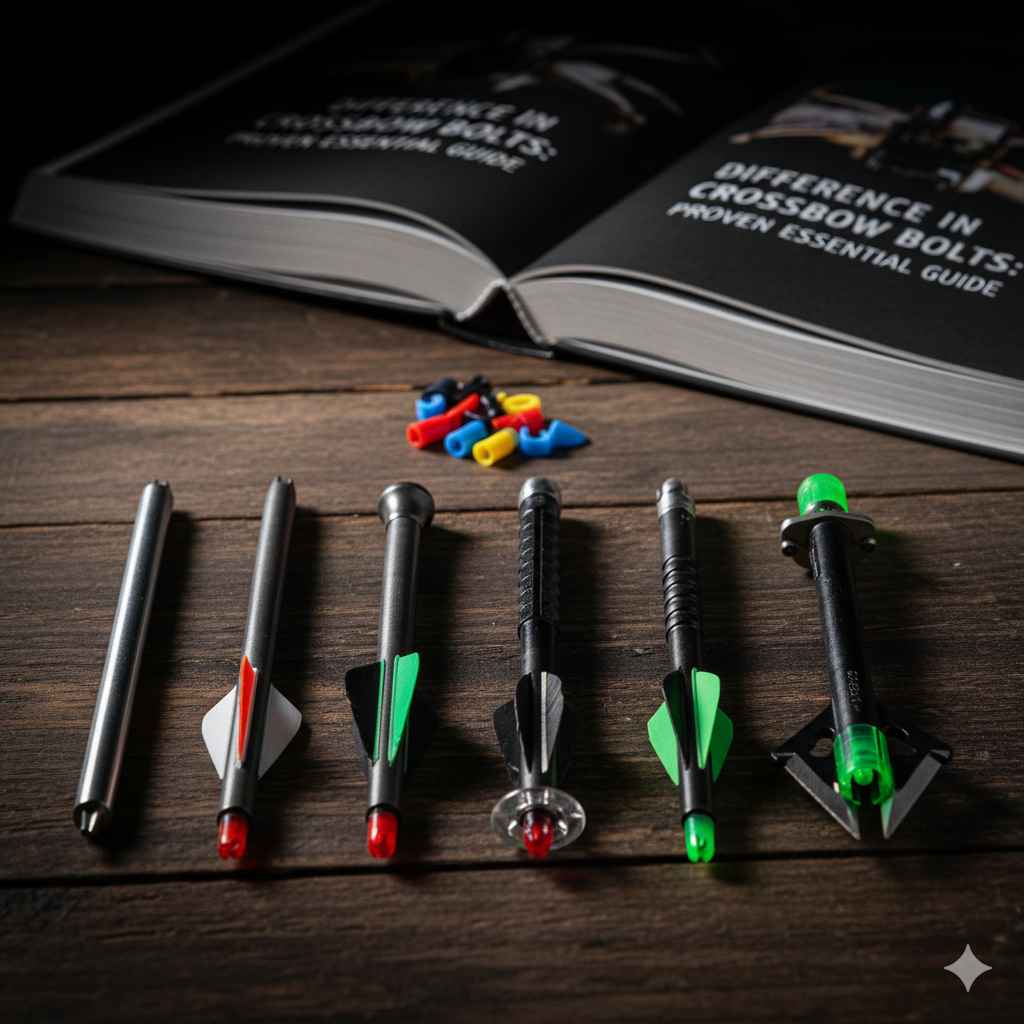
The main difference in crossbow bolts comes down to material (carbon vs. aluminum), diameter (standard vs. micro), spine rating, and weight. Choosing the right combination is essential for accuracy, safety, and matching your crossbow’s power specifications perfectly.
Welcome to the exciting world of crossbow shooting! As a beginner, you might feel a little lost looking at all the arrows—or bolts—lined up at the pro shop. It seems like they are all the same, but making the wrong choice can mean poor accuracy or, worse, damaged equipment. Don’t worry! Understanding the difference in Crossbow Bolts is simpler than it looks. I’m here to break down the confusing terms into easy steps. We will look at what makes one bolt better for your bow than another. By the end of this guide, you’ll choose bolts with total confidence. Let’s get started making your shots count!
Decoding Crossbow Bolts: Why Choosing the Right One is Non-Negotiable
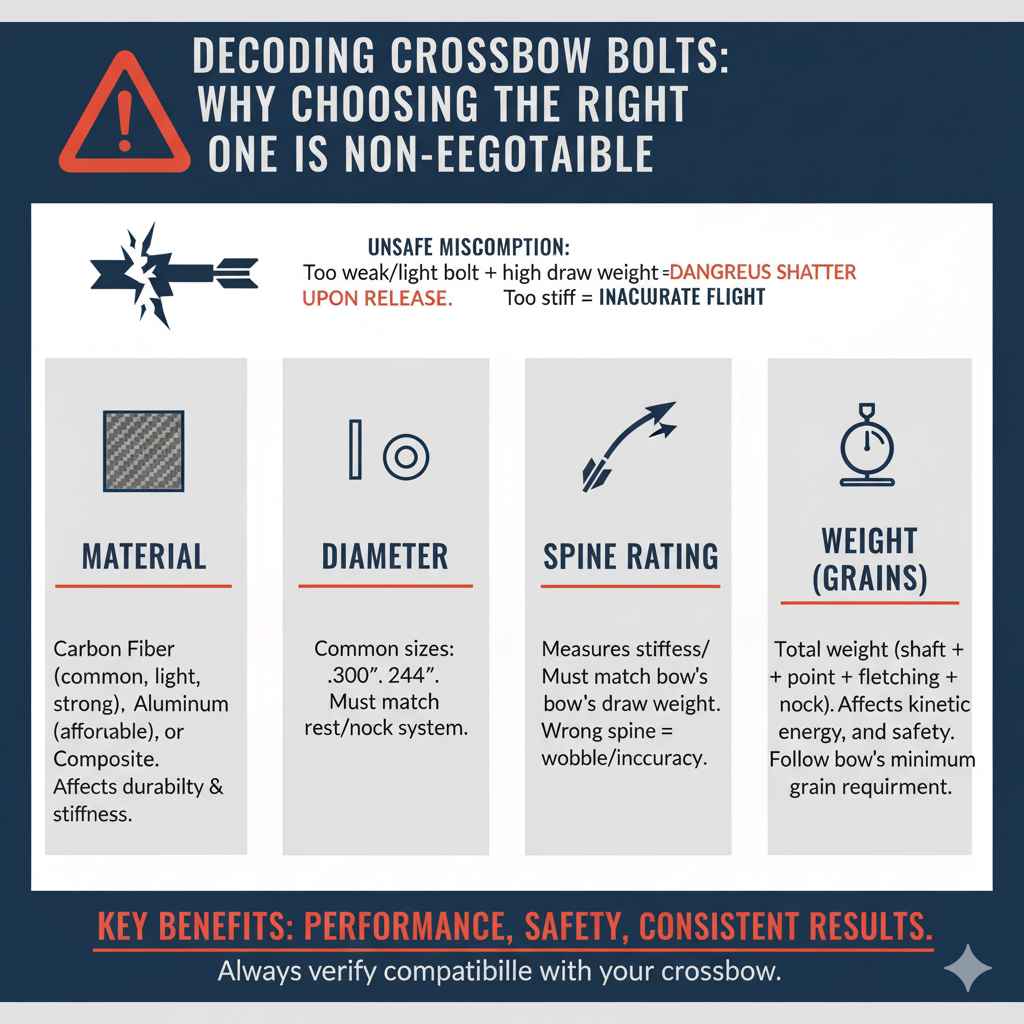
When you first start, you might think any arrow will work in any crossbow. That’s a common—and potentially unsafe—misconception. A crossbow bolt is not just a stick with feathers; it’s a finely tuned piece of equipment designed to work perfectly with the specific energy and power of your bow. If the bolt is too weak or too light for your crossbow’s draw weight, it can shatter upon release, leading to dangerous situations. Conversely, a bolt that is too stiff won’t fly straight, ruining your chance at a tight grouping.
Understanding the key differences ensures you get the best performance, maximum safety, and consistent results every time you practice. We need to look closely at four main areas:
- Material
- Diameter
- Spine Rating
- Weight (Grains)
Let’s explore each factor so you know exactly what to ask for when buying your next set of bolts.
Material Matters: Carbon vs. Aluminum vs. Hybrids
The material your bolt is made from affects its durability, weight, and how it reacts to the force of your crossbow. For most modern shooters, the choice boils down to two main options: carbon and aluminum.
Carbon Crossbow Bolts: The Modern Standard
Carbon bolts are extremely popular today. They are the go-to choice for most hunters and target shooters using modern compound crossbows.
Pros of Carbon Bolts:
- Durability: Carbon is incredibly strong and resistant to bending. If you shoot a target and miss, carbon is less likely to be permanently damaged than aluminum.
- Consistency: Carbon bolts tend to maintain their straightness better over time, leading to more consistent shooting groups.
- Weight: They are generally lighter than comparable aluminum bolts, which can lead to faster speeds, although this depends on the overall design.
Cons of Carbon Bolts:
- Cost: High-quality carbon bolts are usually more expensive upfront than aluminum.
- Brittleness: While strong, when carbon does fail, it tends to shatter or splinter rather than bend. Always inspect carbon bolts closely for cracks after a hard impact.
Aluminum Crossbow Bolts: The Reliable Classic
Aluminum bolts have been used for decades and are still a great, budget-friendly option, especially for beginner setups or older crossbow models.
Pros of Aluminum Bolts:
- Straightening: If you hit something hard, aluminum often bends rather than breaks. A bent aluminum shaft can sometimes be carefully straightened for continued (though perhaps less precise) use.
- Cost: They are typically the most affordable option, making them great for high-volume practice sessions where you might lose or damage a few bolts.
Cons of Aluminum Bolts:
- Weight: They are often heavier than carbon, which might slightly reduce velocity on some bows.
- Durability: They are more prone to bending or denting during transport or hard impacts, which immediately ruins their flight characteristics.
Hybrid Bolts (Carbon-Wrapped Aluminum)
These bolts try to offer the best of both worlds—the spine consistency and straightness of an aluminum core wrapped in durable carbon fiber. They offer excellent performance but usually come with a premium price tag.
Coach Salman’s Tip: For a beginner moving up to a modern, high-speed crossbow (over 350 FPS), carbon is usually the recommended and safest route due to its superior spine consistency and strength ratings.
Diameter Matters: Standard vs. Micro Diameter Bolts
The physical width, or diameter, of the bolt shaft is another crucial factor that dictates how it interacts with the crossbow’s rail and string.
Standard Diameter Bolts (Approx. 0.422 inches)
These are the traditional, wider bolts. They are robust and work well with older or lower-poundage crossbows. Because of their larger surface area, they offer a bit more forgiveness if your spine rating isn’t perfectly matched.
Micro Diameter Bolts (Approx. 0.300 inches or less)
These are the newer, slimmer bolts often seen with high-performance crossbows (those shooting 400 FPS and above). The main reason for shrinking the diameter is aerodynamics and speed. A narrower bolt creates less air resistance, allowing it to travel faster and flatter over long distances.
Why Diameter Affects Safety and Performance:
- Rail Fit: You absolutely must use the diameter specified by your crossbow manufacturer. A bolt that is too thin might sit loosely in the track or rest, leading to instability upon release.
- Speed Rating: High-speed bows generate massive energy. They often require the stiffer structure of a micro-diameter bolt to handle that force without flexing dangerously.
- String Clearance: The string must smoothly clear the bolt shaft. Using the wrong diameter can cause the string to “hang up” or strike the shaft incorrectly, drastically affecting accuracy and potentially causing damage.
Always check your crossbow manual! Manufacturers are very specific about the minimum and maximum bolt diameter they approve for use with their model. Using the wrong size is a quick way to void warranties and risk safety.
The Crucial Factor: Understanding Spine Rating
This is perhaps the most technically important aspect of choosing a bolt, and often the most confusing for newcomers. The spine rating tells you how stiff the bolt is.
What is Spine Rating?
Spine is a measurement of an arrow’s stiffness. In traditional archery (recurve and compound bows), spine is measured by how much the arrow deflects when a weight is hung in the middle. For crossbows, the measurement is slightly different but the principle remains: A higher spine number means a stiffer shaft, and a lower spine number means a more flexible shaft.
Crossbow bolts typically use spine ratings like 300, 340, 350, or 400. Note that for crossbows, these numbers are often the opposite of traditional archery ratings—a lower number means a stiffer bolt.
Why Spine Must Match Your Crossbow
When the crossbow string snaps forward, it pushes the bolt instantly. The bolt must be stiff enough to resist bending under this massive, instantaneous force. If the bolt is too flexible (too low a spine number for your bow):
- It can flex too much around the rail.
- It can hit the riser or the rail on the way out.
- In extreme cases with very powerful crossbows, it can break mid-flight.
If the bolt is too stiff (too high a spine number):
- It won’t react correctly to the string’s energy transfer.
- It may fly inconsistently, resulting in poor accuracy.
How to Find Your Required Spine:
Manufacturers provide a chart showing which spine rating is appropriate based on your crossbow’s draw weight (measured in pounds) and the bolt’s length. For instance, a 185-pound bow shooting a 20-inch bolt might require a 400-spine bolt, while a 225-pound bow shooting the same length might require a 340-spine bolt.
Always consult your crossbow manufacturer’s specifications. For example, manufacturers often base their recommendations on data found by testing bodies like the Archery Trade Association. You can often find these charts easily online by searching for “[Your Crossbow Model] recommended spine chart.”
Weighting It Up: Grains and F.O.C.
The final major difference is weight, measured in grains (a tiny unit of weight). Bolt weight has a huge impact on two things: speed and kinetic energy.
Total Bolt Weight (Grains)
The total weight includes the shaft, inserts, fletching, and the tip (point or broadhead). Crossbow bolts generally weigh more than traditional arrows because they need more mass to handle the crossbow’s power.
- Lighter Bolts: Travel faster, offering a flatter trajectory. However, they carry less kinetic energy downrange and are more susceptible to wind drift.
- Heavier Bolts: Travel slower, resulting in a more parabolic (arcing) trajectory. Crucially, they retain more energy upon impact, which is vital for ethical hunting.
Safety Note: Never use a bolt significantly lighter than what your manufacturer recommends. Modern high-speed crossbows are timed precisely around a minimum recommended bolt weight. Using a very light bolt can cause “dry firing” symptoms, even if the bolt leaves the string, because the crossbow senses too little resistance, potentially damaging the limbs or cams.
Front of Center (F.O.C.) Balance
F.O.C. is the balance point of the bolt, expressed as a percentage. It is calculated based on where the total weight is concentrated relative to the bolt’s total length. For stable flight, the weight needs to be heavily concentrated toward the front (the tip).
A high F.O.C. (usually 10% to 15% is ideal for hunting) ensures the bolt recovers quickly from any wobble during launch and flies true. When you change from a field point to a broadhead, you change the F.O.C., which is why you must always re-zero your crossbow when switching tip types.
Comparing Key Crossbow Bolt Specifications
To make this easy to visualize, here is a comparison table summarizing the primary factors that define the difference in Crossbow Bolts:
| Specification | What It Measures | Beginner Impact | Why It Matters |
|---|---|---|---|
| Material | Carbon, Aluminum, or Hybrid composition. | Durability and cost comparison. | Affects strength, lifespan, and shattering risk. |
| Diameter | The width of the shaft (e.g., 0.422″ vs. 0.300″). | Must match the crossbow rail specifications. | Affects fit on the track and aerodynamics. |
| Spine Rating | Stiffness of the shaft (e.g., 340, 400). | Crucial for safe and accurate launch dynamics. | Too weak = dangerous flex; too stiff = poor grouping. |
| Weight (Grains) | The total mass of the fully assembled bolt. | Impacts velocity and kinetic energy delivery. | Must meet the minimum weight requirement of the crossbow. |
Fletching: The Fins That Guide the Flight
While not part of the core structural difference in Crossbow Bolts, the fletching (the vanes or feathers at the back) is essential for stable flight. Think of them as the small wings that keep the bolt pointed forward.
Vanes vs. Feathers
Modern crossbows almost exclusively use plastic vanes because they handle the high speeds better than traditional feathers.
- Plastic Vanes: Durable, weather-resistant, and maintain their shape under high speed. They come in different shapes (dish, offset, shield).
- Feathers: Used more in traditional archery. While they straighten arrows quickly, they are easily damaged by moisture and wear out faster when slapping against the rail during the shot sequence of a crossbow.
Fletching Quantity and Pattern
Most crossbow bolts use three fletchings, though some specialized designs use four. The pattern—how much the vanes are angled (helical or offset)—helps spin the bolt slightly in flight. This spin helps correct minor imperfections in the shaft or tip alignment, improving accuracy.
Important Consideration: If you are hunting, make sure the fletching you choose is short enough to clear the crossbow’s rail or any internal limb stops when the string is drawn back. A bolt with fletching that is too large can interfere with the string path, causing serious accuracy issues.
Nocks: The Connection Point
The nock is the small cup at the rear of the bolt that clips onto the crossbow string. This small component is incredibly important because it controls the initial push-off force.
Types of Crossbow Nocks
Most modern crossbows require either a flat-back nock or a moon-shaped nock.
- Flat-Back Nocks: These have a flat surface where they contact the string. They are common on many modern bows.
- Moon Nocks: These have a concave, crescent-shaped back that cradles the crossbow string perfectly.
Critical Safety Rule: You must only use the nock type specified by your crossbow manufacturer. Modern, high-powered crossbows often require a specific design to ensure the string releases evenly. Using the wrong nock can cause the bolt to fly inconsistently or, in rare cases, prevent the string from releasing cleanly, leading to a dry-fire situation.
Many top-tier crossbow brands (like TenPoint or Ravin) use proprietary nocks that are designed to work seamlessly with their string systems and rail designs. Always check the manual!
Practical Shopping Guide: Matching Bolts to Your Bow
Now that you know the components, let’s put it all together into a simple action plan for buying your first batch of bolts. Safety and consistency are our goals.
Step 1: Consult Your Crossbow Manual (The Golden Rule)
Before looking at any store shelf, find the owner’s manual for your crossbow. It will explicitly state:
- Minimum recommended bolt weight (in grains).
- Required spine rating (e.g., 340).
- Required diameter (e.g., 0.300″ or standard).
- Required nock type (flat or moon).
This information is the absolute baseline for safe operation. You cannot deviate from this safely. To learn more about general archery safety standards, you can reference guidelines from organizations like the National Archery in the Schools Program (NASP), which emphasizes equipment verification.
Step 2: Choose Material Based on Use
If you are only shooting paper targets indoors and budget is a concern, aluminum might work. However, if you are hunting or practicing outdoors where bolts might be dropped or hit hard surfaces, invest in carbon or a carbon-wrapped aluminum shaft.
Step 3: Verify Spine and Length
If your manual says you need a 400-spine bolt, you buy a 400-spine bolt. If the manual allows a range (say, 350 to 400 spine for your draw weight), choose the one that puts you closer to the middle of the recommended range for the best balance.
Bolt Length: This is determined by measuring from the nock groove to the front of the shaft (where the tip screws in). Always select a bolt length that is slightly longer than the distance from the trigger catch to the front of the crossbow frame when cocked. A bolt that is too short can be dangerous.
Step 4: Match Components (Tips and Nocks)
Once you have the correct shaft, purchase the matching nocks (usually included or sold separately) and use the same tip type (field point or broadhead) for practice that you plan to use in the field. This ensures your sight settings remain accurate for the intended purpose.
The Impact of Bolt Differences on Accuracy
Why do these technical differences matter so much for the beginner who just wants to hit the bullseye? Because accuracy stems from consistency.
The Consistency Chain
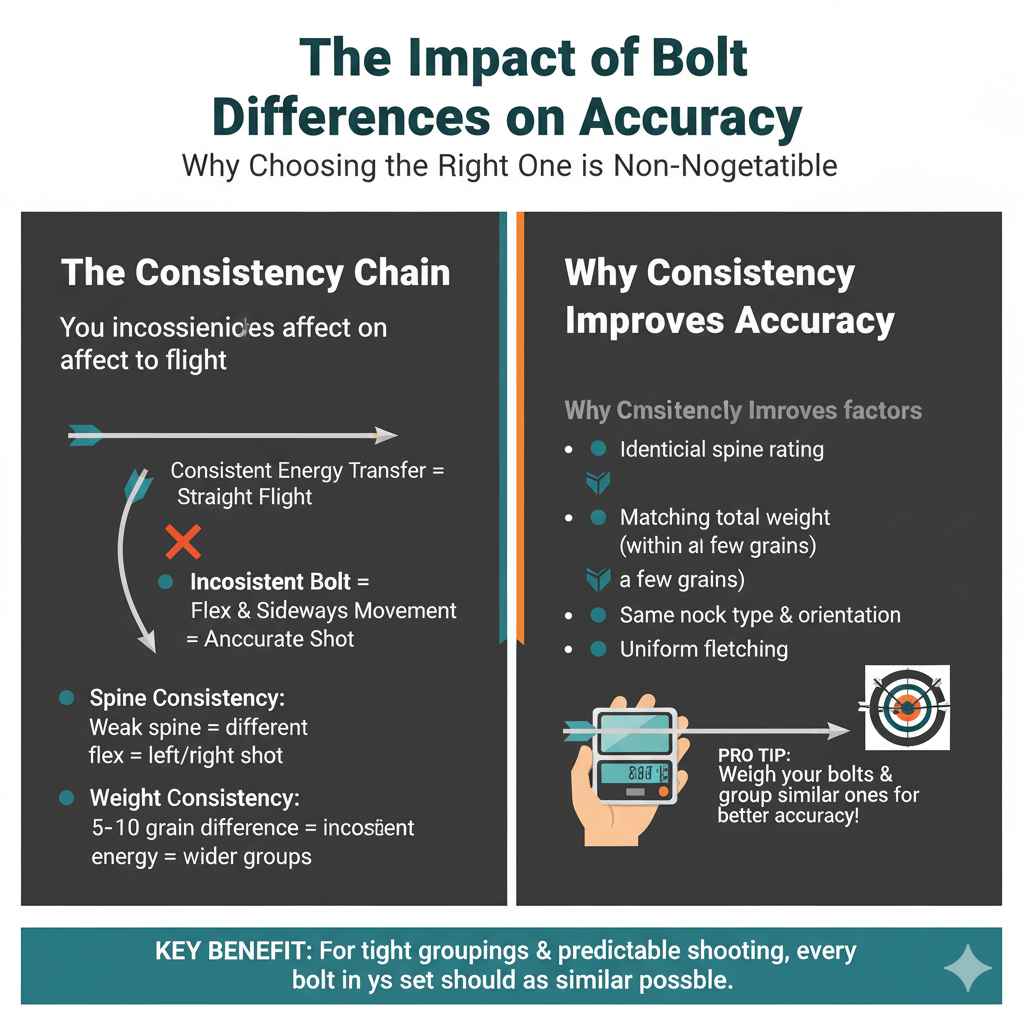
Imagine a perfectly tuned crossbow. When the string fires, it needs to impart energy to the bolt in a way that pushes it straight forward. Any inconsistency in the bolt’s structure will cause it to flex oddly, leading to sideways movement that ruins your shot.
- Spine Consistency: If you buy a batch of 400-spine bolts, but one is slightly weaker (say, 410 spine), it will flex differently than the others, causing that one shot to go slightly left or right.
- Weight Consistency: Even a 5–10 grain difference between bolts can slightly change how the string transfers energy to the shaft. Over longer distances, that small variation becomes visible on the target as wider shot groups.
- Why Consistency Improves Accuracy
- For tight groupings and predictable shooting, every bolt in your set should be as similar as possible.
- Key consistency factors include:
- Identical spine rating across all bolts
- Matching total weight (grains) within a few grains
- Same nock type and orientation
- Uniform fletching size and angle
- Many experienced crossbow shooters actually weigh their bolts on a small grain scale and group bolts that weigh nearly the same. This small step can noticeably improve accuracy when shooting at longer distances.
Frequently Asked Questions (FAQ)
Q1: What is the most important difference in crossbow bolts for beginners?
The most important factors are weight and spine rating. These must match your crossbow’s power and manufacturer recommendations. Using the wrong bolt weight or stiffness can reduce accuracy and even damage the crossbow.
Q2: Are carbon crossbow bolts better than aluminum?
Carbon bolts are generally stronger, lighter, and more durable, which makes them the preferred choice for most modern crossbows. Aluminum bolts are still useful for beginners because they are cheaper and easier to replace, but they bend more easily.
Q3: Can I use regular arrows in a crossbow?
No. Crossbow bolts are shorter, heavier, and designed for the unique power delivery of a crossbow. Using regular arrows meant for compound or recurve bows can be unsafe and may damage your equipment.
Q4: How many grains should a crossbow bolt weigh?
Most modern crossbows require bolts weighing between 400 and 500 grains total weight, including the field point or broadhead. Always check your crossbow manual for the minimum recommended bolt weight before shooting.
Q5: Do heavier bolts shoot more accurately?
Heavier bolts usually provide better stability and more kinetic energy, especially for hunting. However, they travel slower. The best option is a balanced bolt weight recommended by your crossbow manufacturer.
Q6: How often should crossbow bolts be replaced?
Replace bolts immediately if you notice:
- Cracks in carbon shafts
- Bent aluminum shafts
- Loose inserts or nocks
- Damaged fletching
Even small structural damage can affect accuracy and safety.
Conclusion: Choosing the Right Crossbow Bolt for Performance and Safety
Understanding the difference in crossbow bolts is one of the most important steps for any beginner entering the sport. While bolts may appear similar at first glance, factors such as material, diameter, spine rating, and weight all play a crucial role in how the bolt performs once it leaves the crossbow.
Carbon bolts dominate modern crossbow shooting thanks to their strength and durability, while aluminum remains a reliable option for beginners and budget shooters. Diameter and spine rating must match the crossbow’s specifications to ensure a safe and stable launch, while proper bolt weight guarantees the crossbow absorbs and transfers energy correctly.
Most importantly, always follow your crossbow manufacturer’s recommendations when selecting bolts. The right bolt ensures your equipment functions safely, improves accuracy, and helps you develop consistent shooting habits.
In the end, a well-matched crossbow bolt allows you to focus on what truly matters—improving your aim, building confidence, and enjoying every shot you take.