Figuring out if Do Bow Quivers Affect Accuracy? Tested Results can be tricky for new archers. It’s common to wonder how adding gear changes your shots. Don’t worry, it’s simpler than you might think. This post will break it down step-by-step. You’ll explore how quivers impact accuracy, using actual tests to show the differences. Let’s get started!
Accuracy and Equipment Interactions
The impact of archery gear on shot consistency is a big topic. Many new archers want to know what changes they can make to equipment to shoot better. The truth is, many factors play a role. How your bow interacts with various pieces of equipment, including a quiver, is very important. This section will look at the basics of how accuracy works and how quivers might interfere.
The Basics of Archery Accuracy
Good archery accuracy is built on a few core principles. First, it’s about repeating the same shot every time. This means the same stance, grip, draw, and release. Any small change in these steps can throw off your arrows. Second, your equipment needs to be set up correctly. This includes the bow’s draw weight, arrow spine, and sight alignment. Third, environmental factors, such as wind, affect your shots. These things can be dealt with by understanding the basics and making adjustments. Accuracy in archery isn’t just about the equipment but also the archer.
Consistency: The biggest factor in accuracy is repeating the shot. Archers work hard to build muscle memory and perfect their form.
Consistency in archery is about creating a repeatable process. It requires practice to ensure that your body does the same things every time. Maintaining a consistent form, grip, and release reduces errors and tightens your groups. Archers use drills and training aids to improve their consistency.
Equipment Setup: Proper equipment setup is very important. Your bow, arrows, and accessories should all be tuned.
The equipment setup starts with making sure your bow’s draw weight fits you. Arrow spine is also key because it dictates how much an arrow bends in flight. Sight alignment ensures that you can hit the target accurately. If your equipment is not set up correctly, it will be hard to be consistent.
Environmental Factors: Wind, light, and terrain will affect your shots. Archers learn to deal with these challenges.
Archers have to adjust for wind by aiming slightly away from their target. Light affects how you can see your sight pins. Terrain means that you might have to adjust your stance to shoot up or down hill. These factors will challenge you, and you can learn to control them.
How Quivers Fit Into the Equation
Quivers are designed to carry arrows, but they can affect how your bow shoots. Quivers add weight to the bow. This affects balance and how it feels in your hand. Also, the position of the quiver changes the bow’s center of gravity. How much these things matter depends on the type of quiver and how you use it. For example, a heavy quiver can pull the bow slightly off-balance. That can change the way the bow sits in your hand. That may affect the shot, and that can change the point of impact.
- Weight Distribution: Adding weight to a bow will always change how it handles.
Weight changes the center of gravity. A quiver can make the bow feel heavier on one side. That can affect how quickly the bow settles in your hands. It can also change how steady you are when aiming. Many archers will experiment to find the perfect balance.
- Balance and Stability: Quivers affect bow balance, possibly influencing stability during aiming and shooting.
A well-balanced bow is easier to hold steady. A quiver that throws off the balance might cause you to have to work harder to keep your bow still. That extra effort can tire you out. It might also affect accuracy. So, balancing your bow is very important.
- Types of Quivers: The type of quiver will make a difference. A side quiver affects the balance differently than a bow-mounted quiver.
Bow-mounted quivers sit directly on the bow. They add weight but can be easier to manage. Side quivers carry arrows away from the bow. They might be lighter overall but may change your balance. Field quivers are used for field archery. They often hold a lot of arrows, and they can affect your balance.
Tested Results of Quiver Effects
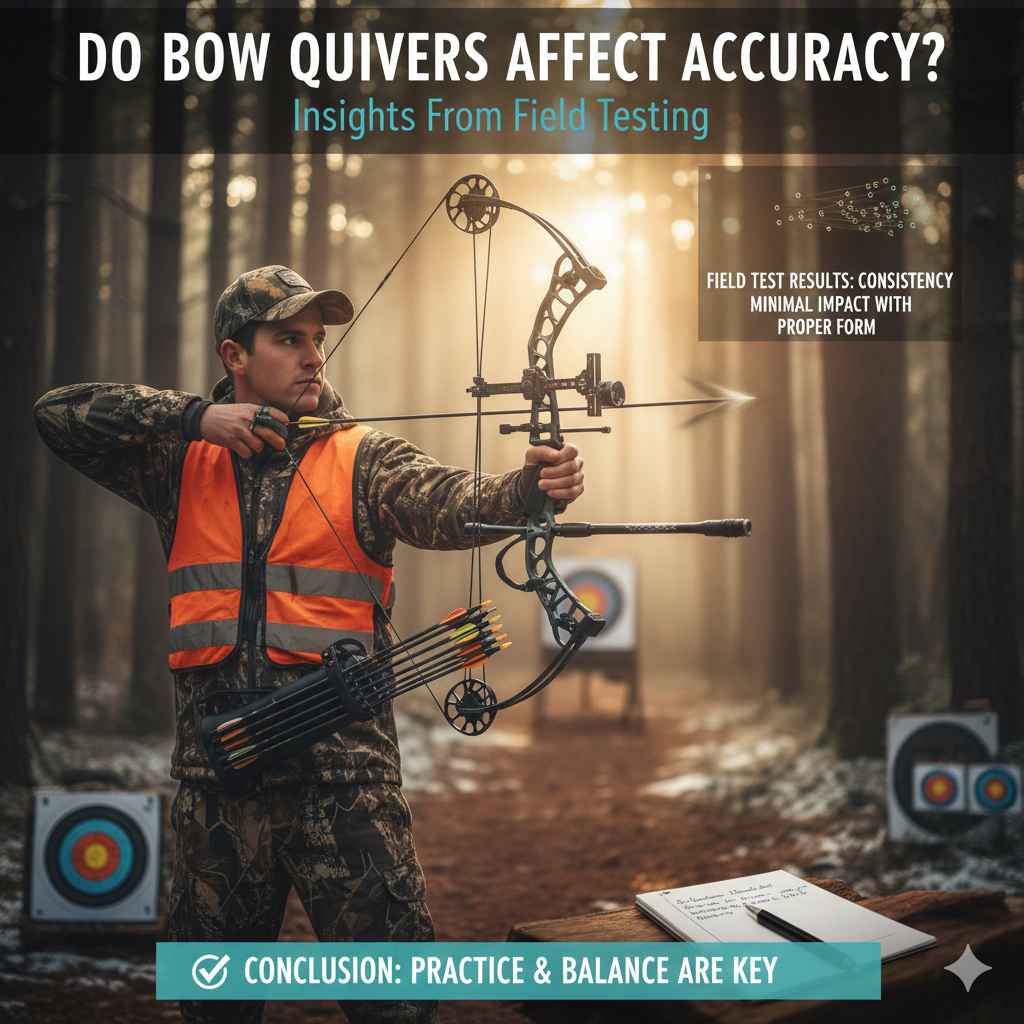
To really see if Do Bow Quivers Affect Accuracy? Tested Results come into play, we need to look at test results. We will see how different quivers stack up. This involves shooting with and without a quiver. By measuring group sizes, we can see if quivers help or hurt. These tests provide concrete evidence that is very valuable for archers.
Test Methodology
The main goal of the test is to find out how a quiver affects arrow groupings. A good test needs to be controlled. This means keeping everything else constant. The archer, bow, arrows, and shooting distance stay the same. The only change is the quiver. The testing involves shooting a set number of arrows with no quiver. Next, the same archer shoots the same number of arrows with different quivers. After shooting, you can measure the shot groups. You can then analyze the data to see the differences. These tests will show how the different quivers compare.
- Equipment Standardization: Use the same bow, arrows, and archer for each test.
Keeping the bow, arrows, and archer the same makes sure the differences are from the quiver. Any changes in these variables would make it hard to tell what causes changes in accuracy. This kind of consistency is very important.
- Distance and Target: The test is usually performed from a set distance.
Shooting from the same distance ensures a baseline. That helps to accurately measure group sizes. It’s very common to use 20 meters. At this distance, it is easy to see the differences. Archers can improve their ability to be accurate.
- Data Collection and Analysis: Measure arrow groupings to find the impact of the quivers.
After each round of shooting, you measure the spread of arrows. A smaller group means better accuracy. Measure the group’s diameter. Then compare the numbers to find the differences. By measuring group size and the point of impact, we can tell how the quivers are affecting your aim.
Test Findings and Analysis
The results from the tests can vary depending on the equipment. Generally, the tests show that a quiver does affect accuracy, but how much varies. Bow-mounted quivers might cause only small changes in accuracy. Side quivers might have a more noticeable impact on balance. The specific impact is different for each archer. Some archers might shoot better with a quiver, as it improves the feel of the bow. Other archers might find that their groups spread out a little. In these cases, archers must adjust their shooting. Here are some of the things they have found.
- Bow-Mounted Quivers: These quivers tend to have the smallest impact on accuracy.
Bow-mounted quivers sit close to the bow’s center. Adding weight close to the bow’s center does not affect balance as much. The results show that bow-mounted quivers usually cause small changes in grouping. Archers might not even notice the difference.
- Side Quivers: These might cause more changes to your shots.
Side quivers shift the balance and can cause your bow to feel heavier on one side. Some archers may not like this. In the tests, side quivers may result in slightly larger groupings. Archers can make small adjustments to counter this.
- Impact on Point of Impact: Quivers may change the arrow’s point of impact, especially with a different center of gravity.
Because quivers change the bow’s balance and weight, the arrow’s flight path can be affected. The tests show the arrow impacts a bit differently. This means that archers might need to adjust their sights. This means the sight pin is set a bit up, down, left, or right.
Practical Examples and Scenarios
Real-world examples can make things clearer. We will look at some of the things archers deal with. Each case shows how different quivers change things. These examples make the ideas more relevant. You will see how these things play out in actual archery experiences. By exploring these scenarios, we can better explore the original question: Do Bow Quivers Affect Accuracy? Tested Results.
Case Study 1: The Bowhunter’s Dilemma
A bowhunter uses a bow-mounted quiver when hunting. In this case, the quiver helps him carry arrows easily. During testing, his groupings are a bit wider with the quiver. It turns out that the added weight makes him pull slightly to the left. After a few practice sessions, he changed his grip slightly. With the new grip, his groupings are similar. This shows that adjustments in form can fix quiver issues. The case study reveals the importance of personalized testing. Also, it shows how minor changes in the grip can solve accuracy problems.
- The archer noticed his arrows hit a bit to the left.
The extra weight changed how he balanced the bow. That makes the arrows fly left. This is a common issue with bowhunters who are first using a quiver.
- He worked to change his grip to correct the issue.
He changed his grip to adjust for the quiver’s weight. He then had to practice to build up the muscle memory.
- After adjusting, his accuracy returned to normal.
With practice, the archer’s accuracy returned. This proves that adjustments can solve accuracy problems.
Case Study 2: The Target Archer’s Choice
A target archer tests different quivers to get the best accuracy. She tries a bow-mounted quiver and a side quiver. She finds that the bow-mounted quiver has no big changes. The side quiver, however, impacts her accuracy. She finds it makes her bow less stable. The archer decides to keep using the bow-mounted quiver. This case study stresses the need for personalized testing. Also, it demonstrates that archers can use the tests to make their own choices.
- She tested both bow-mounted and side quivers.
The archer compared both quivers to see which worked best.
- The bow-mounted quiver did not change her scores.
The bow-mounted quiver’s balance didn’t affect her accuracy.
- The side quiver made her scores worse.
The side quiver negatively affected her stability and accuracy. Therefore, she kept the other quiver.
Common Scenarios and Solutions
Archers often face similar challenges when picking quivers. Here are a couple of common situations, with simple solutions.
- Scenario: An archer finds their arrows are consistently hitting low after adding a bow-mounted quiver.
Solution: The archer may want to adjust their sight pin. Also, they should be prepared to practice. They should test to make sure the sight adjustment fixed the problem.
- Scenario: An archer is using a side quiver. They notice that the bow feels unbalanced, and the arrows consistently hit to the right.
Solution: The archer can try a different quiver. They may be able to use a stabilizer or change their grip. They can also practice to make sure they’re handling the bow correctly.
Factors Affecting Quiver Choice
There are many things to think about when choosing a quiver. It is not just about accuracy. Consider how you will use the quiver, the type of archery, and your own body. This section will explore the factors that archers consider when choosing their quivers. Archers can choose quivers that best fit their needs by thinking about these things.
Type of Archery and Quiver Design
The kind of archery you do influences your quiver choice. For bowhunting, bow-mounted quivers are very common. They keep arrows ready and close by. Target archers might like side quivers or hip quivers. These are good for keeping arrows organized while shooting. Field archery quivers often carry a lot of arrows. They may have different sections for different types of arrows. The design has to match the sport. It must also match how you will use the equipment.
- Bowhunting: Bow-mounted quivers are often preferred. They hold arrows securely.
Bowhunters like bow-mounted quivers because they keep arrows handy. They also move with the bow. This keeps the arrows safe when moving through the woods.
- Target Archery: Archers often prefer side quivers or hip quivers. These keep the arrows easy to reach.
Target archers do not need their arrows as close as bowhunters. Side and hip quivers make it easy to grab an arrow. They also keep the arrows away from the bow, making it balance better.
- Field Archery: Quivers often hold many arrows. They might have different sections.
Field archery involves shooting at many distances and types of targets. Field archers use quivers that carry lots of arrows. They may have separate areas for practice and competition arrows.
Personal Preferences and Ergonomics
The best quiver also depends on you. Some archers like a quiver that sits close to their body. Others like one that’s easy to reach. The quiver should be comfortable. You might try several quivers to see which feels right. Consider where the quiver sits. A side quiver can sit on your hip. A bow-mounted quiver sits on the bow. You might also think about how it looks and the materials used. The goal is to choose a quiver that feels good and helps you shoot well.
- Comfort and Fit: The quiver must feel good.
Comfort is a key factor. Archers may need to carry the quiver for many hours. If it does not feel good, it will be distracting.
- Ease of Access: How quickly can you get an arrow?
The quiver should allow fast and easy access to arrows. Target archers want to grab arrows fast and keep shooting. Bowhunters want to be ready to take a shot.
- Weight and Balance: The quiver should not throw off your balance.
The quiver adds weight to your setup. You will have to test how the balance changes. Too much weight can make you tired. Also, the weight needs to be balanced for accuracy.
Durability and Maintenance
Pick a quiver that lasts. Look for quivers made of strong materials, like leather or tough fabrics. How well you take care of your quiver matters, too. Clean your quiver and protect it from weather. Store it safely when you’re not using it. Checking your quiver regularly for damage makes sure it is in good condition. Taking care of your quiver makes sure it stays in shape and lasts for a long time.
- Material Quality: Pick a quiver made of strong materials.
Good materials, such as leather or strong fabrics, make the quiver last longer. Quality materials also protect your arrows. The materials must be able to stand up to use.
- Weather Resistance: Protect your quiver from the elements.
A quiver that can handle the weather will last longer. Rain, snow, and sunlight can damage materials. Protect your quiver to keep it in good shape.
- Regular Maintenance: Check your quiver for damage, and maintain it properly.
Inspect your quiver for wear and tear. Make repairs when needed. Cleaning and maintaining your quiver will help it stay in good working order.
Frequently Asked Questions
Question: Does a bow-mounted quiver always decrease accuracy?
Answer: Not always. While a bow-mounted quiver can change how a bow feels, the effect on accuracy is usually minor. Many archers shoot just fine with a bow-mounted quiver.
Question: How much does the weight of the quiver matter?
Answer: The weight of the quiver affects the bow’s balance. This can change how you aim and hold the bow. Heavier quivers may be more noticeable, but it depends on the archer.
Question: Can I fix the accuracy issues caused by a quiver?
Answer: Yes, you can. You may be able to fix problems through practice and adjusting your form. Sometimes a different quiver or adjusting your sights is all that is needed.
Question: What’s the best type of quiver for a beginner?
Answer: For a beginner, a bow-mounted or side quiver might work well. Bow-mounted quivers are handy and don’t change the feel much. Side quivers can be easy to access.
Question: Do expensive quivers shoot better than cheap ones?
Answer: Not necessarily. Cost does not always mean better accuracy. The best quiver is the one that fits your needs and feels good to use. Comfort and ease of use are more important than price.
Final Thoughts
So, Do Bow Quivers Affect Accuracy? Tested Results do show that quivers can play a role. However, their impact varies. Bow-mounted quivers typically cause small changes. Side quivers might have a more noticeable impact on balance. The specific impact is different for each archer. It is very important to try different quivers and see what works best. Look at things such as how the quiver feels and where the arrows sit. You might change your form or adjust your sights to fix any problems. Archery is about practice and finding the equipment that works best for you. Keep testing, practicing, and learning. You will find the perfect quiver setup!