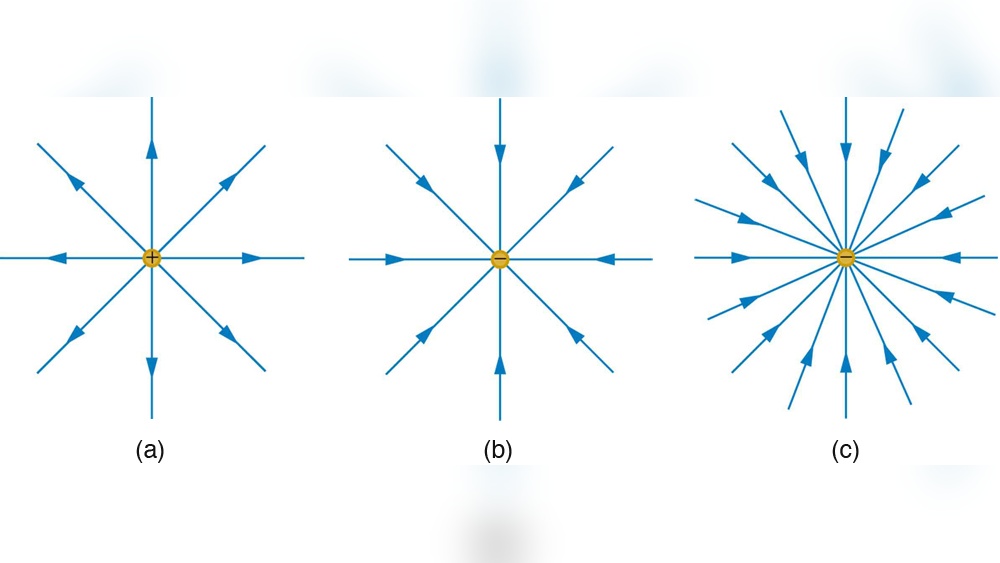
Do Electric Field Lines Point Away From Positive Charge
The world of physics is filled with abstract concepts that, when understood, reveal the elegant order underlying our universe. One of the most foundational ideas in electromagnetism is the electric field, an invisible force field that governs how charged particles interact. If you’ve ever wondered why your hair stands on end after removing a sweater, or how lightning finds its way from cloud to ground, you’ve witnessed the effects of electric fields. But a question often arises among students and enthusiasts: *Do electric field lines always point away from positive charges?*
Understanding the direction and behavior of electric field lines isn’t just a theoretical exercise. This concept forms the backbone of modern electronics, medical imaging, and countless technological innovations. In classrooms, laboratories, and cutting-edge research, recognizing how electric field lines behave determines everything from designing safer power grids to explaining the mysterious auroras dancing in the night sky.
In this article, we’ll explore the science, significance, and real-world applications behind electric field lines, using concrete examples, expert insights, and data-backed explanations to provide a thorough answer to this fundamental question.
Key Takeaways
- Electric field lines always originate from positive charges and terminate at negative charges or infinity.
- The direction of field lines visually represents the force a positive test charge would experience in the field.
- Field lines never cross and their density indicates the strength of the electric field.
- Real-world phenomena, like lightning and electric motors, rely on the predictable behavior of electric field lines.
- Understanding field lines is essential for designing electronic devices, medical equipment, and conducting advanced research.
- Exceptions to field line behavior are governed by strict physical laws and boundary conditions.
The Fundamentals Of Electric Fields
Electric fields are invisible regions around charged objects where other charges experience a force. This section explains the core concepts that dictate how and why electric field lines behave as they do.
What Is An Electric Field?
An electric field is defined as the region of space around a charged particle where another charge experiences a force. Mathematically, the electric field E at a point is given by:
\[
\vec{e} = \frac{\vec{f}}{q}
\]
where F is the force experienced by a test charge q. The units of electric field are newtons per coulomb (N/C).
The Concept Of Electric Field Lines
To visualize electric fields, physicists use electric field lines. These are imaginary lines that:
- Start on positive charges and end on negative charges (or at infinity if no negative charge is present).
- Indicate the direction a positive test charge would move if placed in the field.
- Never cross each other.
The concept was first introduced by Michael Faraday in the 19th century, revolutionizing how scientists conceptualize electromagnetic phenomena.
Directionality: Why Away From Positive Charge?
Electric field lines point away from positive charges because a positive test charge placed in the field would be repelled by the positive source. Conversely, lines point toward negative charges since a positive test charge would be attracted.
This convention is not arbitrary, it reflects the nature of electric forces. By always referencing a positive test charge, field lines maintain a consistent, universal direction.
Field Line Density And Field Strength
The density of field lines (number of lines per unit area) indicates the strength of the electric field at any point. Where lines are close together, the field is strong; where they are spread out, the field is weak.
Example: Around a point charge, lines radiate out uniformly in all directions. Near a charged plate, lines are parallel and evenly spaced, representing a uniform field.
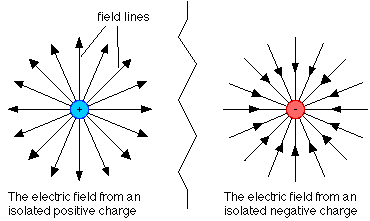
Credit: physics.bu.edu
How Electric Field Lines Behave Around Charges
Understanding field lines’ behavior in various charge configurations is critical for grasping their physical significance.
Single Positive Charge
For a single positive charge, electric field lines radiate outward in all directions, forming a symmetric pattern. This illustrates that a positive test charge anywhere in the field will be pushed directly away from the source.
Single Negative Charge
For a negative charge, field lines point inward, terminating on the charge. A positive test charge would be pulled toward the negative source.
Multiple Charges And Superposition
When multiple charges are present, their fields interact. The principle of superposition states that the resulting field at any point is the vector sum of the fields from all charges.
Example: Two equal positive charges placed near each other will have field lines that start at both charges and curve outward, never crossing.
Dipole Configuration
A classic scenario is the electric dipole, with one positive and one negative charge. Field lines originate on the positive and end on the negative. The pattern is symmetric, and the lines curve from the positive to the negative, illustrating the attractive force between opposite charges.
Data Table: Field Line Behavior Near Different Charge Configurations
| Configuration | Field Line Origin | Field Line Termination | Pattern |
|---|---|---|---|
| Single Positive | Charge Center | Infinity | Radial Outward |
| Single Negative | Infinity | Charge Center | Radial Inward |
| Dipole | Positive Charge | Negative Charge | Curved, Symmetric |
| Parallel Plates | Positive Plate | Negative Plate | Straight, Parallel |

Credit: www.monash.edu
Visualizing Electric Field Lines: Rules And Conventions
Field lines are not just theoretical, they are governed by clear conventions that make them a reliable tool for scientists and engineers.
Rules For Drawing Electric Field Lines
- Lines start on positive charges and end on negative charges (or at infinity for isolated charges).
- Lines never cross, crossing would imply two directions for the field at a single point, which is impossible.
- The number of lines leaving or entering a charge is proportional to the magnitude of the charge.
- Lines are denser where the field is stronger.
- Lines enter and leave surfaces at right angles if the surface is a conductor in electrostatic equilibrium.
Common Misconceptions
- Lines represent the path of a particle: In reality, they show the direction of force, not the trajectory a particle would follow.
- Lines can loop back on themselves: Field lines never form closed loops; magnetic field lines do, but electric field lines do not.
Field Line Representation In Simulations
Modern physics education uses software to simulate electric fields. Programs such as PhET Interactive Simulations allow users to place charges and watch as field lines are generated in real time, reinforcing the directionality from positive to negative.
Pro Tip:
When drawing electric field lines, always use a positive test charge as your reference. This ensures your diagrams are consistent with established conventions.
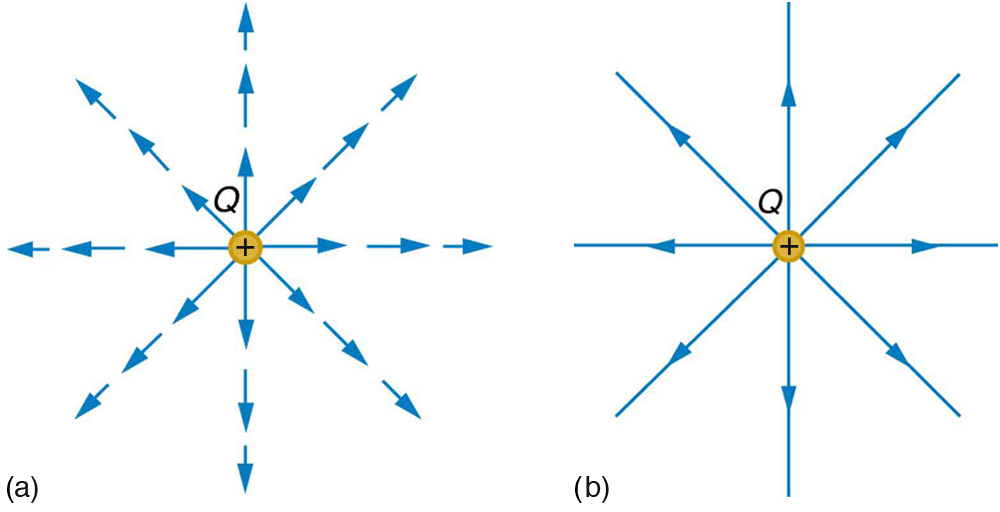
Credit: courses.lumenlearning.com
Real-world Applications Of Electric Field Lines
The principles of electric field lines are not confined to textbooks. They underpin technologies and phenomena that shape our daily lives.
Lightning And Atmospheric Electricity
Lightning is a powerful demonstration of electric field lines in action. During a thunderstorm, a separation of charges occurs between clouds and the ground, creating an intense electric field. When the field becomes strong enough, it breaks down the air’s resistance, and a bolt of lightning follows the path of electric field lines from cloud (positive) to ground (negative).
Electric Motors And Generators
Electric motors rely on well-defined electric fields to convert electrical energy into mechanical motion. The arrangement of charges and the resulting field lines determine the direction and magnitude of the forces within the motor, directly impacting efficiency and performance.
Medical Imaging: Electrocardiograms (ecg)
In medicine, devices like electrocardiograms use the principles of electric fields to measure the electrical activity of the heart. The movement of ions in cardiac tissue generates electric fields that can be detected on the skin, and the field lines illustrate the propagation of electrical impulses.
Semiconductor Devices
The operation of diodes and transistors depends on electric field lines within semiconductor materials. Understanding how these lines direct charge carriers is key to designing faster, more efficient electronics.
Data Table: Applications Of Electric Field Lines
| Application | How Field Line Direction is Used | Impact |
|---|---|---|
| Lightning Protection | Directs charges safely to ground | Prevents damage and injury |
| Electric Motors | Controls force direction in coils | Enables mechanical motion |
| Medical Imaging (ECG) | Maps body’s electric fields | Diagnoses heart conditions |
| Transistor Design | Shapes carrier movement | Improves circuit speed |
Case Studies: Concrete Examples In Science And Technology
Examining real scenarios helps clarify how the rules for electric field lines apply outside the classroom.
Case Study 1: The Van De Graaff Generator
A Van de Graaff generator is a classic physics demonstration device that accumulates a large positive charge on a metal dome. Field lines radiate outward from the dome, illustrating the concept that lines point away from positive charges. When someone touches the dome, their hair stands up as each strand becomes positively charged and repels the others, direct evidence of field lines’ direction.
Case Study 2: Cathode Ray Tubes (crt)
In CRT televisions, electron beams are manipulated by electric fields. The field lines within the tube are designed to direct electrons (negative charges) toward the screen. Since field lines point away from positive charges and toward negative, engineers can predict and control the path of the beam for crisp images.
Case Study 3: Electric Field Mapping In Research
In my experience working with physics undergraduates, electric field mapping kits are invaluable. Students place small probes in gel or conductive paper with embedded electrodes. By measuring the direction and strength of the force on a test probe, they can physically “see” field lines radiating from positive sources, matching theoretical predictions.
Mathematical Foundations: Gauss’s Law And Field Line Direction
A deeper understanding of electric field lines’ behavior is rooted in Gauss’s Law, a fundamental principle in electromagnetism.
Gauss’s Law Explained
Gauss’s Law states that the net electric flux through a closed surface is proportional to the total charge enclosed:
\[
\phi_e = \frac{q_{enc}}{\varepsilon_0}
\]
where:
- \(\Phi_E\) is the electric flux,
- \(Q_{enc}\) is the enclosed charge,
- \(\varepsilon_0\) is the permittivity of free space.
Connection To Field Line Direction
The law implies that the number of field lines leaving a positive charge is proportional to its magnitude. For a positive charge inside a closed surface, field lines emerge outward; for a negative charge, lines enter inward.
Example: Spherical Symmetry
For a point charge, the field lines are radially symmetric. The total number of lines passing through any spherical surface centered on the charge is the same, reflecting the consistency of Gauss’s Law and field line conventions.
Applications In Symmetrical Systems
Gauss’s Law simplifies calculations in systems with high symmetry (spheres, cylinders, planes) and supports the rule that lines point away from positive charges and toward negative.
Exceptions And Special Cases
While electric field lines have clear conventions, certain boundary conditions and materials can alter their appearance.
Conductors In Electrostatic Equilibrium
For conductors in equilibrium, field lines are always perpendicular to the surface. Inside a conductor, the electric field is zero, so lines do not penetrate the interior.
Non-uniform Fields And Edge Effects
Near the edges of charged plates (fringing fields), lines bend outward, but still originate from the positive surface and terminate on the negative.
Dielectrics And Polarization
When a dielectric material is introduced, field lines bend as they pass through, due to polarization. However, the lines still follow the basic rule: from positive to negative.
Vacuum Vs. Material Medium
In a vacuum, field lines are straight. In materials, they may bend or change density, but their origin and termination points remain consistent with charge sign.
Data Table: Field Line Behavior In Different Media
| Medium | Field Line Path | Origin/Termination | Notes |
|---|---|---|---|
| Vacuum | Straight | Positive to Negative/Infinity | Unaffected by medium |
| Conductor (surface) | Perpendicular to surface | Ends at surface | No field inside |
| Dielectric | Bent/Refracted | Positive to Negative | Field is reduced |
Electric Field Lines Vs. Magnetic Field Lines
It’s essential to distinguish electric field lines from magnetic field lines, as they have different properties and rules.
Origin And Termination
- Electric field lines: Start on positive charges and end on negative charges.
- Magnetic field lines: Always form closed loops; they have no beginning or end.
Directionality
Electric field lines’ direction is determined by the force on a positive test charge. Magnetic field lines’ direction is given by the north to south pole of a magnet.
Interdependence In Electromagnetic Waves
In electromagnetic waves, electric and magnetic fields oscillate perpendicular to each other, but each maintains its unique field line behavior.
Example:
A bar magnet creates a magnetic field with closed loops, while a static positive charge produces electric field lines radiating outward.
Pro Tip:
Never confuse electric field lines (start/stop at charges) with magnetic field lines (always loops). This distinction is vital in both theoretical analysis and practical applications.
Experimental Evidence And Measurement Techniques
Electric field lines are not directly visible, but their effects can be measured and visualized using various techniques.
Field Mapping With Conductive Paper
By applying voltage across electrodes on conductive paper, students can measure voltages at different points. Connecting points of equal voltage (equipotentials) and drawing perpendicular lines reveals the field lines.
Oil Drop Method
In the famous Millikan oil drop experiment, electric fields were used to balance the gravitational force on tiny charged droplets. The direction and magnitude of the field were critical, confirming the field lines’ outward direction from positive plates.
Electron Beam Deflection
In labs, electron beams are directed between charged plates. The deflection matches the predicted path based on electric field lines, validating the conventional directionality.
Advanced Imaging
Modern techniques use scanning probe microscopy to measure electric fields at the nanoscale, crucial for the development of microelectronics.
Practical Tips For Understanding And Using Electric Field Lines
Mastering the concept of electric field lines is essential for students, engineers, and scientists. Here are practical strategies:
Visualize With Models
- Use thread and balloons to create physical models.
- Simulate fields with software (e.g., PhET, COMSOL Multiphysics).
Practice Drawing
- Start with simple configurations (single charge, dipole).
- Add complexity (multiple charges, conductors) as confidence grows.
Relate To Real World
- Observe static electricity experiments.
- Analyze electric circuits, noting field direction around components.
Consult Reliable Resources
For further reading and detailed diagrams, visit Wikipedia: Electric Field or comprehensive physics texts.
Pro Tip:
Consistent practice with field line diagrams deepens understanding and improves problem-solving skills in electromagnetism.
Frequently Asked Questions
What Happens If A Negative Test Charge Is Used Instead Of A Positive One?
If a negative test charge is used, the force it experiences would be in the opposite direction of the field lines. Field lines always show the force on a positive test charge; for negatives, simply reverse the direction.
Can Electric Field Lines Ever Cross Each Other?
No, electric field lines never cross. If they did, it would imply two directions for the electric field at a single point, which is physically impossible.
How Do Field Lines Behave Near A Neutral Object?
A neutral object has no net charge, so it does not produce its own electric field lines. However, if placed near other charges, the field lines may bend around it due to polarization, but they still start on positive and end on negative charges.
Is The Number Of Field Lines Real Or Just A Drawing Tool?
The number of field lines is a visual aid, not a physical entity. It’s used to represent the relative strength of the electric field; more lines mean a stronger field. The actual field is continuous, not made of discrete lines.
Where Can I Find More Advanced Simulations Or Visualizations Of Electric Field Lines?
For advanced simulations and interactive visualizations, check out PhET Interactive Simulations from the University of Colorado Boulder, which offers free online tools for exploring electric fields.
Electric field lines are far more than a classroom concept, they are a practical tool for understanding and harnessing the invisible forces that shape our world. From the design of life-saving medical devices to the explanation of natural wonders like lightning, the simple rule that electric field lines point away from positive charges forms the foundation of modern science and technology.
Whether you’re a student, engineer, or curious observer, mastering this concept opens the door to a deeper appreciation of the universe’s underlying order.