Do Electric Fields Point From Negative To Positive
Electric fields are fundamental to understanding electricity, magnetism, and much of modern technology. From lightning bolts to smartphone screens, electric fields are everywhere, shaping how energy moves and interacts with matter. Yet, one of the most common questions in physics classrooms and engineering labs is deceptively simple: Do electric fields point from negative to positive? The answer, while seemingly straightforward, reveals much about the underlying structure of physics, the way we define scientific conventions, and the practical realities of electrical systems.
In everyday life, the direction of electric fields determines how charges move, how circuits operate, and even how our bodies sense electrical stimuli. Misunderstanding this concept can lead to confusion when reading circuit diagrams, interpreting scientific literature, or troubleshooting electronic devices.
This article explores the direction of electric fields, the conventions that define them, and the real-world implications for students, hobbyists, and professionals alike. By the end, you’ll have a nuanced understanding of why and how electric fields point the way they do, and why it matters.
Key Takeaways
- Electric field direction is defined by convention: Electric fields point from positive to negative charges, not the other way around.
- Field lines represent the force on a positive test charge: The direction of field lines shows the path a positive test charge would follow.
- Practical implications: The convention affects circuit design, electronics, and even biological systems.
- Negative-to-positive confusion arises from electron flow: Although electrons move from negative to positive, the electric field direction is opposite.
- Understanding field direction is crucial for science and engineering: It impacts theoretical physics, electrical engineering, and practical device troubleshooting.
Credit: courses.lumenlearning.com
The Fundamental Definition Of Electric Fields
What Is An Electric Field?
An electric field is a region of space around a charged object where another charged object experiences a force. This field is a vector quantity, meaning it has both magnitude and direction. The strength of the field at any point is defined as the force per unit charge that would be exerted on a small, positive test charge placed at that point.
Mathematically, the electric field (E) is given by:
E = F / q
where F is the force experienced by the test charge and q is the magnitude of the test charge. The SI unit of electric field is newtons per coulomb (N/C) or volts per meter (V/m).
Historical Context: The Positive Test Charge Convention
The convention for electric field direction dates back to Michael Faraday and James Clerk Maxwell. They defined the direction of the electric field as the direction a positive test charge would move. This choice was arbitrary but consistent with the positive charges discovered first in glass rods and amber.
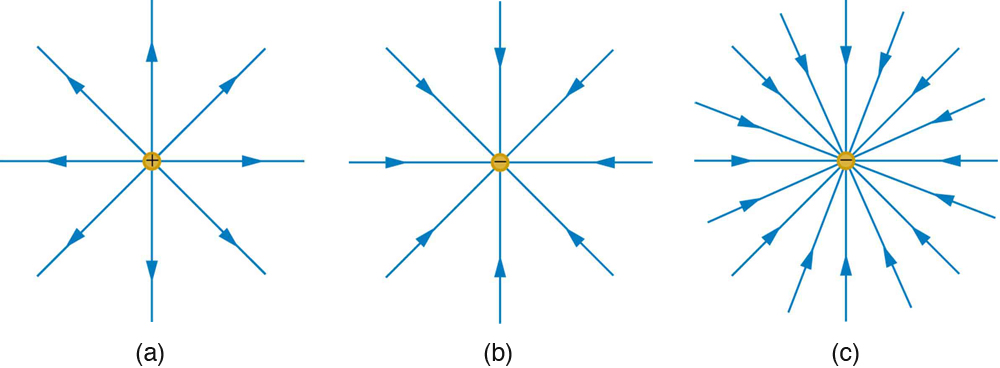
- Electric field lines point away from positive charges
- Electric field lines point toward negative charges
This means that, by definition, electric fields always point from positive to negative.
Visualizing Electric Field Lines
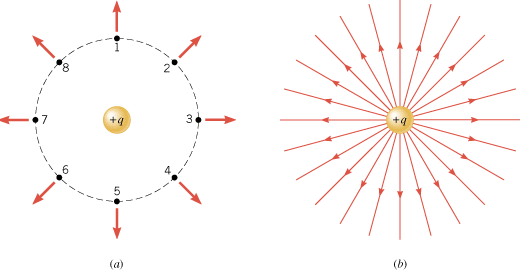
Electric field lines are a graphical tool to represent the direction and strength of an electric field. Each line shows the path a positive test charge would take under the influence of the field.
Key features:
- Lines start on positive charges and end on negative charges
- The density of lines indicates field strength
- Field lines never cross
These conventions help visualize complex charge distributions and predict the behavior of charged particles.
Example: The Field Of A Point Charge
Consider a single, isolated positive charge Q. The electric field radiates outward in all directions. If the charge is negative, the field points inward toward the charge.
| Charge Type | Direction of Field Lines | Example Diagram |
|---|---|---|
| Positive | Away from charge | → ● |
| Negative | Toward charge | ● ← |
This simple example underpins all more complex electric field scenarios.

Credit: flexbooks.ck12.org
The Physics Behind Field Direction
The Force On Charges
The direction of the electric field is intimately tied to the force experienced by charges. By convention, the field at any point is the direction of the force on a positive test charge.
- A positive charge in an electric field moves along the field direction
- A negative charge moves opposite to the field direction
This means that if you release a proton in an electric field, it will accelerate in the direction of the field. An electron, being negatively charged, moves in the opposite direction.
The Role Of Electrons And Conventional Current
A common source of confusion is the distinction between electron flow and conventional current. In metals, it is the negatively charged electrons that physically move, from regions of lower potential (negative) to higher potential (positive). However, by historical convention, electric current is defined as the flow of positive charge.
- Electron flow: Negative to positive
- Conventional current: Positive to negative
Electric fields are aligned with the direction of conventional current, not electron flow. This is why, in most circuit diagrams and theoretical discussions, the field points from positive to negative.
Example: Parallel Plate Capacitor
A parallel plate capacitor consists of two metal plates, one positively charged and one negatively charged, separated by an insulator. The electric field inside the capacitor is uniform and points from the positive plate to the negative plate.
| Plate | Charge | Field Direction |
|---|---|---|
| Left | Positive | → |
| Right | Negative | ← |
This setup is a classic example in physics and engineering, illustrating the field direction between two oppositely charged plates.
Mathematical Description
The electric field due to a point charge is described by Coulomb’s Law:
E = (1 / 4πε₀) × (Q / r²)
where:
- E is the electric field strength
- Q is the source charge
- R is the distance from the charge
- Ε₀ is the vacuum permittivity
The sign of Q determines the field direction: positive Q means the field points outward; negative Q means inward.
Electric Field Direction In Different Contexts
Conductors Vs Insulators
In conductors, charges are free to move. Any excess charge resides on the surface, and the electric field inside a conductor is zero (in electrostatic equilibrium). The field just outside a conductor points perpendicular to the surface, away from positive charges and toward negative ones.
In insulators (dielectrics), charges are bound and cannot move freely. The electric field can exist inside, and the direction follows the same convention.
Batteries And Circuits
In a typical battery, the positive terminal is at a higher electric potential, and the negative at a lower potential. When connected in a circuit, the electric field inside the wire points from the positive terminal to the negative terminal, guiding the movement of conventional current.
- Electrons, the actual charge carriers in metals, move from negative to positive.
- Electric field (and conventional current) moves from positive to negative.
This distinction is essential when analyzing circuit diagrams, especially for beginners.
Biological Systems
Electric fields also play a pivotal role in biology. For example, nerve impulses are electrical signals generated by the movement of ions across neuron membranes. The direction of the electric field inside nerve cells determines the direction of ion flow and, consequently, the transmission of signals.
A classic example is the action potential: when a neuron fires, the electric field across its membrane reverses, leading to the propagation of the nerve signal.
Atmospheric Phenomena
Lightning is a spectacular demonstration of electric fields at work. Before a lightning strike, a strong electric field builds up between clouds and the ground, with field lines running from the positively charged upper regions of the cloud to the negatively charged base, and ultimately to the ground. The field direction explains the path of charge movement during a strike.
Credit: demo.webassign.net
Common Misconceptions About Electric Field Direction
The Negative-to-positive Myth
A widespread misconception is that electric fields point from negative to positive. This belief often arises from thinking about electron flow in wires, where electrons move from the negative terminal to the positive terminal of a battery. However, this movement is opposite to the direction of the electric field, as defined by the positive test charge convention.
Why Not Use Electron Flow?
While using electron flow as the basis for electric field direction might seem logical, it would require redefining centuries of scientific literature, equations, and engineering standards. The current convention provides consistency, even if it sometimes feels counterintuitive.
- Pro Tip: Always remember, electric field direction is about where a positive charge would go, not where electrons actually move.
Visual Representation Errors
Another source of confusion is misinterpreting diagrams. Some textbooks or online resources may draw field lines incorrectly, especially in artistic renderings. Always check the legend or key for the direction of field lines.
Example: Real-world Circuit Troubleshooting
When troubleshooting a circuit, assuming the wrong direction for the electric field can lead to incorrect diagnoses. For instance, in my experience working with student-built circuits, many beginners incorrectly place components based on electron flow rather than the conventional current and field direction, causing short circuits or malfunctioning designs.
Conflating Potential Difference And Field Direction
Potential difference (voltage) always relates to the difference in electric potential between two points. The electric field points downhill in terms of potential: from higher potential (positive) to lower potential (negative).
| Potential Side | Charge | Electric Field Direction |
|---|---|---|
| High | Positive | → |
| Low | Negative | ← |
This analogy is similar to gravity: objects “fall” from higher to lower gravitational potential, and positive charges “fall” from higher to lower electric potential.
Practical Applications Of Electric Field Direction
Electronics Design
The proper interpretation of electric field direction is crucial in electronics design. Components like diodes, transistors, and capacitors rely on the correct placement relative to the circuit’s field direction. For example, diodes allow current to flow in one direction only, the direction aligned with the conventional current and electric field.
Electrostatic Precipitators
Electrostatic precipitators are used in industrial processes to remove fine particles from exhaust gases. They operate by creating a strong electric field, causing charged particles to migrate toward collecting plates. The direction of the field determines which plate collects the particles (positive or negative).
Particle Accelerators
In particle accelerators, electric fields are used to accelerate charged particles like protons and electrons. The field direction must be carefully controlled to ensure particles move in the desired direction. For instance, in a linear accelerator, the field switches direction in time with the particle motion.
Case Study: Cathode Ray Tubes (crts)
Older televisions and oscilloscopes used cathode ray tubes, where electrons are emitted from a cathode and accelerated toward a phosphorescent screen by an electric field. The field is set up from the anode (positive) to the cathode (negative), but the electrons move from the cathode to the anode, opposite the field direction.
- Application: The direction of the electric field determines the image formation and beam steering inside the tube.
Medical Devices
Medical imaging devices like electrocardiograms (ECGs) and defibrillators rely on electric fields to monitor or influence the heart’s electrical activity. The placement of electrodes and the interpretation of signals depend on a correct understanding of field direction.
Environmental Sensing
Certain sensors detect electric fields to measure atmospheric or geological phenomena. For example, field mills measure the electric field at Earth’s surface, providing data for weather prediction and studying atmospheric electricity.
Pro Tip:
When designing or troubleshooting any electronic system, always verify the field direction using the positive test charge convention. This approach prevents errors and ensures compatibility with standard circuit diagrams and component datasheets.
Experimental Evidence And Measurement Of Electric Fields
Methods Of Measuring Electric Fields
There are several methods for measuring electric fields in the laboratory:
- Electrostatic voltmeters: Measure potential difference and infer field strength.
- Field mills: Use rotating sensors to detect field strength at a point.
- Pockels effect devices: Rely on changes in optical properties of certain crystals in an electric field.
All these instruments are calibrated based on the positive test charge convention for field direction.
Real-world Example: Atmospheric Electric Field Measurement
The Earth’s surface typically has a vertical electric field of about 100 V/m under fair weather conditions. This field points downward, from the atmosphere to the ground, consistent with the ground being negative relative to the air.
- Atmospheric electricity measurements confirm this direction globally.
Laboratory Demonstrations
In university physics labs, electric field mapping is a common experiment. Students use conductive paper and voltage probes to map equipotential lines and infer the direction of the electric field between electrodes.
- Observation: Field lines are always perpendicular to equipotential lines and point from high to low potential.
Data Table: Measurement Techniques
| Technique | Use Case | Direction Convention |
|---|---|---|
| Electrostatic Voltmeter | Laboratory voltage measurement | Positive to Negative |
| Field Mill | Atmospheric field measurement | Positive to Negative |
| Pockels Effect Device | High-speed transient fields | Positive to Negative |
Example: Van De Graaff Generator
A Van de Graaff generator is a device that creates high voltages by accumulating charge on a metal dome. The electric field at the surface points radially outward from the dome if it is positively charged, and inward if negatively charged, illustrating the universal field direction convention.
Electric Fields In Advanced Physics And Engineering
Maxwell’s Equations And Field Direction
The foundational equations of electromagnetism, Maxwell’s Equations, are built on the convention that electric fields point from positive to negative. For example, Gauss’s Law states that the electric flux out of a closed surface equals the charge enclosed divided by the permittivity of free space:
∮ E · dA = Q_enclosed / ε₀
This law is valid only if the field direction follows the positive test charge convention.
Semiconductor Devices
In semiconductor physics, the direction of electric fields determines the operation of diodes, transistors, and integrated circuits. For instance, in a PN junction, the electric field at the junction points from the P-type (positive) to the N-type (negative) material, affecting current flow and device function.
High-voltage Engineering
Designing power transmission lines and high-voltage equipment requires precise knowledge of electric field distribution to prevent arcing, insulation breakdown, and ensure safety. Simulations and physical models always use the standard field direction convention.
Case Study: Electrostatic Discharge (esd) Protection
ESD protection in electronics relies on understanding how electric fields build up and discharge between objects. The field direction determines the path of current flow during a discharge event, influencing the placement of protective components.
Theoretical Physics: Field Reversals
In advanced physics, electric fields can reverse direction in certain scenarios, such as in plasma physics or quantum electrodynamics. However, the underlying convention remains unchanged: field direction is always defined by the force on a positive charge.
Example: Electric Field Reversals In Plasmas
In plasma devices, electric fields can be dynamically manipulated to control particle motion. Field reversals are used to confine or expel particles, but the direction is always referenced to the positive test charge convention for clarity and consistency.
Frequently Asked Questions
What Happens If I Reverse The Direction Of The Electric Field In A Circuit?
Reversing the electric field in a circuit (e. g. , by swapping battery terminals) will reverse the direction of conventional current flow. This can cause devices like diodes or polarized capacitors to malfunction or become damaged, as they are designed to operate with current and field in a specific direction.
How Does The Electric Field Direction Affect Electron Movement?
Electrons, being negatively charged, move opposite to the direction of the electric field. If the field points from positive to negative, electrons will flow from negative to positive. This is important to remember when analyzing current flow in metals and semiconductor devices.
Can Electric Fields Ever Point From Negative To Positive?
By definition, electric fields always point from positive to negative. However, if the charge distribution is such that the negative region is at a higher potential, the field could locally appear to point from negative to positive. This is rare and typically arises in complex, dynamic systems.
How Do Electric Fields Interact With Magnetic Fields?
Electric fields and magnetic fields are interconnected, especially in moving charges. According to Maxwell’s Equations, a changing electric field can create a magnetic field, and vice versa. The direction of these fields follows the right-hand rule and is essential for understanding electromagnetic waves and devices like transformers.
Why Is The Positive Test Charge Convention Still Used, Despite Electron Flow?
The positive test charge convention provides consistency across physics and engineering disciplines. Changing to an electron-based convention would cause widespread confusion and require rewriting textbooks, equations, and engineering standards. The current convention allows for universal communication and understanding.
The direction of electric fields is a foundational concept that permeates physics, engineering, and countless modern technologies. Although electrons, the true charge carriers in most materials, move from negative to positive, the convention defines electric fields as pointing from positive to negative.
This choice, rooted in historical context and practical utility, ensures clarity in communication, consistency in scientific equations, and reliability in engineering design. By mastering this principle, you can confidently analyze circuits, understand natural phenomena, and innovate in technology, knowing exactly which way the invisible arrows of the electric field are pointing.