Field Archery Competitions: What to Expect on Course Day
A field archery competition usually runs in groups of about 3 to 4 archers, one target at a time, with scores written after each end. Missed calls, wrong lane order, or poor timing can cost points and slow the whole group. This guide walks through arrival, the walk to each target, shooting, scoring, target etiquette, and pack-up.
What field archery looks like on course day
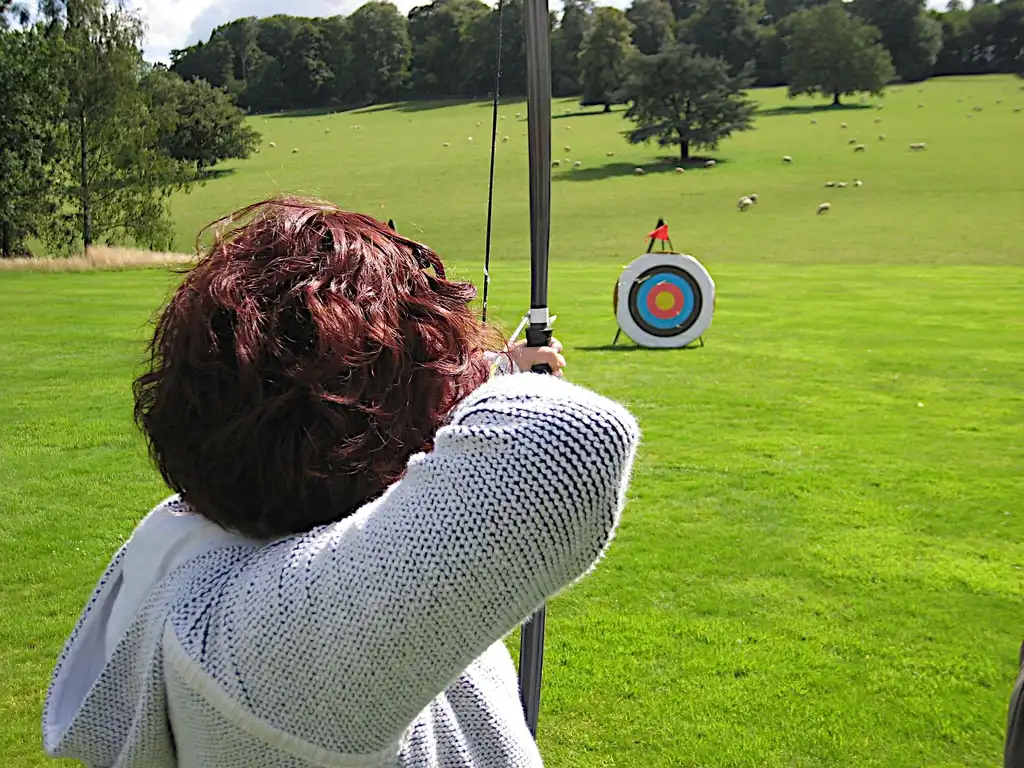
Field archery takes place outdoors on a course set through woods, hills, creek beds, and other uneven ground. Targets sit at varying distances, and the shot may climb or drop with the terrain. Beginners usually notice two things fast: there is more walking than on a flat target range, and the target order matters as much as the shot itself.
How a field course is laid out
A course is set with target lanes that move through the property in sequence. The group follows a set order, shoots, scores, then walks to the next target. The terrain can change from lane to lane, so footing and angle matter even before the bow comes up.
Field archery also uses different bow classes, and equipment limits change by class. Freestyle, barebow, and traditional are common class names, but the exact allowed sights, stabilizers, and releases depend on the rulebook for the event.
How group rotation usually works
Most groups move in a set shooting order. One archer shoots, the others stay clear, then the next archer takes the line. At the end of the target, the group scores arrows before moving on. That rhythm stays the same even when the course gets steeper or the target is awkwardly placed.
Beginners often worry about being slow. It is normal to pause, check the stake, and settle footing before shooting. What slows a group most is usually confusion about whose turn it is, or walking forward before the score is written.
What beginners notice first
The first target often feels more complicated than expected. There may be a short walk, a climb, a view of the target from an odd angle, and a need to confirm the correct stake color before shooting. The course is built to test judgment as well as bow handling.
Say your first target is uphill and the correct stake is 20 yards from the face. The uphill angle still changes the look of the shot line, so a beginner who stares only at the face may hold too high or too low. The safer habit is to confirm the stake, the lane, and the footing before drawing.
What happens before the first shot
Before the first shot, archers arrive early, register, and get oriented to the course and shooting order. Then they move to the start point, carry what they need for the day, and wait for the group to be sent out. The first few minutes are about confirming rules, not rushing to the line.
Arrival and registration
Expect check-in, bow class confirmation, and a quick explanation of course procedures. Some events also confirm target order, scorecard handling, and any marked or unmarked format for the day. If the event uses stake colors for different divisions, that is usually explained before anyone starts walking.
Gear check and warm-up
At minimum, bring your bow, arrows, scorecard tools if the event does not supply them, water, and enough food to get through the round. Weather protection matters too. A light shell, hat, and footwear that handles mud or loose ground are more useful than extra gear you will not use.
Most archers also keep a marker, tab, or other score tool handy. If the event rules require group scoring, it helps to have something ready before the first target instead of searching through a bag while everyone waits.
Walking to the first target
The walk to the first target gives a good preview of the day. Some lanes are short and flat. Others cut across slopes or across damp ground where footing matters more than distance. A beginner should expect pauses for everyone to get into position and confirm the correct shooting stake.
Field archery course-day reality check
| stage of day | what happens | what you do | common beginner mistake |
|---|---|---|---|
| arrival | Check-in, bow class confirmation, and course briefing happen before shooting starts. | Register early, confirm division, and listen for the day’s format and stake colors. | Skipping the briefing and missing a rule that affects your lane or scorecard. |
| registration | The event team assigns or confirms group order and may explain marked or unmarked shooting. | Ask about scoring duties, target count, and where the first group starts. | Assuming every lane uses the same format. |
| walking the course | The group moves target to target over woods, hills, and rough ground. | Watch footing, carry only what you need, and stay with the group. | Walking ahead to inspect the face while others are still shooting. |
| first end | The group shoots the first target, then scores before moving on. | Wait your turn, shoot from the correct stake, and mark arrows only after scoring rules allow it. | Shooting from the wrong stake or rushing into the lane early. |
| marked versus unmarked distances | Marked stakes show posted yardage; unmarked events require distance judgment. | Confirm the stake color and judge the lane before drawing. | Trusting a guess when the event is unmarked. |
| scoring | Arrows are scored after each end using the round’s point system. | Help verify arrow positions and write scores before moving. | Forgetting to score a close call before the group walks off. |
| pass-throughs and bounce-outs | Some arrows may bounce out or pass through the target. | Call the issue immediately and wait for target captain judgment if needed. | Pulling the arrow away before anyone can see where it was. |
| end-of-round packing up | The group finishes the course, turns in cards if required, and leaves the area clean. | Collect gear, check for missed arrows, and confirm the scorecard is complete. | Leaving without checking the card or the ground behind the target. |
How the field round is scored
The field round uses white-and-black scoring rings with a 5-point center, 4 points for the next ring, and 3 points for the outer rings. Each field-round target gets four arrows, and adult field-round distances run from 20 feet to 80 yards. A full adult NFAA field round can be one 28-target course or two 14-target courses.
The maximum score per field-round target is 20 points for amateurs and 24 for Professionals. In amateur divisions, an X is used for ties. In professional divisions, the X is commonly scored as 6 points.
Target faces and ring values
Field target faces are simple compared with some other formats, but the scoring still rewards precision. The center is worth 5, the next ring is worth 4, and the outer scoring rings are worth 3. Arrow placement matters more than center-watching from the waiting line.
Four arrows per target
Four arrows make up a field target end. After the fourth arrow, the group scores and moves on. That makes pacing important, because a small delay on one lane can affect the entire group for the rest of the course.
What changes in hunter and animal rounds?
Hunter and animal rounds change the target face and the shot count, so beginners should not assume a field-round routine will carry over unchanged. Hunter rounds run from 11 to 70 yards and use an all-black face with a white center. Animal rounds use paper animal targets, allow up to three shots per target, and reward the first-arrow hit most strongly.
Hunter round distances and faces
Hunter rounds use an all-black face with a white center, which makes the aiming picture different from a white-and-black field face. Distances can be odd yardages such as 17 or 53 yards, so there is usually less symmetry than a beginner expects from a flat range.
The scoring pattern is the same 5-4-3 structure used on field targets. The main difference is visual: the black face can make edge calls feel less obvious, especially in dim woods or shadow.
Animal round shots and scoring
Animal rounds allow up to three shots per target. If the first arrow hits, the archer moves on immediately. Extra arrows are not free insurance; they lower the score value, so the first shot matters most.
Picture a paper deer target with a clear first-arrow hit in a scoring area. The group does not keep shooting just because there is time left. The first hit ends the turn, and the lane resets for the next archer.
Marked or unmarked: what changes on the course?
Marked courses list the distance at the stake. Unmarked courses do not, so the archer has to judge the yardage from the terrain and target size. World Archery field championships split qualification into a marked day and an unmarked day, which shows how differently the two formats test judgment.
Marked stakes and posted yardage
Marked stakes reduce guesswork. The posted distance tells you where the shot begins, even though the uphill or downhill angle still affects the feel of the lane. This format is easier for new competitors because the yardage is stated instead of inferred.
Unmarked yardage judgment
Unmarked field-style events require distance judgment from the archer. That matters beyond competition. Unmarked practice can transfer to hunting judgment because the shot is built around reading the ground, the lane, and the target size before deciding where to hold.
A common first-timer mistake is to treat an unmarked lane like a marked one. The target may look close from one angle and far from another, especially on a slope. The better habit is to judge the stake, the target face, and the terrain together.
What should you do at the stake?
At the stake, stay inside the rules for that lane, shoot from the correct position, and avoid crowding the line. Walk-up targets and fan targets often require one arrow per stake, so the archer may need to move to a different position between shots. Shooting the wrong target counts as a miss.
Walk-up and fan targets
Walk-up and fan formats spread the shots across different stakes or distances. In those formats, one arrow is shot at each stake. The format changes the rhythm of the end because the archer moves between positions instead of shooting all arrows from one spot.
Avoiding wrong-target misses
Wrong-target errors usually happen when the course has several faces in view or the group is spread out on a tight lane. Before drawing, confirm the correct target number, the correct stake, and the direction the group is shooting. That quick check saves points.
What happens with misses and arrow issues?
Misses are part of field archery, but some arrow issues have special rules. A bounce-out that is witnessed can be re-shot. Pass-throughs may be carefully pushed back through to score, obvious unscoreable pass-throughs may be re-shot, and claimed pass-throughs need target captain judgment. More than the prescribed number of arrows creates a one-ring penalty for each extra arrow.
Bounce-outs
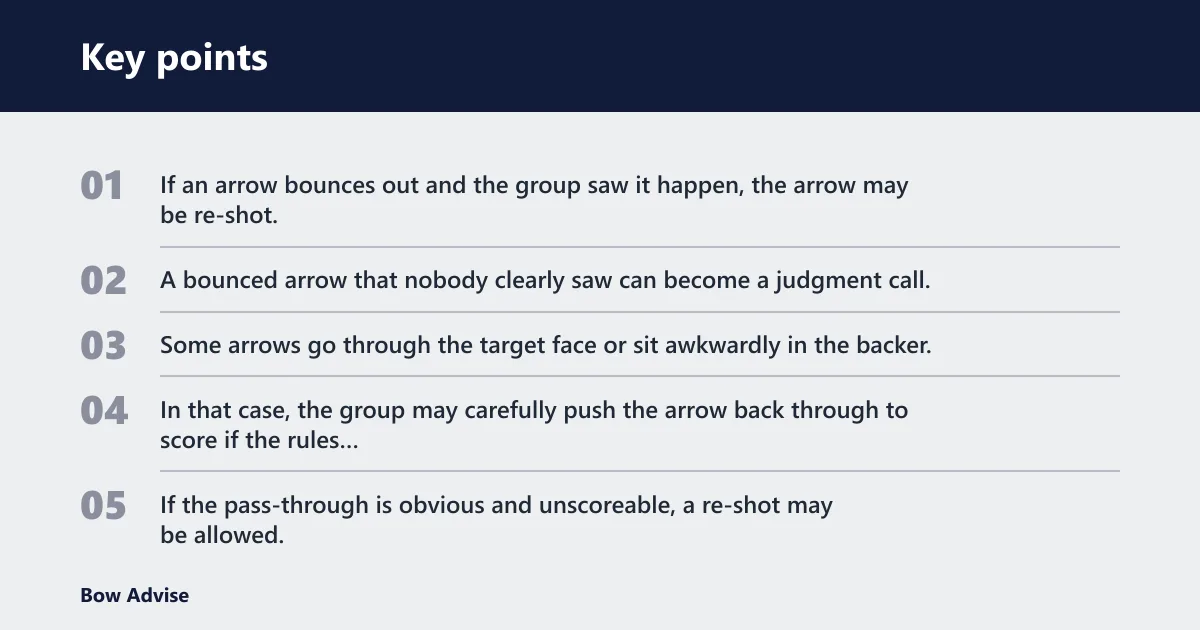
If an arrow bounces out and the group saw it happen, the arrow may be re-shot. The key word is witnessed. A bounced arrow that nobody clearly saw can become a judgment call, so the group should stop and call for the proper official or target captain rather than guessing.
Pass-throughs
Some arrows go through the target face or sit awkwardly in the backer. In that case, the group may carefully push the arrow back through to score if the rules allow it. If the pass-through is obvious and unscoreable, a re-shot may be allowed. Claimed pass-throughs need target captain judgment.
Suppose an arrow goes clean through a thin section of the target and lands behind it with a visible hole in the face. The group should not invent its own answer. The correct step is to stop, call it out, and let the target captain decide whether the arrow scores or gets re-shot.
Extra arrows and wrong-target arrows
Shooting more than the prescribed number of arrows creates a one-ring penalty for each extra arrow. That rule matters because a beginner may fire again after an uncertain hit without realizing the lane already counted its full shot total. The scorecard should match the actual number of arrows shot.
What should you bring to a field archery competition?
Bring the bow setup allowed in your class, the correct arrows, water, snacks, and weather protection. Clothing should suit walking and changing conditions. It helps to think in two piles: must-have items for the round to happen, and comfort items that make the course easier to handle.
Must-have items
- Bow and arrows that fit your class rules
- Scorecard or scorekeeping tool if required
- Water for the walk between targets
- Weather-ready footwear with good footing
- Any required safety or class-specific gear
Comfort items for weather and walking
- Snacks for a long course
- Rain shell or light weather layer
- Hat or sun protection
- Small towel or cloth for wet hands or wet arrows
- Spare socks if the ground is damp
Equipment class checks before you leave
Check the event’s equipment class rules before the drive to the course. Freestyle, barebow, and traditional may all be allowed, but not with the same accessories. The bow that works in one class may not fit another, so a quick rules check prevents a long walk back to the vehicle.
Frequently asked questions
What should I expect at my first field archery competition?
Expect a walk through woods or rough ground, a small group rotating target by target, and scorekeeping after each end. The day usually starts with registration and a briefing, then moves into a steady cycle of walking, shooting, scoring, and moving on.
How does a field archery course work on the day?
The group follows the course in order, shoots at each target lane, records the score, and then walks to the next target. Distances may be marked or unmarked, and the terrain can change from flat ground to hills or creek beds without warning.
How many arrows do you shoot in field archery?
In a standard field round, each target requires four arrows. Hunter rounds and animal rounds work differently, so the arrow count depends on the format. Animal rounds allow up to three shots per target, while walk-up and fan targets often use one arrow per stake.
Are field archery distances marked or unmarked?
They can be either. Marked stakes show the distance on the course. Unmarked events require the archer to judge the yardage from the lane, the target, and the terrain. Many beginners find marked rounds easier, then use unmarked practice to build judgment.
How is scoring handled in field archery?
Field-round scoring uses 5 points for the center, 4 for the next ring, and 3 for the outer rings. Each target is worth up to 20 points for amateurs, and pro divisions score differently. Scores are written after each end before the group moves on.
What happens if I miss, bounce an arrow, or shoot the wrong target?
A miss stays a miss, and a wrong-target arrow counts as a miss. A witnessed bounce-out can be re-shot. Pass-throughs may be pushed back through to score, but obvious unscoreable pass-throughs may be re-shot only if the rules and target captain allow it.
Do I need special gear or clothing for field archery competition?
You do not need fancy clothing, but you do need gear that fits the class rules and clothing that handles walking and weather. Footwear matters a lot on uneven ground. A light weather layer, water, and a small snack bag are smart additions for a long course day.