Different Types of Arrows: 4 Shaft Materials Compared
Arrows come in 4 main shaft materials: wood, aluminum, carbon, and aluminum/carbon hybrids, each with different weight, durability, and cost tradeoffs. Pick the wrong one for your draw weight and the arrow flexes too much or too little, causing wobble or missed shots. This guide covers arrow spine, all 4 material types, and how to match points and fletching to your setup.
Why Arrow Choice Matters for Beginners
Your arrow is the partner to your bow. They must work together perfectly. Think of it like a team: if one part isn’t right, the whole shot suffers. The main job of the arrow is to fly straight and true after leaving the bowstring. If you pick an arrow that is too stiff or too flexible for your bow’s power, it will flex too much or too little, leading to frustrating misses.
For new archers, understanding arrow basics helps build good habits early on. It prevents wasted money on gear that isn’t a good match and, most importantly, ensures you stay safe while practicing. Let’s start with the most important concept when matching an arrow to a bow: spine.

Understanding Arrow Spine: The Secret to Accuracy
Spine rating is the most crucial technical detail when buying arrows. It sounds complicated, but it’s just a measure of the arrow’s stiffness. Imagine pushing down on the middle of the arrow shaft with a standard weight. The amount it bends tells you its “spine.”
Why is stiffness important?
- Too Stiff: The arrow won’t bend enough when the bowstring hits it. It flies erratically, often hitting left or right of your target.
- Too Weak (Flexible): The arrow bends too much, flexing severely as it leaves the bow. This causes a wobble or fishtailing, making accuracy impossible.
Different bows (recurve, compound, traditional) exert different amounts of force, requiring different spines. Compound bows, often having faster speeds, generally need stiffer arrows than traditional longbows.
How to Find the Right Spine Number
You should always consult the manufacturer’s spine chart for your specific bow. Never guess! These charts use your bow’s weight (measured in pounds at your draw length (measured in inches).
Here is a general, simplified idea of how spine charts work:
| Bow Weight (Draw Weight) | Typical Arrow Spine Range (Inches deflection) |
|---|---|
| 20–30 lbs | .400 to .500 |
| 30–45 lbs | .340 to .400 |
| 45–60 lbs | .300 to .340 |
| 60+ lbs | .250 to .300 |
Pro Tip: If you are borrowing a bow or unsure of the exact settings, it is generally safer (though less accurate) to choose an arrow slightly stiffer than calculated, rather than one that is too weak. However, always seek guidance from a professional pro shop!
The Four Main Components of an Arrow
Every arrow, whether for a backyard target or a big game hunt, shares four primary parts. Understanding these helps you choose the right combination for your needs.
- The Shaft: The body of the arrow. This is where material and spine come into play.
- The Point (Tip): The front end that makes impact. Its weight and shape change based on use (target vs. hunting).
- The Fletching: The fins or feathers at the back that stabilize the arrow in flight.
- The Nock: The U-shaped piece that clips onto the bowstring.
Different Arrow Shaft Materials
The material your shaft is made from affects its weight, durability, and cost. For beginners, the material choice usually boils down to durability versus feel.
1. Aluminum Arrows
These are often the first arrows beginners buy because they are affordable and consistent. They are tough enough to handle light knocks.
- Pros: Very consistent flight path, relatively inexpensive, easy to find spine ratings.
- Cons: Can bend permanently if they hit a hard target edge or a rock, making them unusable until replaced.
- Best For: Indoor range shooting and beginners who frequently lose or damage arrows due to minor misses.
2. Carbon Arrows
Carbon is the material most serious target archers and traditional hunters use today. They are strong and lightweight.
- Pros: Extremely durable, lighter weight (which can mean faster speed), and they do not bend—they shatter if they fail, which is safer than a bent shaft releasing energy unpredictably.
- Cons: More expensive than aluminum, and if they get a hairline crack, they must be discarded immediately for safety.
- Best For: Serious outdoor target practice, 3D archery, and serious hunting.
3. Wood Arrows
These are traditional and beautiful, often used with classic recurve or longbows.
- Pros: Offer a classic aesthetic; excellent for traditional archery enthusiasts.
- Cons: Inconsistent spine from one arrow to the next, heavy, and very susceptible to humidity changes, which alters their flight.
- Best For: Historical reenactment and traditional archers focused on form over extreme speed.
4. Aluminum/Carbon Hybrids
These shafts combine both materials, aiming for the best of both worlds—the durability of carbon with the weight characteristics of aluminum. They are usually high-end and best left until you gain more experience.
Best Aluminum Arrows Pick
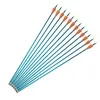
Aluminum Arrows (12-Pack) – $43.99
This guide covers aluminum as one of the 4 main shaft materials — these come with removable tips for both compound and recurve bows.
- Best for: archers wanting a consistent, mid-priced alternative to carbon or wood
- Why we picked it: removable tips let you test different points without buying new shafts
- Main drawback: heavier than carbon, so expect a slightly different trajectory
Compare more arrow materials and points
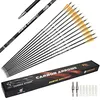 Option 1 Carbon Arrows (12-Pack) – $37.99
|  Option 2 Cedar Wood Shafts (12-Pack) – $77.14
|  Option 3 100/125/150/300gr Field Points – $8.79
|
As an Amazon Associate we earn from qualifying purchases.
Choosing Your Arrow Point (Tip)
The front end of the arrow determines what happens when it hits whatever you are aiming at. Points are generally categorized by weight and purpose. Tip weight significantly affects the arrow’s balance, known as the Front of Center (FOC).
Target Practice Points (Field Points)
These are generally inexpensive, durable points meant for repeated use against foam or bag targets. They have a field tip shape, usually made of hardened steel.
- Shape: Rounded or slightly conical.
- Weight: Common weights are 100 grains or 125 grains. A heavier point moves the FOC forward, which helps stabilize the arrow for better distance accuracy.
Hunting Points (Broadheads)
These are designed to cause maximum tissue damage for ethical hunting. They are complex and require serious respect and knowledge. Never shoot a broadhead at a regular foam target until you are certain the target can stop it. Many broadheads will punch straight through standard beginner targets.
Types of Broadheads:
- Fixed-Blade Broadheads: These blades cannot move. They are incredibly reliable and tough, as nothing mechanical can fail. They require perfect arrow tuning because their larger cutting surface catches more air.
- Mechanical (Expandable) Broadheads: These blades deploy or open upon impact. They fly more like field points (making tuning easier) but have moving parts that some hunters distrust.
Beginner Safety Note: If you are just starting to shoot, stick to field points. Broadheads are specialized tools and should only be used when adhering to local hunting regulations and ethical standards. You can learn more about safe projectile use from organizations like the Centers for Disease Control and Prevention regarding sporting safety, which applies to safe handling of all projectiles.
Understanding Fletching: Feathers vs. Plastic Vanes
Fletching refers to the fins at the back of the arrow. Their job is stabilization. As the arrow flies, the fletching acts like the rudder on a boat, keeping the point moving toward the target and preventing wobbling.
1. Plastic Vanes
These are the most common type for modern target archers and nearly all compound bows.
- Durability: Very tough. They handle rain, moisture, and impacts with target foam better than feathers.
- Drag: They create more drag than feathers, meaning they slow the arrow down slightly more.
- Tuning: Some vanes are helical (curved) or offset (angled) to induce spin, which improves flight stability significantly.
2. Natural Feathers
Feathers are the traditional choice, almost exclusively used with traditional bows or for very high-end target shooting where maximum speed is required.
- Durability: Easily damaged by rain or moisture, which warps them and ruins flight. They often need replacing.
- Drag: They create less drag than plastic, allowing for slightly higher speed retention.
- Fletching Angle: Traditional archers often use a right-wing (right-facing) or left-wing (left-facing) feather configuration based on whether they shoot off a shelf or use a palm rest.
Advice for Beginners: Start with plastic vanes. They are low maintenance and reliable across different weather conditions. If you eventually switch to a wooden hunting arrow or a traditional recurve, you can then experiment with feathers.
Selecting the Right Nock
The nock is the small plastic piece that connects the arrow to the string. It must fit your string diameter and be durable enough not to break on release.
Nock types are usually defined by the shape of the string channel:
- Half-Moon Nocks: The most popular style for modern compound and recurve bows. They have a semi-circular opening.
- Super or Capture Nocks: Most common on compound bows where the string has a small brass or aluminum bead attached to it. These nocks fully enclose the bead, offering very consistent alignment.
You must choose a nock that perfectly matches your bowstring. If the nock is too loose, it can fall off before release (a dangerous dry fire!). If it’s too tight, it can take too much energy from the string, leading to poor performance. Most bow manufacturers recommend a specific nock type for their equipment.
Arrow Length: Measuring Correctly for Safety and Power
The length of the arrow shaft (measured from the bottom of the nock groove to where the point inserts) is critical for both safety and performance. Shooting an arrow that is too short is one of the fastest ways to cause severe injury to your bow.
The Danger of Short Arrows
If an arrow is too short, the nock might be sitting below the handle area of the bow when fully drawn. This means the front of the arrow shaft, which is not supported by the bow’s shelf or basket, snaps down onto the bow limb or rest upon release. This causes massive stress, often leading to the limb cracking or even shattering—a very dangerous situation called a dry-fire.
How to Determine Your Draw Length and Arrow Length
You must first know your specific draw length. If you are buying your first bow, have an archery pro measure you. A common, simple method (though less accurate than a professional measurement) involves using a pre-strung bow:
- Draw the bow back to your normal anchor point (where your fingers touch your face/neck).
- Measure the distance from the string back to the hinge of the bow’s riser (handle). This is your measured draw length.
The Rule of Thumb for Arrow Length: Take your measured draw length and add 1 to 1.5 inches. This extra length ensures the front of the arrow stays supported by the bow rest or arrow shelf even at full draw.
| Measurement Step | Result |
|---|---|
| Measured Draw Length (e.g., 28 inches) | 28″ |
| Add Safety Margin (1.5 inches) | + 1.5″ |
| Recommended Arrow Length | 29.5″ (You would buy a 30-inch arrow and cut it down, or buy a 29.5″ arrow if available) |
Putting It All Together: Arrow Selection for Different Disciplines
The “different kinds of arrows” are really just combinations of the components we discussed, optimized for a specific activity. Let’s look at common scenarios.
1. Beginner Target Practice Arrows (The Workhorse)
If you are learning the basics, consistency and durability against a common target type are key.
- Shaft: Aluminum or inexpensive Carbon.
- Spine: Match your bow’s specs exactly.
- Point: 100-grain Field Points.
- Fletching: Durable plastic vanes (straight or offset).
- Length: At least 1 inch longer than your full draw length.
2. 3D Archery Arrows (The Speedsters)
3D archery involves shooting foam animals at unknown distances. You need speed and good stability to hold a line.
- Shaft: Carbon (for lighter weight and speed).
- Spine: Match the bow, often choosing the stiffest arrow that still tunes correctly for maximum speed.
- Point: Heavier field points (125 grains) are common to push the Front of Center (FOC) forward for better stability at long ranges.
- Fletching: Low-profile, small plastic vanes to reduce drag.
3. Hunting Arrows (The Ethical Choice)
Hunting arrows prioritize penetration and reliable broadhead flight.
- Shaft: Stiff, heavy-walled Carbon is preferred for maximum rigidity and tissue penetration.
- Spine: Generally stiffer than target equivalents, often .300-.340, because broadheads create more drag.
- Point: Broadheads (fixed or mechanical). Weight is often 100 or 125 grains.
- Fletching: Often smaller vanes (3 or 4) to minimize air resistance under windy conditions, though some archers use three feathers for traditional setups.
4. Indoor Target Arrows (The Heaviest Fighters)
Indoors, speed isn’t as vital as grouping tight. Heaviness helps absorb wind or slight human errors.
- Shaft: Often heavy gauge aluminum or thick carbon.
- Spine: Usually selected to be slightly weaker (more flexible) than the absolute minimum required, as targets are close.
- Point: Small, flat-faced brass points prevent splatter and maximize the space between arrows on the target face.

Arrow Tuning Basics for Beginners
Once you have the right components, you need to tune them to your bow. This is the step that turns a good arrow into a great one. Tuning ensures the arrow leaves the string smoothly without excessive side-to-side wiggle.
The initial tuning element you control is the rest adjustment. If your arrow flies consistently to the left (for a right-handed shooter), you might need to move your rest slightly left, and vice-versa.
A great resource for learning about precise bow tuning is found in resources provided by manufacturers of precision archery gear. For example, reputable bow sight makers often have extensive guides on arrow flight correction. If you are using a modern compound bow, always check the manual or visit a local pro shop certified for your bow brand to ensure proper tuning methods are used, especially regarding kinetic energy requirements for hunting tips, per guidelines sometimes referenced by state wildlife agencies during season preparation.
Frequently Asked Questions (FAQ) for New Archers
What is the difference between a spine of .400 and .340?
A .400 spine arrow is more flexible (weaker) than a .340 spine arrow. When shooting the same bow, the .340 shaft will bend less, making it stiffer.
Can I use hunting arrows for target practice?
Yes, you can use identical shafts with field points for practice. However, always practice with field points first.