Different Kinds of Arrows: Proven Essential Tools
Understanding the different kinds of arrows is crucial for safe and accurate shooting. Arrows are primarily categorized by their material (carbon, aluminum, wood), spine, and intended use (recurve, compound, traditional). Choosing the right type ensures your bow performs consistently and safely.
Welcome to the wonderful world of archery! If you’ve ever stood in front of a rack of arrows, you might feel a little confused. Aluminum, carbon, wood—what is the difference? It’s easy to feel overwhelmed by the choices, but picking the right arrow is simpler than you think. Think of the arrow as the final, most important link between you and your target. Getting this piece right makes practice fun and accurate. Don’t worry; we will break down the different kinds of arrows into easy, clear steps today. By the end of this guide, you’ll know exactly what you need for your bow, helping you build confidence every time you step up to the line.
Why Arrow Choice Matters: Beyond Just Hitting the Target


Many beginners think any arrow will work, as long as it fits the bow’s length. While length is very important, the arrow’s material and stiffness (called “spine”) affect everything: safety, accuracy, and arrow shelf life. An arrow that is too weak or too heavy can make your bow shoot poorly or, worse, cause dangerous situations.
Safety is the number one reason to understand arrow differences. Arrows designed for a high-powered compound bow should never be used on a low-poundage beginner recurve, as they might fly unstable. Conversely, a very soft arrow shot from a powerful bow can break upon release, which is very dangerous. Let’s look at the main ways we classify these essential tools.
The Three Main Arrow Materials: Wood, Aluminum, and Carbon
Arrows are primarily chosen based on what they are made from. This material affects durability, weight, and cost. Here is a breakdown of the three most common types you will see at any archery shop.
1. Wood Arrows: The Classic Feel
Wood arrows are the traditional choice, favored by archers using longbows or traditional recurves. They offer a beautiful, classic aesthetic and are often used in historical or traditional archery disciplines.
Pros and Cons of Wood Arrows
- Pro: Perfect for traditional shooting styles and look fantastic.
- Pro: Easily adjustable—you can sand them down to change the spine slightly.
- Con: Less durable; they can crack or warp if stored improperly or hit hard objects.
- Con: Inconsistent spine from shaft to shaft, meaning more time spent hand-selecting and tuning.
Best For: Traditional archery enthusiasts, barebow shooters, and those prioritizing the classic look and feel.
2. Aluminum Arrows: Consistency is Key
Aluminum arrows were the standard for competitive target archery for decades. They are made from a single piece of aerospace-grade aluminum tubing. They are known for being very straight and consistent from one arrow to the next.
Pros and Cons of Aluminum Arrows
- Pro: Excellent consistency in spine and weight for repeatable accuracy.
- Pro: Durable against flexing; they bend instead of breaking sharply.
- Con: Heavy compared to carbon arrows.
- Con: Once bent, they are extremely hard to straighten perfectly, often requiring replacement if bent badly.
Best For: Indoor target leagues or archers who want a slightly heavier arrow for steady shooting.
3. Carbon Arrows: The Modern Go-To
Carbon fiber is the material of choice for most modern target archers, bowhunters, and recreational shooters today. They are lightweight, fast, and very durable.
Pros and Cons of Carbon Arrows
- Pro: Extremely fast and lightweight, giving a flatter trajectory.
- Pro: Very durable and slightly more forgiving if you hit a hard surface (though they can shatter if severely damaged—always check!).
- Con: Can be more expensive upfront than aluminum or basic wood shafts.
- Con: If they break, they can splinter, creating sharp edges you must watch out for.
Best For: Compound bow shooters, modern recurve target archers, and most first-time buyers looking for all-around performance.
4. Carbon-Aluminum Hybrids: The Best of Both Worlds
For serious competitive shooters, you might encounter hybrid arrows. These feature a carbon core wrapped in an aluminum jacket. They offer the speed and lighter weight of carbon but the durability and superior spine consistency necessary for elite indoor circuits.
Note for Beginners: While hybrids are excellent, they are usually more than necessary when starting out. Stick to pure carbon or aluminum until you begin competing seriously.
Understanding Arrow Spine: The Critical Factor
The spine of an arrow refers to its stiffness or resistance to bending. This is arguably the most critical specification you need to match to your bow. If an arrow spine is too weak (too flexible) for your bow’s draw weight and speed, it can lead to inaccurate grouping or potentially unsafe arrow flight. If it is too stiff (too rigid), it will also fly inconsistently.
What Determines Spine Requirements?
Spine is not just a number you guess; it’s determined by three main factors related to your specific setup:
- Bow Draw Weight: The heavier the draw weight (e.g., 50 lbs vs. 25 lbs), the stiffer the arrow spine needs to be to handle the force.
- Arrow Length: Longer arrows are generally more flexible than shorter arrows made from the same material.
- Point Weight: Heavier tips require a slightly stiffer shaft to maintain balance and tune correctly.
Using Spine Charts
Every arrow manufacturer provides a spine chart specific to their product line. You must consult the chart provided by the arrow maker, but the principle remains the same: find your weight and length combination on the chart to see the recommended spine number.
For instance, a person drawing 30 lbs with a 28-inch arrow might need a 500-spine arrow. If they draw 50 lbs at the same length, they might need a much stiffer 300- or 340-spine arrow. Always check the resources provided by major archery organizations or the manufacturer, like those often referenced in safety guidelines maintained by government departments such as the National Park Service for general outdoor recreation best practices, which often overlap with range safety.
Here is a simplified visual example of how spine rating works conceptually (actual spine ratings vary widely by material and manufacturer):
| Spine Rating (Lower Number) | Stiffness Level | Best Suited For |
|---|---|---|
| 300 – 400 | Very Stiff (Heavy) | High-poundage Compound Bows (55+ lbs) |
| 500 – 600 | Medium Stiffness | Mid-range Recurves and Compounds (35–50 lbs) |
| 700 – 1000+ | Very Flexible (Light) | Low-poundage Recurves and Youth Bows (under 35 lbs) |
Arrow Components: More Than Just the Shaft
The shaft is the main body, but the parts attached to it (the components) drastically influence how the arrow flies and performs.
1. Arrow Points (Tips)
The tip is what hits object! Points are generally categorized by their intended purpose:
- Field Points: These are the standard, general-purpose tips used for target practice. They are usually blunt or slightly conical and often come in metal weights (as small threaded inserts) that allow you to fine-tune the arrow’s front-of-center (FOC) weight.
- Target Points: Similar to field points but often feature a slightly more rounded or flat face for better scoring, especially in paper targets.
- Broadheads: These are used exclusively for hunting. They feature sharp, razor-like blades designed to create a large wound channel. Crucially, broadheads should NEVER be used for casual target practice as they can be extremely difficult (and dangerous) to retrieve and destroy targets easily.
2. Fletchings (Vanes or Feathers)
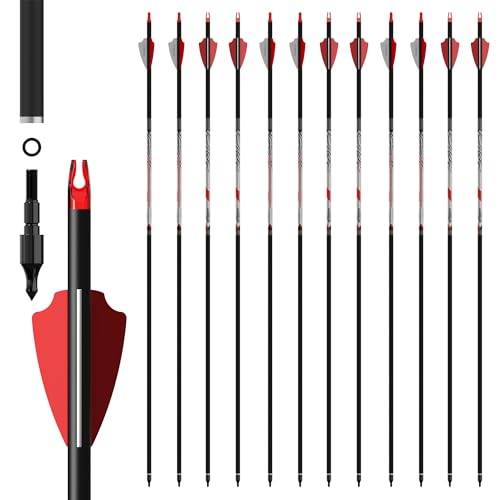
Fletchings are the fins at the back of the arrow that provide stabilization during flight, much like the fins on a rocket. They help the arrow correct its path after leaving the bow.
- Plastic Vanes: Most modern arrows use plastic vanes. They are durable, weather-resistant, and perform well with modern compound bows using launchers or rests.
- Feathers (Natural Fletching): Traditional archers prefer feathers. They offer excellent stabilization, especially on older bows or those shot off the hand/carpet, but they are easily damaged by rain or rough handling.
You will usually see three or four fletchings per arrow. The one closest to the shooter that touches the bow is called the cock feather, and the other two or three are hen feathers. Always ensure the cock feather is oriented correctly relative to your arrow rest!
3. Nocks
The nock is the plastic cup at the very rear end of the arrow that clips onto the bowstring. Nocks must match your bow type:
- Standard Nocks: Work with traditional bowstrings.
- Small Diameter/Pin Nocks: Used often with compound bows that employ a “pin system” for added durability and precise centering.
Safety Tip: Always inspect your nocks before shooting. A cracked nock can cause the arrow to fly off sideways upon release, which is dangerous for everyone nearby.
Matching Arrows to Your Bow Type
The bow style you own dictates the general characteristics needed for your arrows. While the spine is specific to your draw weight, the construction is often specific to the bow mechanism.
Recurve and Traditional Bows
These bows rely on the archer’s natural ability to stabilize the arrow. Arrows for these bows tend to be:
- Often lighter in weight (unless using heavy wood shafts).
- Require precise spine tuning because the arrow rests marginally or on the archer’s hand.
- Feathers (for traditional) or vanes (for modern Olympic-style recurves) are common.
Compound Bows
Compound bows use cams and cables to deliver power very fast, often requiring stiffer arrows to manage the speed and kinetic energy.
- They almost exclusively use carbon or aluminum shafts due to the high speeds generated.
- They typically use arrow rests that cradle the entire bottom of the arrow (like drop-away rests), making vane choice critical for clearance.
- Compound archers often prefer heavier points to increase the Front of Center (FOC) balance for better penetration and stability at high speeds.
A Step-by-Step Guide to Buying Your First Set of Arrows
As a beginner, you don’t need to buy the most expensive arrows on the market. You need a safe, consistent set that matches your current equipment. Follow these steps before heading to the store.
Step 1: Know Your Draw Weight and Length
You must know exactly how many pounds your bow pulls at your full draw, and how far you pull the string back (measured from the string to the back of the bow riser at full draw). If you aren’t sure, ask a qualified pro shop technician to measure you. They can do this safely and accurately.
Step 2: Check Your Bow Manufacturer’s Guidelines
Look up the manual for your specific bow model (especially if it’s a compound). Many bow manufacturers explicitly recommend arrow spine ranges to ensure warranty coverage and safe operation. This is your legally safest starting point.
Step 3: Select Your Material (The Beginner Choice)
For most beginners using a modern recurve or compound bow, Easton T-Series carbon arrows (or equivalent X-series carbon mix) are an excellent, reliable starting point. They offer a great balance of price, safety, and performance.
Step 4: Determine the Ideal Spine Rating
Using the guidelines from Step 2 and the arrow manufacturer’s chart (found on the box or their website), cross-reference your draw weight and draw length to select the correct numerical spine rating (e.g., 400, 500, 600).
Step 5: Choose the Right Length and Finish
The arrow length should be about one to two inches longer than your draw length for absolute safety (you want the tip well clear of the bow rest). Your pro shop might cut them slightly shorter later if needed for fine-tuning, but start long.
For practice, choose standard field points (80 to 125 grains are common starting points for target work).
Step 6: Inspect and Tune
When you receive your arrows, check every single one. Look for hairline cracks, especially on carbon. Test them dynamically (by paper tuning or bare shaft tuning) with your bow. A good arrow should fly straight without wobbling excessively. If they wobble, you might need to adjust your arrow rest setup or verify your spine selection.
Advanced Tuning Concept: Front of Center (FOC) Weighting
FOC stands for Front of Center. It is the percentage of the arrow’s total weight that rests in the front half of the arrow (the tip end). FOC is vital for long-distance accuracy and penetration, especially in hunting.
A good rule of thumb for general target shooting is to aim for an FOC between 8% and 15%. Hunting arrows often require slightly higher FOC (up to 20%) for better momentum.
How is FOC Controlled?
You control FOC primarily by changing the weight of the point:
- Switching from a 100-grain tip to a 125-grain tip moves the center of weight forward, increasing FOC.
- Using heavier inserts or components in the shaft can also subtly adjust this balance.
While beginners should focus purely on spine and length first, understanding FOC is the next step toward advanced tuning.
Arrow Safety and Maintenance: Keep Your Tools Reliable
An arrow is only as good as its maintenance. Taking care of your equipment ensures your safety and maximizes your enjoyment.
Inspecting for Damage is Non-Negotiable
This is where we emphasize safety once more. Before every single session, quickly check your arrows:
- Carbon Check: Roll the shaft gently on a flat, hard surface (like a glass table). If the shaft wobbles or rocks unevenly, it means the shaft is bent or has internal delamination. Discard it immediately. For deeper inspection, you can use the “light test”—hold the shaft up to a bright light source in a dark room and look for light shining through any pinholes or cracks.
- Aluminum Check: Look closely for bends or kinks. A kinked aluminum shaft compromises its structural integrity and should be removed from service.
- Nock Check: Look for any chips, cracks, or deformation in the nock groove. Replace any suspect nocks.
Cleaning and Storage
Store your arrows vertically in a quiver or arrow rack. Never leave them lying on the ground where they can be stepped on or run over by a vehicle. Keep them out of extreme heat (like inside a car on a hot day), which can damage plastic components or warp wood shafts.

Frequently Asked Questions (FAQ) for New Archers
Q1: Can I use my compound bow arrows on my recurve bow?
Generally, no, unless the draw weight of the recurve is very low and the arrow spine is very flexible. Compound arrows are often much stiffer (lower spine) and built to withstand higher initial speeds than a beginner recurve can safely launch.
Q2: What does “spine” really mean in simple terms?
Spine just means how stiff the arrow shaft is. A high number (like 1000) means it’s wobbly and weak; a low number (like 300) means it’s very stiff and strong.
Q3: How do I know if I need aluminum or carbon arrows?
For 90% of beginners today, carbon arrows are recommended. They are lighter, faster, and generally more forgiving than aluminum in terms of modern tuning characteristics.
Q4: Do I have to buy arrows that match my bow brand?
No. Arrow brands do not need to match the bow brand. You only need to match the arrow’s specifications (spine, length) to your bow’s specifications (draw weight, draw length).