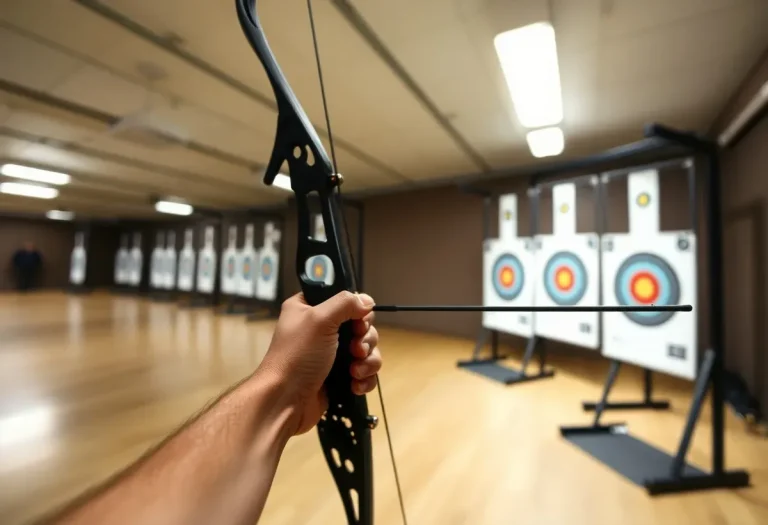
How To Have Indoor Archery Contests: Proven Best
To have the best indoor archery contests, focus on absolute safety (clear backstops, designated shooting lines), choose accessible targeting games (like ring toss or balloon popping), and keep scoring simple. A fun, low-pressure environment is key for beginners to build confidence indoors.

Silipull
Silipull 8 Pcs Archery Set Adult, Bow…
- Complete Archery Experience: dive into the world of archery with our recurve bow set, a nice merge of fun and safety for enthusias…
- Suitable Size for Everyone: our bow and arrow set is designed for inclusivity, featuring a recurve bow sized at approximately 54 x…
- Durable Materials: constructed from quality fiberglass, the recurve bow offers outstanding impact resistance and durability; The s…
As an Amazon Associate I earn from qualifying purchases.
Is the weather keeping you off the range? Or maybe you just need a fun, competitive activity right in your own home or community center? Organizing an indoor archery contest can feel tricky. You worry about safety, space, and making sure everyone has a good time, not just the experts. As your guide, I can tell you that hosting a fantastic indoor event is totally achievable, even with limited space and beginner archers.
We will break down everything you need, from mandatory safety checks to creative, fun scoring systems. Get ready to turn your indoor space into an exciting, safe, and friendly arena. Let’s look at the proven best ways to host your own indoor archery contests!
The Foundation: Safety First in Indoor Archery
When shooting indoors, safety is not just important—it is the number one rule. Unlike outdoor ranges where missed shots disappear into fields, indoor environments require perfect containment. If you skip this section, you are skipping everything else. Indoor safety relies on three key elements: the Backstop, the Range, and the Gear.
1. Selecting and Setting Up the Perfect Backstop
The backstop is the most critical piece of safety equipment indoors. It must stop the arrow completely without allowing it to bounce back or punch through. Never rely on just flimsy cardboard or drywall.
Best Indoor Backstop Options
For beginner and hobbyist contests, you need reliable stopping power paired with easy setup.
- Bag Targets: These are excellent for lower poundage bows (under 30 lbs). They are portable and stop arrows quickly. Ensure they are large enough for the distance you are shooting.
- Layered Foam Blocks (For Higher Pounds): If you have slightly stronger bows, dense, layered foam targets are the standard. They often come in large blocks specifically designed for archery stops.
- DIY Stop Systems: A budget-friendly yet effective method involves creating a sturdy wooden frame and filling it with layered materials like old carpet scraps, heavy contractor bags filled with rags, or specialized archery netting hung in front of a solid wall. Always check resources like local archery association safety guidelines for wall protection standards before building your own system, such as those advised for community centers.
Crucial Tip: Always place your backstop several feet away from any wall, barrier, or object that is not your intended stop material. You need a clear ‘safety margin’ inside the stopping area, just in case.
2. Defining the Shooting Area and Safety Zones
A strong backstop won’t help if people are standing where arrows might land! Clear, defined zones prevent accidents.
- Establish an Absolute Firing Line (Shooting Line): This must be clearly marked using bright tape (like caution tape or floor tape). No archer, spectator, or equipment should cross this line while shooting is active.
- Determine Shooting Distance: For beginners indoors, shorter is safer and more accurate. Distances between 10 and 15 yards are ideal. This reduces the risk of a low-poundage bow’s arrow falling short or an over-shot arrow leaving the intended safety area.
- Clear the Sides and Rear: Ensure the area beside the archers and behind them has nothing breakable, no sharp corners, and ample empty space. Spectators must stand well behind the archers, far away from the direct line of sight to the target.
- One-Up, One-Down Rule: Only one person should be retrieving arrows at a time. When fetching arrows, the range officer or host must loudly announce, “Range Safe! Archers Step Down!” When shooting resumes, announce, “Clear to Shoot! Archers Step Up!”
3. Checking Archery Equipment
A broken bowstring or crack in the riser can be dangerous indoors where the arrow has less distance to slow down naturally.
- Inspect Bows: Before anyone shoots, ensure bows (even rental or loaner bows) have no cracks, deep scratches, or frayed/frayed/weathered strings.
- Arrow Check: Use only arrows that are appropriate for the bow’s draw weight. Broken, cracked, or bent shafts must be permanently removed from use immediately. Never shoot damaged arrows.
- Proper Draw Weight: For new archers, use low-poundage recurves (e.g., 15–25 lbs). This ensures they can shoot safely without straining and that the arrows are easily stopped by standard indoor targets.

Planning Your Indoor Archery Contest Format
The “best” indoor contest is the one that is the most fun and fair for the level of experience in the room. For beginners, skip complex Olympic-style scoring. Focus on engagement!
Choosing the Right Target Style
Standard paper targets can get boring quickly indoors. Mix it up with game-style targets that encourage teamwork and light competition.
Game-Based Target Ideas for Beginners
| Contest Name | Target Setup | Scoring Focus |
|---|---|---|
| The Balloon Pop | Balloons taped to a portable foam target. | One point per balloon popped. Bonus points for specific colors (if you use them). Fast-paced and audible feedback! |
| The Ring Toss (Archery Style) | Large foam rings (like hula hoops or pool noodles cut and taped) hung vertically, overlapping slightly. | Rings have point values (e.g., Outer Ring = 3 pts, Inner Ring = 5 pts). Accuracy over power. |
| Clown Face/Dartboard Replica | Printable or drawn large target faces with clearly defined rings. | Traditional scoring (e.g., 10 points in the center). Good bridge to standard target shooting. |
| Pin Shooting (Bowling Pin Style) | Set up lightweight plastic cups or lightweight plastic bowling pins just behind the main backstop or on a separate, safe surface. | Knocking the object over scores points. Emphasizes aiming for impact rather than just center mass. |
Structuring the Contest Rounds
Keep the commitment short for each round. Beginners might lose focus or tire quickly, affecting their enjoyment.
- Warm-Up Round (Mandatory): 5 to 10 practice arrows per person at a close, safe distance (5 yards). This allows everyone to settle their nerves and check their equipment feels right after setup.
- Preliminary Rounds (Skill Building): Run 2 to 3 different game formats back-to-back (e.g., 3 ends of Balloon Pop, then switch to 3 ends of Ring Toss).
- The Final Showdown: Use the highest-scoring game type or a designated “target accuracy” round for the final score tally.
Tip on Ends: An “end” is traditional archery terminology for a set number of shots taken by all participants before scoring or retrieving arrows. Keep ends short—5 arrows per end is usually enough for indoor fun.
Simple and Effective Indoor Contest Scoring
The best indoor contests are those where the scoring is easy to understand, quick to calculate, and doesn’t discourage new shooters. Forget complicated rules found in professional tournaments.
Scoring Methods for Maximum Fun
1. Blind Drop Scoring (Best for Immediate Feedback)
This method means archers shoot multiple arrows, and only the best arrow counts toward their score for that end. This rewards consistency without punishing an occasional bad shot.
- Each shooter gets 5 arrows per end.
- If shooting a dartboard style, they score the highest ring hit by any of their 5 arrows.
- If shooting a “Clown Face” target, you might score the total of the two best arrows.
2. Cumulative Round Scoring (Best for Tracking Progress)
In this format, every arrow counts. It’s straightforward addition.
If you have 4 ends planned, and each end is worth a maximum of 40 points (10 points max per arrow):
Total Possible Score = 4 ends x 40 points/end = 160 points.
3. Team Relay Scoring (Great for Social Events)
Divide participants into teams of 3 or 4. Before the contest begins, assign roles within the team rotation:
- Archer A shoots the first end.
- Archer B shoots the second end.
- Archer C shoots the third end.
- The team’s score is the sum of A + B + C.
This takes the pressure off individual performance and encourages teammates to cheer each other on! This collaborative approach significantly boosts the morale of beginner groups.
Scorekeeping Tools
You don’t need fancy apps. A simple clipboard and printouts work perfectly.
| Tool | How to Use It | Why It Works Indoors |
|---|---|---|
| Printable Score Sheets | Use columns for Archer Name, End 1, End 2, End 3, Total. | Keeps tracking neat; easy to post results visibly. |
| Colored Stickers/Tape | Place a different colored sticker on each archer’s arrows before they shoot. | When arrows are in the target, you instantly know whose arrow belongs where, speeding up score collection immensely. |
| White Board or Easel | Write the current game rules and target point values where everyone can see them. | Reduces confusion and keeps the focus on shooting, not calculating. |
Optimizing Your Indoor Space for Archery Contests
Most people hosting indoor contests aren’t in a dedicated gym; they are using a basement, garage, or large room. Size matters, but layout matters more.
Calculating Minimum Safe Dimensions
The two most important measurements are the shooting distance (Stance to Target) and the Safety/Retrieval Zone (Target to Backstop).
Here is a baseline guide. Remember, longer is always better when setting distances indoors, but this plan works for smaller spaces (e.g., a 2-car garage or medium hall).
| Element | Minimum Safe Distance (Beginners/Recurves) | Ideal Distance (For Better Play) |
|---|---|---|
| Shooting Distance (Stance to Target) | 10 yards (approx. 9 meters) | 15 yards (approx. 13.7 meters) |
| Backstop Safety Margin | 3 feet (approx. 1 meter) behind the target | 5 feet (approx. 1.5 meters) behind the target |
| Archer Lane Width | 4 feet per archer (shoulder-to-shoulder) | 5 feet per archer |
Enhancing the Environment for Fun
Good lighting and clear instruction transform a simple activity into a real contest.
- Lighting: Ensure the target area is brightly lit. Shadows can make judging arrow placement difficult when scoring. Overhead light is best.
- Sound Control: Decide if you want background music. Upbeat, moderate-level music can boost energy. However, if you are relying heavily on verbal commands (“Range is hot!”), keep the music low so all instructions are clearly heard.
- Designate Roles: Even for small groups, assign one person as the Range Safety Officer (RSO). This person manages the “hot/safe” commands and resolves scoring disputes. This clearly defined leadership prevents confusion.
The Importance of the Draw Weight Check (RSO Duty)
Before the contest starts, the RSO must verify that the draw weight of any bow being used is appropriate, especially when using community property or loaner bows. For educational or fun indoor events, a good benchmark is to have no bow exceed 30 pounds of pull (draw weight). Higher weights require much more robust targets and create a higher risk of equipment failure indoors. For more detailed guidance on safe bow selection, resources like the National Archery in the Schools Program (NASP) often provide excellent, safety-focused standards for managed environments.
Creative Indoor Contest Variations
If you host contests often, variety keeps people coming back. These variations are designed to target different skills without requiring massive space changes.
Variation 1: Target Movement (Simulated Field Archery)
You cannot move the target face, but you can move the shooting position.
- Set up two distinct shooting lines: A close line (5 yards) and a far line (15 yards).
- During one “End,” archers shoot 3 arrows from the close line and 3 arrows from the far line.
- The challenge is managing personal form transition between the two distances quickly.
Variation 2: The Pressure Cooker (Time-Based Shooting)
This tests focus under mild time constraints, great for intermediate hobbyists.
- Give each archer a set time window (e.g., 90 seconds) to shoot their 5 arrows assigned for that end.
- The Range Officer calls time. Any archer not behind the shooting line when the 90 seconds expire forfeits those arrows for that end (no score).
- This forces archers to manage their setup and aiming time efficiently.
Variation 3: Blind Scoring (Focus on Feel)
This is an excellent confidence builder for beginners.
- Set up a standard target with clear scoring rings.
- Archers shoot their 5 arrows.
- Before anyone looks, they must verbally guess their estimated aggregate score (e.g., “I think I scored 32 total”).
- The person whose guess is closest to the actual score wins a bonus point cluster for that end, regardless of their raw score. This rewards thoughtful estimation and focus during the shot process.
Troubleshooting Common Indoor Archery Issues
Inevitably, something won’t go exactly to plan. Here are quick fixes for the most common indoor contest hiccups.
Problem: Arrows are sticking too deeply in the target.
Solution: This is common with new, dense foam. If arrows are hard to pull, it slows the game down immensely. Try lightly dusting the target face with talcum powder or cornstarch. This reduces surface friction slightly, making removal much easier. Also, ensure you are using appropriately sized and weighted arrows for the bow’s draw weight.
Problem: Spectators or people walking by disturb the archers.
Solution: Clear visual barriers are mandatory. Even if you don’t have portable screens, stretch brightly colored caution tape or rope around the shooting area, creating a visible boundary that cannot be crossed during active shooting. The RSO must enforce this boundary firmly but kindly.
Problem: The low light makes accurate aiming difficult.
Solution: If overhead lights are weak, use temporary, battery-powered work lights or powerful LED spotlights aimed directly at the target face. A well-lit bullseye is key for encouraging good aiming habits indoors.
Problem: Archers are tense and not relaxing into the shot.
Solution: This is where the friendly atmosphere comes in. If a shooter misses badly, the RSO or host should immediately call out a positive correction or joke rather than silence. For example: “Great grouping! We just need to move that group just a little bit left!” Focus on the process, not the miss.

FAQ: Beginner-Friendly Indoor Archery Contest Questions
Got quick questions about logistics? Here are the answers every new host needs.
| Question | Simple Answer |
|---|---|
| What is the safest indoor range distance for beginners? | 10 yards (about 9 meters) is the safest standard distance for beginners shooting recurve bows indoors. |
| Can I use my compound bow indoors? | Yes, but only if your backstop is rated to safely stop its higher velocity. For simple fun contests, it’s often easier to stick to lower-poundage recurves (under 30 lbs) for maximum safety and target longevity. |
Related pick: Check today's price on Amazon