Indoor Archery vs Outdoor Archery: Key Differences
Indoor archery rewards tight tune and clean execution at 20 yards. Outdoor archery asks for wind reads, distance control, and wider setup changes. Pick the season that matches your main target distance and local tournament calendar, or you will spend practice on the wrong skills. This guide compares scoring, setup, and training for recurve and compound indoors versus outdoors.
| Decision factor | Indoor Archery | Outdoor Archery | Winner |
|---|---|---|---|
| Distance and conditions | Usually shot at 18 to 20 yards, with no wind | Shot at longer, varied distances, including 70+ yards, with wind, sun, and changing light | Depends on the goal |
| Scoring pressure | Small target faces and line calls can decide points | Larger or varied faces; score changes often come from distance and wind drift | Indoor Archery |
| Gear setup | Often one fixed sight setting and larger-diameter arrows | Multiple sight marks or a sight tape, usually with thinner arrows | Depends on discipline |
| Training demands | Precision, repeatable anchor, and clean release | Distance judgment, wind reading, stamina, and adaptation to weather | Depends on season and goals |
| Beginner access | Often winter-friendly and league-friendly | Better for field skills, hunting carryover, and full-round realism | Indoor Archery |
Indoor archery vs outdoor archery: the core trade-off
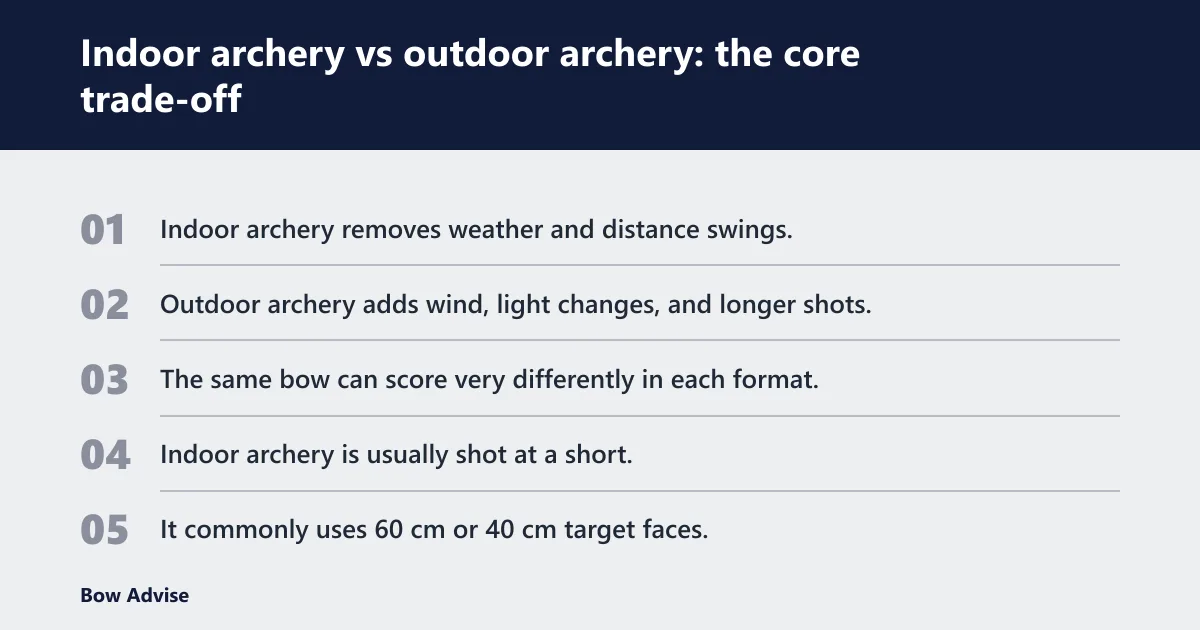


Indoor archery removes weather and distance swings, so the round rewards repeatable shooting at one mark. Outdoor archery adds wind, light changes, and longer shots, so the archer must manage form and conditions together. The same bow can score very differently in each format.
Indoor archery
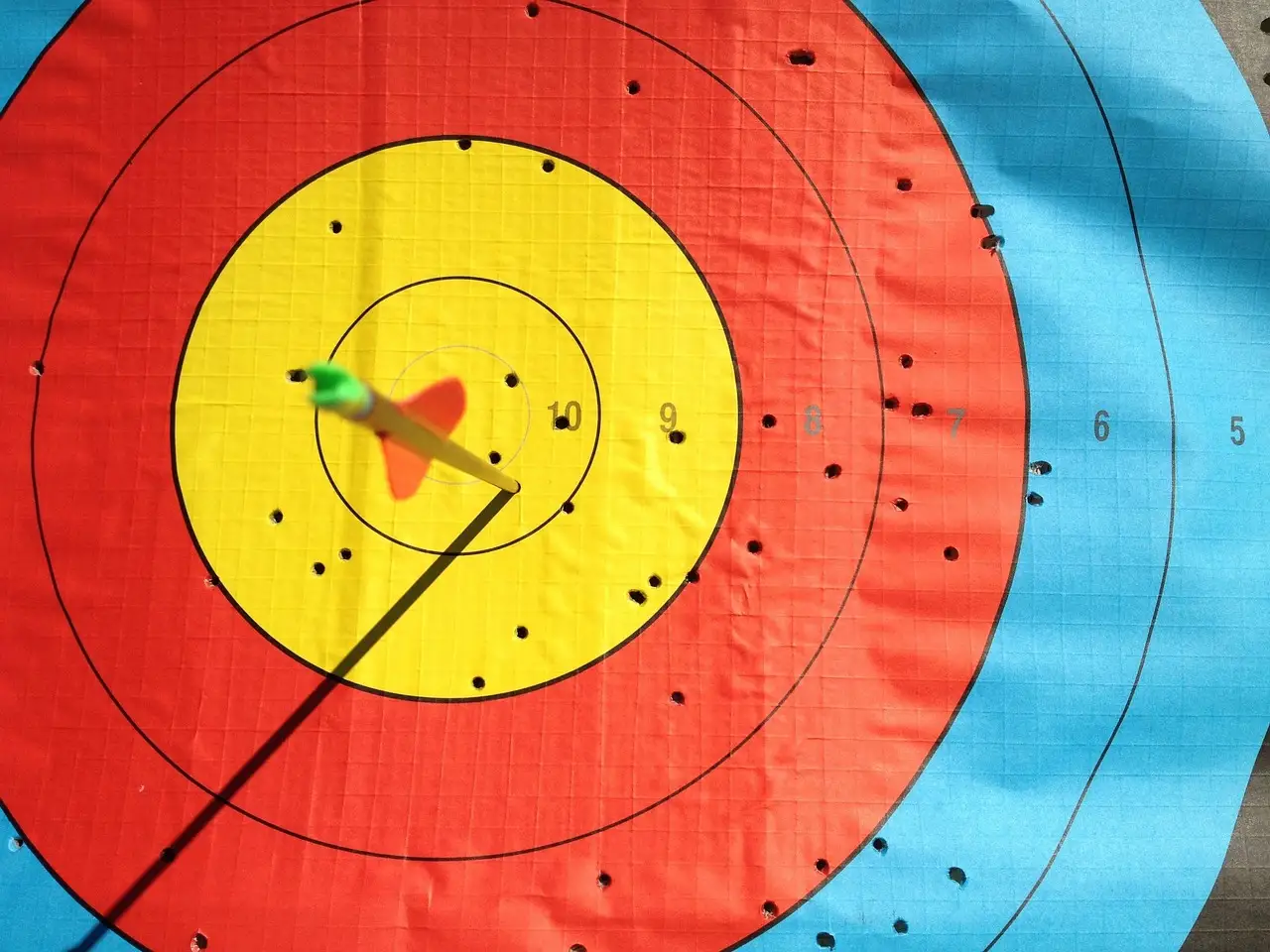
Indoor archery is usually shot at a short, fixed distance in a controlled environment with little to no wind. It commonly uses 60 cm or 40 cm target faces, and the scoring demand is tight because small shifts can change the score at the line.
Outdoor archery
Outdoor archery covers longer, varied distances, including 70+ yards, and can include target rounds, field archery, and 3D archery. It adds wind, sun, and changing light, so score outcomes depend on more than a clean release.
Why the format matters
The format changes what “good shooting” means. Indoors, a tiny aiming error can cost points on a small face. Outdoors, the same miss can grow because of wind drift, distance, and how well the archer judges the shot.
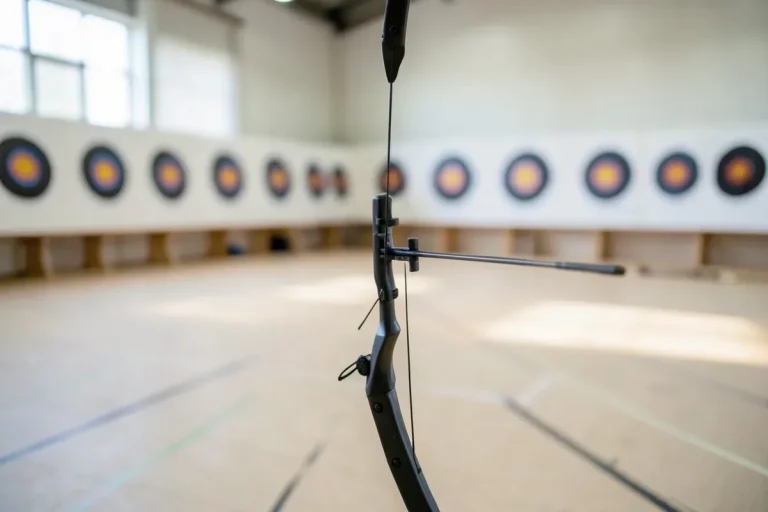
📊 Indoor archery is shot at short, fixed distances, usually 18 to 20 yards. Source: Indoor vs Outdoor Archery: Key Differences & Which Is Right for You.
What changes in competition rules and scoring?
Indoor and outdoor archery are scored differently because the target, distance, and environment are different. Indoor rounds use short, fixed distances and small faces, so line calls matter more. Outdoor rounds spread scoring across longer distances, and misses are often driven by wind, light, or poor distance judgment.
Indoor distance and target faces
Indoor archery is shot at short, fixed distances, usually 18 to 20 yards, and often 18 meters. Smaller faces make the middle harder to separate, which means a borderline arrow can swing the score if it kisses a line.
Outdoor distances and score spread
Outdoor archery ranges farther, and for recurve the standard outdoor distance can vary up to 90 meters. At these ranges, arrows spend more time in the air, so small sight errors and wind drift show up as wider score spread.
How scoring pressure changes for recurve and compound
Compound archers usually see tighter groups at distance because of magnification and mechanical holding advantages, but outdoor wind still opens group size. Recurve archers feel the distance jump more sharply, because hold stability, anchor consistency, and arrow flight all matter across a wider range of yardage.
Say your indoor league uses a 40 cm face and an arrow lands on the line. That one call can decide a match arrow. Outdoors, the bigger issue may be whether a left-to-right breeze pushed the same arrow into the 8 ring before it ever reached the target.

How do gear and setup differ?
Indoor and outdoor setups do different jobs. Indoor gear usually centers on one sight mark, larger-diameter arrows, and a cleaner, simpler setup. Outdoor gear needs more distance marks, more sight adjustment, and equipment choices that cut wind drift instead of chasing line-cutting alone.
Arrow diameter
Indoor archers often use larger-diameter arrows for scoring advantage because a wider shaft can cut more line on a close target face. Outdoor archers often choose thinner or lighter arrows to reduce wind drift and maintain a flatter, more forgiving trajectory at longer distance.
Sight setup
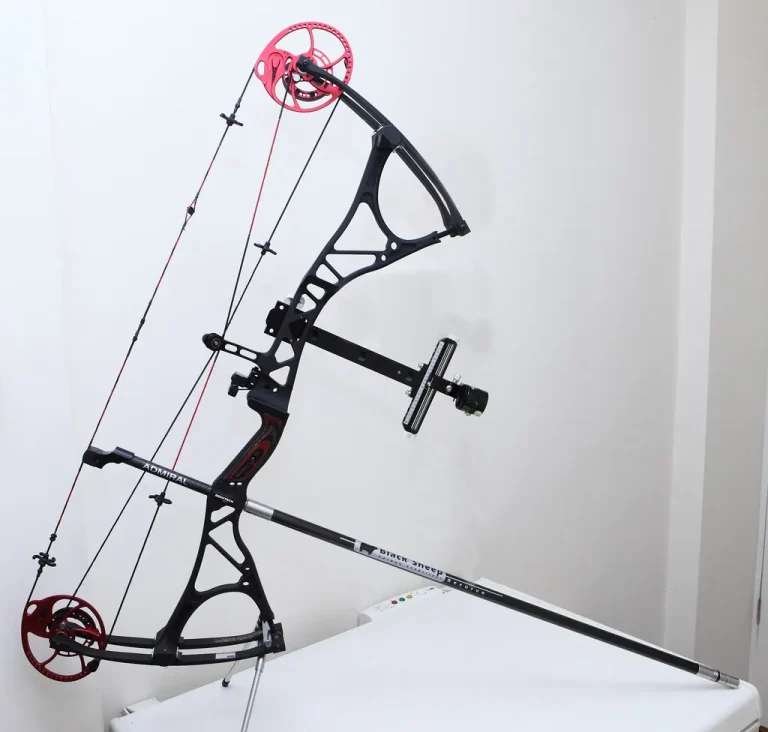
Indoor archery often uses one fixed sight setting because the distance does not change. Outdoor archery uses multiple distance marks, and a sight tape is common for elevation at different distances. That means the sight picture and the pin setting are part of the outdoor game plan.
Stabilizer, peep, and accessory changes
Accessories do not have to change completely, but priorities do. Indoors, a steadier hold and clean follow-through matter most. Outdoors, stabilizer balance, peep clarity, and setup repeatability matter because the archer may adjust for distance and wind across an entire round.
What should recurve archers change between formats?
Recurve archers usually need a real setup reset between indoor and outdoor rounds. Arrow spine, point weight, and sight marks may all change, and the indoor anchor rhythm that feels perfect at 18 meters can turn too rigid or rushed at longer outdoor distances.
Arrow spine and point weight
Recurve tuning often changes when the distance changes. A setup that groups well indoors may not behave the same outdoors if the arrow is too stiff, too weak, or matched to the wrong point weight. Outdoor tuning should support clean arrow flight at distance, not only close-range grouping.
Indoor anchor habits that can hurt outdoor consistency
Indoor shooting encourages a very still, narrow process because the target is close and the score is sensitive. Outdoors, over-focusing on a tiny anchor sensation can create tension and make the shot less adaptable to wind and longer aiming time.
Aiming and grouping priorities
Indoor recurve work should prioritize center control on a small face. Outdoor work should prioritize repeatable groups in changing conditions, then sight correction across distance. At 18 meters, a good tune may look excellent; at 70+ yards, that same tune has to survive more variables.
What should compound archers change between formats?
Compound archers usually keep the same bow style but change the details that drive score. Arrow diameter, sight tape, and peep alignment matter more outdoors, while indoor tuning often centers on a clean, repeatable setup at a fixed distance where small aiming errors are easier to see.
Arrow selection and diameter choice
Compound indoor shooters often favor larger-diameter arrows because line-cutting matters on small faces. Outdoors, thinner shafts are common because wind drift becomes a bigger score factor than close-range line cutting. A heavy indoor shaft can be excellent inside and less ideal at distance.
Sight tape, peep, and letoff considerations outdoors
Outdoor compound shooting usually means multiple sight marks or a sight tape. Peep height and sight picture must stay consistent through different distances, and letoff makes it easier to hold, but it does not remove the need for clean execution under wind pressure.
Why tuning expectations change at 18 meters
At indoor distance, the bow may look very forgiving even if the outdoor tune is not finished. That is why a setup can score well indoors and still show larger spread outdoors. The farther the target, the more the bow reveals about arrow flight and consistency.
Competition transition checklist: indoor to outdoor

Moving from indoor to outdoor usually takes 2 to 4 weeks of adjustment if the archer wants the new setup to score cleanly. The biggest changes are distance, arrow choice, and sight marks. A rushed switch often creates low confidence, wide groups, and poor readjustment of form.
- Set the new target distance first: move from 18 to 20 yards or 18 meters indoors to your outdoor practice yardage, then confirm actual sight marks before chasing score.
- Change arrows if needed: choose larger-diameter arrows for indoor scoring and thinner or lighter arrows outdoors to reduce wind drift.
- Reset sight marks: for recurve, confirm new distance references; for compound, build a fresh sight tape or new sight chart for outdoor yardage.
- Check arrow flight at close distance before long range: confirm clean tune first, then confirm grouping at outdoor distance.
- Plan one wind-focused session per week outdoors: practice holding off, reading flags, and accepting that the center may not always be the correct aiming point.
- Track group size, not just score, during the first 2 weeks; a shrinking group is the first sign the transition is working.
Indoor-to-outdoor setup changes for recurve and compound
| Step | Recurve | Compound | Why it matters |
|---|---|---|---|
| Distance change | Reconfirm sight marks as distance extends toward standard outdoor rounds | Build a new sight tape or distance card | Elevation changes more outdoors than indoors |
| Arrow change | Check spine and point weight for outdoor flight | Switch to thinner outdoor shafts if wind drift is a problem | Arrow behavior changes with distance and wind |
| Form focus | Keep anchor repeatable, but relax indoor-style tension | Keep peep alignment and release clean under longer aiming time | Indoor habits can be too rigid outdoors |
Suppose a beginner compound shooter moves from a 20-yard league to a 50-yard outdoor round in one week. If the old sight mark is kept, the first arrows will land low, and the shooter may think the bow is “off” when the real issue is a stale sight setup.
Choose indoor archery if… / choose outdoor archery if…
Indoor archery fits archers who want fixed-distance scoring, winter training, or a simple league format. Outdoor archery fits archers who want longer distances, wind management, and a round that looks closer to hunting or field conditions. The right choice depends on access, goals, and how much setup change you want to manage.
Choose indoor archery if…
Choose indoor archery if your local club runs winter leagues, if you want a controlled environment, or if your budget is tight and you prefer one stable sight setting. It is also the better start when your current goal is cleaner execution at short distance rather than learning wind and multiple yardages.
Choose outdoor archery if…
Choose outdoor archery if you want to learn distance judgment, wind reading, and the kind of shot planning that carries over to field archery, 3D, or bowhunting. It also makes more sense if your calendar is built around spring and summer tournaments rather than winter indoor leagues.
Best fit for beginners
For beginners, indoor archery is often easier to enter because the environment is more controlled and the learning target is simpler. Outdoor archery is better when the beginner already has basic form and wants a broader challenge, more stamina work, and conditions that can feel closer to real-world shooting.
What distance is indoor archery shot at?
Indoor archery is usually shot at short, fixed distances. Some competitions use 18 to 20 yards, and the fixed setup means every arrow is shot under the same distance conditions. That makes it ideal for precision work and repeatable scoring.
Because the distance does not change, indoor rounds reward a stable anchor, consistent sight picture, and a clean release. Small flaws are easier to spot because there is no wind to hide them.
What is the difference between indoor and outdoor archery competitions?
Indoor competitions are short-range, controlled, and scored on small target faces, while outdoor competitions use longer distances and conditions that change with wind, weather, and light. The indoor format is more about precision at a fixed distance; the outdoor format adds judgment, adjustment, and physical endurance.
That difference changes how archers prepare. Indoor work builds repetition. Outdoor work demands repeatability plus adaptation, especially for recurve and compound archers who must manage sight changes and arrow behavior across distance.
Is indoor archery easier than outdoor archery?
Indoor archery is usually easier to control because there is little to no wind, less weather to account for, and no changing distance. That does not mean it is easy. Small target faces and line calls can make indoor scoring unforgiving, especially when the group is close but not fully centered.
Outdoor archery is harder to manage because the environment changes the shot. A stable form may still lose points if a gust pushes the arrow or the archer misreads the distance. The better question is which challenge matches the archer’s current goal.
What gear changes between indoor and outdoor archery?
The main changes are arrow diameter, sight setup, and sometimes stabilizer balance. Indoor archers often use larger-diameter arrows and one fixed sight setting. Outdoor archers usually move to thinner arrows and multiple sight marks or a sight tape for different distances.
Recurve archers often revisit spine and point weight. Compound archers often rebuild sight tapes and confirm peep alignment. Both styles need clean arrow flight, but the setup priorities are not the same indoors and outdoors.
Why do archers use different arrows indoors and outdoors?
Archers use different arrows because the scoring problem changes. Indoors, larger-diameter arrows can cut more line on a close target face. Outdoors, thinner arrows usually reduce wind drift and handle longer distances better, even if they give up some line-cutting advantage.
Arrow choice is also tied to trajectory. At long range, small differences in weight and diameter show up more clearly. The right shaft indoors is not always the right shaft outdoors, especially for competitive recurve and compound setups.
How does wind affect outdoor archery scores?
Wind is one of the biggest outdoor score variables because it moves the arrow off line before it reaches the target. Even a mild crosswind can change impact point enough to turn an inner ring into a lower score. Indoor archery removes that problem completely.
Outdoors, archers must hold off, adjust aim, or wait for a better condition window. The needed correction depends on distance, arrow speed, and the direction of the gusts, so outdoor scoring rewards judgment as much as execution.
Can I switch between indoor and outdoor competitions in the same season?
Yes, but the switch should be planned. A transition from indoor to outdoor may take 2 to 4 weeks because the distance, sight marks, and arrow choice change. Switching too quickly can create bad habits, especially if the archer keeps indoor settings for outdoor rounds.
The safest approach is to separate the transition into setup, distance confirmation, and wind practice. That prevents indoor anchor habits from carrying over unchanged into longer, more variable outdoor shooting.
Which style is better for beginners, indoor or outdoor archery?
Indoor archery is usually the better first competition format for beginners because it is controlled, predictable, and easier to schedule in winter. The fixed distance makes it simpler to learn form and sight setup without also managing wind, sun, and changing yardages.
Outdoor archery becomes the better choice once the beginner wants more realism, broader competition options, or better carryover to field and hunting-style shooting. The right entry point is the one that matches local access, budget, and the next event on the calendar.