How to Wear a Back Quiver for Traditional Archery
Wear a back quiver high on the strong-side shoulder, tilt it slightly forward, and set the strap so arrow nocks sit above the shoulder line but below the ear; about a 10 to 20 degree forward tilt is commonly said to give the cleanest draw. If it rides too low or loose, arrows snag, the quiver swings, and quiet movement becomes hard. This guide covers fit, strap adjustment, draw access, arrow orientation, and quick field checks before you hunt or shoot.
What a back quiver
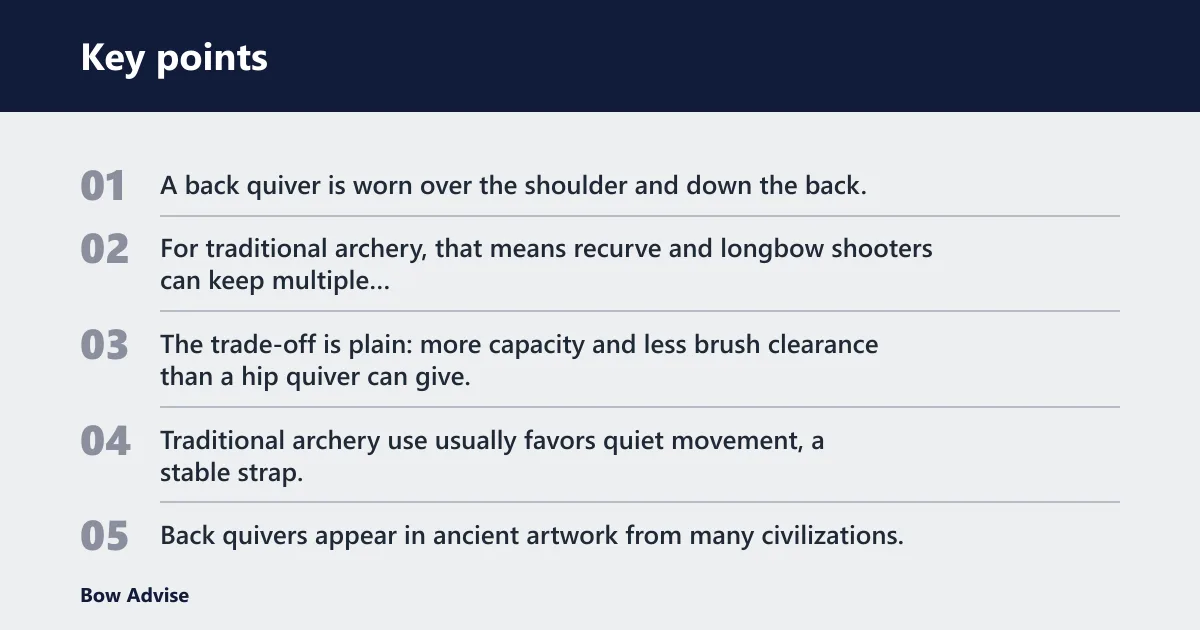


A back quiver is worn over the shoulder and down the back, with arrows carried in a vertical back layout. For traditional archery, that means recurve and longbow shooters can keep multiple arrows close while staying with a classic carry style. The trade-off is plain: more capacity and less brush clearance than a hip quiver can give.
Back quiver basics for traditional archery
Traditional archery use usually favors quiet movement, a stable strap, and an opening that lets shafts settle without crowding. Back quivers appear in ancient artwork from many civilizations, but the practical question is wear mechanics, not decoration. The quiver must sit where the archer can reach the shafts without twisting the shoulders hard.
How it differs from a bow quiver
A bow quiver mounts on the bow, while a back quiver rides on the body. That difference matters in field use. A bow quiver keeps arrows near the bow hand and can change how the bow feels in the hand and in the brush. A back quiver shifts the carry load to the shoulder and back, so it depends more on strap fit and body position.
Where a hip quiver fits instead
A hip quiver is waist-mounted and gives rapid arrow access with minimal movement. It is a common baseline for target archery because the draw is short and direct. Back quivers generally provide greater capacity, while hip quivers usually win on speed and a simpler grab path.
How should a back quiver sit on your back?
A back quiver should sit high enough that the arrow openings clear the shoulder cleanly, but not so high that the top edge jams under the ear or collar. A slight forward tilt helps the nocks stay reachable and reduces shoulder collision. Low carry can work, but it raises snag risk and often makes the draw angle worse.
High-back carry setup
High-back carry places the quiver body between the shoulder blades and the upper back, with the opening near the strong-side shoulder. This is the best starting point for cleaner access. It usually keeps the shaft tops away from the lower arm and helps arrows clear hooded layers better than a low ride.
Low-back carry setup
Low-back carry sits farther down the spine, sometimes near the lower ribs. It can feel stable at first, but the draw often needs more shoulder rotation and a deeper reach. Brush contact also rises because the quiver sits closer to waist height and can swing more during walking.
Crossbody carry setup
Crossbody carry runs the strap so the load tracks diagonally across the torso. That can help with stability, especially on some body types, because the quiver shifts less than a loose single-shoulder setup. It also helps keep the opening aimed where the drawing hand can find it without over-rotating the upper body.
Left-handed and right-handed setup
Handedness changes where the opening sits and which shoulder carries the strap. A right-handed archer usually wants the quiver on the left side so the drawing hand can reach back cleanly without crossing over the bow side. A left-handed archer usually mirrors that arrangement.
Which shoulder should carry the strap?
The strap normally rides on the shoulder opposite the drawing hand. That keeps the drawing elbow free and puts the opening where the hand can enter from a natural angle. If the shoulder side is wrong, the arm must twist across the neck, which slows the draw and raises snag risk.
How arrow orientation changes access
Arrow orientation should match the draw path. The nocks should present toward the drawing hand so the fingers can find a shaft without fishing around inside the hood. If the arrows lean too far rearward, the hand catches collars and jacket seams. If they lean too far forward, the shafts can poke the shoulder on the draw.
Common setup errors for opposite-handed shooters
A frequent error is swapping the shoulder but leaving the hood angle unchanged. Another is loading too many arrows for the opening size, which makes the top shafts bind. Say a right-handed archer wears the quiver on the left shoulder but tilts the hood backward; the draw hand often has to reach behind the head and the first arrow feels buried.
Back quiver wear-fit checklist
Use this checklist before buying or before field carry. It focuses on body position, arrow access, and the failure signs that show up first.
| Body position cue | Arrow-access test | Common failure sign |
|---|---|---|
| High-back carry, opening above the shoulder blade | Reach back and touch the top arrow without lifting the elbow above ear height | Neck twist, shoulder pinch, or the hand hits the hood edge |
| Low-back carry, hood near mid-back | Draw one arrow while standing square and then while turning 30 degrees | Arrow tip catches clothing or the quiver swings away from the hand |
| Crossbody carry, strap crossing the chest | Walk 10 steps, stop, and draw without re-setting the strap | Quiver slides on the back or presses under the arm |
| Right-handed setup, opening on the left side | Drawing hand reaches the nocks before the shoulder rotates fully back | Cross-body reach, missed grip, or collar snag |
| Left-handed setup, opening on the right side | Repeat the same reach with the mirror setup and same clothing layer | Twisting at the waist to recover the arrow |
| Arrow load kept below crowding point | Shake gently and listen for shaft chatter | Rattling, binding, or arrows jammed hard against the rim |
How do you draw arrows cleanly?
Clean drawing comes from a quiet shoulder path, a stable strap, and a hood that presents the top shaft to the hand. The elbow should move back just enough for the hand to find the nock, not so far that the shoulder lifts and the quiver shifts. Hooded or collared clothing can block the path, so test with the layers you plan to wear.
Clear the shoulder without snagging
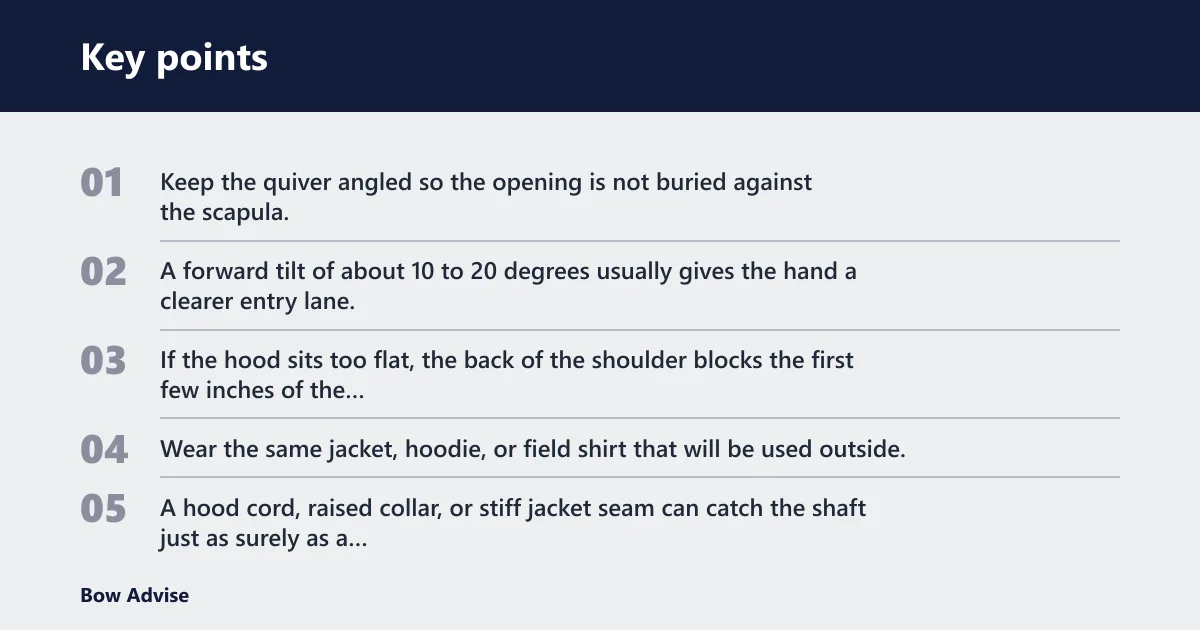
Keep the quiver angled so the opening is not buried against the scapula. A forward tilt of about 10 to 20 degrees usually gives the hand a clearer entry lane. If the hood sits too flat, the back of the shoulder blocks the first few inches of the draw.
Test draw angle with hooded or collared clothing
Wear the same jacket, hoodie, or field shirt that will be used outside. A hood cord, raised collar, or stiff jacket seam can catch the shaft just as surely as a bad strap angle. If the arrow catches on clothing twice in a row, the fit is wrong even if the quiver feels comfortable standing still.
Check for sway, bounce, and brush contact
Walk, stop, crouch, and turn. The quiver should stay close to the back without bouncing off the spine. Back quivers are more prone to noise when moving through underbrush, so a loose strap or overlong shaft will show up fast as brush tap or arrow rattle.
Picture an about 31-inch arrow set in a quiver sized for shorter shafts. The extra length can poke above the hood and catch branches, then tilt the load so the whole quiver swings as the archer turns. Trimming the fit or choosing a larger opening removes that problem before a hunt starts.
What to look for in a traditional quiver
Choose for fit first, then for material and capacity. For traditional archery, the best quiver is the one that stays quiet, clears the shoulder, and keeps arrows reachable without a second motion. Leather, polyester, and canvas each bring different noise and durability trade-offs, so the right choice depends on where the quiver will be carried.
Shoulder strap length and padding
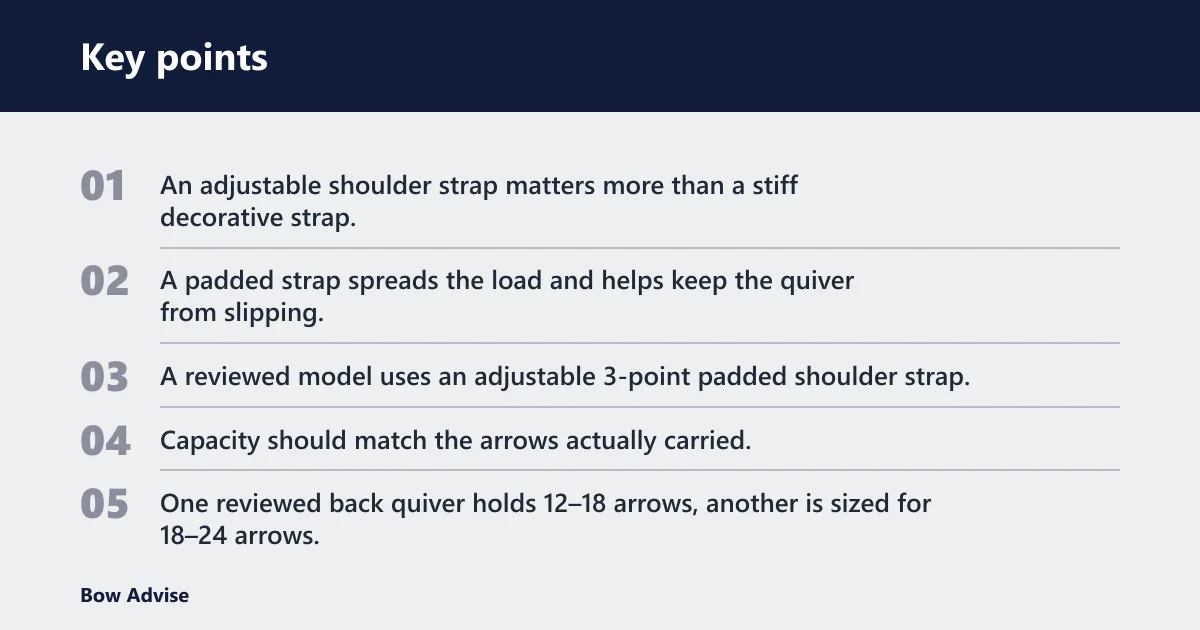
An adjustable shoulder strap matters more than a stiff decorative strap. A padded strap spreads the load and helps keep the quiver from slipping. A reviewed model uses an adjustable 3-point padded shoulder strap, which gives more control over ride height and sway than a simple single strap.
Arrow capacity and crowding
Capacity should match the arrows actually carried, not the largest number the hood can swallow. One reviewed back quiver holds 12–18 arrows, another is sized for 18–24 arrows, and a reviewed canvas back quiver can hold approximately 30 arrows. As capacity rises, crowding risk rises too, especially near the opening and at the nock end.
Material choice and noise
Leather often feels traditional and can hold shape well. Polyester is commonly used where lighter weight or lower maintenance matters. Canvas can be quiet and practical, but material alone does not solve movement noise. Loose seams, hard hardware, and excess shaft movement matter more than the label on the shell.
Opening diameter and shaft fit
Opening size affects how easily arrows enter and leave the hood. One model uses a 3.5-inch opening diameter, and another uses a 4-inch opening diameter. The wider opening usually helps with thicker shafts or crowded loads, while the smaller opening may feel tidier with fewer arrows and slimmer shafts.
MOLLE system options for modular carry
A product description can include a MOLLE design for customization, and some dual-use quivers support back sling wear and belt hanging. That kind of modularity can help an archer tune carry options, but it is still secondary to fit. Traditional archery use should stay the priority, especially if the quiver will be used in quiet field settings.
Is a back quiver better than a hip quiver?
Neither one is always better. A back quiver can carry more and may feel closer to a traditional field setup, while a hip quiver is usually faster to access and easier to manage on the range. For quiet movement and brush work, the better choice depends on how much arrow access and how much carry stability the archer needs.
Target range use
On a target line, a hip quiver usually wins because it keeps arrows visible and close to the hand. The access path is short, and the archer does not need to rotate the shoulder as much. Back quivers can still work, but the draw is more position-dependent.
Field and hunting use
For field use, the shoulder carry can make sense when extra arrow capacity matters. The drawback is noise control. Back quivers are more prone to noise when moving through underbrush, and loaded quivers can alter center of gravity when the archer bends, turns, or climbs a slope.
Speed versus stability
A belt or hip quiver offers rapid arrow access with minimal movement. A back quiver generally gives greater capacity, but that gain can come with more sway, more snag risk, and a more complex draw. A common first-timer mistake is choosing capacity first, then discovering the arrows crowd the hood and rattle during a 20-yard walk.
How do you wear a back quiver for traditional archery?
Wear it on the strong-side shoulder, keep the hood high enough for a clean reach, and angle it forward just enough for the drawing hand to find the nocks without a hard shoulder twist. A good setup keeps the arrows above the shoulder line, quiet on the walk, and reachable with one smooth motion.
60-second field test at home
- Load the quiver with the number of arrows you plan to carry, or one less than full capacity.
- Put on the same shirt, hoodie, or jacket you expect to wear outdoors.
- Walk 10 steps, stop, and draw one arrow without lifting the shoulder.
- Turn 90 degrees, crouch once, and draw a second arrow.
- Listen for rattle, feel for strap slip, and check whether the hood edge or collar catches the shaft.
- If the quiver shifts, rubs the neck, or forces a reach behind the head, shorten the strap or raise the ride height before field use.
Frequently asked questions
What is an archery quiver?
An archery quiver is a carry system for arrows. It can be worn on the body, mounted on the bow, or hung at the waist. The main jobs are arrow storage, access, and control of movement while the archer walks, draws, and shoots.
What is a bow quiver?
A bow quiver attaches to the bow itself and carries arrows on the bow rather than on the body. It can keep arrows close at hand, but it also adds weight to the bow and can change how the bow balances in hand and in brush.
How many arrows should a traditional back quiver hold?
For most traditional archers, the right number is the smallest load that still covers the session or hunt. Capacities of 12–18 arrows, 18–24 arrows, and around 30 arrows all exist, but more arrows can mean more crowding and more noise. A practical load often leaves spare room in the hood.
Can a back quiver be worn crossbody or only over one shoulder?
It can be worn either way. Single-shoulder carry is the classic setup, but crossbody carry can improve stability and help the quiver stay put on some bodies. The key is whether the strap length lets the opening stay reachable without pulling the hood into the neck or underarm.
Should a back quiver sit high or low on the back?
High-back carry is usually the better starting point because it gives cleaner arrow access and fewer brush problems. Low-back carry can work, but it often increases sway and makes the draw longer. The best height is the one that keeps the nocks reachable and the quiver quiet during movement.
Does a back quiver work for hunting or only target practice?
It works for both, but hunting asks more of the fit. The quiver must stay quiet, stay clear of branches, and keep arrows from shifting as the archer moves. For target practice, access speed matters more; for hunting, stability and noise control matter first.
What should I look for in a traditional archery back quiver?
Look for a strap that adjusts enough to set ride height, a hood opening that fits the shaft diameter, and a capacity that avoids crowding. Material choice matters for wear and noise, but the real test is whether the quiver stays steady and lets the hand reach the arrows without awkward shoulder movement.