Back Quiver vs Hip Quiver: Pros and Cons for Archers
Choose a hip quiver if you shoot mostly standing, walking, or kneeling and want fast arrow grabs with less shoulder movement. Choose a back quiver only if you accept slower access for a cleaner carry and a more traditional look. A poor fit slows draws, tangles arrows, and can make bending or seated shooting awkward. This guide compares back and hip quivers by movement, arrow access, noise, comfort, and common use cases.
| Decision factor | Back quiver | hip quiver | Winner |
|---|---|---|---|
| Arrow access during active shooting | Slower; requires reaching over the shoulder | Faster; side access at the hip | hip quiver |
| Walking, bending, and brush handling | Can shift, spill, or snag when bending or in low brush | Flatter on the leg and easier to manage near branches | hip quiver |
| Seated comfort | Can interfere with a seat back or tree stand movement | Usually easier to wear while seated | hip quiver |
| Arrow capacity | Often 12-30 arrows or more than a dozen | Commonly 12-24 arrows, with some designs up to 20 | Back quiver |
| Accessory storage | Usually limited | Pockets or clips for scorecards, pencil, rangefinder, or glove are more common | hip quiver |
| Best-fit discipline | Traditional use, some hunting, open ground | Target, field, and many 3D setups | hip quiver |
What is the difference between a hip quiver and a back quiver?
A hip quiver hangs on the belt at your side, so the arrow opening stays near your hand. A back quiver hangs diagonally across the back, which gives a traditional look and often more capacity, but it asks for a longer, less direct draw.
Hip quiver layout and carry position
Most hip quivers are worn on the hip and made from leather or synthetic fabrics. The common target style angles fletching forward, while the field style angles fletching backward. That layout keeps the shaft close to the body and makes sorting arrows easier on the line.
Back quiver layout and carry position
Back quivers hang diagonally on the back. Traditional leather versions are common, and modern adjustable versions exist too. Hunt & Hike notes that back quivers are preferred by traditional archers and sling across the back, which explains their appeal when the goal is a cleaner carry rather than quick access.
Field quiver and target quiver variants
A field quiver is a hip-style belt carry with fletching angled backward instead of forward. It rides flatter on the leg and usually snags less in brush, which helps on field and 3D courses. A target quiver is a hip quiver variant with fletching angled forward and more accessory storage.
Which quiver is faster to draw from?
A hip quiver is faster for most archers because the arrows sit at the side and the hand travels a shorter path. A back quiver can work, but the over-the-shoulder reach is slower and more dependent on practice, shot cadence, and body position.
Side access from the hip
The hip draw is direct. That matters when you are shooting multiple arrows in a round, walking between shots, or grabbing a replacement shaft after a miss. Archery Supplier describes hip quivers as belt-worn with arrows at your side, which matches the shorter hand path.
Over-the-shoulder reach from the back
Back quivers require the hand to go over the shoulder and down into the quiver mouth. That motion is workable, but it slows retrieval for beginners and can get clumsy if the bow arm is busy, the ground is uneven, or the shooter is seated.
How practice changes retrieval
Practice reduces retrieval difficulty with either type. Even so, practice does not erase the basic geometry: the hip quiver stays closer to the draw hand, while the back quiver asks for a larger motion. For fast indoor target rounds, that difference is easy to feel.
How do they handle movement, brush, and bending?
Movement is where the two designs separate most clearly. Hip quivers usually stay more controlled during walking and bending, while back quivers can shift, poke, or spill arrows if the shooter leans forward, ducks under branches, or sits in a tight spot.
Walking and branch snag risk
Field quivers are built for moving through terrain. Their backward-angled fletching and flatter ride help reduce branch snagging on courses and while hiking. Back quivers can brush against pack straps, seat backs, or low limbs more easily, especially in tight cover.
Kneeling and seated shooting
Kneeling is manageable with both if the quiver sits clear of the legs, but seated shooting favors the hip quiver. A back quiver can press against the seat back or shift when the torso turns, which is a real nuisance on a tree stand, stool, or crowded shooting line.
Bending over and arrow spill risk
Do back quivers fall out when you bend over? They can, depending on opening shape, arrow fit, and how full the quiver is. That is why the comparison table lists carry as medium for some back designs: arrows can shift or fall out when the body folds forward. Say your quiver is half full and you bend to pull a target from the ground; a loose fit can let shafts slide and rattle.
Which quiver fits target, field, and hunting?
Target archery generally favors the hip quiver, field and 3D often favor the field quiver version, and hunting can go either way depending on terrain. The right pick is less about tradition and more about how much you move, kneel, sit, and reach for arrows during the shot sequence.
Target line use
Morr Innovations says hip quivers are best for target archery and competitions. That makes sense because target quivers can hold numbered arrows in order, keep accessories close, and stay accessible during repeated ends. Target archers also benefit from the quicker side draw when the line is busy.
3D and field course use
For field and 3D archery, a field quiver is often the stronger hip-quiver option. It rides flatter on the leg and keeps fletching oriented to reduce snagging in brush. Morr Innovations also notes that back quivers are ideal for hunters and open or lightly wooded areas, but that does not make them the best choice for every course walk.
Hunting and tree stand use
Back quivers can appeal to traditional hunters in open cover, but tree stand use changes the picture. A quiver on the back can interfere with the seat, harness, or stand rail, while a hip quiver can catch on brush if the hunter is crawling or squeezing through tight cover. In a tree stand, the hip option is usually easier to live with.
Choose back quiver if… / Choose hip quiver if…
Choose a back quiver if you want the traditional look, want higher arrow capacity, and mostly shoot in open space where bending, crawling, and seated movement are limited. Choose a hip quiver if you want faster arrow access, more accessory storage, and better control during standing, walking, kneeling, or crowded-line shooting.
Choose back quiver if…
Pick a back quiver if your shooting is slow, deliberate, and mostly upright. It also makes sense if you prefer a traditional leather style and can accept that retrieval takes more shoulder movement. For open-ground hunting, that trade can be acceptable.
Choose hip quiver if…
Pick a hip quiver if you shoot recurve or compound in target rounds, field rounds, or 3D courses and want quicker access to arrows. It is also the safer choice for seated use, hot weather, and any setup that benefits from scorecard, pencil, glove, or rangefinder storage.
When a field quiver is the middle ground
A field quiver is the middle ground when you want hip-quiver speed but less snagging in brush. It is the better belt-carry option for moving courses because the arrows ride flatter and the fletching points backward. That makes it easier to hike, step, and kneel without fighting the quiver.
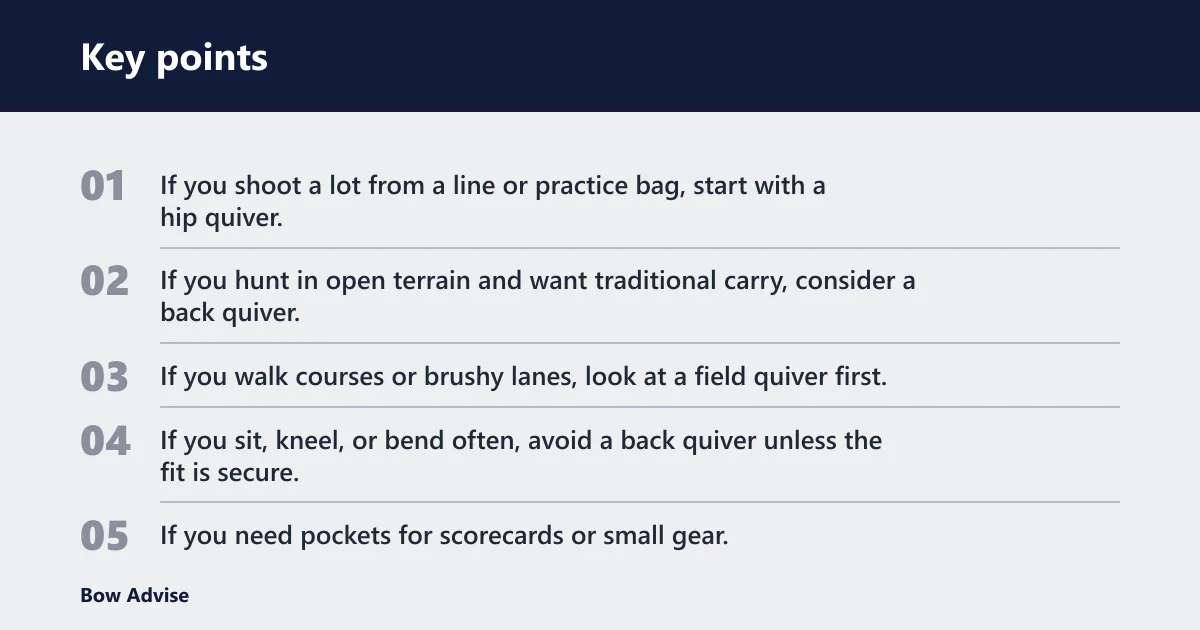
- If you shoot a lot from a line or practice bag, start with a hip quiver.
- If you hunt in open terrain and want traditional carry, consider a back quiver.
- If you walk courses or brushy lanes, look at a field quiver first.
- If you sit, kneel, or bend often, avoid a back quiver unless the fit is secure.
- If you need pockets for scorecards or small gear, choose a hip design with accessory storage.
Suppose a beginner shoots about 30 arrows at a target bale, then bends to pull a stray arrow from the grass. A hip quiver keeps the next arrows at the side and out of the way. A back quiver may still work, but the extra shoulder reach and bend risk become obvious.
A common first-timer mistake is choosing a back quiver for the look alone, then trying to use it on a crowded range line. The arrows can sway more while walking, the draw takes longer, and the quiver can bump a seat or jacket sleeve when space is tight.

Frequently asked questions
Is a hip quiver or back quiver better for beginners?
Hip quivers are often a practical choice for beginners because they are easier to load, faster to reach, and less awkward during basic standing practice. The shorter draw motion helps new archers build a repeatable arrow grab without needing to learn an over-the-shoulder reach first.
What are the pros and cons of a field quiver versus a hip quiver?
A field quiver is still a hip quiver, but with fletching angled backward for courses and brush. That helps with snagging and leg clearance. A target-style hip quiver can be better for line shooting and sorted arrows, while a field quiver is better for movement through terrain.
Can a back quiver hold more arrows than a hip quiver?
Yes. Back quivers are described as holding more arrows than hip quivers, and the comparison often lands around 12-30 for back quivers versus 12-24 for hip quivers. Capacity still depends on design, divider layout, and how the quiver is intended to be used.
How do hip and back quivers compare for comfort in hot weather?
Hip quivers usually feel better in hot weather because they leave the back open to airflow. Back quivers can trap heat against the back and shoulders, especially under a shirt, jacket, or pack. That difference matters most during summer practice or long walks between target stations.
Which quiver is quieter in brush and on the range?
A properly fitted hip quiver is often quieter in brush because it sits flatter and is less likely to swing into branches. On the range, a target quiver can sway and hit the side more while walking, which adds noise and annoyance. Back quivers can also rattle if arrows are loose.
Do back quivers fall out when you bend over?
They can, especially if the mouth is open, the fit is loose, or the quiver is partly empty. That is one reason back quivers are less forgiving during bending, kneeling, or ground-level work. A tighter design helps, but it does not remove the basic spill risk.