Barebow vs Recurve Competition: Which Fits You Best?
Barebow competition is the simpler, lower-cost choice if you want to shoot without a sight, clicker, or long stabilizers; recurve competition is the better fit if you want those allowed tools and a more equipment-driven pathway. Pick the wrong class and you can buy the wrong gear, enter the wrong division, and spend a season fixing a setup that should have matched the rule book from day one. This guide compares legality, equipment, scoring pathway, and what changes on tournament day.
Barebow vs recurve competition: what changes?
The biggest difference is not the bow limb shape. It is the rule set around the bow. Barebow is a recurve-based class with tight limits on accessories, while recurve competition allows a more adjustable setup with a sight, stabilizers, a clicker, and a pressure button.
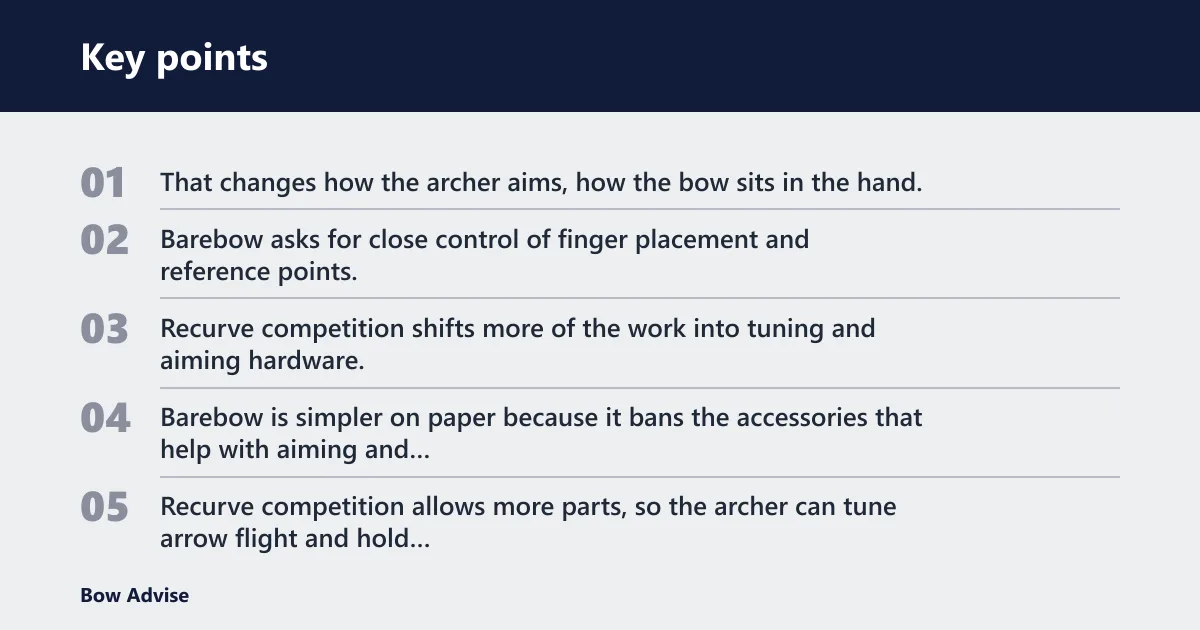
That changes how the archer aims, how the bow sits in the hand, and which events feel natural. Barebow asks for close control of finger placement and reference points. Recurve competition shifts more of the work into tuning and aiming hardware.
| Decision factor | Barebow | Recurve Competition | Winner |
|---|---|---|---|
| Legal aiming hardware | No sight, no clicker, no stabilizer system | Sight, stabilizer system, clicker, and plunger allowed | Recurve Competition |
| Competition pathway | Recognized in target, indoor, field, and 3D archery | Used in target, indoor, field, and 3D; also the Olympic-style path | Tie |
| Aiming method | String walking, gap shooting, or instinctive aiming | Sight-based aiming with tuning support | Depends on goal |
| Learning curve | Less equipment complexity, more aiming skill work | More gear to learn, but aiming is usually easier for new archers | Recurve Competition |
| Best fit | Archer who wants a stripped-down, rule-tight division | Archer who wants Olympic-style progression and accessory tuning | Depends on goal |
Legal equipment changes the whole round
Barebow is simpler on paper because it bans the accessories that help with aiming and stabilisation. Recurve competition allows more parts, so the archer can tune arrow flight and hold steadier under pressure. That difference affects setup time, inspection checks, and how much a missed sight mark can matter.
Where the competition path diverges
Both styles appear in target, indoor, field, and 3D archery, but they do not feel the same in those settings. Barebow leans on body alignment and reference points. Recurve competition leans on a built bow, which is why many archers treat it as a more adjustable pathway.
Why the winner changes by factor
Recurve Competition wins the accessory row because it allows more tools. Barebow wins for archers who want fewer parts and fewer setup choices. On the pathway row, neither is inherently better; the right answer depends on whether the archer wants an Olympic-style track or a barebow division.
📊 World Archery recognised barebow for target archery in 2020. Source: Barebow.
What is barebow competition?
Barebow competition is a recurve-based class with strict limits on aiming and stabilisation gear. World Archery recognized barebow for target archery in 2020. Under that rule set, the bow can use fixed weights on the riser, but no other stabilisation or dampers are permitted.
How barebow is set up
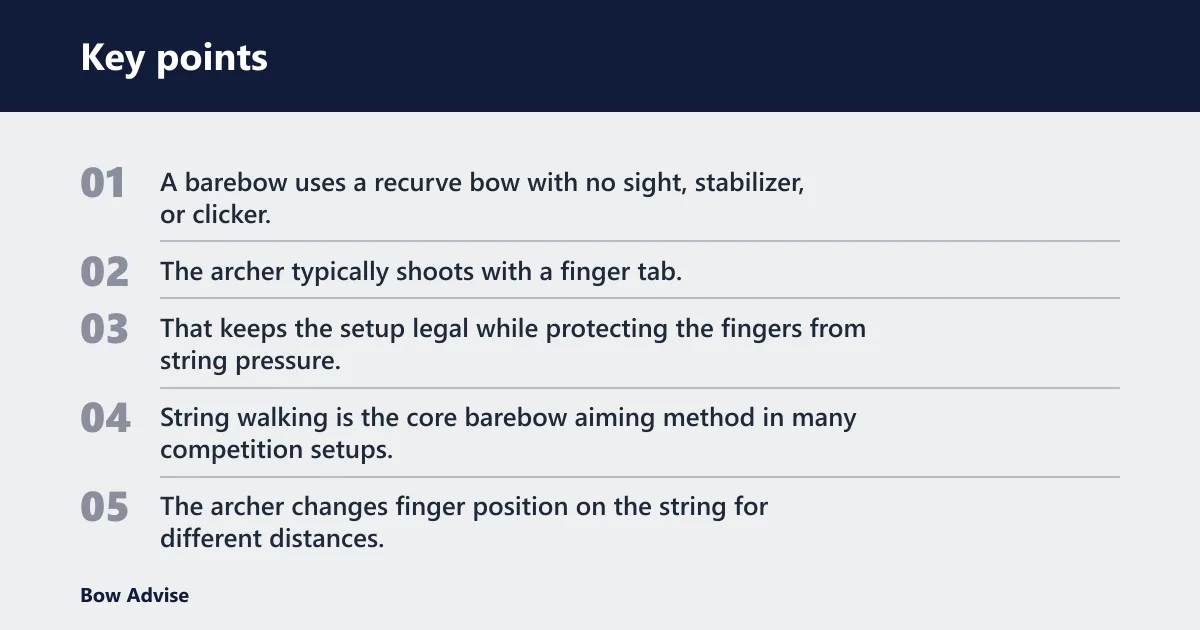
A barebow uses a recurve bow with no sight, stabilizer, or clicker. The archer typically shoots with a finger tab, and the tab is unmarked so it does not become an aiming aid. That keeps the setup legal while protecting the fingers from string pressure.
How barebow aiming works
String walking is the core barebow aiming method in many competition setups. The archer changes finger position on the string for different distances, which changes the arrow’s launch angle and point of impact. That is why barebow takes practice even though the bow itself looks simple.
Where barebow is shot
Barebow is used in target, indoor, field, and 3D archery. In target archery competition, barebow archers shoot at 50 metres and use a 122-centimetre target face. World Archery barebow matches are decided using the set system, so match points matter as much as raw grouping.
What is recurve competition?
Recurve competition uses a recurve bow with more accessory support than barebow. Olympic recurve can use a sight, stabilizer system, clicker, and plunger, which gives the archer more control over aim, balance, and arrow flight. It is the only bow style used in the Olympic Games.
What the extra parts do
The sight gives a consistent aiming reference. The stabilizers help balance the bow and manage movement. The clicker gives a repeatable draw-length cue. The pressure button, often called a plunger, helps arrow flight by refining how the shaft leaves the bow.
Why recurve feels more adjustable
Recurve competition gives the archer more ways to tune performance before the first end is shot. That helps in target rounds, indoor lines, and field rounds where consistent flight matters. It also means more parts to set up, check, and maintain before a tournament.
Is barebow legal in target archery competition?
Yes. Barebow is legal in target archery competition under World Archery rules, and World Archery recognized barebow for target archery in 2020. In that format, barebow archers shoot at 50 metres on a 122-centimetre target face, and matches use the set system.
What that means on tournament day
This is not a casual or informal class. Barebow target rounds have a set distance, a set face size, and a set match format. That matters because a barebow archer who trains mostly at short indoor distances may still need to adapt to 50 metres and the scoring rhythm of set play.
How scoring feels different
Set system scoring rewards winning ends, not only piling up raw points. One strong end can swing a match, which changes pacing and mental focus. Barebow shooters must manage hold, finger placement, and shot execution without the feedback loop of a sight pin.
Which is harder to learn: barebow or recurve?
Recurve is usually easier for a new archer to learn at first because the sight gives a clear aiming reference. Barebow often feels harder early on because the archer must solve aiming with string walking, gap shooting, or instinctive reference points while also learning solid form. The harder path is not always the better long-term choice.
Aiming difficulty versus gear complexity
Recurve has more parts, so the setup can feel more technical. Barebow has fewer parts, but the aiming system asks more from the archer. A common first-timer mistake is thinking fewer accessories means easier shooting. In practice, the archer still has to build a repeatable method for each distance.
When recurve feels easier
Suppose a 14-year-old archer wants clear feedback at 18 metres indoors. A sighted recurve setup can make the first months less confusing because the aiming reference is obvious. That does not mean the bow is simpler overall, only that the first aiming step is often easier.
When barebow may be the better long-term fit
Barebow can be a better match for an archer who enjoys problem-solving, distance management, and a stripped-down class. The trade-off is slower mastery. The archer has to own more of the aiming process instead of relying on hardware to carry that load.
Choose barebow if… / Choose recurve if…
Choose barebow if you want a recurve-based competition class with fewer allowed accessories, if you like string walking, or if you want a division that stays close to the bow’s bare essentials. Choose recurve if you want sights, stabilizers, and a more adjustable Olympic-style route with clearer aiming support.
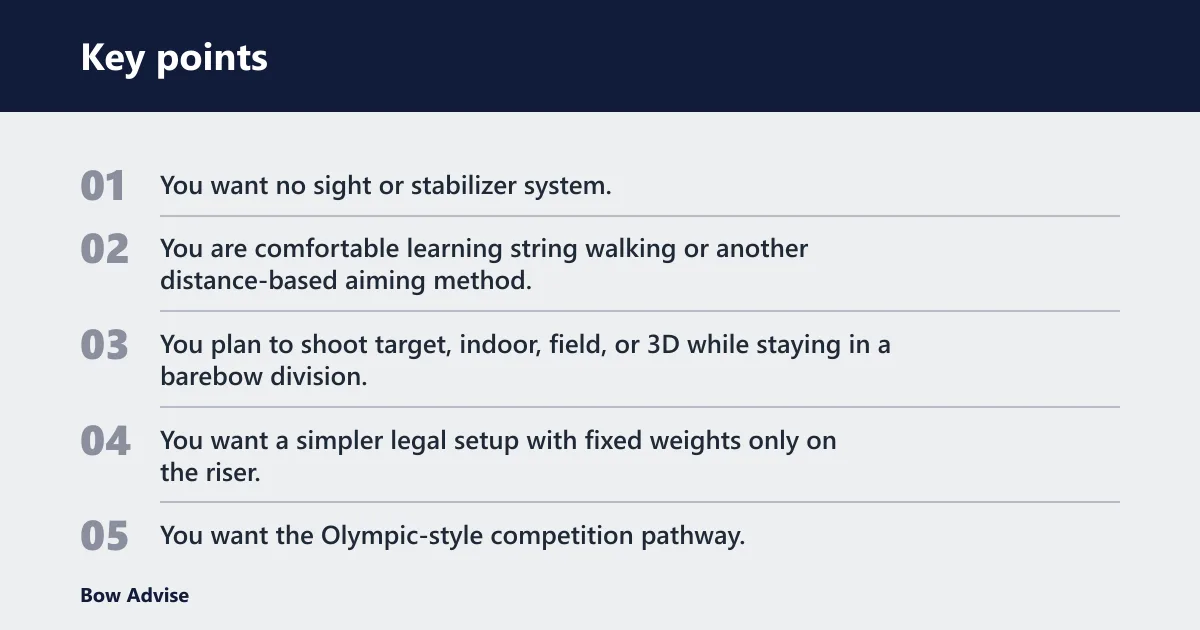
Choose barebow if…
- You want no sight or stabilizer system.
- You are comfortable learning string walking or another distance-based aiming method.
- You plan to shoot target, indoor, field, or 3D while staying in a barebow division.
- You want a simpler legal setup with fixed weights only on the riser.
Choose recurve if…
- You want the Olympic-style competition pathway.
- You prefer a sight picture and a clearer aiming reference.
- You want to tune the bow with a stabilizer system, clicker, and plunger.
- You want a setup that usually feels more forgiving for early-distance work.
Can the same bow be used for both?
Yes, in many cases, a recurve-based bow can be adapted between barebow and recurve competition if the setup changes to fit the division rules. That means removing the sight and stabilizer system for barebow, then fitting the allowed recurve accessories when entering recurve class. The bow itself is not the issue; the legal configuration is.
When barebow is the wrong choice
Barebow is the wrong fit if the archer wants an Olympic-style progression, expects to rely on a sight from the start, or wants stabilizers to do part of the balance work. It is also a poor choice if the local club mainly runs recurve instruction and almost no barebow competition lanes.
When recurve is the wrong choice
Recurve is a poor fit if the archer wants a low-part-count division and dislikes gear tuning. It can also be frustrating for someone who wants a more traditional competition feel and does not want to spend time on accessory alignment before every event.
Frequently asked questions
What is the difference between barebow and recurve competition?
Barebow competition uses a recurve-based bow with no sight, clicker, or stabilizer system, while recurve competition allows those accessories. The practical difference is that barebow pushes more of the work into aiming skill, while recurve gives the archer more hardware for aiming and tuning.
Is barebow legal in target archery competition?
Yes. Barebow is legal in target archery under World Archery rules, and it has been recognized in target archery since 2020. In that division, barebow target rounds are shot at 50 metres on a 122-centimetre target face and often use the set system.
What equipment is allowed in barebow competition?
Barebow allows a recurve bow with fixed weights on the riser, a finger tab, and basic components that do not aid aiming or stabilisation. It does not permit a sight, clicker, or stabilizer system. That is the core compliance line to check before entering an event.
Which is harder to learn: barebow or recurve?
Recurve can feel easier at the start because the sight gives a clear aiming point. Barebow usually takes longer to master because the archer must manage distance changes through string walking or another barebow aiming method. The setup is simpler, but the aiming work is not.
Can I shoot a barebow in indoor competition?
Yes, barebow is used in indoor competition where the event rules allow that division. The exact face size and round format can vary by governing body and event. Before entering, check whether the tournament offers barebow as a separate class and what indoor target format it uses.
Can the same bow be used for barebow and recurve competition?
Often yes, if the bow is a recurve base and the archer changes the setup to match the division rules. Barebow requires the bow to stay free of sight and stabilizer systems, while recurve competition can add those parts back. The switch is legal only if the event’s rule book allows the final setup. (en.wikipedia.org)
barebow recurve vs olympic recurve
Barebow recurve and Olympic recurve are both recurve-based, but Olympic recurve is the accessory-heavy competition format with sight, stabilizer, clicker, and plunger support. Barebow uses the same basic bow family without those tools. If the goal is Olympic-style competition, recurve is the direct path.
recurve bow vs traditional bow
A recurve bow has limbs that curve away from the archer at the tips, which changes how it stores and returns energy. A traditional bow is a broader category and may include longbows or other simpler forms. In competition, recurve is the more clearly defined target division.
longbow vs recurve for beginner
For a beginner, recurve is usually the easier competition entry point because it has a more standardized setup and clearer sight-based options. Longbow can be simpler in hardware, but it gives less built-in aiming support. If the goal is target competition, recurve usually fits the learning curve better.
longbow vs recurve hunting
For hunting, recurve generally gives more consistency and more accessory options, while longbow keeps the setup simpler and closer to a traditional style. The better choice depends on the hunter’s draw length, practice time, and comfort with aiming under stress. For competition use, recurve remains the more structured path.