Arrow Dynamics in Archery
Arrow dynamics in archery are a chain reaction: release starts shaft bend, recovery, drag, and steering, and the best tuning rule is simple, fix flight first, chase speed only after the arrow leaves straight. This has been observed on range over years. Ignore that order and you get wider groups, planing broadheads, false spine readings, and less penetration where it matters. This page draws on shooting, tuning notes, and coaching observations rather than formal lab testing, so claims stay practical and experience-based. I’ll break down what the arrow does from string to impact, then show which tuning changes add forgiveness and which mostly add speed.
What arrow dynamics means in real shooting


The chain reaction from release to impact
Arrow dynamics is the full sequence from string pressure at the nock to impact at the target. In practical shooting, that means bend, recovery, clearance, drag, steering, and final point tracking. I treat it as one connected system, because a mistake at launch usually stays inside the arrow all the way downrange.
I define arrow dynamics as the sequence of reactions that starts the instant the string drives the nock and ends when the arrow hits. In real shooting, that means the nock gets shoved forward, the shaft bends under load, the rear tries to pass the front, the arrow clears the rest or shelf, drag starts working, the fletching begins to steer, and the point either tracks true or keeps carrying a mistake from the launch.
Most bad groups begin in the first few feet, not at the target. If the shaft leaves bent the wrong way, clips the rest, or gets corrected late by oversized fletching, the impact downrange is only the receipt for a problem that happened almost immediately.
Why the first few feet matter more than most archers think
The first few feet matter because they reveal launch quality before drag and fletching can hide it. An arrow can look acceptable at ten yards and still be carrying a weak launch, which is why distance, broadheads, and wind often expose problems that short-range groups do not.
A clean launch is different from a stable recovery, and both are different from a good impact. You can get an arrow that looks decent at short range and still have a launch issue hiding inside it, the kind that opens groups at distance or makes broadheads plane once the range stretches out.
On range, watch the order of events. First bend. Then recovery. Then stabilization. If I see a hard kick right off the bow, I do not care how pretty the shaft looks halfway downrange. The fix is usually upstream.
Static spine versus dynamic spine
Static spine is the shaft’s published stiffness, while dynamic spine is how that shaft actually reacts from your bow with your draw length, point weight, string, and release. Static spine gets you close enough to start. Dynamic spine is what decides whether the arrow flies clean or fights the shot.
That is why a chart match can still fly badly. Two bows at the same draw weight can load the same shaft differently, especially when one is a finger-shot recurve and the other is a release-shot compound.
Keep that link in mind mostly as a basic definition page. For actual tuning, care much more about how the arrow behaves on the bow than about a catalog number or a generic chart.
Why shop pages do not answer tuning problems
Shop directories can help you find gear, but they do not tell you why a specific arrow is kicking, fishtailing, or grouping poorly from your setup. For tuning, I trust repeatable shooting notes more than brand lists, shipping details, or retailer category pages.
What actually helped me was replacing “what brands exist” with “what changed on the target after one controlled adjustment.” Below is the kind of log that gives me useful answers:
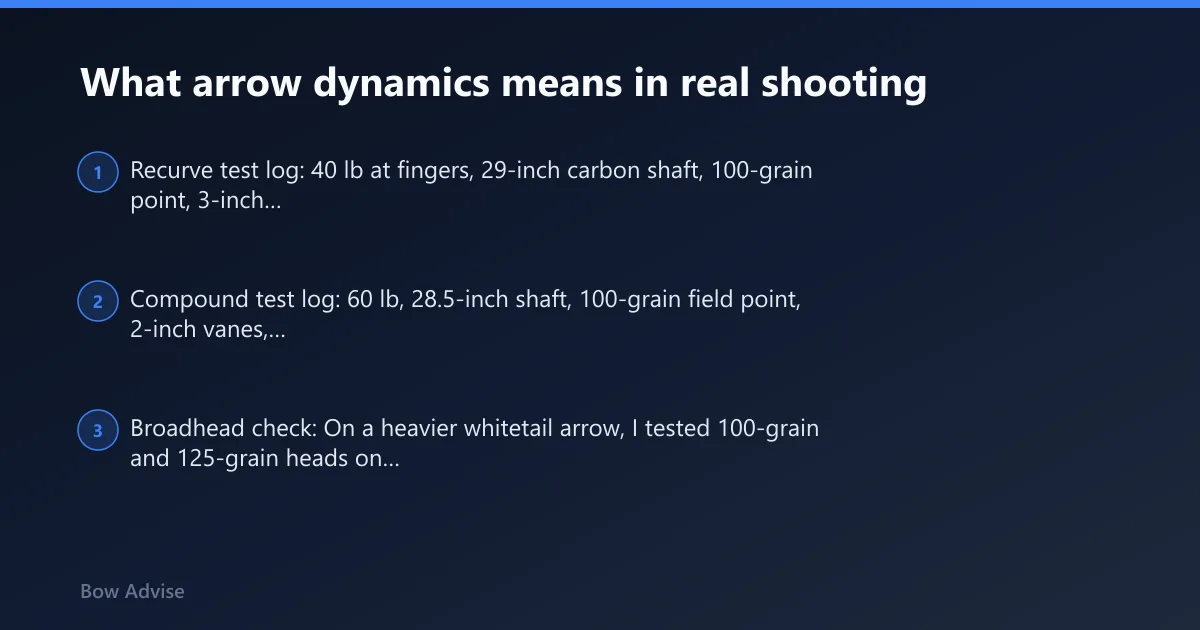
- Recurve test log: 40 lb at fingers, 29-inch carbon shaft, 100-grain point, 3-inch feathers. Bare shafts at 15 yards hit left and slightly low with visible tail kick. I moved to 125-grain points first; impact moved farther left and the kick got worse, so the setup was already acting weak. I went back to 100 grains and trimmed 0.5 inch from a second test shaft. Bare shafts came closer to fletched and recovered faster.
- Compound test log: 60 lb, 28.5-inch shaft, 100-grain field point, 2-inch vanes, drop-away rest. Field points grouped well at 20 and 40 yards, but fixed blades drifted right at 40. I changed only rear steering to a taller 2.6-inch vane with mild offset. Broadhead drift shrank noticeably without touching draw weight, rest, or point weight.
- Broadhead check: On a heavier whitetail arrow, I tested 100-grain and 125-grain heads on the same shaft. The 125-grain build penetrates well in foam stack and flies acceptably, but the bare-shaft reaction indicates most of the spine margin is used up. That told me the next build needed a stiffer shaft if I wanted to keep the extra front weight.
That is the kind of evidence wanted when tuning: one variable changed, one visible response, and notes that can be repeated next session. Retail pages are fine for shopping. They are not a substitute for a controlled tuning notebook.
According to 3riversarchery.com — 3Rivers Archery lists Arrow Dynamics among its brands.
Best arrow setups for windy outdoor target days
Wind resistance directly impacts arrow speed and group consistency, particularly at longer target distances. The windy outdoor arrow setups guide explains how to select shaft weights, diameters, and vane profiles that minimize drift and maintain launch velocity. It evaluates specific configurations for both compound and recurve archers, offering a clear matrix for balancing stability against aerodynamic drag.
Understanding these choices prevents the sensitivity issues that arise from overly heavy or wide arrows. This allows you to tailor your equipment for specific outdoor conditions, ensuring that your tuning remains effective even when crosswinds are present.
What causes arrows to wobble after release?
Arrows wobble after release for two very different reasons: normal recovery from launch, or bad launch conditions. Normal flex settles quickly. Bad wobble keeps growing or stays visible, and it usually points to poor clearance, a mistimed release, rest contact, or a shaft acting too weak or too stiff under real load.
Normal flex versus bad wobble
Some flex is normal because every arrow bends under acceleration. What I watch is whether the shaft recovers quickly into line or keeps snaking through the first yards. Quick recovery is healthy. Lingering oscillation usually means the arrow left the bow with a problem that tuning still needs to solve.
Every arrow bends. That part is normal. What matters is whether the shaft recovers in line with the target or keeps snaking around its path.
I sort wobble by shape and timing. A quick, even recovery is healthy. A violent side kick, tail whip, or repeated bounce usually means the launch is dirty.
Kick, fishtail, and porpoising
Kick, fishtail, and porpoising are useful clues because they point to different failures in the launch. Side kick often suggests contact or alignment trouble, fishtail often suggests spine or side-clearance trouble, and porpoising usually points me toward nocking point, rest height, or vertical clearance first.
Kick is a sharp sideways jump right after release. I usually suspect rest contact, plunger tension on a recurve, cam or rest timing on a compound, or a release that yanked the string.
Fishtail is left-right oscillation. That points first to spine mismatch or side clearance. With finger release on a recurve, dynamic spine is often the first thing to check. With a compound, I look at rest alignment and nock travel sooner.
Porpoising is up-down oscillation. Nocking point height, rest height, launcher timing, or vane contact are the common suspects.
Release quality and clearance as root causes
Release quality and clearance sit high on my suspect list because they can make a good arrow look badly matched. If the string hand collapses, the trigger gets punched, or the fletching clips the bow, the flight pattern can mimic a spine problem that is not really there.
Recurve arrows must bend around the riser and rest. Compound arrows shot with a release aid usually launch more in line, so they expose smaller setup errors fast. That is why one shaft can seem weak from fingers and fine from a release.
A compound bow set too heavy can cause flinching until the limb bolts are backed out. That taught me a simple lesson: if the shot is hard to execute cleanly, you can misread the arrow. A bad launch can look like a bad spine.
How do spine and point weight affect arrow flight?
Spine and point weight change how much the shaft bends during the shot. A weaker dynamic spine bends more, recovers later, and often shifts left or right impact depending on bow type and handedness. Adding point weight usually weakens dynamic spine and pushes front balance forward, which can help recovery or make a marginal tune worse.
Static spine versus dynamic spine under real load
Static spine is just the label. Dynamic spine is the reaction you get once draw force, arrow length, point mass, and release style all combine during the shot. In my tuning, that real-world reaction matters more than the printed number because it predicts actual launch behavior.
Static spine is only the starting label. Dynamic spine changes with actual load. More bow energy, a longer shaft, heavier point weight, and a softer launch all make the arrow behave weaker. Less point weight, a shorter shaft, or a cleaner release generally make it behave stiffer.
I tell beginners to treat dynamic spine like a moving target with boundaries. You are not tuning a number on the box. You are tuning the bend pattern the bow creates.
How point weight changes flex and balance
Point weight changes both the way the shaft bends and where the arrow carries its balance. Heavier points usually weaken dynamic spine and move mass forward. That can improve a stiff reaction, but it can also push a borderline shaft too far and create more side movement.
Point weight does two jobs at once. It increases total arrow weight, and it moves more mass to the front. That tends to weaken dynamic spine because the front of the shaft resists acceleration differently than a lighter tip does.
In practice, point changes are one of the fastest tuning levers. On setups, a moderate point-weight bump can calm a stiff reaction, but if the shaft is already on the weak side, the same change often makes fishtailing and broadhead drift worse.
How spine affects left and right impact
Spine often shows up as left-right separation, but I never diagnose from impact alone. I pair impact with visible flight, bare-shaft response, and bow type. Recurves usually show spine more clearly, while compounds can hide spine problems behind rest alignment, timing, or grip torque.
For a recurve shot off fingers, spine often shows itself clearly in left-right impact, especially with bare shafts. A dynamically weak arrow tends to strike one side, and a dynamically stiff arrow the other, depending on handedness. The key is to diagnose that alongside arrow flight, not by impact alone.
For a compound with a release aid, left-right impact can still reflect spine, but I trust it less as a first signal. Rest alignment, yoke or cam issues, and torque can move impacts without the shaft being the main problem.
Where I start when the chart is close but flight is wrong
If I am close on paper but wrong in flight, I start with point weight because it is fast, cheap, and reversible. A 25-grain change often tells me the direction of tune quickly. If that barely changes anything, then I look harder at length, clearance, or bow setup.
If the bow is in the right spine neighborhood but flight is poor, change point weight before buying new shafts. It is quicker, reversible, and it shows me whether the setup wants weaker or stiffer dynamic reaction. If the response is small or inconsistent, I move to shaft length or a different spine class.
How does arrow length affect stability and tune?
Arrow length affects stability because it changes both safety margin and dynamic spine. A longer shaft behaves weaker and gives more clearance past the rest at full draw. A shorter shaft behaves stiffer and can recover cleaner, but cutting too much reduces safety margin and can push a once-good tune into harsh flight.
Length is a tuning lever, not only a fit check
Arrow length is not just a safety measurement. It is also a strong tuning lever because changing length changes dynamic spine. I treat cutting as a later-stage adjustment, not an opening move, because it is permanent and can quickly turn a decent setup into a bad one.
Archers often think of length only as “long enough to be safe.” That is the floor, not the whole answer. Shaft length changes flex a lot. Cut the same model shorter and it usually reacts stiffer under load.
That is useful when a shaft is close but slightly weak. It is a bad move when the arrow already looks stiff or when the setup needs more front mass for broadheads.
Safe clearance past the rest at full draw
Safe length comes before all other tuning goals. I want visible shaft in front of the rest at full draw and enough margin that small form changes do not create a dangerous setup. Accept a slightly imperfect tune before accepting a shaft that looks questionable at draw.
I want clear, visible shaft in front of the rest at full draw, not a guess. For beginners, I strongly prefer a coach or pro shop to verify this before any cutting. Once the shaft is too short, there is no tuning trick that makes that safe.
Fix form, eye dominance, and draw fit first. Then trim around a stable shot, not a temporary one.
When cutting helps and when it hurts
Cutting helps when the setup is truly weak, the draw length is settled, and the point weight is already where you want it. It hurts when the shaft is already near stiff, the archer is still changing form, or broadhead tuning needs more spine margin instead of less.
Cutting helps when the shaft is acting weak, clearance is already fine, and the point weight is settled. Cutting hurts when the shaft is already near stiff, when broadheads need more steering, or when the archer’s draw length is still changing.
When deciding whether to cut, test the longer shaft first with the intended point weight. If it flies clean and groups well, I do not cut just to chase speed.
Skylon Radius Arrow Fit and Tuning Overview
The Skylon Radius review breaks down everything an archer needs to know before buying a budget carbon shaft. It walks through fit guidelines, spine options, and how the arrows respond during tuning on both recurve and compound setups. Durability tests, practice‑versus‑light‑hunt suitability, and a detailed fit‑table that flags safe, borderline, or poor picks are all covered. Knowing these specifics saves time and money by preventing mismatched spines that cause wasted tune cycles and missed points. For anyone looking to balance cost with consistent performance, the article is a practical decision‑making tool.
How arrow weight, diameter, and FOC change forgiveness
Total arrow weight and grains per pound
Total arrow weight changes how sharply the bow loads the shaft and how forgiving the shot feels. Lighter arrows can be quick and flat, but heavier arrows often calm the launch. Use grains per pound as a starting filter, then test whether the added mass actually improves groups.
Total arrow weight changes how violently the bow launches the shaft and how much speed you keep or give up. Lighter arrows usually feel faster. Heavier arrows often buy a calmer shot and better broadhead manners, though the gain stops if the shaft becomes too weak for the setup.
Use grains per pound as a practical filter, then test around it. The bow indicates whether forgiveness was bought or if the arrow was only slowed down.
Slim shafts versus standard shafts
Shaft diameter is mainly a use-case decision, not a magic fix. Slim shafts usually hold line better in wind, while standard shafts can be simpler to build and tune across mixed uses. Pick diameter after determining the job, not because one style is automatically more accurate.
Arrow diameter is less about fashion than use case. Slim shafts tend to drift less in crosswind and can carry better line at distance. Standard-diameter shafts can be easier to tune around some rests and inserts, and they are often simpler for mixed target and hunting setups.
For hunting, diameter also affects how the arrow behaves on impact and through hide, tissue, and bone. For target use, pass-through behavior on some target faces and pull ease can matter more than raw speed.
FOC helps some setups and hurts others
FOC can help the point lead the shaft, especially with fixed-blade broadheads, but it is not a free upgrade. More front bias also weakens dynamic spine. If the shaft is already close to weak, extra FOC can tighten broadhead behavior briefly while making the overall tune less forgiving.
Front-of-center balance can help the point lead the shaft, especially with broadheads. But high front bias is not free. It weakens dynamic spine. If the shaft already sits on the weak side, more FOC can make groups worse, not better.
This is where archers get tricked. They add front weight to fix broadhead steering, broadhead groups improve a little, and then bare shafts get ugly. The real fix may be a stiffer shaft plus the front weight, or more steering from the rear instead.
Choose the tradeoff on purpose
| Priority | Arrow choices that usually support it | What you give up first | Where I use it most |
|---|---|---|---|
| Speed | Lighter total grains, lower point weight, shorter shaft if safe, lower-drag fletching | Forgiveness, broadhead control, downrange calm | Some target compounds |
| Forgiveness | Balanced total grains, enough spine margin, moderate point weight, adequate steering | A little speed | Most club and field setups |
| Penetration | Heavier total grains, stable front balance, tune that stays clean with broadheads | Flat trajectory | My whitetail rigs |
Choosing durable carbon shafts for 3D courses
Scoring well on 3D targets requires arrows that resist hard foam impacts and maintain a flat trajectory. Durable carbon shafts paired with small vanes, a reinforced insert or outsert system, and a spine matched to your draw weight deliver the tightest groups over long service life. Selecting the wrong setup leads to planing errors, broken nocks, and costly mid-season replacements.
A detailed breakdown of failure modes, course conditions, and build specifications helps you match arrow diameter, weight, and stiffness to your specific bow speed. Understanding these variables ensures your equipment survives repeated strikes on dense targets without sacrificing accuracy. Review the full guide to 3D archery arrow selection before finalizing your next competition setup.
What fletching works best for tuning arrows?
The best fletching for tuning is the smallest setup that fully stabilizes your arrow for its actual job. Feathers usually forgive recurve clearance better. Vanes usually fit compound rests and broadhead use better. More length, height, or helical adds steering, but it also adds drag and can hide a launch problem instead of fixing it.
Feathers versus vanes
Feathers are often the easier diagnostic choice on recurves because they forgive light contact, while vanes are usually the stronger practical choice on compounds and hunting arrows. I pick the style that suits the rest, the clearance, and the end use rather than treating one as universally better.
Feathers compress and clear risers well, so I like them on many recurves, especially off the shelf or with tighter side clearance. Vanes are tougher in weather and pair better with most compound rests, especially for hunting arrows.
If a recurve has minor clearance issues, feathers often let me see the real tune sooner. If a compound is broadhead-bound, good vanes give me more repeatable steering.
Length, height, and profile
Fletching size should finish stabilization, not rescue a poor launch. Bigger or taller profiles add steering and can settle a marginal shaft, but they also add drag and may hide the fact that the bow-arrow match still needs work underneath.
More steering is not automatically better. High-profile or longer fletching can straighten a struggling shaft, but it can also mask a weak-spine problem at short range and cost line-holding in wind.
I choose enough rear steering to finish the job the bow started. Field points need less. Broadheads often need more, especially fixed-blade heads.
Straight, offset, and helical
Straight fletching gives the least drag, offset adds moderate steering, and helical gives the strongest spin and broadhead control. I start with the least aggressive orientation that still stabilizes the arrow, then increase only when the real use case justifies the extra drag.
Straight fletching gives the least drag and usually the most speed. Offset adds steering with modest drag. Helical gives the strongest spin and broadhead control, but it can exaggerate clearance issues if the setup is tight.
For recurve tuning, I prefer to solve clearance and spine first, then pick fletching. For compound hunting arrows, I am more willing to use offset or helical once the paper, bare shaft, or broadhead response says the launch is already decent.
Evaluating Used Carbon Arrows for Hunting Setups
Buying used carbon arrows like the Beman ICS Hunter saves money only when the shafts pass strict condition checks. Straight, uncracked shafts weight-matched within two grains can still tune cleanly on a hunting bow, but compromised carbon costs tuning time, ruins broadhead flight, and risks equipment damage.
The supporting guide breaks down exactly what to inspect before purchasing older shafts, covering spine verification, finished weight consistency, and compatibility with modern inserts. It also compares the ICS Hunter against current carbon options to show where it still holds up. Use this Beman ICS Hunter review to decide whether a used set is worth building or better left on the shelf.
Choosing a budget barebow riser for consistent arrow tuning
A stable platform is the foundation of clean arrow flight. The Kinetic Vygo targets budget-conscious barebow archers who need an ILF riser with included weights, avoiding the extra cost of aftermarket stabilization for a first setup or backup bow.
However, its fit and resale value trail higher-end options like the Gillo G2 or GT. Our Kinetic Vygo barebow review breaks down exactly which archer types benefit from the factory weight system, where the riser falls short in top-tier stability, and how to decide if it matches your tuning needs before you spend twice on replacement parts.
Choosing the Right Arrows for Indoor Target Archery
The guide on indoor target arrows explains the key specs—shaft diameter, spine, length, point weight, and vane size—that determine how cleanly an arrow will tune on a recurve or compound bow. It also offers a quick comparison chart, highlights top picks like the Easton X23 and Gold Tip NINE.3 MAX PRO, and answers common questions about fat versus slim shafts and spine matching.
Understanding these factors matters because the wrong arrow can produce noisy tuning, loose groups, and lost points, while a well‑matched arrow delivers tighter indoor scores and smoother performance. Use the article’s checklist to narrow down options before you buy, saving time and money on trial‑and‑error.
Crossbow bolts versus vertical-bow arrows: flight and tuning differences
Crossbow bolts are shorter and heavier than standard vertical-bow arrows, and they must match your crossbow’s minimum grain weight and exact length specification to fly correctly. Using the wrong projectile causes erratic flight paths, louder shots, reduced accuracy, and potential damage to the bow’s limbs or string.
Understanding how mass, balance, and forward-of-center (FOC) differ between these two setups is essential for hunters and target shooters transitioning between platforms. A detailed breakdown of crossbow bolts vs arrows explains how speed, drop, and stability change based on shaft length and point weight, helping you select the right projectile for consistent performance.
Why recurve and compound arrow tunes differ
Finger release versus mechanical release
Recurve and compound tunes differ mostly because the release path differs. Fingers displace the string and force the arrow to bend around the bow, while a release aid drives the nock more directly. That makes recurves more spine-sensitive and compounds more sensitive to alignment and timing.
Recurve and compound arrow tunes differ because the release changes the load path. Fingers shove the string off-center and ask the shaft to bend around the bow. A release aid drives the nock more directly. That makes recurve tuning more spine-sensitive and compound tuning more sensitive to rest position, timing, and launch alignment.
What matters more on a recurve
On a recurve, I care most about center-shot, plunger tension, nocking point, and whether the archer repeats the same string picture and release. Because the arrow is flexing around the bow, small dynamic-spine or clearance mistakes usually show themselves sooner than they do on a compound.
On a recurve, I pay close attention to plunger tension, center-shot, nocking point, and the string picture the archer repeats. Because the arrow is flexing around the bow, dynamic spine errors show up fast.
Bare shaft work is especially useful here. If the archer’s release is stable, bare shafts tell the truth. If the release is collapsing, they can lie hard.
What matters more on a compound
On a compound, ensure the bow is mechanically calm before blaming the arrow. Cam timing, nock travel, rest position, and grip torque can all create spine-like symptoms. Once those are stable, tune arrow details for broadhead flight, grouping, and forgiveness.
On a compound, keep cam timing, nock travel, and rest setup clean before touching arrow details too much. A launcher that drops late, a rest set sideways, or torque at the grip can create symptoms people blame on spine.
Compounds also tempt people to chase speed. I get it. Still, if I am building a hunting setup, I will trade a little speed for broadhead flight every time.
Use-case recommendations
My basic split is simple: forgiving shafts and clean clearance for recurve, mechanically clean launch and enough rear steering for compound. After that, tune for the job, which means lower drag for many target setups and more stability margin for broadhead hunting setups.
For target recurve, I like forgiving shafts, clean clearance, and fletching that does not bully the arrow. For hunting recurve, I still want forgiveness first, but I accept more steering if broadheads demand it.
For target compound, I bias toward launch consistency and low-drag fletching once the tune is stable. For hunting compound, tune with the broadhead plan in mind from the start, not after field points look good.
Matching carbon spine to bow tune and point weight
A carbon shaft only performs when its spine aligns with your specific bow tune and point weight. The Black Eagle Spartan delivers reliable hunting accuracy if your finished arrow lands between 400 and 600 grains, but setups outside that window cause tuning slips, speed loss, and poor broadhead flight.
Understanding which configurations suit this shaft prevents wasted money and inconsistent groups. Our Black Eagle Spartan review breaks down the exact builds it favors, the ones it struggles with, and how it stacks up against similar carbon arrows so you can choose a setup that holds tune under real hunting conditions.
Adjusting arrow tune for recurve versus compound bows
Recurve and compound bows require different tuning approaches because launch mechanics alter arrow behavior, even when using identical shafts. Recurves typically demand stiffer spine reactions due to finger release dynamics, while compounds offer more forgiveness through mechanical let-off and consistent nock travel. Understanding these distinctions prevents misdiagnosing clearance issues as spine problems or blaming equipment for form errors.
This guide breaks down how the same arrow performs differently across bow types and provides specific troubleshooting steps for each platform. Learn to separate spine stiffness concerns from clearance conflicts and identify when poor flight stems from technique rather than gear by studying recurve vs compound tuning.
Arrow dynamics tuning decision table
How to read the table
Use the table as a first move, not a guarantee. Match the symptom to the most likely arrow-side fix, make one change, and retest. If the symptom improves but does not disappear, keep going in that direction. If it gets worse, reverse course and inspect release or bow setup before changing more parts.
| Flight problem | What it usually points to | Arrow change most likely to fix it first | Why that change helps |
|---|---|---|---|
| Hard sideways kick on release | Clearance problem or dynamic spine edge case | Switch to lower-contact fletching or feather on recurve; if clearance is clean, reduce point weight | Reduces rear contact first; if no contact, stiffens dynamic reaction slightly |
| Fishtail left-right through first yards | Weak or stiff dynamic spine, usually more obvious on recurve | Change point weight in the direction that moves dynamic spine toward center | Fastest reversible way to shift dynamic spine |
| Porpoising up-down | Nock height or vane contact more than spine | Use shorter or lower-profile fletching only after nock height is checked | Reduces rear interference if vertical clearance is tight |
| Weak spine signs | Too much bend under load | Shorten shaft if safe, or reduce point weight | Both make the arrow react stiffer |
| Stiff spine signs | Too little bend under load | Increase point weight before buying weaker shafts | Weakens dynamic spine without changing the whole build |
| Left or right impact with clean-looking flight | Borderline spine or center-shot mismatch | Small point-weight change first | Separates dynamic spine issue from sight or rest issue |
| Poor grouping with decent speed | Launch is touchy, tune lacks forgiveness | Add moderate total arrow weight or more forgiving fletching | Calms launch reaction and helps recovery |
| Broadhead planing | Field-point tune does not carry over, insufficient steering, or weak dynamic spine | Add more steering first: longer vane or more offset/helical, then reassess point weight and spine | Broadheads amplify front steering demand |
| High FOC side effects | Front-heavy build weakened a marginal shaft | Reduce point weight or move to stiffer shaft class | Restores spine margin while keeping front balance useful |
Order of operations so you do not chase two problems at once
- Confirm safe arrow length at full draw.
- Check obvious clearance: rest, shelf, cables, launcher, fletching.
- Shoot for launch quality first, not speed.
- Use point weight as the first reversible dynamic-spine test.
- Cut shaft only when safety margin and direction of tune are clear.
- Pick fletching to finish stabilization, not to hide a bad launch.
- For hunting, verify with broadheads before calling the job done.
My tuning workflow for cleaner flight and tighter groups
Start with a safe baseline
I start with a safe, repeatable baseline: a shaft in the right spine neighborhood, visible length past the rest, known point weight, and a bow I can shoot cleanly. Then I look for patterns over several arrows, because one good shot or one ugly shot is not enough data.
I begin with a shaft in the right spine neighborhood, a safe length with visible clearance in front of the rest, and a point weight I already trust for that bow type. Then shoot enough arrows to determine whether the pattern is repeatable, because one clean shot proves nothing.
My recurve test sequence
My recurve sequence is bare shaft first, then fletched confirmation. I start close enough to see launch shape, then move back once the reaction is clear. Point weight is usually my first reversible lever, and shaft cutting only comes later when the direction of tune is obvious.
Here is a specific recurve protocol I have used with club shooters and on my own bows:
- Setup A: 40 lb recurve at 28 inches, 29-inch carbon shaft, 100-grain point, 3-inch parabolic feathers. Shoot three fletched and two bare shafts at 10, then 15, then 20 yards. If the bare shafts show consistent weak reaction, test 85-grain points before touching length.
- Setup B: 36 lb recurve, 30-inch shaft, 125-grain point, 4-inch feathers for a broadhead-oriented build. If broadhead weight is non-negotiable, I first adjust plunger and center-shot, then compare a shorter test shaft of the same model before abandoning the spine class.
- Mark each shaft to know exact length and point mass. When one arrow flies better, I want to know why, not just guess.
For recurve, I start with bare shafts at short to mid distance, then compare them to fletched arrows. I watch nock travel, side kick, and impact trend together. If dynamic spine needs to be moved, usually test point weight before trimming length.
Then I confirm with my actual fletching and, if the setup is for hunting, with the broadhead plan in mind. I do not wait until the end to think about broadheads.
My compound test sequence
My compound sequence starts with the bow, not the arrow. I verify rest behavior and general launch alignment, then compare field points and broadheads before making arrow changes. If broadheads disagree while field points look good, usually test rear steering and spine margin before chasing speed.
Here is the kind of compound protocol that gives me useful answers instead of noise:
- Setup A: 60 lb compound, 28.5-inch shaft, 100-grain field point, 2-inch low-profile vanes. Confirm clean field-point groups at 20 and 40 yards. If fixed blades drift, switch only the fletching first to a 2.6-inch vane with slight offset and retest.
- Setup B: 70 lb compound, 29-inch hunting shaft, 125-grain fixed blade, 3-fletch high-profile vanes. If the arrow is quiet and groups but broadheads still show side bias, test a stiffer spine sample before reducing head weight, because it is better to keep the hunting head weight if the bow wants more shaft margin.
- For compounds, I make only one change at a time: rest position, point weight, vane size, or shaft class. Mixing two adjustments at once ruins the log.
For compound, I want the bow mechanically calm first. Then test arrow reaction. If the launch is clean with field points but broadheads drift, I resist the urge to blame the head immediately. Often the arrow needs more rear steering or more spine margin.
If the archer is new, I pay extra attention to shot execution. A trigger punch can fake a tuning problem all day.
What I log after each change
I log the exact build and the exact response after every change: shaft length, point weight, fletching, distance, impact pattern, and visible launch shape. That simple discipline is what turns tuning from guesswork into a repeatable process I can trust next week.
I write down shaft length, point weight, total arrow weight, fletching style, impact pattern, visible launch shape, and whether the change helped or hurt. That notebook saves me from circles. It also shows which changes bought forgiveness and which only bought speed.
A typical entry in my notebook looks like this:
- 29-inch shaft, 100-grain point, 3-inch feathers, bare shaft left at 15 yards, visible tail kick, groups average 3.5 inches.
- Same shaft, 85-grain point, bare shaft closer to fletched, kick reduced, groups average 2.75 inches.
- 28.5-inch test shaft, 100-grain point, best recovery so far, groups average 2.5 inches, note to verify broadhead plan before final cut.
Frequently asked questions
how to hold an arrow in archery
Place the nock on the string under the nocking point, set the cock vane in the correct orientation for your rest, and support the bow without squeezing the arrow against the riser. If you are shooting recurve off the shelf or rest, light contact is fine. Pinching the nock or clamping the shaft is not.
When teaching beginners, look for unnecessary tension first. A lot of “mystery” flight problems start with someone gripping the arrow or pinching the nock during the draw. A relaxed setup gives the arrow a fair chance to leave cleanly.
how to shoot an arrow in archery
Set your stance, draw smoothly, anchor in the same spot, aim, and release without adding extra hand movement. The key for arrow dynamics is a clean launch. If the draw weight is too high or the release is yanked, even a well-matched arrow can leave crooked and mislead your tuning.
Shooters often spend money on new shafts when the real issue is simply that the bow is hard for them to control. I would rather lower variables and get a clean release first than chase equipment fixes for a form problem.
why are my arrows grouping poorly
Poor groups usually come from launch inconsistency, not from speed alone. Check release quality, draw weight, rest contact, nock height, and whether the shaft is reacting too weak or too stiff. If the arrows look calm only after several yards, you are likely tuning the symptom at the target instead of the cause at the bow.
That has been one of the most consistent lessons in my own tuning notes. A setup can feel fast and still group badly because the arrow is recovering late. I would rather have a calmer launch and smaller groups than a little extra speed on paper.