How Arrow Length Affects Stability, Speed, and Safety
Arrow length affects stability, speed, and safety. A shorter arrow is usually a bit faster and often stiffer, while an arrow that is too short can create clearance problems and a real risk of the point or insert passing the rest at full draw. Ignore that and you can get erratic groups, poor tune, vane contact, or an unsafe setup. This guide explains how length affects forgiveness, speed, and the rest of the tuning stack for recurve and compound bows.
Why arrow length matters
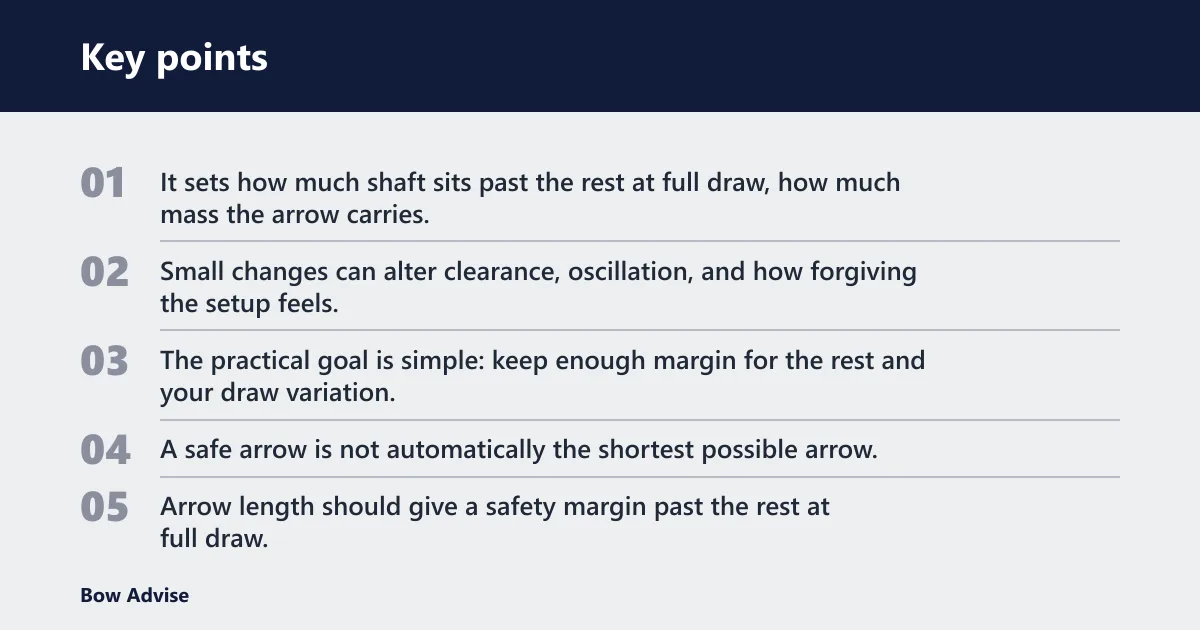


Arrow length is more than a sizing number. It sets how much shaft sits past the rest at full draw, how much mass the arrow carries, and how the shaft behaves under load. Small changes can alter clearance, oscillation, and how forgiving the setup feels.
The practical goal is simple: keep enough margin for the rest and your draw variation, while avoiding unnecessary length that adds weight and pushes you toward a weaker spine choice. A safe arrow is not automatically the shortest possible arrow.
Safety margin at full draw
Arrow length should give a safety margin past the rest at full draw. Many recommendations use draw length plus 1 to 2 inches for safety clearance, and most archers add between half an inch and one inch beyond the arrow rest at full draw. Some coaches recommend up to one and a half inches of overhang for new archers.
That margin matters because draw length is not fixed in real shooting. Stance, anchor point, heavy clothing, and a hurried release can change where the string stops. A short shaft that looks fine on paper can end up too close to the rest when the shot breaks cleanly or when form shifts under pressure.
Clearance, forgiveness, and rest contact
Longer arrows give more room for error. That extra room helps the shaft stay supported through the draw cycle and reduces the chance that the point, insert, or broadhead sits too close to the rest at full draw. On compound bows, that matters because the arrow must clear the rest cleanly through the shot.
Too much length has its own cost. A longer shaft usually weighs more, and the added arrow weight can reduce launch speed. It can also change balance and how the shaft recovers after the string leaves it, which affects tune and group shape.
Why small length changes matter
Length changes are not minor once they affect spine or clearance. A half-inch can be enough to change whether a shaft is safe on the rest, whether a broadhead clears cleanly, or whether the arrow may need a different spine class. That is why arrow length belongs in the tuning stack, not just in the cutting station.
How do you measure draw length first?
Draw length comes first because it anchors the rest of the setup. Size the arrow from the actual bow, with the archer’s real stance and anchor, not from a guessed number on a chart alone. A change in anchor or body position can shift draw length enough to matter.
A common shortcut estimates draw length by dividing fingertip-to-fingertip wingspan by 2.5. That can help as a starting point, but it is still only a starting point. The actual bow and actual anchor should confirm the number.
Measure on the actual bow
Draw length should be checked at full draw on the real bow setup. That means the same release style, the same anchor, and the same stance the archer will use in practice. If the anchor creeps forward or the chest rolls open, the true draw length can change.
That matters most for beginners and growing archers. A youth archer who gains arm length, or anyone who changes posture, may outgrow the earlier measurement. Recheck before cutting arrows short.
Use the archer’s real anchor and stance
Finger shooters and release shooters do not hold the string the same way. Finger release on a recurve or traditional bow often needs a more conservative shaft length because the anchor point can vary slightly from shot to shot. A compound shooter with a consistent hinge or index release can usually work with a tighter fit, but only if anchor and form are repeatable.
Heavy winter layers can also push the anchor outward. A bow that fit in a T-shirt may feel cramped in a jacket. That is one reason a little extra length is often the safer first cut.
Why draw length can shift with form
Form changes alter the number you actually need. Shoulder position, wrist angle, and how firmly the bow shoulder stays open can all shift the measured draw. A setup sized to a guessed number may be short enough for one stance and too short for another.
For that reason, the most useful number is not a chart-only estimate. It is the draw length measured on the bow the archer will use, with the anchor they can repeat.
How long should an arrow be?
Many recommendations use draw length plus 1 to 2 inches for safety clearance. That is a practical starting point, not a universal minimum. The exact overhang should still be checked against the rest, the point style, and the actual bow type.
Arrow length is measured from the bottom of the nock groove to the end of the shaft, not including the point. A 28-inch draw length commonly maps to 29 to 30-inch arrows. The chart also lists a 24-inch draw length as typically needing 25 to 26-inch arrows, and a 32-inch draw length as typically needing 33 to 34-inch arrows.
Start with safety, then trim
Starting long is the safer move for most beginners. It leaves room for the draw to vary and avoids cutting a shaft too short on the first pass. If the shaft is later trimmed, the change should be small and followed by a spine check.
That approach is especially useful for youth archers. Growth spurts can make a fresh arrow set too short within a season, while a slightly long shaft can still be trimmed later.
When to stay longer for safety
Keep more length when the anchor is inconsistent, when the archer wears bulky clothing, or when the bow uses a rest that leaves less physical support at full draw. A beginner with a creeping anchor should not chase the shortest legal length.
Say your 28-inch draw length is measured on the bow, but winter layers push the anchor outward on cold mornings. A 29 to 30-inch shaft gives more room than a tight 28-inch cut and makes a bad surprise less likely.
Arrow length and arrow rest clearance
The rest is the practical reference point. Arrows should extend past it far enough that the shaft, point, or insert does not threaten the rest at full draw, and the bow can fire without the arrow falling out of support. Short arrows can fall off the rest and cause the bow to dry-fire.
For many setups, the useful reference is the rest plus enough shaft to cover normal draw variation. That is why a fixed number by itself is not enough. Compound, recurve, and traditional longbow setups use different rest styles and release methods, so their practical margins differ.
Compound setups
Compound bows often use a capture or drop-away rest, which gives more consistent support but also makes clearance more exacting. A short arrow can still create contact problems at the launcher or around the vanes. The point, insert, and broadhead all need to clear the rest through the shot cycle.
On a compound, too little length is a bigger tuning problem than many beginners expect. It can also become a safety problem if the shaft does not stay supported at full draw.
Recurve and traditional longbow setups
Recurve bows and traditional longbows commonly use finger release and a simpler rest or shelf setup. That changes the practical arrow length because the shaft may flex more during the shot and because the archer’s finger anchor can vary. A longer arrow often gives more forgiveness here.
Traditional bows also tend to tolerate a little extra shaft better than a short, aggressive cut. The tradeoff is added weight and the spine change that comes with it.
Finger release and contact risk
Finger release increases the chance of small form changes at the string. That makes a slightly longer arrow useful, especially for beginners. The goal is to avoid a shaft so short that an imperfect anchor or a hard draw pulls the point too close to the rest.
On any bow, the real check is simple: the shaft must stay safely supported at full draw and clear the rest during the shot.
Arrow length and spine
Length and spine move together. Longer arrows behave weaker, while shorter arrows behave stiffer. That change matters because spine must match draw weight, point weight, and bow setup, not just the bare shaft label.
A longer shaft flexes more under the same load. A shorter shaft flexes less. If the length changes, the spine choice may need to change too.
Longer shafts act weaker
When an arrow gets longer, it usually needs a stiffer spine to keep the tune in range. That is why trimming a shaft is not only about fit. It is also a tuning change that can bring a weak arrow closer to center.
The effect is stronger when the setup already runs on the weak side. Heavy points, higher draw weight, or a soft shaft can move the tune enough that a small length change matters.
Shorter shafts act stiffer
Cutting length makes the shaft behave stiffer. That can help if the arrow was weak, but it can also push the setup too stiff and hurt flight. A shaft that is too stiff can group poorly even when it clears the rest cleanly.
That is why a cut should be followed by a retest, not by a guess that the same spine will still work.
How point weight changes the tune
Point weight is part of the same stack. The common starting points are 100 or 125 grains, and heavier points make arrows behave weaker. A longer arrow or heavier point makes an arrow behave weaker, so both changes should be considered together.
If length increases, a stiffer shaft or lighter point may be needed. If length decreases, the opposite may be true. Never treat those choices separately.
Arrow length decision table
This table gives a starting range for overhang past the rest, then shows what to retest after a cut. It is a starting guide, not a substitute for checking actual clearance on the exact bow.
| Draw-length error | Bow type | Use case | Starting overhang past rest | Retest after a cut |
|---|---|---|---|---|
| 0.0 to 0.5 inch over measured draw | Compound | Consistent anchor, release aid | 0.5 to 1.0 inch | Rest clearance, broadhead clearance, spine, point weight |
| 0.0 to 0.5 inch over measured draw | Recurve | Repeatable finger anchor | 0.5 to 1.0 inch | Arrow flight, spine, bare-shaft tune |
| 0.5 to 1.0 inch over measured draw | Compound | Beginner, inconsistent anchor | 1.0 to 1.5 inches | Clearance at full draw, vane contact, spine check |
| 0.5 to 1.0 inch over measured draw | Recurve or longbow | New archer, winter layers, finger release | 1.0 to 1.5 inches | Shelf clearance, group consistency, spine and point weight |
| 1.0 to 2.0 inches over measured draw | Any bow | Youth growth spurt or uncertain anchor | 1.0 to 2.0 inches | Recheck draw length before trimming, then spine |
After any cut, confirm the shaft still clears the rest at full draw and still matches the spine and point weight. If the arrow was only barely weak before the cut, even a small trim may move it into a better range.
- Measure draw length on the actual bow with the real anchor.
- Choose a starting shaft length that gives the needed overhang.
- Check rest clearance at full draw before trimming.
- Confirm spine against draw weight and point weight.
- Trim in small steps, then retest the tune.
What happens when an arrow is too short or too long?
A shaft that is too short can be unsafe. A shaft that is too long is usually safer but may be slower and harder to tune. The practical effect depends on how much longer or shorter the shaft is and on whether the bow is a recurve, compound, or traditional longbow.
0.5 inch over target length
At 0.5 inch longer than needed, most setups gain a little more safety margin with only a small tuning cost. The arrow may behave slightly weaker, but the effect is usually manageable if the spine was chosen with some room to spare.
This is often a sensible buffer for beginners or for archers whose anchor is not perfectly repeatable.
1.0 inch over target length
At 1.0 inch longer than needed, the arrow is still commonly workable, but the extra shaft adds more weight and weakens the dynamic spine more clearly. That can help a shaft that was stiff, or it can push a borderline shaft into a weak tune.
The upside is a larger safety margin at full draw. The downside is more retuning if the original spine was already close.
2.0 inches over target length
At 2.0 inches longer than needed, the shaft is usually much safer for clearance but often too heavy for a clean tune without other changes. More shaft length means more weight, slower launch, and a stronger move toward weak dynamic spine.
That amount of extra length is best treated as a temporary starting point, not a final answer, unless the archer truly needs the margin.
A common first-timer mistake is cutting to the shortest number that still looks safe on paper. That can leave too little room for clothing, anchor drift, or a new release habit, and it can force a spine choice that is hard to tune later.
Frequently asked questions
How does arrow length affect stability and accuracy?
Arrow length affects stability by changing how the shaft flexes and how much margin it has past the rest. A longer shaft is usually more forgiving at full draw, but it can be weaker in dynamic spine and slower because of added weight. A shorter shaft is faster and stiffer, but less forgiving.
How long should an arrow be for my draw length?
A common starting point is draw length plus 1 to 2 inches, measured from the bottom of the nock groove to the end of the shaft. That gives safety clearance for rest contact and draw variation. The final length should still match the actual bow, anchor, and rest style.
Can arrows be too short for a compound bow?
Yes. Too-short arrows can fall off the rest and can create a dry-fire risk on some setups. They can also leave vanes or the shaft too close to the launcher, which hurts tuning and may damage the arrow. Compound setups need especially careful clearance checks at full draw.
Do longer arrows fly slower than shorter arrows?
Usually yes, because extra shaft length adds weight. More weight generally lowers launch speed. Drag matters in flight, but the main reason a longer finished arrow leaves the bow slower is the added mass. A longer shaft can also shift balance and change how the arrow recovers after release.
How much overhang should an arrow have past the rest?
Most archers add between half an inch and one inch beyond the arrow rest at full draw, and some coaches recommend up to one and a half inches for new archers. That range is a starting point. The actual safe overhang depends on draw variation, bow type, and rest clearance.
Does bow type change the ideal arrow length?
Yes. Compound bows, recurves, and traditional longbows do not handle length the same way. Finger release, rest style, and how much the arrow is supported at full draw all change the practical margin. A longbow or recurve often benefits from a slightly more forgiving starting length than a tightly tuned compound.