Crossbow Bolts vs Arrows: Flight and Performance Guide
Crossbow bolts are often shorter and heavier than vertical-bow arrows, and the right choice is the one that matches your crossbow’s minimum grain weight and exact length spec. A poor fit can cause bad flight, louder shots, worse accuracy, and damage to the bow. This guide breaks down how length, mass, balance, and crossbow tuning change stability, drop, and real-world accuracy.
This guide is part of our Arrow dynamics in archery series.
| Decision factor | Crossbow bolts | Arrows | Winner |
|---|---|---|---|
| Crossbow fit | Built for a crossbow rail, trigger system, and short power stroke | May be sold as “arrows,” but only work if the shaft length and nock setup match the crossbow spec | Crossbow bolts |
| Launch stability | Shorter shafts can be very stable when spine, mass, and length match the crossbow | Longer shafts may flex more and can be less forgiving in a crossbow launch | Crossbow bolts |
| Downrange drop | Often flatter at practical crossbow ranges when paired with the right speed class | Longer or lighter shafts can lose speed faster if the setup is not tuned | Crossbow bolts |
| Safety margin | Usually safer when chosen to the maker’s length and grain rules | Higher mismatch risk if a vertical-bow arrow is assumed to be interchangeable | Crossbow bolts |
| Field flexibility | Usually narrower in acceptable options, which simplifies selection | Broader retail labeling, but more room for buying the wrong shaft | Crossbow bolts |
What is the difference between crossbow bolts and arrows?
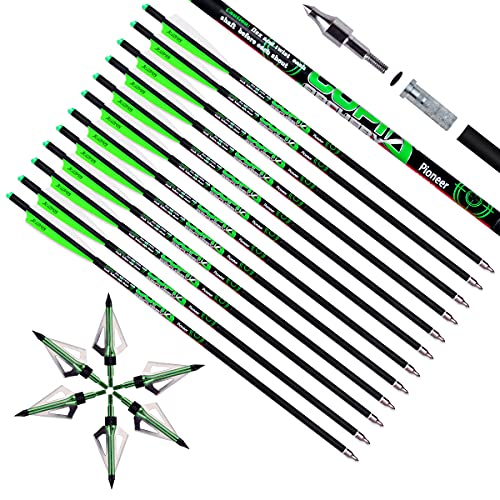


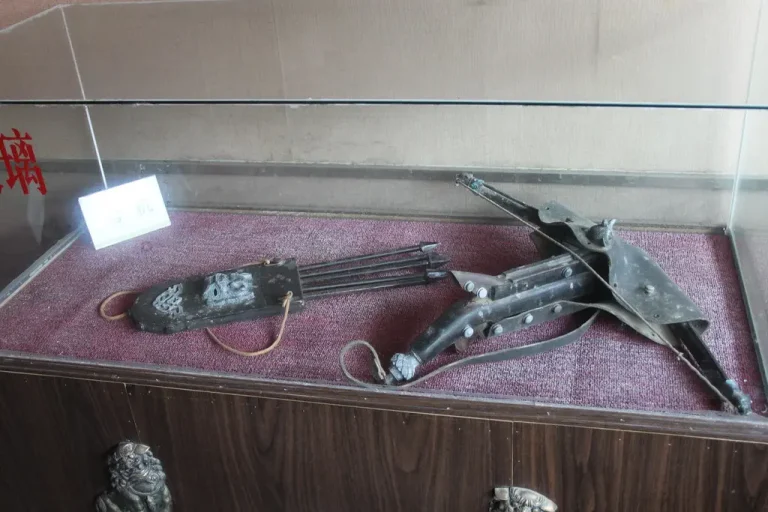
Crossbow bolts and arrows are both arrow-like projectiles, but the term on the box matters less than the fit, length, mass, and nock style the crossbow needs. Crossbows use a horizontal prod and trigger mechanism, so the projectile must leave the rail cleanly and stay stable through launch. (en.wikipedia.org)
In retail listings, the same item is often called an arrow, a bolt, or a quarrel. That overlap can hide a key point: a projectile that works in a vertical bow may still be wrong for a crossbow, even if the label sounds familiar.
Why the naming overlap exists
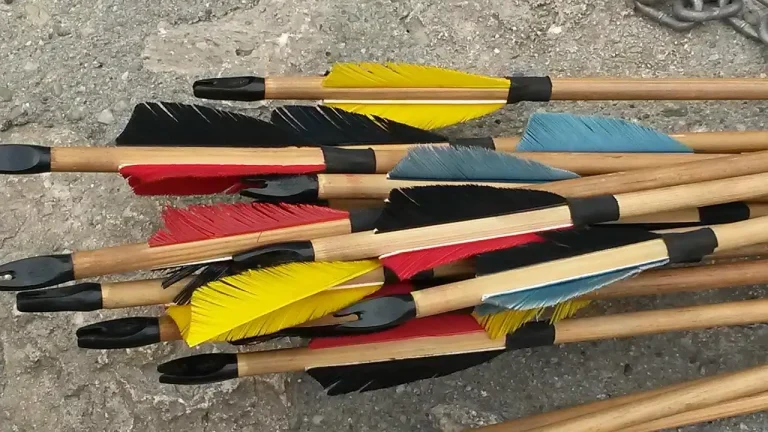
In archery language, “arrow” is the broad term. In crossbow use, “bolt” is the more common term for the shorter projectile format. Some sellers still use “arrow” because it is the term most buyers recognize, not because the shaft is suitable for every bow type.
The name does not tell you enough. Length, weight, and front-of-center balance tell you far more about how the shot will behave.
What matters more than the name on the box
A crossbow needs a projectile that matches its rail geometry, speed class, and minimum grain weight. Newer crossbows are often quieter, lighter, and easier to aim than older models, but they still punish a poor projectile match.
Crossbows and bows both send stored limb energy into a shaft. The crossbow just gives the shooter more time on target after cocking, and that extra aiming time does not fix the wrong bolt.
📊 Each crossbow was shot in three-arrow groups at 20 yards. Source: 12 Best Crossbows in 2026 For Every Scenario.
How do crossbow bolts fly differently?
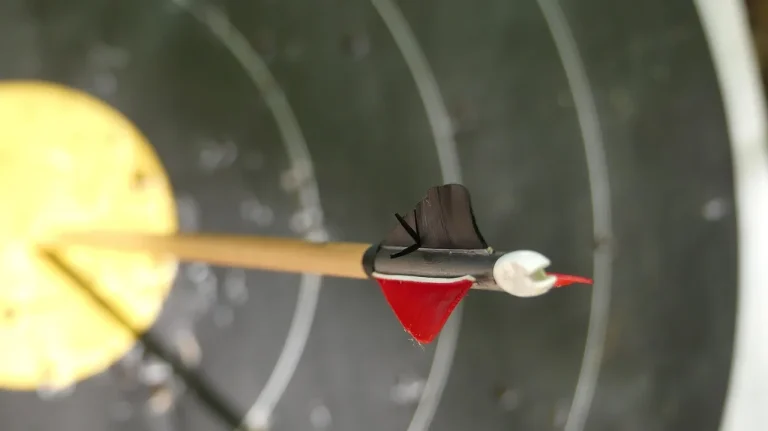
Crossbow bolts fly differently because the launch happens from a horizontal platform, with a shorter acceleration window and a harder need for clean clearance. Length, stiffness, mass distribution, and shaft diameter shape how well the bolt leaves the rail and how much it drops on the way downrange.
Those factors matter more in a crossbow than they do in many vertical bow setups. A shaft that is merely “good enough” in a compound bow can wobble, group poorly, or run too close to the rail in a crossbow.
Length and stiffness effects on launch stability
Shorter bolts can be stable because they resist excess flex during the fast crossbow launch. That said, shorter is not automatically better. If the shaft is too short for the model, clearance and safety problems can appear fast.
Stiffness matters because the bolt has to leave the rail without excessive oscillation. Too much flex can open groups and make the shot feel inconsistent from one bolt to the next.
Mass distribution and front-of-center balance
Where the mass sits along the shaft changes how the bolt tracks after launch. A front-heavy setup can settle the nose more quickly, while a poorly balanced shaft can yaw and waste energy before it reaches the target.
For crossbows, practical accuracy often improves when the projectile has a sensible front-of-center balance rather than an extreme one. That balance is one reason a bolt built for a crossbow can behave better than a generic arrow of similar length.
Shaft diameter, drag, and downrange drop
Shaft diameter affects drag. A larger diameter can catch more air, which can matter as distance grows. A slimmer shaft may hold speed a little better, but only if the rest of the setup is tuned and the shaft still matches the crossbow’s requirements.
Downrange drop is not just about speed at launch. It also depends on how steadily the bolt flies after release and how much speed it sheds during flight.
Why do crossbows need specific bolts or arrows?
Crossbows need specific bolts or arrows because the power stroke, draw weight, rail design, and speed class all affect how the projectile leaves the bow. A mismatch can cut speed, add vibration, and create unsafe clearance or loading issues.
That requirement is more than a maker preference. It is part of how the crossbow transfers stored energy into the shaft and how the shaft survives that transfer.
Power stroke and draw weight set the limits
Power stroke is a key driver of crossbow speed. A longer power stroke usually gives the projectile more time to accelerate, while draw weight influences how much effort it takes to cock the bow and how much energy the system stores.
Those two variables work together. A crossbow in the roughly 125 lb draw-weight and 330 FPS range is not the same setup as a more powerful hunting model that sends a heavier shaft at a different speed class.
What happens when length or mass is off
If the bolt is too light, too short, or simply outside the maker’s spec, the shot can become loud, erratic, or hard on the bow. If it is too heavy, speed can fall enough to change point of impact and trajectory in a way the shooter did not plan for.
Say your crossbow calls for a minimum 400-grain setup and a 20-inch shaft, but the shop sells a shorter shaft with a lighter tip. The bow may still fire it, yet the flight can open up and the noise can rise because the system is no longer tuned to that load.
How do speed, accuracy, and noise compare?
Speed, accuracy, and noise all matter, but they do not always move in the same direction. A fast crossbow is not automatically the most accurate, and the quietest setup is not always the flattest-shooting one. Real performance depends on the complete system.
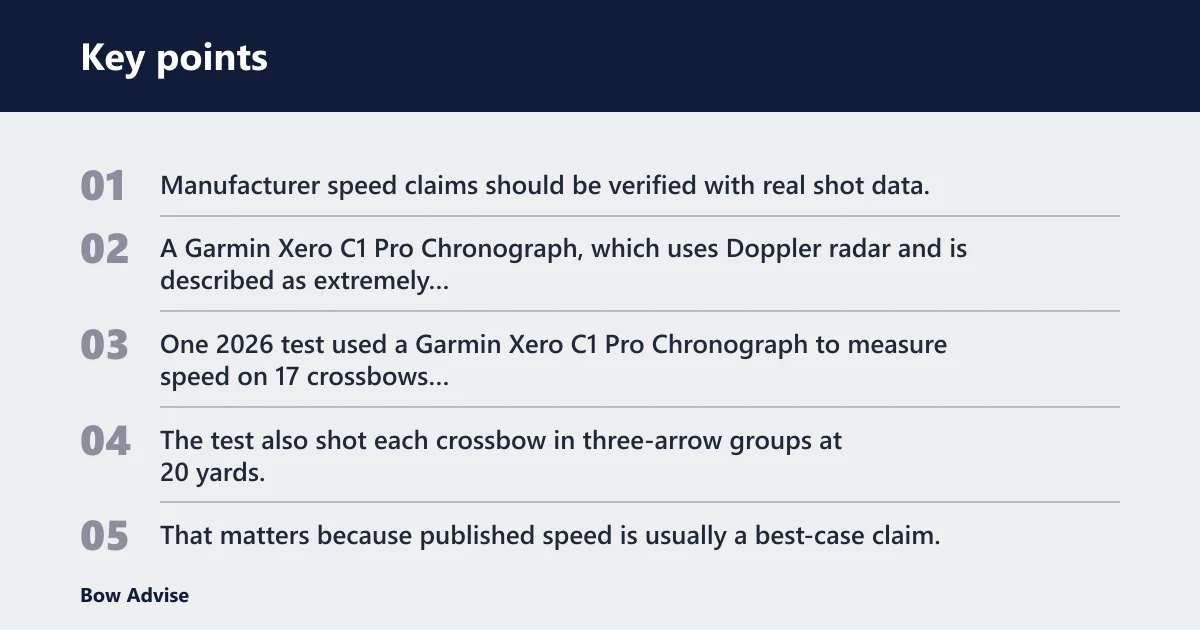
Manufacturer speed claims should be verified with real shot data. A Garmin Xero C1 Pro Chronograph, which uses Doppler radar and is described as extremely accurate, can help compare claimed speed with actual performance.
Real speed versus advertised speed
One 2026 test used a Garmin Xero C1 Pro Chronograph to measure speed on 17 crossbows over more than 100 hours. The test also shot each crossbow in three-arrow groups at 20 yards, which is the kind of setup that reveals more than a headline FPS number.
That matters because published speed is usually a best-case claim, not a guarantee with your exact bolt and field setup. Power stroke, bolt mass, and tuning can shift real speed away from the brochure number.
Arrow or bolt speed variance shot to shot
Arrow or bolt speed variance is a useful consistency check. In that 2026 test, speed variances under 1.0 fps were observed, which shows how tightly some systems can track from shot to shot when the setup is sorted.
Lower variance helps practical accuracy because point of impact is easier to predict. If two bolts leave at noticeably different speeds, the group can spread even if the shooter does everything right.
Noise and vibration as a hunting factor
Noise and vibration are secondary to fit and stability, but they matter in hunting. A crossbow that launches the wrong shaft can transmit more shock, more sound, or both, and that can be a problem in close cover.
Modern crossbows are quieter than older models, but the projectile still affects the final shot sound and feel.
Decision table: what bolt or arrow should you choose?
The right choice depends on speed class, power stroke, and intended use. Use the table below as a practical filter, not as a substitute for the maker’s manual.
| Speed class / power stroke | Intended use | Recommended length | Recommended mass range | Main failure risk to watch for |
|---|---|---|---|---|
| High-speed hunting crossbow with a long power stroke | Deer hunting, broadhead use, tight field groups | Usually the maker’s listed length; often around 20 inches in common hunting setups | Heavier, maker-approved hunting weights | Too-light shaft causing harsh launch and noisy shots |
| Mid-speed crossbow with moderate power stroke | Mixed target and hunting use | Exact factory spec, not a shorter substitute | Mid-range shaft weight matched to the bow | Inconsistent grouping from poor balance or spine mismatch |
| Entry-level crossbow with shorter power stroke | Target shooting, practice, basic hunting | Whatever the manual lists, with no guesswork | Stable, not ultra-light, within the minimum grain rule | Unsafe clearance or poor accuracy from the wrong shaft diameter |
| Power-draw device setup | Users who want easier cocking and simple handling | Factory-specified length only | Projectiles that preserve safe energy transfer | Mismatch between cocking system, rail, and projectile spec |
How to read the table
Shorter and lighter is not the rule. The right shaft is the one the crossbow was designed to shoot at that speed class. For example, Barnett Hyper Raptor GTX launches 20 in HyperFlite arrows up to 425 FPS and is listed with 142 ft-lb of kinetic energy, which shows how tightly some models are tied to a specific projectile format.
By contrast, Barnett Explorer Recruit XP is rated at 330 FPS and uses a 125 lb draw weight, which puts it in a very different setup lane. CenterPoint Patriot 425 is sold as a crossbow with a power-draw device, another reminder that the cocking and projectile system should be treated as one package.
Can I use any arrow in a crossbow?
No. You cannot treat every arrow as a crossbow projectile, because fit, clearance, and maker limits matter. A shaft that seems close in length or weight may still be wrong if the nock, diameter, or grain weight falls outside the crossbow’s spec.
That mismatch can be inaccurate at best and unsafe at worst. The label “arrow” does not guarantee crossbow compatibility, and the label “bolt” does not guarantee it either.
Fit, clearance, and rail compatibility
The shaft must clear the rail and ride the string path the way the bow expects. If it is too long, too short, or too large in diameter for the rail and retention system, the shot can be sloppy or unsafe.
A common first-timer mistake is buying a shaft because the length sounds close enough. In a crossbow, close enough is not enough.
Why manufacturer limits matter
Maker limits exist because the projectile is part of the bow’s operating system. The crossbow’s speed class, power stroke, and draw weight all affect what the shaft can absorb and how it exits the rail.
Those limits also help manage noise and vibration. A proper match usually feels cleaner and groups better because the system is working inside its intended range.
What should hunters and target shooters prioritize?
Hunters should prioritize reliable flight, legal and ethical energy at distance, and a shaft that matches the crossbow’s hunting setup. Target shooters should prioritize repeatable grouping, low speed variance, and a projectile that is easy to tune with the chosen points and practice heads.
Both groups need the same baseline: proper fit, correct minimum grain weight, and a shaft that the maker approves. The difference is where the emphasis lands after that.
Hunting setup priorities
For hunting, a slightly heavier and maker-approved shaft often makes sense because it can help steady the shot and support useful downrange energy. Kinetic energy matters here, but only as part of a full package that also includes point of impact consistency.
If the shot is loud, erratic, or borderline on the bow’s spec, the setup needs attention before season use.
Target shooting priorities
For target work, consistency matters more than chasing the lightest shaft. A setup that groups well at 20 yards with low shot-to-shot variance is usually more useful than one that posts a higher advertised FPS number but groups worse.
Suppose a shooter wants a quiet practice rig for backyard bullseyes. A shaft that matches the bow’s exact length and weight spec will usually beat a lighter, generic “arrow” that only seems similar on paper.
Choose crossbow bolts if…
Choose crossbow bolts if you want the safest default for a crossbow, especially when the maker lists a specific length and minimum grain weight. Bolts are the clearer match for the rail, the trigger system, and the speed class. Choose a generic “arrow” only when the crossbow maker explicitly allows that exact projectile spec.
For hunting, bolt choice should favor stable flight, clean release, and the correct energy window. For target shooting, it should favor tight grouping and low variance shot to shot.
Frequently asked questions
Do crossbows shoot bolts or arrows?
Crossbows shoot arrow-like projectiles called bolts or quarrels, and many sellers call them arrows too. What matters is not the label, but whether the shaft is approved for that crossbow’s speed class, power stroke, and rail design.
How do crossbow bolts affect flight and accuracy?
Bolts affect flight and accuracy through length, stiffness, balance, and shaft diameter. A shaft that matches the bow well leaves the rail more cleanly, oscillates less, and groups more consistently. A poor match can open groups and make the shot louder or harsher.
Are shorter crossbow bolts better than arrows?
Shorter bolts are not automatically better. They can be stable in the right crossbow, but if the shaft is too short for the model, clearance and safety problems can appear. The correct length is the one the manufacturer specifies, not the shortest option on the shelf.
What bolt length should I use for my crossbow?
Use the exact length listed by the crossbow maker, or the approved range if the manual gives one. That spec is tied to the bow’s speed class, rail geometry, and energy transfer. A guess based on another model can lead to poor flight or unsafe fit.