Best Hunting Arrows for Pass-Through (2026): research shows
For pass-through performance, the best hunting arrows are the ones that tune cleanly with your broadhead on your own bow setup, usually a shaft with appropriate spine, the right point weight, and a finished arrow weight in roughly the mid-400s to mid-600s grains. Poor dynamic tune wastes energy, opens groups, and leaves broadheads planing instead of driving straight. This guide covers spine choice, arrow weight, FOC, broadhead tuning, and the setup checks that improve penetration without guesswork.
Quick comparison
| Product | Badge | Best for | Price | ||
|---|---|---|---|---|---|
 | Muzzy Trocar 100 Grain 3-Blade Broadhead – 3 Pack, Multi,Muzzy | Our pick | 3-blade broadhead · 100 grain · Trocar tip | $37.75 Price as of 10 Oct 2026 | View |
 | Pointdo 30inch Carbon Arrow Fluorescence Color TargetingPointdo | Budget pick | 30" carbon arrows · Fluorescent fletching · Adjustable nocks | $32.99 Price as of 10 Oct 2026 | View |
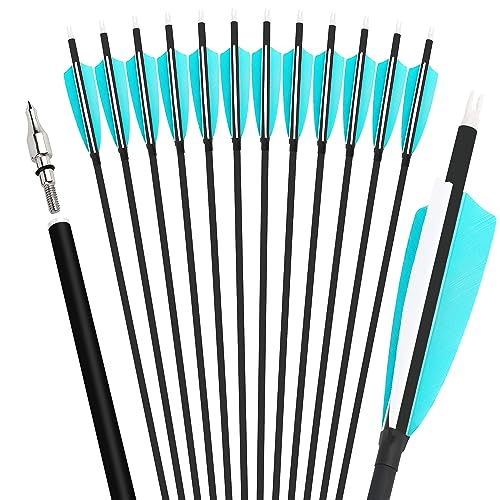 | ZSHJGJR 30 Inch Archery Carbon Arrows Hunting Arrows withZSHJGJR | Also great | 30" carbon arrows · Turkey feathers · Replaceable field points | $39.99 Price as of 10 Oct 2026 | View |
For most deer setups, a midweight carbon shaft with clean broadhead flight is the safest starting point. For elk or heavier bone, move toward higher finished weight, tighter front-end control, and a build that stays stable after point and insert changes.
How we chose
The main filter was broadhead flight at hunting tune, not field-point grouping alone. A shaft had to fit real bow setups: draw weight, draw length, bow speed, point weight, insert weight, and the game being hunted.
We also weighed diameter, straightness consistency, and how easily a build can be tuned without pushing spine too soft. Finished mass matters, but only after the arrow stays stable through release and into the broadhead.
Carbon arrows are the standard hunting choice because they balance durability, speed, and weight options in one package. Aluminum/carbon hybrid options matter for heavy-front builds, but they are a niche choice for hunters who want more mass up front.
Best hunting arrows for pass-through performance: best overall arrow for tuned broadhead flight and deep penetration
The best overall arrow is usually the one that gives clean broadhead flight first, then enough mass and front-end balance for the target animal. For most bowhunters, that means a carbon hunting shaft with correct spine, a sensible point weight, and a finished build that does not force the broadhead to correct the shot.
Why this build type wins for most bowhunters
Pass-through performance is a tuning result. A shaft that is too weak, too heavy in the point, or too large in diameter can lose speed and show broadhead planing before it ever reaches the target with authority. A correctly matched carbon build is easier to tune, easier to source, and easier to repeat across a full dozen arrows.
Outdoor Life lists the Easton 5.0 in .001 and .003 straightness versions, with spine options that include 200, 250, 300, 340, 400, and 500. That range matters because spine must match draw weight, draw length, and point weight before pass-through claims mean much.
The Easton 5.0 also uses a .204-inch inside diameter and the 340 spine weighs 7.4 grains per inch. That is the sort of detail that helps a bowhunter estimate finished arrow mass and front-end behavior before making a purchase.
Quick picks
| Best for | Key spec focus | Why it fits |
|---|---|---|
| General hunting setups | Matched spine, clean broadhead tune, midweight carbon | Best balance of speed, grouping, and penetration |
| Heavy-front builds | Higher finished mass, stiffer shaft, tighter front-end control | Better for elk-class setups and quieter shots |
| Windier conditions or longer shots | Micro-diameter, stable broadhead flight | Less drift, better line-holding at distance |
| Budget hunting and practice crossover | Simple carbon shaft, easy broadhead tuning | Lower cost without giving up core hunting performance |
Which arrow material is best for penetration?
Carbon shafts are the best default choice for penetration because they give hunters strong durability, useful speed, and many weight options in one package. Aluminum/carbon hybrid arrows can work well for heavy-front builds, but they are more specialized and are not the first choice for most hunters.
Carbon shafts for most hunting setups
Bowhunting Essentials identifies carbon arrows as the gold standard for modern hunting. That fits the market reality: carbon is easier to find in hunting spines, straightness tolerances, and micro-diameter formats that work with broadheads and fixed-blade tuning.
Carbon also makes it easier to build around a target animal. A deer setup does not need the same finished mass as an elk setup, and carbon gives enough flexibility to move between those goals without changing platforms.
Aluminum/carbon hybrid arrows for heavy-front builds
Hybrid arrows make sense when a hunter wants extra mass and front-end weight for penetration-focused work. They can be a smart choice for heavier animals, but they are usually less common and less forgiving than a simple carbon build when the tune is off.
Composite or tapered arrows sit in this niche too. Bowhunting Essentials notes them as niche products for extreme penetration, which is a clue that they belong in specific setups, not as the default answer for every bowhunter.
Why material matters less than tune once the arrow is built
A perfect material choice cannot rescue weak spine or bad broadhead tune. Once the arrow is built, the release, spine match, insert weight, and point weight control how the shaft behaves in flight and on impact.
Micro-diameter vs standard diameter: which is better?
Micro-diameter shafts are usually better for wind drift and penetration, while standard-diameter arrows are easier to build, source, and tune for many hunters. The right answer depends on bow speed, broadhead style, and whether the goal is long-range stability or simple, forgiving hunting performance.
When micro-diameter shafts help penetration and wind drift
Micro-diameter arrows reduce frontal area, so they generally cut wind better and can carry into the target with less drag. That helps at longer distances and in setups built for deeper penetration on tougher game.
The tradeoff is real. A smaller shaft can require more careful component choice, and the hunter still has to keep broadhead flight clean. If the front end is too heavy for the spine, the shaft can become hard to tune even if the diameter is ideal.
When standard diameter arrows are the smarter choice
Standard-diameter shafts are the smarter choice for hunters who want straightforward tuning and easy component availability. They are often less fussy with inserts, nocks, and broadhead setups, which helps if the goal is repeatable hunting arrows without a long tuning process.
For close-range deer hunting, standard diameter is often enough. If the arrow is flying straight and carrying the right mass, the target animal does not care whether the shaft is micro or standard.
Diameter tradeoffs for broadheads and close-range hunting
Broadheads amplify errors. A shaft that looks fine with field points can still plane badly with a fixed blade, especially if the shaft is weak or the front end is overbuilt. Micro-diameter can reduce drift, but it does not replace correct spine and a sound tune.
Arrow spine, FOC, and broadhead tune: how they work together
Arrow spine is shaft stiffness. Lower spine numbers mean stiffer arrows, so a 300 spine is stiffer than a 400 spine. For hunting, spine must match draw weight, draw length, point weight, and broadhead tune or the arrow may leave the bow in a way that bleeds penetration and precision.
Why lower spine numbers mean stiffer shafts
Spine is a deflection stiffness rating. When the number goes down, the shaft gets stiffer. That matters because stiff enough is better than barely soft enough when fixed-blade broadheads are in the mix.
Too weak and the shaft can kick badly on release. Too stiff and the bow may still tune, but the build may need more point weight or other changes to reach acceptable flight.
How point weight and insert weight change dynamic spine
Front-end weight bends the shaft more in flight. A heavier point or insert system can make the arrow behave weaker dynamically, even if the spine rating looks fine on paper. That is why a bowhunter cannot choose spine in isolation.
Insert systems such as HIT inserts and half-outs matter because they change front-end weight and the tune window. A heavier insert can help penetration and FOC, but it can also push a shaft into weak-spine behavior if the rest of the build is already soft.
How FOC can help or hurt if the shaft is mismatched
Front-of-center is the forward balance of the finished arrow. Used well, it can improve stability and penetration. Used badly, it can make a weak shaft harder to tune and increase broadhead flight problems.
FOC should be treated as part of the whole build, not a goal by itself. A balanced arrow with clean broadhead flight will beat an extreme front-heavy build that sprays arrows or loses speed too quickly.
Best arrows by hunting setup
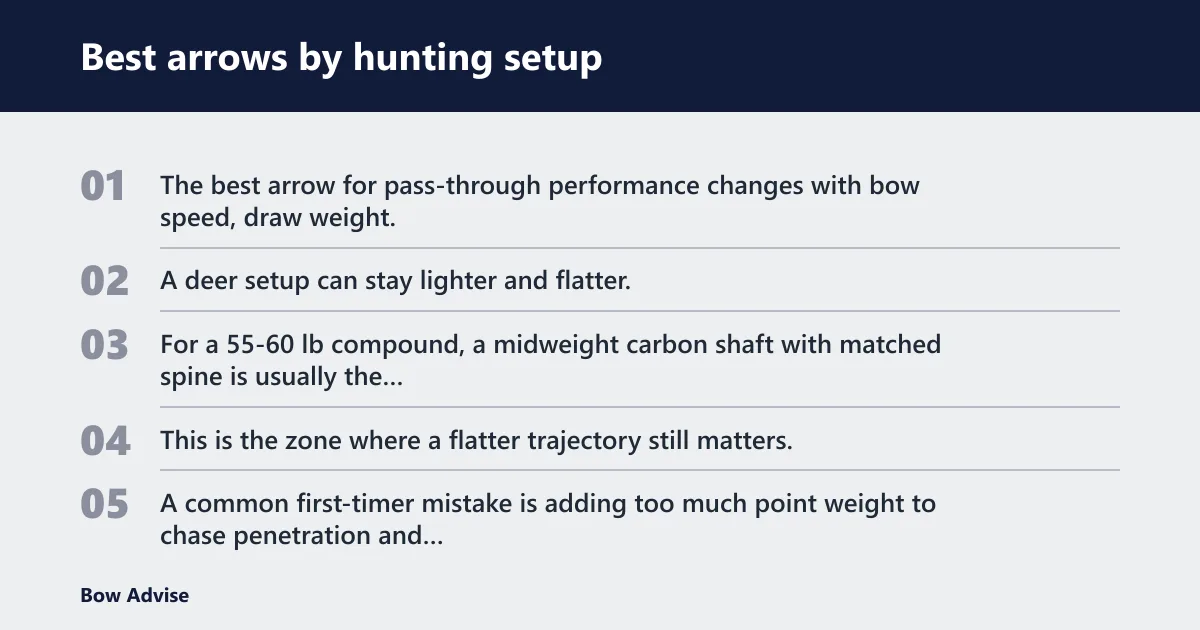
The best arrow for pass-through performance changes with bow speed, draw weight, and game size. A deer setup can stay lighter and flatter, while elk and other heavy-game builds benefit from more mass, stronger spine, and a more controlled front end.
55-60 lb compound: lighter, faster crossover build
For a 55-60 lb compound, a midweight carbon shaft with matched spine is usually the safest pick. This is the zone where a flatter trajectory still matters, especially for hunters who split time between 3D and hunting.
A common first-timer mistake is adding too much point weight to chase penetration and then wondering why broadheads start steering the arrow. The fix is usually better spine selection, not more mass alone.
60-70 lb compound: balanced penetration build
For a 60-70 lb compound, a more penetration-focused build makes sense because the bow has enough energy to carry a heavier finished arrow without giving up too much speed. This is the sweet spot for many deer and elk hunters who still want a forgiving tune.
Heavier arrows usually carry more momentum, but too much mass can slow the shot, flatten the tune window, and make the bow less forgiving at distance. The goal is enough finished weight to help penetration, not the heaviest arrow possible.
Heavier game: higher mass and stronger front-end setup
For heavier game, the build should favor stability and retained momentum. That usually means a stiffer shaft, a more controlled insert system, and a finished arrow weight that does not rely on speed alone for terminal effect.
Heavy-bone shots are different from soft-tissue shots. A deer lung shot may pass through with a moderate build, while an elk shoulder shot asks more from the shaft, broadhead, and front-end setup.
Deer versus elk versus turkey differences
Deer setups can run lighter and still pass through cleanly if the arrow tunes well. Elk setups should usually push toward more mass and a stiffer, more stable build. Turkey is its own case: the shot is short, but the angle can be awkward, so clean flight and controlled penetration matter more than raw speed.
Pass-through decision matrix
| Bow setup | Recommended spine | Total arrow weight | Point weight | Diameter tier | Failure case if pushed too far |
|---|---|---|---|---|---|
| 55-60 lb compound, 285-310 fps, deer-focused | 300-400 spine, depending on draw length and insert weight | 400-500 grains | 100-125 grains | Standard or micro-diameter | Too weak a spine or too much point weight can cause broadhead planing and poor arrow recovery |
| 60-70 lb compound, 290-330 fps, balanced hunting | 250-340 spine | 450-575 grains | 100-150 grains | Micro-diameter preferred for wind and penetration | Too little mass may pass through deer but lose momentum on larger animals; too much mass can slow the bow and tighten the tune window |
| 60-70 lb compound, elk or similar heavier game | 250-300 spine, often with stiffer front-end support | 500-650 grains | 125-200 grains | Micro-diameter or small standard | Over-heavy point weight can weaken dynamic spine and create tail-left or tail-right impact issues with fixed blades |
| 3D-to-hunting crossover, 55-65 lb | 300-400 spine | 400-500 grains | 100-125 grains | Standard diameter often simpler | Too much total mass hurts trajectory and makes the build less useful for target practice at varied distances |
| Turkey-focused setup | 300-400 spine | 425-525 grains | 100-125 grains | Standard or micro-diameter | Weak spine or poor broadhead tune can spoil short-range precision and reduce control on steep angles |
This matrix is a decision tool, not a rulebook. Insert systems can shift the build enough that two arrows with the same spine rating behave differently once the front end is assembled. That is why broadhead tune has to validate the final arrow, not the label on the shaft.
How much arrow weight helps pass-through performance?
More arrow weight usually helps pass-through performance because it raises momentum and keeps the shaft driving after impact. The useful range depends on bow speed, draw weight, and game size, but the goal is enough mass to carry through the target without making the setup sluggish or hard to tune.
How to think about finished arrow mass
Grains per inch, or GPI, is the shaft weight density used to estimate finished arrow mass. Once shaft length, insert weight, nock, vanes, and point are added, the total can move a long way from the bare shaft number.
That is why two 300-spine arrows can behave very differently. One with a heavier insert and broadhead may need more attention to tune, while another with a lighter front end may fly cleaner but give up some penetration.
Why too much mass can backfire
Too much mass can cost speed and flatten trajectory. If the bow loses too much launch speed, the hunter may miss the clean tune window or create a setup that is hard to hold on target at normal hunting distances.
Pass-through performance needs balance. The arrow should be heavy enough to carry momentum, but not so heavy that it turns the bow into a weak, slow system with poor forgiveness.
What arrow diameter is best for hunting broadheads?
Micro-diameter shafts are usually best for hunters who want lower wind drift and a better penetration profile, while standard diameter arrows are often easier to build and tune. The better choice is the one that keeps broadheads flying straight at your actual hunting distance and setup.
Broadheads reveal the truth
Broadheads magnify arrow flight issues faster than field points. If the shaft is weak or the front end is too heavy, the broadhead may plane, which steals penetration before the arrow has a chance to do its job.
That is why a field-point-only tune is not enough for a serious hunting build. A fixed blade needs to confirm the arrow’s behavior, not merely the bow’s general consistency.
Why diameter is only one part of the answer
A small diameter does not fix weak spine. A standard diameter does not ruin a build if the tune is right. Diameter is best treated as a helper, not the main driver of penetration.
Recommended arrows by use case
For simple hunting setups, the Pointdo 30inch Carbon Arrow is the easiest budget-friendly option to consider. It gives a basic carbon hunting and practice platform with fluorescent fletching and adjustable nocks, but the tradeoff is that it is more of a general-purpose arrow than a dedicated penetration build.
For heavier-front hunting and more serious broadhead work, the Easton 5.0 is the stronger all-around specification to study. Its .204-inch inside diameter, Acu-Carbon construction, and multiple spine choices make it easier to build around a real hunting tune, though the price may be higher than a basic practice shaft.
For a traditional-leaning setup, the ZSHJGJR 30 Inch Carbon Arrows are a workable crossover choice with turkey feathers and replaceable field points. The drawback is that the 500 spine label may fit some lighter or more traditional bows better than stronger compound setups, so spine verification is essential.
Best hunting arrows for pass-through performance: which one should you buy?
For most bowhunters, the best buy is the arrow that matches draw weight, broadhead, and finished mass without forcing a bad tune. If the setup is simple, choose a standard carbon hunting shaft with the correct spine. If the goal is elk or long-range stability, move toward micro-diameter and a heavier front end.
Best budget pick for simple hunting setups
The Pointdo carbon arrow is the budget path if the goal is a straightforward hunting-and-practice setup. It is not the most specialized pass-through choice, but it gives a low-cost way to build a basic carbon arrow for lighter hunting needs.
Best midrange pick for most bowhunters
The Easton 5.0 is the best midrange fit for hunters who care about repeatability and broadhead tune. The stated .001 and .003 straightness options, the .204-inch inside diameter, and the broad spine range make it easier to tune around real-world hunting needs.
Best premium pick for micro-diameter or heavy-front builds
For hunters building toward more penetration-focused setups, a micro-diameter shaft with the right spine and front-end weight is the smarter premium path. Outdoor Life names the Victory RIP XV Xtreme Velocity Elite as its best lightweight hunting arrow, the Victory HLR Elite as its best long-range hunting arrow, and the Easton FMJ Max 5mm Match Grade as its best heavyweight hunting arrow.
Best pick for deer, elk, or 3D-to-hunting crossover
For deer, a balanced carbon shaft with clean broadhead flight is usually enough. For elk, a heavier build with stronger front-end control makes more sense. For 3D-to-hunting crossover use, pick the arrow that keeps your broadheads honest without making practice arrows feel wildly different from hunting arrows.
Frequently asked questions
What are the best hunting arrows for pass-through performance?
The best hunting arrows for pass-through performance are the ones that tune cleanly with your broadhead at your exact bow setup. That usually means a correctly spined carbon shaft, a sensible point weight, and a finished build heavy enough to carry momentum without ruining flight or trajectory.
Do micro-diameter arrows penetrate better?
Micro-diameter arrows often penetrate better because they reduce drag and cut wind more cleanly. That said, the gain only matters if the shaft spine, point weight, and insert system are matched well. A poorly tuned micro-diameter build can still underperform a simpler standard shaft.
What spine should I choose for broadheads and pass-throughs?
Choose the spine that matches your draw weight, draw length, point weight, and insert setup. Lower spine numbers mean stiffer shafts, and fixed-blade broadheads usually reward a slightly stiffer, cleaner-tuned build rather than one that is right on the edge of weak.
How much arrow weight helps pass-through performance?
Enough weight to keep momentum through the target helps, but the right number depends on the bow and game. Many hunting builds land in the midweight-to-heavy range, with finished arrows often built heavy enough to improve penetration without turning the setup slow or hard to tune.
Are heavy arrows better than light arrows for hunting?
Heavy arrows are often better for penetration because they carry more momentum and usually fly with less noise. Light arrows are flatter and faster, which can help at distance, but they give up some terminal push. The best choice depends on the animal and your effective range.
How does FOC affect pass-through performance?
FOC can improve stability and penetration when it is balanced correctly with spine and total arrow mass. Too much front weight can make a shaft act weak and hurt broadhead flight. Moderate, well-matched FOC usually beats extreme front-heavy builds for hunting.