Beman ICS Hunter Arrow Review: Is It Still Worth It?
The Beman ICS Hunter is still worth buying used if the shafts are straight, uncracked, and weight-matched within 2 grains, and if the price leaves room for inserts and a fresh build. Bad used carbon costs me tune time, broadhead flight, and sometimes a bow. I buy it only after I check condition, spine, finished weight, and whether it tunes cleanly on a hunting setup.
This guide is part of our Arrow dynamics in archery series.
Beman ICS Hunter arrow review: my verdict


My verdict is a cautious yes. I would buy a clean used set for a hunting bow if the spine fits my draw weight, the cut length is right, and the shaft passes a wobble check. I would skip worn or unknown shafts because tuning headaches erase the savings fast.
The Beman ICS Hunter is an older carbon hunting shaft, so I treat it as a used tool, not a fresh product. That matters. Old carbon can still fly well, but only if it is straight, has sound inserts, and matches the bow instead of making the bow accept it.
When I would buy it used
I’d buy it when I want a budget hunting build, I can inspect the arrows in hand, and I have time to tune. It fits a compound bow or a carefully matched recurve setup. It fits less well if I want a ready-to-shoot purchase with no extra work.
When I would skip it
I’d skip it if the seller cannot confirm cut length, if the shafts have visible scrapes around the insert end, or if I need perfect consistency without sorting. I’d also skip it when newer arrows cost only a little more and bring better straightness control and clearer component options.
What the Beman ICS Hunter is built for
This is a carbon hunting shaft that can suit broadhead-capable setups. It was built to give hunters a practical shaft for field points and fixed blades, with spine choices meant to cover common draw weights. On a hunting bow, that is still the right job for it.
Because it is an older shaft, I pay more attention to what happened after it left the factory. Storage, repeated pulls from a target bag, hard impacts, and bad cuts all matter now. A shaft that was fine years ago may not be fine today.
Carbon hunting shaft construction
Carbon construction gives the shaft solid durability for its size, but carbon does not excuse damage. I still check every shaft for straightness, ring marks, cracks near the insert, and nock wear. One bad shaft in a group can make the whole setup shoot poorly.
Original hunting use case
This shaft was meant for hunting, not for speed bragging. That means the right question is whether it will fly clean with my bow and broadhead, not whether it sounds fast on paper. Clean tune and enough total arrow weight matter more than hype.
Why older hunting shafts need extra inspection now
Older shafts have one big problem: you often do not know their history. I have seen good-looking arrows hide bad cuts, loose inserts, and tiny bends that show up only when I roll them on glass. That is why used-market inspection matters more here than with a new sealed dozen.
Is the Beman ICS Hunter arrow still good for hunting?
Yes, it can still be good for hunting if the shafts are straight, the spine fits the bow, and the finished build tunes with the broadhead you plan to carry. It is a usable hunting arrow, not a guaranteed good purchase. Condition and setup decide the answer.
For field points, it is easier to get moving. For fixed blades, the margin shrinks. I care less about the brand name and more about whether the arrow leaves the bow without funny tail kick or broadhead planing. That is where old shafts earn or lose their keep.
What it can still do well
A solid used set can group well, carry enough weight for hunting, and hold up to normal practice if the shafts are sound. If I am building a budget deer setup, I mainly want repeatable flight and clean penetration, not the newest decal on the shaft.
Where age and wear can make it a poor buy
If the shafts vary in length, have worn nock ends, or show any wobble, I expect trouble. The shaft may still hit paper with field points, then open up with broadheads. That kind of false good news is expensive once you start changing heads and components.
What spine, arrow length, and total weight should you check?
Check spine against draw weight, draw length, and cut length together. A shorter shaft usually acts stiffer. A longer shaft usually acts weaker. Then add point weight and finished arrow weight, because a bow that tunes with one point weight may not tune the same with a heavier one.
I want the spine to fit the bow first, then I want the total weight to make sense for the hunt. A light arrow can be fast and still tune badly. A heavier arrow can tune well and still be poorly matched if the spine is off.
Spine deflection and bow match
Spine is the shaft’s deflection rating, and I treat it as a tuning starting point, not a promise. Weak arrows show broadhead drag, lazy left impact for many right-handed compound shooters, and noisy recovery. Stiff arrows often show opposite behavior and can resist clean tune adjustment.
How cut length changes stiffness
Cutting the shaft shorter makes it stiffer. That can save a weak setup or create a stiff problem if you go too far. I always measure from the throat of the nock to the end of the carbon and leave enough safety margin for full draw and rest clearance.
Using point weight and total finished weight
Point weight changes the dynamic tune and the final setup weight. I look at finished arrow weight, not just shaft weight. GPI tells me part of the story, but insert, nock, fletching, and point weight decide the real hunting build. That is the number that matters.
| Check | What I look for | Why it matters |
|---|---|---|
| Spine | Matches bow draw weight, draw length, and cut length | Controls broadhead flight and tune margin |
| Arrow length | Enough length for safe full draw and rest clearance | Too short can be unsafe; too long can act weak |
| Point weight | Consistent across the set | Changes dynamic spine and impact behavior |
| Finished weight | All arrows within 2 grains | Keeps groups and broadhead flight more consistent |
| Straightness | No visible wobble in a roll test | Bad shafts group poorly and can plane with broadheads |
How do I know if a used Beman ICS Hunter is worth buying?
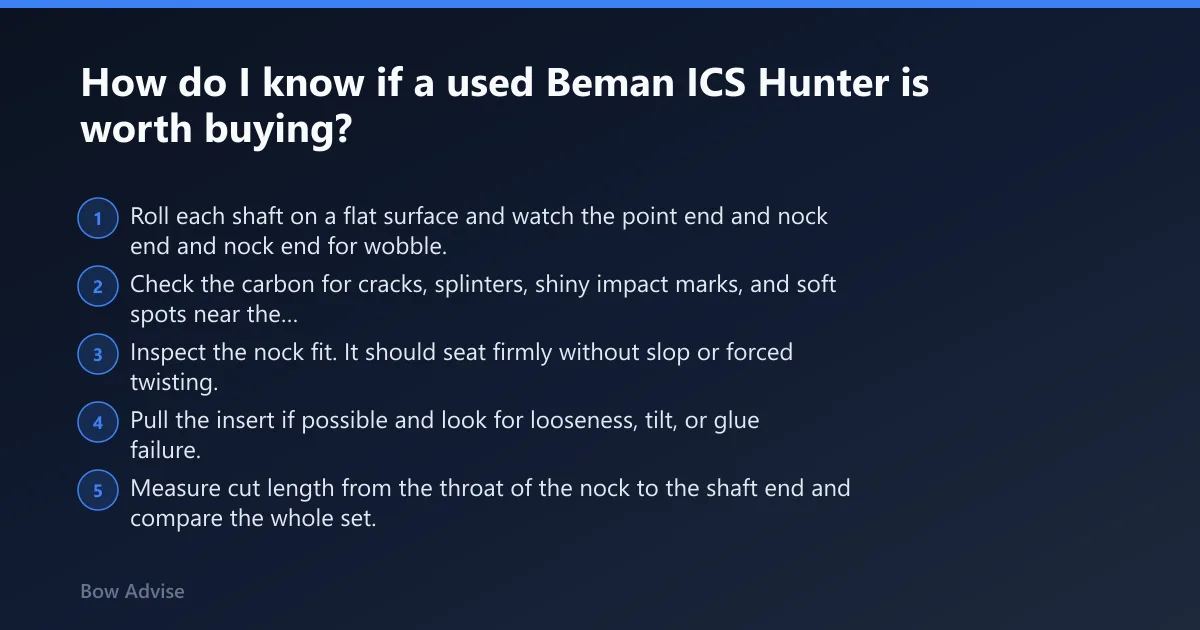
A used set is worth buying if the shafts roll straight, the nocks fit cleanly, the inserts are solid, and the cut lengths match closely. If I find wobble, crushed ends, or mixed lengths, I treat the set as a parts lot, not a hunting set. That saves money and grief.
I learned early that sloppy setup punishes you. I see the same pattern with arrows: people blame form when the shaft is wrong.
Used-shaft inspection checklist
- Roll each shaft on a flat surface and watch the point end and nock end for wobble.
- Check the carbon for cracks, splinters, shiny impact marks, and soft spots near the insert.
- Inspect the nock fit. It should seat firmly without slop or forced twisting.
- Pull the insert if possible and look for looseness, tilt, or glue failure.
- Measure cut length from the throat of the nock to the shaft end and compare the whole set.
- Sort by weight and reject any shaft that is far off the rest of the group.
- Only build the set if the arrows still look and feel consistent.
Straightness check and wobble test
Roll the shaft on a known flat surface and watch both ends. A small visual wobble is enough for me to pause. Straightness tolerance affects grouping, and with broadheads it affects how much forgiveness the setup gives when your release is not perfect.
Nock fit, insert condition, and cut-length matching
A worn nock can hide other problems because it makes the rear of the shaft feel loose. A damaged insert can throw broadheads off center. Different cut lengths in the same set change stiffness and make tuning harder, so I do not mix them for hunting.
Hands-on used-shaft decision checklist
I use a simple go or no-go method. If the set passes straightness, component fit, and length checks, it can earn a build. If a couple of arrows fail, I stop and move on. Cheap arrows are not cheap if they eat tuning time.
Decision checklist
- Go: shafts roll true, lengths match, and inserts are tight.
- Go: weight spread stays tight enough that I can sort the set by hand.
- Go: the spine suits my bow after I account for cut length and point weight.
- No-go: cracked carbon, crushed ends, or visible wobble.
- No-go: loose insert fit, sloppy nock fit, or mixed cut lengths I cannot explain.
- No-go: broadhead flight risk that would take more money to fix than the arrows are worth.
How does the Beman ICS Hunter compare with modern carbon arrows?
Modern carbon arrows usually give me better straightness control, clearer spine sorting, and more component options. The Beman ICS Hunter can still shoot well, but newer shafts often make the buy easier and the build more predictable. That matters when I want less sorting and less guesswork.
Where the older shaft still works, it wins on price if the set is clean. Where it loses, it is usually in consistency after years in circulation. A new shaft with known history can save more time than it costs.
What bow setup works best with the Beman ICS Hunter arrow?
The best fit is a compound bow or a well-tuned recurve with a sensible spine match and matched components. I would not assume crossbow use unless the exact shaft, spine, and speed rating fit that platform. Bow type changes how forgiving the arrow will be.
For a compound, the shaft can work well if paper tune and walk-back tune line up. For a recurve, I want the arrow cut and spined carefully because launch is less forgiving. For crossbows, I stay conservative and verify platform compatibility first.
Compound bow fit
On a compound, I look for clean rest clearance and broadhead stability. That usually means the right spine, a sensible point weight, and a fletching setup that steers the front of the shaft without adding drag problems.
Recurve fit
On a recurve, the arrow reacts more to release quality and bow reaction. I use longer arrow length and careful spine choice.
Crossbow limitations
I do not treat this as a casual crossbow arrow. Crossbows put different stress on shafts and components, and the exact arrow must be verified for that platform. If you are buying used, do not guess here.
What point weight should I use with the Beman ICS Hunter arrow?
Use a point weight that matches the spine and the bow’s tune, not the heaviest head you can find. For hunting, I usually start with the point weight that keeps the shaft flying clean and lets me tune fixed blades without fighting the bow. That is the real target.
Heavier points weaken dynamic spine. Lighter points stiffen it. If broadheads are my goal, I choose the weight that helps the arrow recover cleanly and still gives me the finished arrow weight I want for penetration and quiet flight.
How do I know if my Beman ICS Hunter arrows are too weak or too stiff?
Weak arrows often show broadhead tail wag, impact that drifts, and a left or right pattern that gets worse as I step back. Stiff arrows often act the opposite way and can refuse to tune cleanly even when the rest and sight look right. Paper and walk-back tests tell the story.
I also watch bare shafts. If the shaft flies poorly bare, then field points will only hide the problem. Fixed blades make weak and stiff behavior easier to see, which is why I tune with the head I plan to hunt.
Can I use the Beman ICS Hunter arrow on a compound bow?
Yes, if the spine, length, and finished weight fit the bow. That is the condition I care about. A compound bow can shoot this shaft well, but only if the rest clearance is clean and the broadhead tune is sorted before hunting season.
I would build it on a compound only after checking draw weight, draw length, cut length, and point weight together. If the bow is set too heavy or the arrow is too weak, the shaft will tell on you fast.
What should I check before buying used Beman ICS Hunter arrows?
Check straightness, nock fit, insert condition, cut length, and weight spread before money changes hands. If the arrows are not straight and matched, the savings disappear in tuning time. I want proof in hand, not a seller’s memory of how they shot years ago.
My go or no-go rule is simple: if the shaft rolls true, the component fit is solid, and the lengths match, I can tune it. If not, I pass. A used carbon arrow should save money, not create a repair project.
Frequently asked questions
What spine does the Beman ICS Hunter arrow come in?
The Beman ICS Hunter was offered in multiple spine choices, and that is the part I care about most on the used market. The right spine depends on draw weight, draw length, and cut length. I would not buy by spine label alone without checking the actual build.
Is the Beman ICS Hunter arrow good for broadheads?
It can be, but only if the shaft is straight and the tune is right. Fixed-blade heads expose weak spine, bad inserts, and poor fletching faster than field points do. I would paper tune first, then confirm with walk-back tune and the actual broadhead.