Dynamic Spine vs Static Spine: Why Arrows Tune Differently
Arrows with the same static spine can tune differently because dynamic spine changes with shaft length, point weight, insert weight, nock fit, fletching drag, and bow efficiency; the rule is simple: anything that weakens the launch makes the arrow behave weaker. Ignore that, and you can chase bad paper tears, poor groups, or a bare shaft that never matches the chart. This guide tracks the variables that move dynamic spine and gives a practical recurve and compound tuning path.
| Decision factor | Dynamic Spine | Static Spine | Winner |
|---|---|---|---|
| Predicts real shot behavior | Yes. It reflects what the arrow does when released from a specific bow. | No. It is a lab deflection number only. | Dynamic Spine |
| Best for buying the first shaft size | Useful after setup details are known. | Useful as the starting label before tuning. | Static Spine |
| Accounts for bow speed, release, and point weight | Yes. Those inputs move tune directly. | No. The label stays fixed. | Dynamic Spine |
| Works as a chart reference | Needs calculator inputs and setup details. | Gives the baseline spine class for selection. | Static Spine |
Why static spine is only a starting point
Static Spine is the lab number stamped on the shaft label. It comes from a 29-inch shaft supported 28 inches apart with a 1.94-pound, or 880-gram, center load, and the result is reported as inches of deflection times 1,000. A 400-spine shaft deflects 0.400 inches in that test.
Dynamic Spine is the arrow’s real-shot flex behavior. It changes when the shaft leaves the bow, because the bow’s energy, release method, arrow length, front weight, rear weight, and cam behavior all affect how much the shaft bends in flight.
The two are related, but they are not interchangeable. Static spine tells you what the shaft measured on a bench; dynamic spine tells you whether that same shaft behaves stiff or weak on your bow.
Why the lab label is only a starting point
Two shafts can carry the same static spine label and still land in different tune windows. That happens because the label does not know whether the shaft is cut short, tipped with a heavy point, shot from fingers, or launched by a fast cam system.
Think of Static Spine as the baseline category and Dynamic Spine as the shot result. The chart gets you close; the bow decides the rest.
Why the same label tunes differently
Arrow length changes how much the shaft can flex, point weight changes front loading, and release method changes how the shaft is kicked off the string. Rear weight matters too, but usually less than point weight. Put those together and the same spine label can land on opposite sides of tune.
Arrow length and leverage
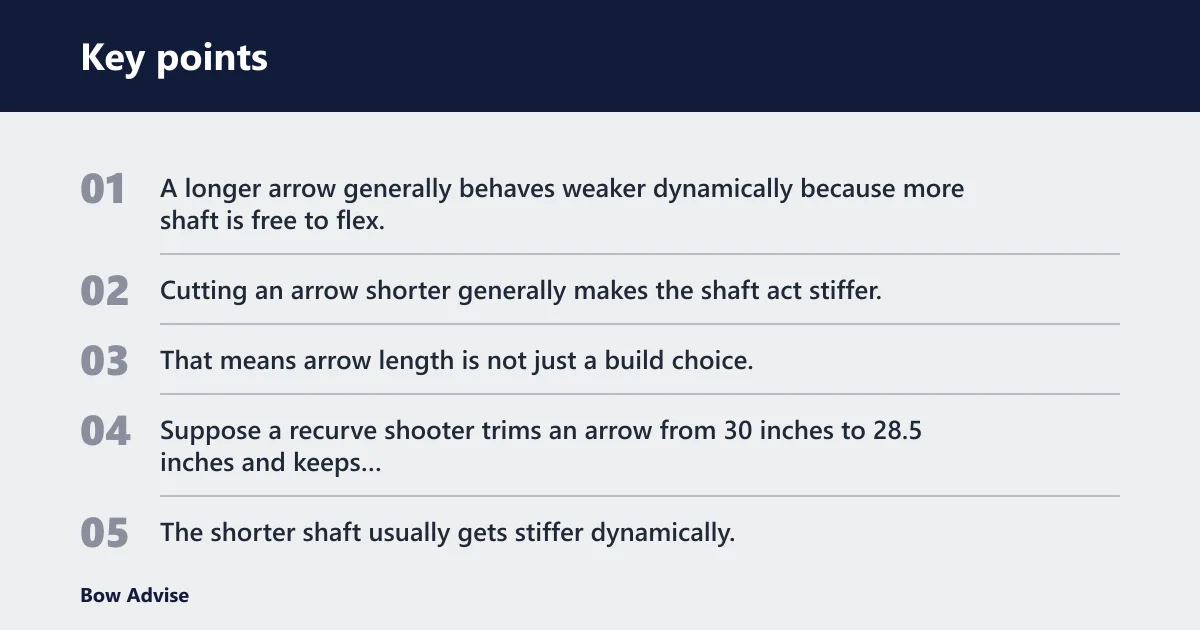
A longer arrow generally behaves weaker dynamically because more shaft is free to flex. Cutting an arrow shorter generally makes the shaft act stiffer. That means arrow length is not just a build choice; it is part of the spine decision itself.
Suppose a recurve shooter trims an arrow from 30 inches to 28.5 inches and keeps everything else the same. The shorter shaft usually gets stiffer dynamically, so a point weight that was working may start to read weak or may group right of center for a right-handed shooter.
Point weight and front loading
Point weight, measured in grains, is a major dynamic spine input because it adds load at the front of the shaft. Heavier points usually make an arrow behave weaker dynamically. Spine calculators use point weight for a reason: the front end drives much of the bend.
A common first-timer mistake is to fix a stiff tear by adding even more point weight without checking shaft length. That can work in small steps, but it can also push the setup too weak and create a different problem.
Release type and rear weight
Mechanical release and fingers are treated as different dynamic-spine inputs because they launch the shaft differently. Finger release can increase arrow paradox, so finger shooters often need a different dynamic tune than release-aid shooters.
Nock and fletching weight also matter, but they are a smaller rear-weight effect than point weight. More rear mass can shift the setup slightly stiffer or weaker depending on the full build, yet it rarely moves tune as much as point weight or a length change.
What bow factors change dynamic spine the most?
Bow speed and cam aggressiveness are often among the biggest factors affecting dynamic spine, after shaft setup details. Faster bows load the arrow harder at launch, and a more aggressive cam can make the shaft behave weaker dynamically. Easton also groups bows by IBO speed into three bands: under 330 fps, 330–360 fps, and 360+ fps.
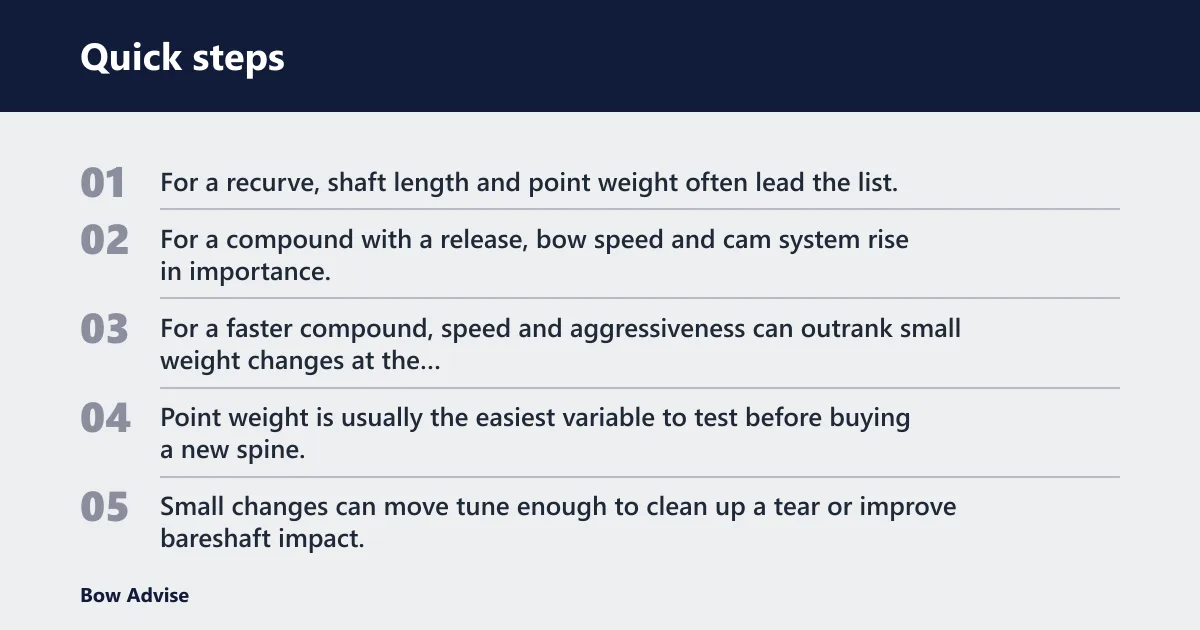
For a recurve, shaft length and point weight often lead the list. For a compound with a release, bow speed and cam system rise in importance. For a faster compound, speed and aggressiveness can outrank small weight changes at the rear of the shaft.
Point weight in grains
Point weight is usually the easiest variable to test before buying a new spine. Small changes can move tune enough to clean up a tear or improve bareshaft impact. But if the shaft is far outside the right class, point weight alone may not be enough.
Arrow length and cut length
Arrow length changes dynamic behavior because it changes the bending arm. Cut length matters even when static spine stays the same on the label. A shaft that looks correct on paper may go weak the moment it is left long for safety or broadhead clearance.
Bow speed and cam aggressiveness
Dynamic spine is affected by bow speed and cam aggressiveness. A single-wheel bow or a softer cam tends to be easier on spine than a faster, high-energy setup. More aggressive cams transfer energy faster, which can make an arrow act weaker dynamically.
Easton notes that dynamic spine depends on release method, bow energy, cam system, arrow weight, spine, length, point weight, nock weight, and fletching weight. That list matches tuning reality: the shaft does not fly in a vacuum.
Release type and finger paradox
Mechanical release and fingers are not interchangeable here. Fingers add string reaction and initial shaft bend, so finger shooters often need a different spine choice than compound release shooters even when draw weight looks similar on paper.
That is why a setup that tunes clean from a release aid may read weak or inconsistent from fingers. The string is doing different work at launch.
Same spine, different tune decision table
| Setup | Likely dynamic behavior | Common tear pattern | First adjustment to test |
|---|---|---|---|
| Recurve fingers | Usually weaker dynamically than the label suggests, especially with longer shafts and heavier points. | For a right-handed shooter: tail-left tear often points to a stiff reaction; tail-right often points to weak reaction. | Adjust point weight or brace a shorter shaft before changing spine class. |
| Compound release | Usually closer to the labeled spine, but still shifted by point weight, arrow length, and nock fit. | For a right-handed shooter: tail-left often suggests stiff; tail-right often suggests weak. | Test point weight first, then small length changes if clearance allows. |
| Faster compound | Often behaves weaker dynamically than the same label on a slower bow. | For a right-handed shooter: weak tune may show as tail-right tear and broadhead drift left at distance; stiff tune may show the opposite. | Move to a stiffer shaft class before adding more point weight. |
That table is the practical part of the decision. Recurve fingers are usually the most sensitive to release reaction. A fast compound is usually the most sensitive to bow speed and cam aggressiveness. A release-aid compound sits between them.
How do you read stiff and weak tune signs?
A dynamically stiff arrow reacts as if the shaft is too hard to bend for the setup. A dynamically weak arrow bends too much. Paper tears and bare shaft impacts tell you which direction the setup is missing, but only if you read them with the shooter’s hand, bow class, and arrow length in mind.
Paper tune tear direction clues
Paper tuning is useful because it gives an early direction check. For a right-handed shooter, a tail-left tear is often associated with a stiff reaction, while a tail-right tear is often associated with a weak reaction. Tail-high tear can also show nocking point issues or clearance problems, so do not read height alone as a spine verdict.
Paper tuning is best at telling you where to start. It is not the final word.
Bare shaft impact and drift clues
Bare shaft tuning is the better confirmation step. An unfletched shaft that lands away from the fletched group, or drifts more at distance, gives a cleaner read on dynamic behavior than a quick paper tear does. It helps separate real spine mismatch from a vane or launcher issue.
Say your compound with a release shoots a clean paper hole at 6 feet, but the bare shaft lands several inches right at 20 yards for a right-handed shooter. That is a clue that the setup is still dynamically stiff even though the paper looked acceptable.
What to change first when the arrow is too stiff or too weak
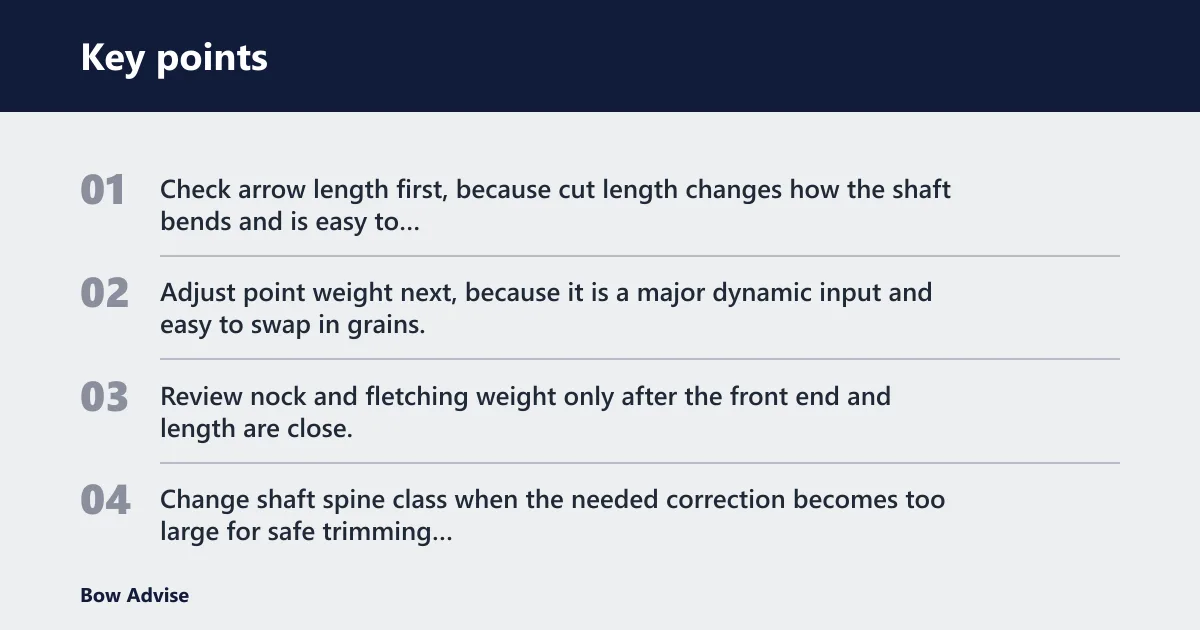
- Check arrow length first, because cut length changes how the shaft bends and is easy to verify.
- Adjust point weight next, because it is a major dynamic input and easy to swap in grains.
- Review nock and fletching weight only after the front end and length are close.
- Change shaft spine class when the needed correction becomes too large for safe trimming or point-weight changes.
If the arrow is too stiff, the first safe move is usually more front weight or a longer shaft if clearance allows. If the arrow is too weak, remove front weight, shorten the shaft if possible, or move to a stiffer shaft class.
Paper tune first or bare shaft tune?
Paper tune first if you need a quick read on the launch. Bare shaft tune second if you want to confirm whether the arrow is truly in tune at real distance. The best workflow uses paper to point the direction and bare shaft to verify the final setup.
When paper tuning is enough to start
Paper tuning is enough to identify a gross mismatch, such as a very weak shaft on a fast compound or a finger-shooting setup that needs a different spine class. It is also useful after a large change in point weight, shaft length, or cam setup.
Why bare shaft tuning confirms the final setup
Bare shaft tuning is the second-stage confirmation test because it shows what the arrow does without vane correction. That matters when the paper tune looks close but the group still drifts, or when the bow shoots clean holes yet broadheads refuse to match fletched arrows.
How to avoid chasing one tear
Do not change three things at once. A paper tear can come from center-shot, rest timing, nock height, or spine. If you keep moving everything together, you will never know which variable fixed the tune.
Choose Dynamic Spine if…
Choose Dynamic Spine if the goal is to predict how the arrow will actually behave from your bow. It is the right choice when you are deciding between point weight, shaft length, release type, and bow speed effects before buying or trimming arrows.
Choose Static Spine if the goal is to sort shafts into a starting class before tuning. It is the right choice when you need the label number to get into the right neighborhood, then refine from there with paper and bare shaft checks.
For recurve fingers, Dynamic Spine usually matters most once the shaft is close on label. For compound release setups, Static Spine helps you choose the class, then Dynamic Spine decides the final point weight and trim. For faster compounds, Dynamic Spine is the stronger guide because speed and cam aggressiveness can move tune enough to make a labeled match behave wrong.


Frequently asked questions
What is the difference between dynamic spine and static spine?
Static Spine is the lab-measured deflection rating taken from a 29-inch shaft supported 28 inches apart with a 1.94-pound center load. Dynamic Spine is the real-shot flex behavior. One is a label; the other is what the bow actually makes the arrow do.
Why can two arrows with the same spine label tune differently?
Because the label does not include shaft length, point weight, release type, nock and fletching weight, or bow speed. A shorter shaft, heavier point, or faster cam can move the setup toward weaker dynamic behavior even when both arrows carry the same static rating.
How do release type and cam aggressiveness affect arrow flex?
Mechanical release and fingers create different launch reactions, so they do not tune the same way. Fingers increase arrow paradox. Aggressive cams transfer energy harder and faster, which can make the arrow flex more and act weaker dynamically than the same shaft on a softer setup.
Does heavier point weight make an arrow weaker or stiffer dynamically?
Heavier point weight usually makes an arrow behave weaker dynamically. It adds front loading and increases the bend on the shaft. That is why point weight is one of the first variables used in spine calculators and in real tuning changes.
Can nock and fletching weight really change spine?
Yes, but the effect is smaller than point weight and shaft length. Extra rear weight can shift tune slightly stiffer or weaker depending on the full setup. Treat it as a fine adjustment, not the first fix for a large mismatch.
What should I test first: paper tune or bare shaft tune?
Start with paper tuning if you need a quick diagnostic on launch direction. Follow with bare shaft tuning to confirm the final setup at distance. Paper tells you where to look; bare shaft tells you whether the setup actually holds up.