How to Compare Arrow Performance for Indoor vs Outdoor Shooting
Compare arrow performance indoors and outdoors by changing one variable at a time, then score group size, sight marks, and point of impact at the same bow weight. The cleanest rule is simple: if a setup groups tighter indoors and gives up little speed or stability outdoors, it can do both. Bad comparisons push you toward the wrong spine, extra drag, weak wind control, and wasted money. This guide gives a repeatable way to compare arrow mass, diameter, tune, distance, and weather effects.
| Decision factor | How to Compare Arrow Performance for Indoor | Outdoor Shooting | Winner |
|---|---|---|---|
| Best test control | Cleaner because wind and glare are easier to limit | Harder because wind and light shift more often | How to Compare Arrow Performance for Indoor |
| Distance realism | Good for seeing setup consistency at a fixed line | Better for seeing whether the arrow holds up across distance | Outdoor Shooting |
| Spine and drag clues | Shows tune issues, but some errors stay hidden at short range | Shows dynamic spine, drag, and wind sensitivity more clearly | Outdoor Shooting |
| Ease of repeatability | High, if target face and lighting stay the same | Lower, because conditions change more from end to end | How to Compare Arrow Performance for Indoor |
| Best use case | Setting a baseline for group shape, tune, and sight marks | Checking which setup survives real distance and drift | Tie |
What changes between indoor and outdoor arrow performance?
Indoor shooting strips away weather so you can see the bow and arrow more clearly. Outdoor shooting adds distance, wind, and shifting light, so the arrow shows how it really flies after launch. A shaft that looks perfect at short range can still drop more, open up, or drift once the line gets longer.
Speed, trajectory, and sight marks
Arrow speed matters in both settings, but outdoors the sight mark tells more of the story. A faster setup may need less elevation and keep a flatter arc at one distance, yet that does not mean better groups if the shaft is out of tune or too wind-sensitive. Read sight marks with group data, not on their own.
Why group shape changes with distance
At short range, a release mistake can hide inside a tight cluster. As distance grows, that same mistake opens the vertical or horizontal spread more clearly. Close range helps with basic tune checks. Longer outdoor distances tell you whether the arrow stays stable in flight.
Which variables matter most before you tune?
Before changing anything, lock the bow setup down. Arrow mass, shaft diameter, spine, point weight, draw weight, release style, and shaft length all change the result. If those shift between sessions, the comparison stops being indoor versus outdoor performance and turns into a mix of different setups.
| Field | Indoor result | Outdoor result |
|---|---|---|
| Bow model and draw weight | ||
| Release style | ||
| Shaft length | ||
| Point weight | ||
| Arrow count per end | ||
| Average group size | ||
| Vertical spread | ||
| Horizontal spread | ||
| Center offset | ||
| Sight mark change | ||
| Fletching contact or tune issue |
How should you set up a fair test?
A fair test keeps the bow setup the same and changes only the setting. Use the same bow weight, the same arrow count, the same shaft length, the same point weight, and the same release style for both environments. Shoot enough arrows in each session to show a pattern, not one lucky end.
Keep bow setup identical
The first rule is direct: do not adjust draw weight, brace height, rest position, or center shot between indoor and outdoor sessions unless the test is about tuning. If those settings move, the result no longer tells you which environment fits the arrow better.
Match arrow count, ends, and rest conditions
Use multiple 6-arrow ends in both settings. A practical minimum is four 6-arrow ends per setup, which gives about 24 arrows for each condition and usually enough data to smooth out one bad release. Use the same rest period between ends so fatigue does not skew the comparison.
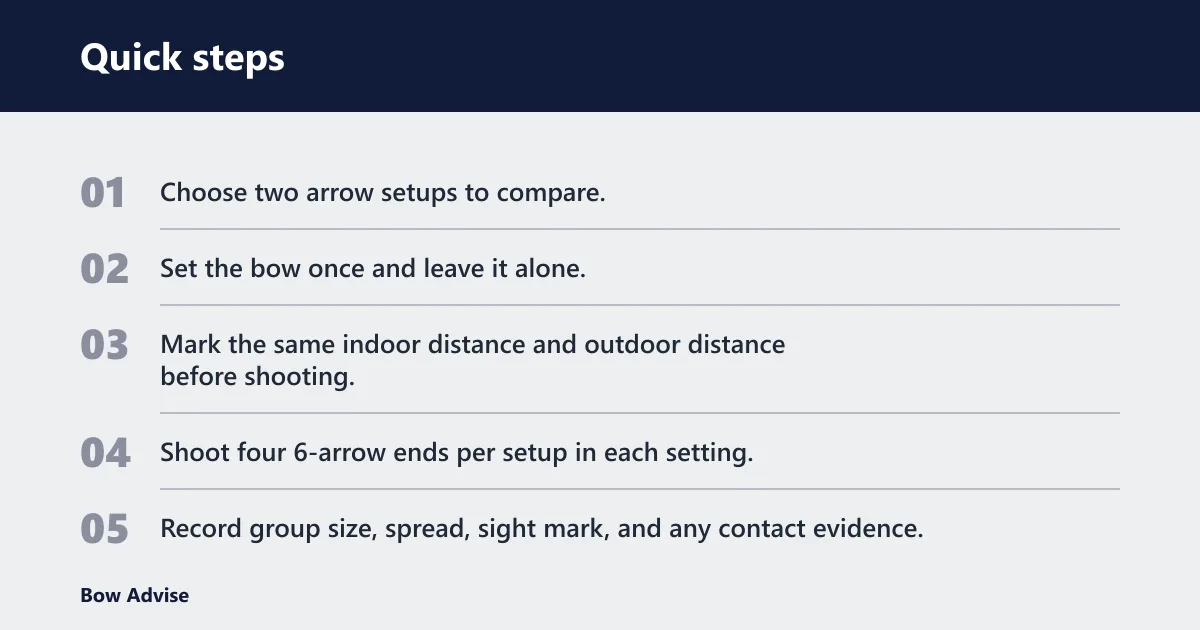
- Choose two arrow setups to compare.
- Set the bow once and leave it alone.
- Mark the same indoor distance and outdoor distance before shooting.
- Shoot four 6-arrow ends per setup in each setting.
- Record group size, spread, sight mark, and any contact evidence.
- Compare the averages, not the best end.
Control for wind, light, and target size
Outdoor wind changes drift, especially with wider shafts or slower arrows. If the wind shifts, pause and note it instead of mixing those shots into the clean set. Use a target face large enough to call the shot cleanly, and keep indoor light steady so aim wobble is not mistaken for arrow change.
Say your indoor test is calm, but the outdoor line has a left-to-right breeze. If the arrow groups open horizontally outdoors, do not blame the shaft alone. Repeat the line on a calmer day or note the wind direction and strength before calling the result.
Which distances should you use indoors and outdoors?
Use one indoor distance and one outdoor distance that are both practical and easy to repeat. The indoor line should be long enough to show group shape clearly, and the outdoor line should be long enough to reveal drift and spine behavior. A common matched pair is about 18 meters indoors and about 30 meters outdoors.
A practical indoor distance
Choose 18 meters indoors if the range allows it. That distance is common, easy to repeat, and long enough to show whether the setup is grouping cleanly without making the test hinge on tiny aiming errors. If the range only allows 20 yards, keep that distance fixed and use it every time.
A matching outdoor distance
Choose 30 meters outdoors as the main comparison distance. It is far enough to expose more flight behavior than a short point-blank test, but still short enough that a reasonable archer can keep data readable. If the setup is for field or hunting use, add a second outdoor line later, such as 50 meters, to check whether the pattern holds.
When to add a second distance
Add a second distance only after the main comparison is finished. The second line helps when two setups look similar at 30 meters but differ in sight mark, vertical stringing, or wind drift. That extra line should not replace the main test; it should confirm whether the result survives more distance.
What should you measure in each session?
Record more than one result from every end. Group size alone can hide a tilted cluster, and sight marks alone can hide weak grouping. The most useful comparison records average group size, vertical spread, horizontal spread, center offset, sight mark change, and any evidence of fletching contact or tune trouble.
Average group size and spread
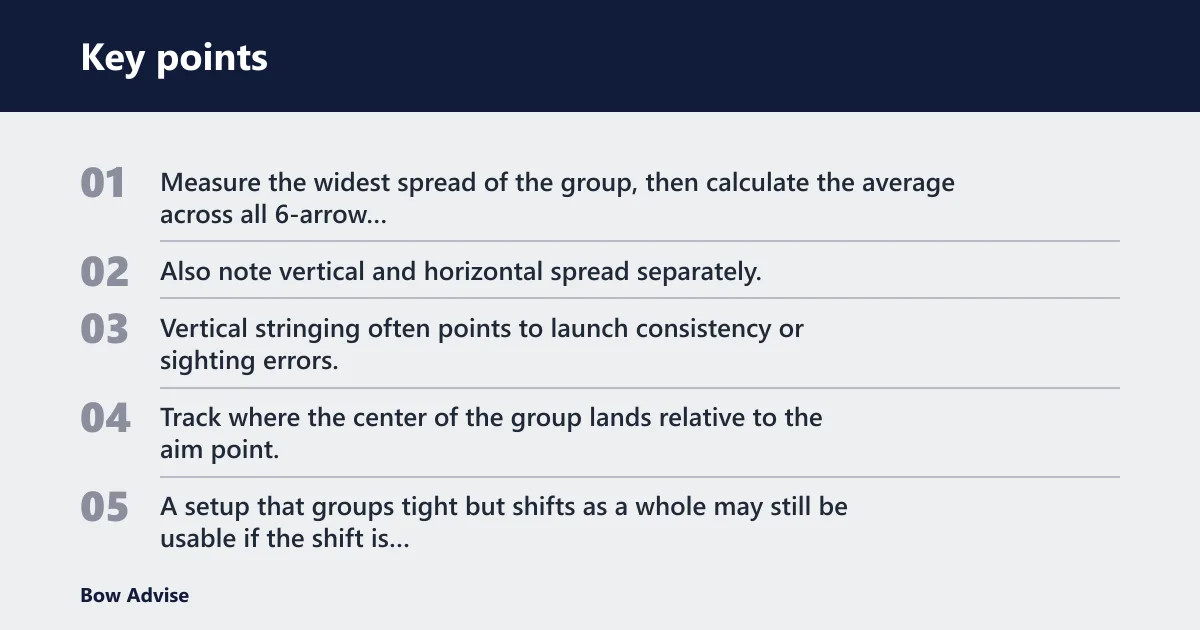
Measure the widest spread of the group, then calculate the average across all 6-arrow ends. Also note vertical and horizontal spread separately. Vertical stringing often points to launch consistency or sighting errors, while horizontal spread can point to wind, torque, or spine mismatch.
Vertical and horizontal impact pattern
Track where the center of the group lands relative to the aim point. A setup that groups tight but shifts as a whole may still be usable if the shift is stable and repeatable. A setup that throws arrows high one end and low the next end is less trustworthy, even if one group looks small.
Signs of tune change or fletching contact
Watch for odd tail marks, vane contact, paper tears where they are part of the bow setup, and broad changes in horizontal spread after a small distance increase. For compound bows, these clues can point to rest timing, nock height, or center shot issues. For recurves, they more often point to spine mismatch or release variation.
Suppose two shaft types both land in the same center spot at 18 meters indoors. If one setup opens more at 30 meters outdoors and also shows more left-right spread, that is a sign to inspect spine, diameter, or wind sensitivity rather than calling the indoor result final.
| Example comparison worksheet | Setup A | Setup B |
|---|---|---|
| Shaft type | Carbon shaft, 5 mm diameter | Carbon shaft, 6 mm diameter |
| Point weight | 100 grains | 100 grains |
| Indoor distance | 18 meters | 18 meters |
| Outdoor distance | 30 meters | 30 meters |
| Ends shot | 4 ends of 6 arrows | 4 ends of 6 arrows |
| Average group size indoors | 11.2 cm | 12.0 cm |
| Average group size outdoors | 17.8 cm | 15.9 cm |
| Horizontal spread outdoors | 11.5 cm | 8.4 cm |
| Center offset outdoors | 3 cm right | 1 cm right |
| Sight mark change | 2 clicks lower outdoors | 1 click lower outdoors |
| Contact or tune issue | No clear contact | Minor nock mark on vane |
How do you read the results without guessing?
Read the result by pattern, not by one arrow. If a setup groups tighter indoors, keeps a similar sight mark outdoors, and does not widen much with distance, it is the stronger all-around choice. If a setup only looks good at one distance and falls apart when the line changes, it needs tuning or replacement.
When one setup is clearly better indoors
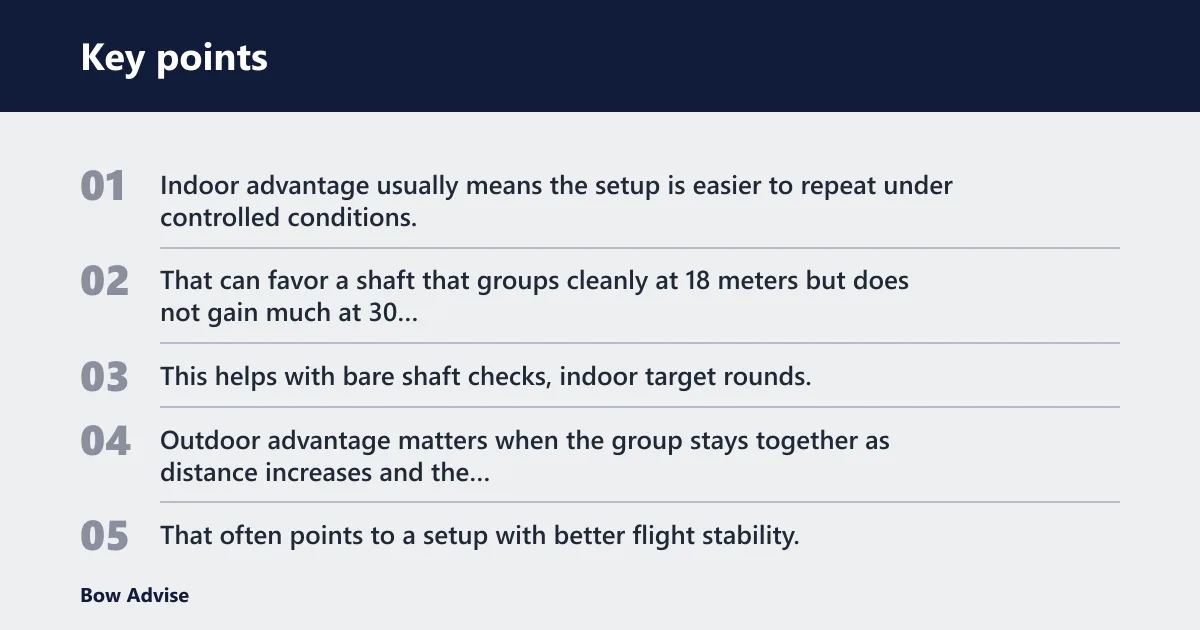
Indoor advantage usually means the setup is easier to repeat under controlled conditions. That can favor a shaft that groups cleanly at 18 meters but does not gain much at 30 meters. This helps with bare shaft checks, indoor target rounds, and any setup where clean group shape matters more than raw distance stability.
When another setup holds up better outdoors
Outdoor advantage matters when the group stays together as distance increases and the sight mark remains manageable. That often points to a setup with better flight stability, lower sensitivity to release error, or less drift in the wind. It does not always mean the arrow is better in every sense; it means it holds value farther downrange.
When the difference points to tuning rather than arrow choice
If indoor groups are decent but outdoor groups open sharply, the issue may be spine, point weight, nock fit, or rest tune rather than the basic arrow model. Recurve shooters often read this with bare shaft and group pattern evidence. Compound shooters usually get more value from paper tune plus group pattern, because the bow’s rest and timing can change the result fast.
A common first-time mistake is to pick the arrow that felt best on one end. A better method is to compare the averages from four 6-arrow ends at 18 meters and 30 meters, then ask which setup kept its group shape, sight mark, and center offset the most steady.
Choose How to Compare Arrow Performance for indoor if…
Choose How to Compare Arrow Performance for Indoor if the goal is to cut weather noise and judge whether a setup groups cleanly under controlled conditions. It is the better pick for a baseline, for tune checks, and for repeatable indoor scoring when the line conditions stay steady.
Choose outdoor Shooting if…
Choose Outdoor Shooting if the goal is to see how the arrow behaves at real distance, under wind and changing light. It is the better pick when the main question is drift, flight stability, and whether the setup still groups well after the arrow has traveled far enough for flaws to show.


Frequently asked questions
How many arrows are enough for a useful comparison?
Use at least four 6-arrow ends per setup in each setting. That gives about 24 arrows indoors and about 24 outdoors for each arrow build, which is usually enough to see a pattern instead of trusting one good end. Fewer arrows can still mislead if one release is poor or one gust moves the group.
Should group size or sight mark matter more?
Group size should come first because it shows repeatability. Sight mark matters next because it shows how much elevation the setup needs at a given distance. A setup that groups well but demands a very different sight picture outdoors may still be usable, but it needs closer review before you call it the better arrow.
Can the same test work for recurve and compound bows?
Yes, but the reading changes a little. Recurve shooters usually get more from bare shaft behavior and group pattern at distance. Compound shooters usually get more from group pattern, sight mark, and any sign of rest contact or timing issues. Paper tune is useful for compound setups, but it should not replace outdoor group data.
Why not compare at very short range only?
Very short range can hide dynamic spine problems, drag effects, and some wind sensitivity. It is good for checking obvious tune faults, but it does not tell the full story. A comparison that stops too close to the line may favor an arrow that looks tidy indoors and falls apart outdoors.
What if one setup is better indoors and another is better outdoors?
That usually means the arrows are solving different problems. The indoor winner may be easier to group, while the outdoor winner may carry better through distance and wind. Choose based on the main use case. If both matter, tune the stronger outdoor setup until its indoor group shape closes the gap.
Do heavier arrows always drift less?
No. Drift depends on mass, diameter, drag, speed, and how far the arrow travels, not on weight alone. A heavier shaft may resist wind better in one setup, while a slimmer or faster shaft may drift less in another. Compare the full result instead of treating weight as the whole answer.