Why Your Broadheads Hit Differently Than Field Points
Broadheads hit differently when arrow spine, bow tune, or point weight is off; match broadheads and field points at 20 yards first, then change one variable at a time until the groups come together. Guessing sends you toward the wrong fix and can leave the bow louder, less forgiving, or weaker at distance. This guide shows how to read the impact pattern and correct the right cause with the fewest changes.
Quick answer
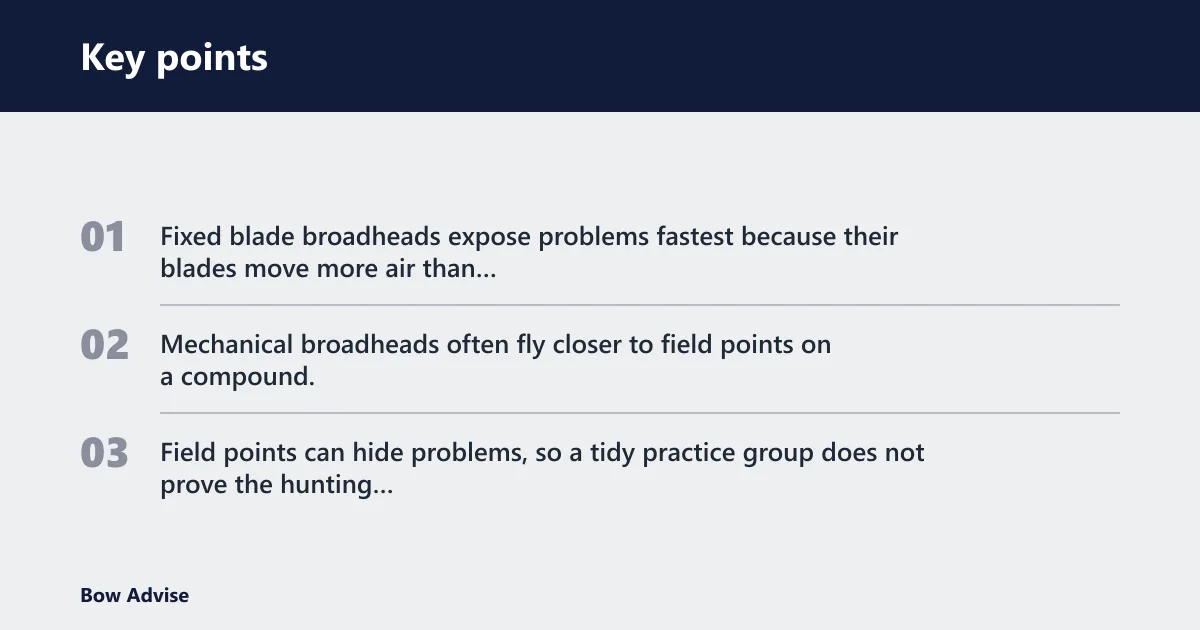
Fixed blade broadheads expose problems fastest because their blades move more air than field points and can plane when the setup is off. Mechanical broadheads often fly closer to field points on a compound, but they still need enough speed and a clean launch. Field points can hide problems, so a tidy practice group does not prove the hunting setup is ready.
What you’ll need
- Field points matched to the hunting-head weight
- A broadhead wrench and at least one spare head
- A target backstop with clear lanes at about 20, 40, and 60 yards
- Paper tuning material placed about 6 feet from the bow
- A bare shaft and matching fletched shafts
- Arrow marker or tape for shaft identification
- Notebook for distance, group direction, and adjustment notes
- Hex keys and the bow’s owner manual for rest or limb adjustments
Broadhead impact matrix
This table helps separate the likely cause from the next move. Read the pattern before touching the sight. A left or right miss at one distance means something different than the same miss that grows or shrinks with distance.
| Impact pattern | Most likely cause | Next adjustment |
|---|---|---|
| Left at 20, farther left at 40 and 60 | Weak spine, rest too far out, or broadhead steering hard | Verify point weight, then move to centershot and spine checks |
| Right at 20, farther right at 40 and 60 | Too stiff spine, over-rested launch, or release timing issue | Match spine to point weight and confirm center-shot setup |
| Low at 20, still low at 40 and 60 | Nock travel, rest contact, or cam timing on a compound | Paper tune at about 6 feet and inspect vane marks |
| High at 20, then more separated at distance | Launch angle error or inconsistent release | Check nocking point, center-shot, and bare shaft behavior |
| Random left/right with one arrow drifting more | Broadhead wobble, bent insert, or damaged shaft | Spin test the head and inspect the arrow components |
| Field points group, broadheads scatter | Clearance problem, vane contact, or broadhead planing | Inspect vane marks and recheck bow tune before sighting |
Why do my broadheads hit left or right?
Left or right impact usually points to a launch problem, not a sight problem. If the miss grows with distance, spine, clearance, or broadhead steering is more likely than a simple sight offset. Check the head for wobble first, then read whether the miss behaves the same at 20, 40, and 60 yards.
Check broadhead spin before changing the bow
- Remove the arrow and roll the broadhead on a bench-mount spin tester.
- Watch the tip and ferrule, not the shaft. Any visible wobble means the head or insert is off.
- Replace the head or correct insert runout before touching the rest.
Say your three-arrow group with field points is tight at 20 yards, but one fixed blade lands 4 inches left and 3 inches low. A wobble-free spin test rules out a bent head, so the next check is spine and center-shot, not the sight pins.
Read the left-right pattern by distance
- Shoot field points and broadheads at 20 yards from the same anchor and release.
- Repeat at 40 yards, then 60 yards.
- Note whether the gap widens or shrinks as distance increases.
Fixed blade heads can steer more as distance grows because their blades make more drag than field points. If the arrow starts left at 20 and ends farther left at 60, that pattern usually fits a weak spine or poor clearance. If the miss is random, return to wobble and vane contact.
How do you correct spine and weight?
Arrow spine matters more for broadheads because dynamic spine changes when point weight changes, even if the shaft stays the same. A 100-grain field point and a 125-grain broadhead can fly differently at the same draw weight. Match hunting-head and practice-head weight first, then judge spine.
Verify arrow spine against draw length and draw weight
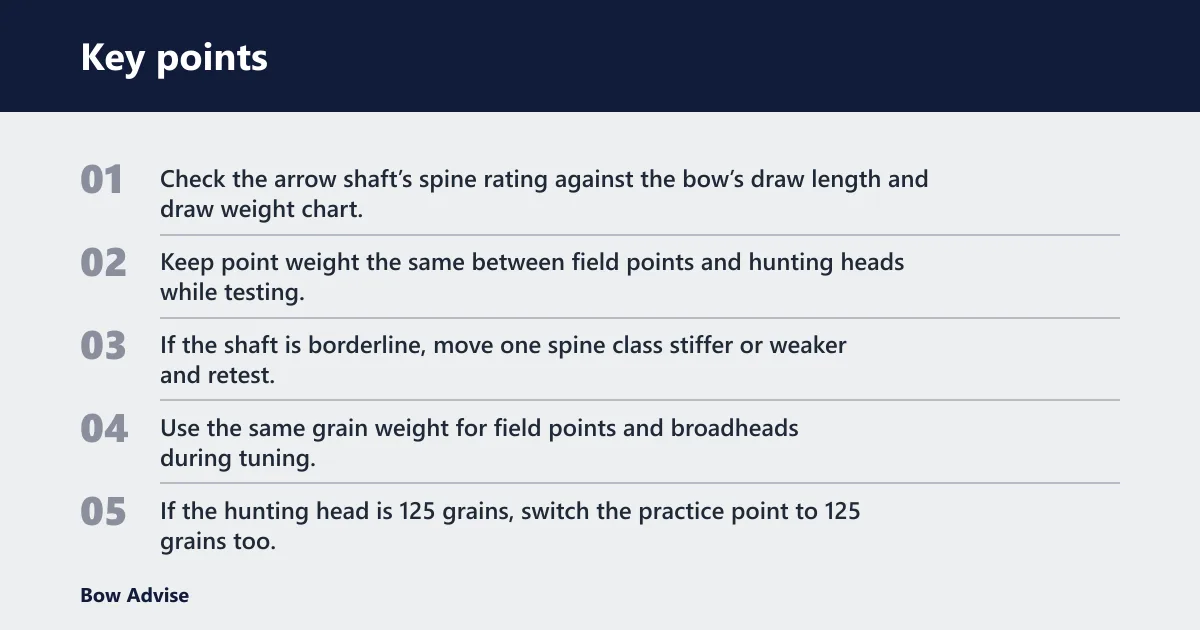
- Check the arrow shaft’s spine rating against the bow’s draw length and draw weight chart.
- Keep point weight the same between field points and hunting heads while testing.
- If the shaft is borderline, move one spine class stiffer or weaker and retest.
Keep point weight matched between practice and hunting heads
- Use the same grain weight for field points and broadheads during tuning.
- If the hunting head is 125 grains, switch the practice point to 125 grains too.
- Retest at 20 yards before moving back.
For example, a compound bow may shoot a 100-grain field point dead center, while a 125-grain fixed blade lands about 3 inches right at 20 yards and about 7 inches right at 60 yards. That extra point weight changes dynamic spine, so the cleanest fix is to match weights before adjusting the rest or sight.
Make one weight change at a time
- Change only the point weight, not the shaft, rest, or sight.
- Reshoot 20 yards after every weight change.
- If the gap closes, repeat at 40 and 60 yards before calling it tuned.
How do you fix nock travel and clearance?
Paper tuning and bare shaft tuning are the clearest way to find nock travel and clearance issues. Paper tuning is a close-range check for arrow flight, while bare shaft tuning shows how the bow launches an arrow compared with a fletched shaft. On a compound, that order matters.
Paper tune for a close-range bullet hole
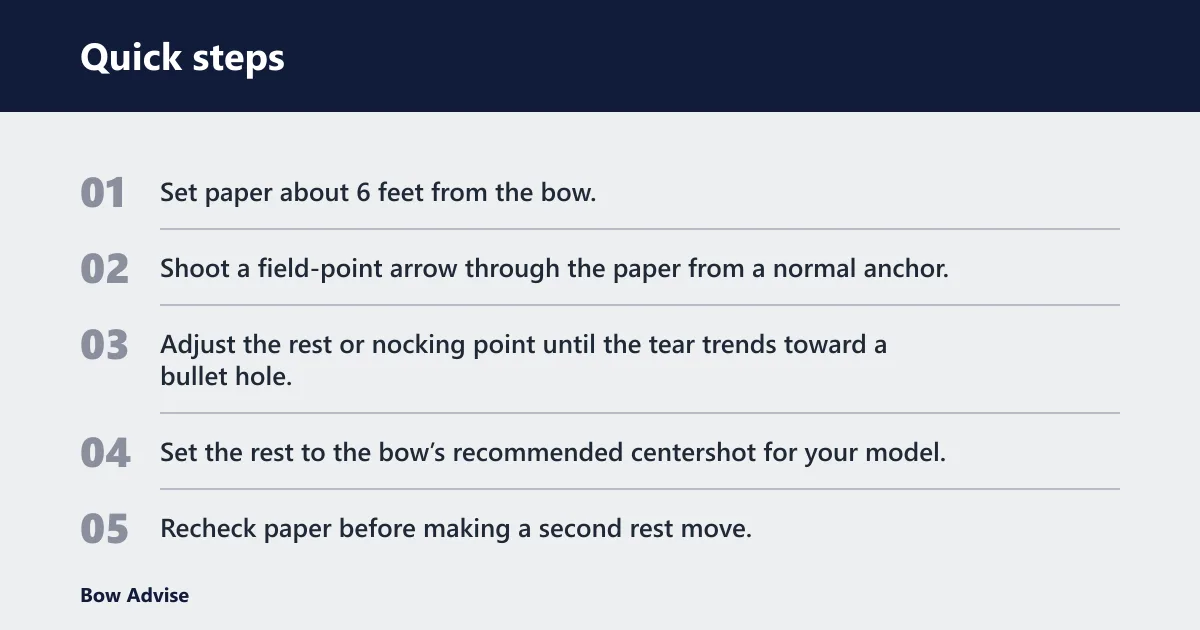
- Set paper about 6 feet from the bow.
- Shoot a field-point arrow through the paper from a normal anchor.
- Adjust the rest or nocking point until the tear trends toward a bullet hole.
Check centershot before moving the rest again
- Set the rest to the bow’s recommended centershot for your model.
- Recheck paper before making a second rest move.
- Only change one direction at a time so the arrow path stays readable.
Use vane contact marks to find clearance problems
- Inspect vanes, rest, riser, and arrow shaft for black marks or cuts.
- Look at the same arrow after several shots.
- Raise vane height if needed; a 0.5 inch vane or taller can help fixed blades, while a 0.4 inch vane may not provide enough steering in some setups.
Paper tuning can look fine while broadheads still strike off line if vanes are brushing the rest or cables. Bare shaft tuning around 30 yards helps confirm the launch. The article suggests checking bare shaft and fletched shaft impact at around 30 yards and aiming for them to land within a couple of inches of each other.
Confirm cam timing on compound bows
- Check both cams for synchronized stop or draw length timing.
- If one cam reaches the stop early, correct timing before broadhead sight work.
- Retest paper after any timing change.
A common first-timer mistake is moving the sight to hide a right miss on a compound when the real issue is cam timing. That only shifts the symptom. Fix timing first, then recheck broadheads at 20 yards and work back to 60 yards.
Compound and recurve correction paths
Compound and recurve bows can show the same broadhead miss for different reasons. A compound gives more room to tune rest position, centershot, cam timing, and vane clearance. A recurve usually offers fewer moving parts, so spine match, nocking point, brace height, and clean release matter more.
Compound bow path
- Spin test the broadhead.
- Paper tune at about 6 feet.
- Set centershot before any sight change.
- Check cam timing and vane clearance.
- Verify broadhead impact at 20, 40, and 60 yards.
Recurve bow path
- Spin test the broadhead and inspect the shaft.
- Match spine to draw length, draw weight, and point weight.
- Check nocking point height and brace height before changing anything else.
- Use bare shaft tuning around 30 yards to compare launch behavior.
For a recurve, spine match, nocking point, brace height, and a clean release carry more weight than rest or cam work. Bare shaft tuning around 30 yards helps confirm whether the launch is clean. Fixed blade broadheads are common hunting heads because they are simple and durable, but they ask more from the bow. Mechanical broadheads deploy on impact and usually fly closer to field points than fixed blades, which is why many compound hunters start there. Even then, they still need adequate arrow speed and good arrow flight.
Common mistakes
Most broadhead problems get worse when too many variables change at once. The fastest path is to diagnose the pattern, then adjust only the most likely cause. Sight pins belong near the end of the process, not at the start.
- Changing the sight before checking spine, wobble, and clearance
- Moving the rest repeatedly without rechecking centershot
- Ignoring a bent head, bent insert, or damaged shaft
- Using a 0.4 inch vane and expecting it to fix severe fixed blade drift
- Assuming field points prove the setup is ready
- Using broadhead flight to cover up a poor release or rushed form
If that didn’t work, try this next
- Return to matched point weight and reshoot at 20 yards.
- Swap to one new broadhead and retest for wobble.
- Move the rest or nocking point only after paper and bare shaft checks disagree.
- For compound bows, verify cam timing again before touching the sight tape.
Prevention is simple: every time point weight changes, retune the bow before sighting in. That keeps the setup from drifting into a false zero and makes future broadhead checks faster.
Frequently asked questions
Why do my broadheads hit left of my field points?
Left impact usually means weak spine, rest position error, or broadhead planing. Check the head for wobble first, then compare field points and broadheads at 20 yards. If the gap grows at 40 and 60, fix the launch, not the sight. Field points can hide the problem.
Why do broadheads and field points hit differently at 20 yards but not 40?
That pattern often means the broadhead is steering early or the bow setup is not consistent. Check vane contact, spine, and centershot. A clean paper tear at about 6 feet and a bare shaft close to the fletched group at 30 yards help confirm whether the bow or the head is driving the difference.
How do I tune a bow so broadheads and field points group together?
Start with a spin test, then paper tune at about 6 feet, then verify at 20, 40, and 60 yards. Keep point weight matched, set centershot, and only change one variable at a time. On a compound, confirm cam timing before moving the sight or making rest changes.
Does arrow spine affect broadhead flight more than field points?
Yes. Broadheads show spine errors faster because the blades amplify any launch mismatch. Dynamic spine changes with point weight, so a 100-grain field point and a 125-grain broadhead can behave differently at the same draw weight. If the shaft is wrong, field points may still look acceptable.
How do I tell if my broadheads are wobbling or out of tune?
Roll the broadhead on a bench-mount spin tester. If the tip traces a circle, the head or insert is off. If the spin is true but the arrow still drifts, look at spine, clearance, and cam timing instead. Bent vanes can also show the arrow is brushing something.
Should I use paper tuning or bare shaft tuning before broadhead tuning?
Use paper tuning first on a compound because it gives a close-range bullet-hole check. Then use bare shaft tuning around 30 yards to compare launch behavior. If both checks are close, broadhead tuning becomes much simpler and sight changes stay minimal.
Do mechanical broadheads fly closer to field points than fixed blades?
Usually, yes. Mechanical broadheads deploy on impact, so they often steer less in flight than exposed fixed blades. That said, they still need enough speed and a clean launch. A compound with poor spine or poor clearance can still make a mechanical head miss enough to matter.
What vane size helps fixed blade broadheads fly better?
A taller vane can help steer fixed blades. A 0.5 inch vane or taller may help in some setups, but vane size alone does not guarantee broadhead stability. If you see contact marks, fix clearance first; vane size cannot cure a brush problem.
How much difference between field points and broadheads is acceptable?
There is no single universal benchmark. If the gap is larger, especially if it grows with distance, keep tuning before trusting the setup in the field.
What should I check first when broadheads won’t group with field points?
Check broadhead wobble first, then spine, then clearance, then centershot and cam timing. That order keeps you from blaming the sight for a launch problem. If the bow is a recurve, move the focus to spine, nocking point, brace height, and release consistency before anything else.