Tuning Arrows for Recurve Bows vs Compound Bows Guide
I tune the same arrow differently on recurve and compound bows because the launch changes, not the shaft. Recurves usually ask for a stiffer shaft reaction, while compounds often give me more room, but the bare shaft makes the final call. Bad tune shrinks groups, ruins broadhead flight, and kills confidence fast. I wrote this guide to show how the same arrow behaves in each bow, then how I separate spine trouble from clearance trouble and my own form mistakes.
| Decision factor | Tuning arrows for recurve bows | Compound bows | Winner |
|---|---|---|---|
| Primary tuning method | Bare-shaft tuning and group comparison | Paper tune and walk-back verification | tie |
| Early setup sensitivity | Nocking point, brace height, tiller, and plunger matter early | Center-shot, cam system, rest, peep, and cable clearance matter early | tie |
| Arrow forgiveness range | Narrower window for weak or stiff reaction | Usually a broader usable window | compound bows |
| Best match for one-arrow households | Works if the shaft is selected around the recurve first | Works if the shaft length and point weight suit the bow | tie |
| Common failure clue | Vertical spread, fishtailing, and poor bare-shaft match | Paper tears, weak left/right reaction, and clearance marks | tie |
What changes between recurve and compound arrow tuning?
The same arrow can fly right on one bow and wrong on the other because the bow sends it off the string in a different way. Recurves depend on the shaft bending cleanly around the riser, while compounds add cams, a rest, and moving parts that can hide or create problems. The shaft may be the same; the test is different.
How the same arrow reacts differently on each bow type
A recurve shows arrow behavior plainly. If the shaft is wrong, the bare shaft usually exposes it. A compound can hide some mismatch longer, but paper tears, rest contact, and distance checks still call it out.
EK Archery says its arrows work with recurve bows, longbows, and compound bows. That is a fit claim, not proof that one shaft tunes the same way on every bow.
Why the test method changes with the bow
On a recurve, I watch launch behavior and the arrow’s bend around the bow window first. On a compound, I look at center-shot, rest timing, and whether the shaft clears the rest and cables. Different launch systems need different checks.
What stays the same across both setups
Arrow spine still comes first. So do arrow length, point weight, and my release. Bad form can copy bad tune on either bow, and I have watched that happen many times at my club.
How do I pick the right arrow spine, length, and point weight?
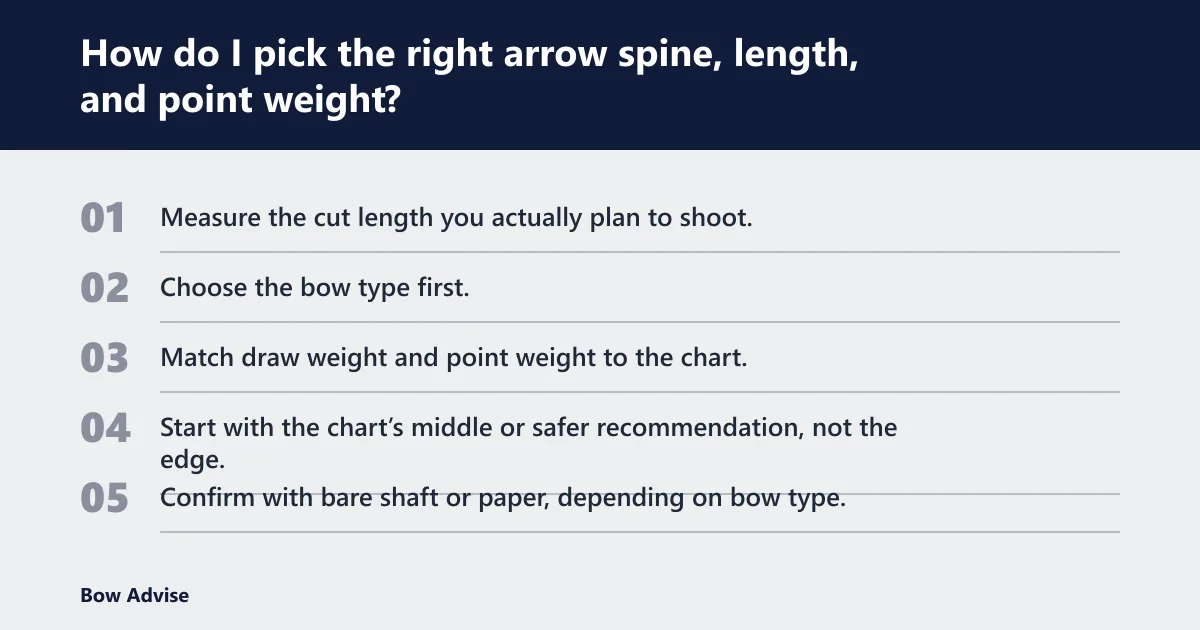
Start with static spine, then adjust for dynamic spine once I know the real cut length and point weight. Static spine is the shaft’s measured stiffness on paper. Dynamic spine is how stiff that shaft acts once I add point weight, length, string speed, and the bow’s launch style.
Static spine vs dynamic spine
Static spine comes from the shaft itself. Dynamic spine shifts when I add a heavier point, leave the shaft longer, or shoot a faster setup. That is why the same shaft can feel weak on one bow and fine on another.
Manufacturer selection charts matter here. I use them before I start guessing, then I confirm with a real tuning test. EK Archery positions its arrows for beginners, training sessions, and casual shooting, and that is the kind of use case where chart selection saves time.
How cut length changes stiffness and safety
Longer arrow length usually makes the arrow act weaker dynamically. Shorter cut length usually makes the arrow act stiffer and can also affect safety margins. I do not trim arrows until I know the bow, the draw length, and the point weight I plan to keep.
How point weight shifts front-of-center and tune response
More point weight shifts mass forward and often makes the arrow act weaker in flight. Less point weight can make the shaft act stiffer. Front-of-center changes how the arrow recovers after release, so a point swap can fix or create a tune problem fast.
How to use a manufacturer selection chart without guessing
- Measure the cut length you actually plan to shoot.
- Choose the bow type first.
- Match draw weight and point weight to the chart.
- Start with the chart’s middle or safer recommendation, not the edge.
- Confirm with bare shaft or paper, depending on bow type.
Recurve tuning: what I check first
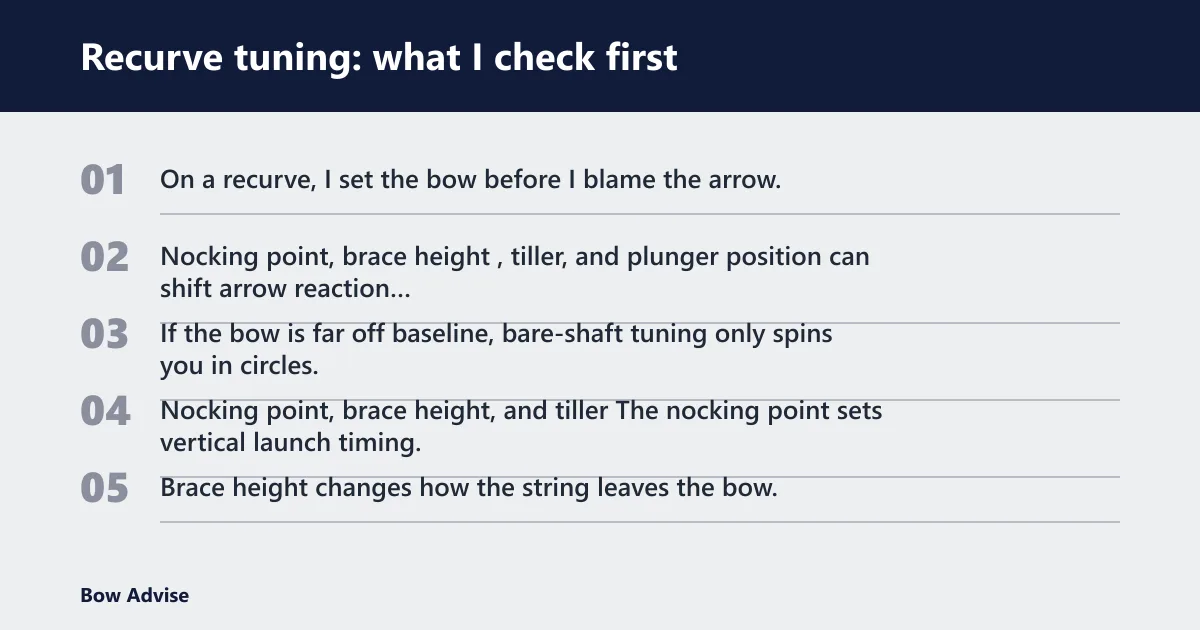
On a recurve, I set the bow before I blame the arrow. Nocking point, brace height, tiller, and plunger position can shift arrow reaction enough to send a new shooter down the wrong path. If the bow is far off baseline, bare-shaft tuning only spins you in circles.
Nocking point, brace height, and tiller
The nocking point sets vertical launch timing. Brace height changes how the string leaves the bow. Tiller affects limb balance, and on an Olympic-style riser, the plunger gives another layer of side-to-side control.
I tune those first because they change the arrow before I touch the shaft. If the bow is badly out of tune, the arrows only carry the blame.
Bare-shaft tuning and what vertical impact tells you
My recurve test starts with a bare-shaft shot beside fletched arrows at close distance. Vertical impact gives me real clues. If a bare shaft hits high or low, it can point me back toward nocking point or vertical launch issues before I start chasing spine.
Recurve arrows are used mainly for hitting practice targets, and that is why the clean group picture matters. The bare shaft plus the fletched group tells me if the shaft fits the bow or fights it.
Using a plunger on Olympic-style risers
A plunger lets me fine-tune the arrow’s side reaction. It is not a cure for a bad shaft. When the spine is close, the plunger helps clean up the last bit of flight and group shape.
When group comparison means more than one single shot
One shot can lie. I want a pattern, not a lucky arrow. If the bare shaft and fletched arrows group together over several ends, I stop changing things and check at distance.
Compound tuning: what I check first
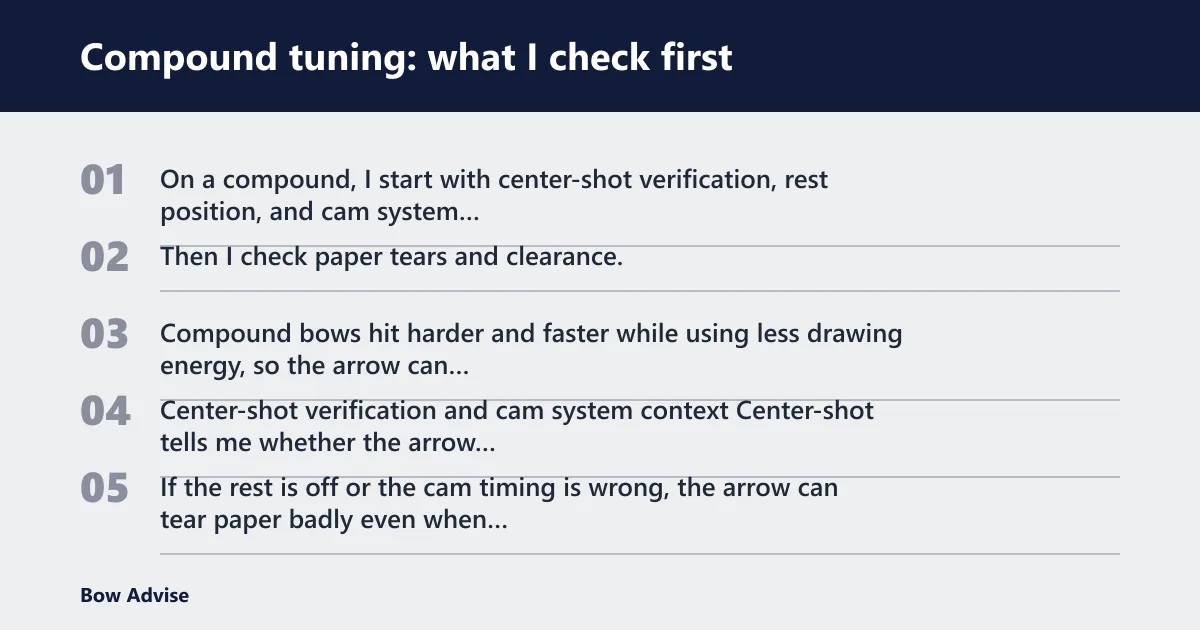
On a compound, I start with center-shot verification, rest position, and cam system context. Then I check paper tears and clearance. Compound bows hit harder and faster while using less drawing energy, so the arrow can leave quick, but a bad setup shows in the flight picture fast.
Center-shot verification and cam system context
Center-shot tells me whether the arrow starts in the right lane. If the rest is off or the cam timing is wrong, the arrow can tear paper badly even when the shaft is close. I want the setup confirmed before I start changing arrows.
Paper tuning and tear interpretation
Paper tuning is my first compound test because it gives a fast snapshot of launch behavior. A clean hole is the goal. A left or right tear points me toward spine, rest position, or a timing issue; a high or low tear sends me back toward nocking point or rest height.
Compound arrows are used for hunting, so flight matters beyond target groups. If I plan to shoot broadheads later, I want the field point flight honest first.
Rest and cable clearance checks
Clearance comes before sighting in. I look for vanes touching the rest, or the string and cables brushing the shaft. If I see contact, I fix that first. No amount of spine chasing will solve a vane strike.
When walk-back verification confirms the setup
After paper gives me a clean start, walk-back verification tells me the arrow stays aligned at distance. If the groups track straight as I step back, the setup is usually close enough to keep. If they drift, I go back to rest position or center-shot.
How do I tell spine problems from clearance problems?
Spine problems show a shaft reacting wrong to the bow. Clearance problems show the arrow getting touched as it leaves. That difference matters because a weak shaft and a rest contact issue can look similar for a few shots, but they need opposite fixes.
Weak and stiff signs on each bow type
On a recurve, a weak arrow often leaves a messy bare-shaft impression and drifts into a predictable side reaction. A stiff shaft reacts the other way. On a compound, weak and stiff can show up in paper tears, broadhead-like wobble, or stubborn group drift.
My first compound bow was set noticeably too heavy for me. I flinched for a month before I backed the limb bolts out. That taught me a simple rule: if my shot changes, I check me before I blame the shaft.
Vanes, rest, and cable contact clues
Clearance issues leave evidence. Vanes can show scrape marks. The rest can leave a contact line. Cables can slap the shaft or vanes and make the arrow look weak when the real problem is mechanical interference.
How shooter form can copy a bad tune
Pluck the string and the arrow will lie to you. Collapse at release and the group opens. Torque the grip and both recurve and compound arrows can show a false spine problem. Good tuning starts with a clean shot, not a quiet bow.
I switched to a left-hand bow after I learned I am left-eye dominant, and my groups got tighter over a short period. That was not an arrow fix. It was me removing a form problem that looked like tuning trouble.
Side-by-side troubleshooting table
| Symptom | Likely cause on recurve | Likely cause on compound | First test | Second adjustment | Stop condition |
|---|---|---|---|---|---|
| Arrow hits left for a right-handed shooter | Stiff dynamic spine or plunger set too hard | Center-shot off, rest too far in, or stiff reaction | Bare-shaft compare at close distance | Check point weight or plunger tension; on compound, verify center-shot | Fletched and bare shafts group together |
| Arrow hits right for a right-handed shooter | Weak dynamic spine or plunger too soft | Weak tear, rest position off, or cable contact | Bare-shaft compare or paper tune | Shorten or stiffen the shaft; on compound, inspect clearance | No contact marks and cleaner group shape |
| High or low impact | Nocking point or brace height issue | Nocking point or rest timing issue | Check vertical group pattern | Move nocking point in small steps or reset rest height | Vertical spread tightens and centers |
| Broadhead-like wobble or tail kick | Bad bare-shaft recovery or poor grip form | Paper tear plus clearance or cam timing issue | Verify clean release and test again | Inspect vanes, rest, and cable path; on recurve, recheck plunger and spine | Arrow flies straight at distance |
Mixed-bow household arrow checklist
- Check the bow type first.
- Match the arrow to the manufacturer chart before cutting.
- Confirm cut length on the actual bow, not the one you assume.
- Choose point weight with dynamic spine in mind.
- Inspect fletching size and clearance needs for each setup.
- Test bare shaft on recurve and paper on compound.
- Avoid reusing an arrow across both bows unless it works through both tuning paths.
Choose tuning arrows for recurve bows or compound bows if…
If your goal is a clean, target-focused setup with simpler launch behavior, recurve tuning is the better path. If you want a hunting-capable setup with a faster shot and a clearer paper-and-clearance workflow, compound tuning wins. For either bow, I start with the right spine, then confirm with the test that matches the bow.
Recurve arrows are mainly used for practice and tournaments, and that fits the bare-shaft workflow well. Compound arrows are used for hunting, and that makes paper tune, clearance, and walk-back checks worth the time. EK Archery says its arrows work across recurve bows, longbows, and compound bows, but my advice is simple: the arrow may fit both, yet the tune still has to earn its place on each bow.
Frequently asked questions
What is the difference between tuning arrows for recurve bows and compound bows?
Recurve tuning leans on bare-shaft comparison, nocking point, brace height, tiller, and plunger adjustment. Compound tuning leans on center-shot, paper tears, rest timing, and clearance. The same arrow can behave differently because the bows launch it differently, so the test method changes with the bow.
Do recurve and compound bows use different arrow spine?
Sometimes yes, even with the same shaft family. Recurves often need a different dynamic reaction than compounds because the launch path and speed profile differ. The manufacturer chart gives the starting point, but the final answer comes from the bow’s actual tuning test.
Should I tune arrows before or after setting up my bow?
After the bow is close enough to a baseline. I set nocking point, brace height, tiller, center-shot, and clearance first, then I tune the arrows. If the bow is not stable, the arrow tune will keep changing underneath you.
How do I know if my arrows are too stiff or too weak?
Use the bow-specific test. On a recurve, a bare shaft that lands consistently off from the fletched group points to spine mismatch. On a compound, paper tears, broadhead-like wobble, and distance drift help show whether the shaft is too stiff or too weak, but clearance must be ruled out first.
What tuning test should I use for a recurve bow?
Use bare-shaft tuning first, then compare the bare shaft with fletched arrows. Watch vertical behavior, not just left-right drift. If the bare shaft and fletched arrows group together and the vertical pattern stays tight, I stop adjusting and confirm at distance.
What tuning test should I use for a compound bow?
Start with paper tuning, then verify center-shot and clearance. After that, use walk-back verification to confirm the setup at distance. If the tears clean up and the groups track straight, the arrow and bow are likely in the right place.