Best Arrows for Windy Target Days (2026): we compared
For windy outdoor target days, start with the lightest stable shaft you can tune, keep diameter as small as your group tolerance allows, and use low-profile vanes unless distance or a recurve needs more steering. Too much weight, width, or vane surface increases crosswind drift, slows launch speed, and makes tuning more sensitive. This guide gives a wind-first matrix for arrow weight, diameter, and vane choice for compound and recurve target setups.
This guide is part of our Arrow dynamics in archery series.
Quick comparison
| Product | Badge | Best for | Price | ||
|---|---|---|---|---|---|
 | PHILOCS 6/12pc Custom Length Carbon Arrows Spine 300 350PHILOCS | Budget pick | Various spines, 6.2mm shaft, 2" vanes | $17.99 Price as of 14 Oct 2026 | View |
 | Easton Legacy 5mm Carbon Hunting Arrow Shafts, SmallEaston | Also great | $133.95 Price as of 14 Oct 2026 | View | |
 | Easton Axis 5mm Carbon Arrows with 50-Grain Steel Half-OutEaston | Upgrade pick | 5mm micro profile, Blazer vanes, 340 spine | $93.17 Price as of 14 Oct 2026 | View |
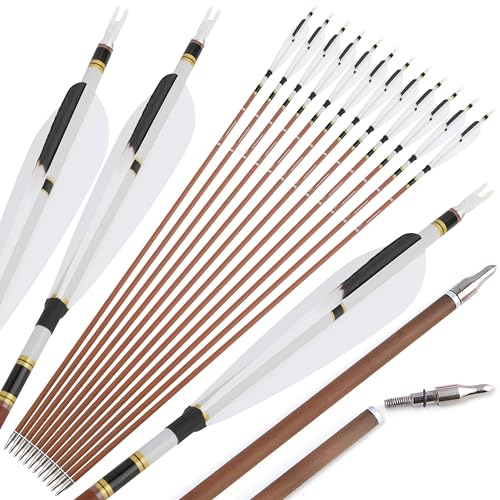 | ZSHJGJR 31" Carbon Arrows Spine 340 400 500 600 ArcheryZSHJGJR | Pair with it | $51.99 Price as of 14 Oct 2026 | View | |
 | Black Eagle Spartan Fletched Carbon Hunting Arrows – 6 PackBlack Eagle | Also great | 400 spine, Blazer vanes, stainless steel inserts | $82.94 Price as of 14 Oct 2026 | View |
The table below compares the main wind-first choices by arrow weight, diameter, vane style, and distance band. It is built for target groups, not broadhead correction.
Use it as a starting point, then narrow the choice around bow type and clearance risk.
📊 The vane selector includes a micro arrow option at .204 inches. Source: Arrow Fletching Guide: Vane Selector + Helical vs Offset.
How we chose
The decision here starts with wind drift, then checks tune, clearance, and distance. A shaft that leaves the bow cleanly and keeps a tight sight picture beats a lighter shaft that sprays groups.
We also separate compound, Olympic recurve, and traditional bow needs, because each one handles vane drag and clearance problems differently.
Distance matters too. A setup that looks fine at 20 yards can fall apart at 50+ yards or 60+ yards, where small steering errors show up fast.
Micro-diameter target setup: best for long-range wind control

Micro-diameter shafts are often a good default for windy outdoor target work at longer distances, around 40 yards and beyond, when the bow is tuned cleanly. Smaller frontal area gives crosswind less to push on, and a light but stable shaft usually keeps sight marks more manageable.
For this class, low-helical or medium-helical vanes are usually enough. The goal is controlled rotation and fast recovery, not the biggest possible fletching package.
Best use case
Choose this setup for outdoor target lines at 40 yards, 50+ yards, and especially 60+ yards where wind drift and group shape matter more than raw arrow speed. It fits archers who already have a clean tune and want the smallest practical shaft.
What vane size and helical angle make sense
For micro shafts, a short, low-profile vane is usually enough. Offset fletching is typically set at 1–3 degrees, and helical fletching creates more spin than offset. For pure target use, that extra spin helps only until drag and clearance risk start rising faster than the gain.
A low helical or medium helical setup is the practical ceiling for many compound target bows. The right answer is the amount of steering that keeps groups tight at distance, not the largest vane that fits.
Most likely failure mode
The common miss here is over-fletching. Too much vane can slow the arrow enough to hurt sight marks, and on some rests it can create contact that shows up as unexplained flyers. A contact checker helps sort real clearance problems from tuning guesswork.
Standard-diameter setup: best for balanced outdoor practice
Standard-diameter shafts are the most forgiving middle ground for many outdoor target archers from 20 to 40 yards. They do not cut wind as well as micro shafts, but they can be easier to live with when the bow is not fully tuned or the archer wants a simpler setup.
For this band, offset fletching is often the sweet spot. It gives rotation and damping without the extra drag of a larger helical wrap.
Best use case
Use a standard shaft when you want a clean balance between tune tolerance, easy arrow build, and decent wind performance. It makes sense for compound and recurve target work where the main distance is 20 to 40 yards.
Where offset fletching is enough
Offset fletching gives some rotation and is easier to jig than helical. That matters on a standard shaft because the arrow already has enough frontal area to catch air, so the fletching does not need to do all the work.
If the arrow group is already tight at 30 yards, moving from offset to more helical often adds more drag than useful correction.
Most likely failure mode
The drawback is simple: more wind push at the same distance than a micro shaft. In gusty crosswind, a standard shaft can still group well, but it usually asks more from the archer’s sight picture and release consistency.
Large-shaft setup: best for forgiving short-to-mid range shooting
Large-diameter shafts can be useful for close outdoor marks, beginner setups, and bows that do not tolerate delicate tuning well. They are easier to tune in some cases, but they pay for that forgiveness with more drag and more wind drift downrange.
At short range, that trade can be acceptable. At longer outdoor marks, the penalty becomes much easier to see.
Best use case
This setup fits up to 20 yards and sometimes 30 yards, especially for new archers or traditional setups where the shaft must clear a shelf cleanly and the tune window is wider. It can also help when a simple setup matters more than maximum outdoor speed.
Why added stability can beat raw speed here
All arrows need stabilizing drag at the rear to fly point-forward. Larger shafts often pair with larger vanes because the system needs more correction to settle down. That can make the arrow feel calmer at release and less sensitive to small form errors.
Still, the benefit is local. Once the line gets longer, the extra frontal area starts working against you.
Most likely failure mode
The biggest downside is slow sight marks and more wind push as distance grows. Big vanes can also cost speed without adding much wind benefit once the arrow is already stable enough. For target archery, bigger is only better until the group stops improving.
Wind setup matrix by distance and bow type
The matrix below translates the wind-first rule into three distance bands and three bow types. The main pattern is consistent: the farther the shot, the more value small diameter and clean, limited vane steering have.
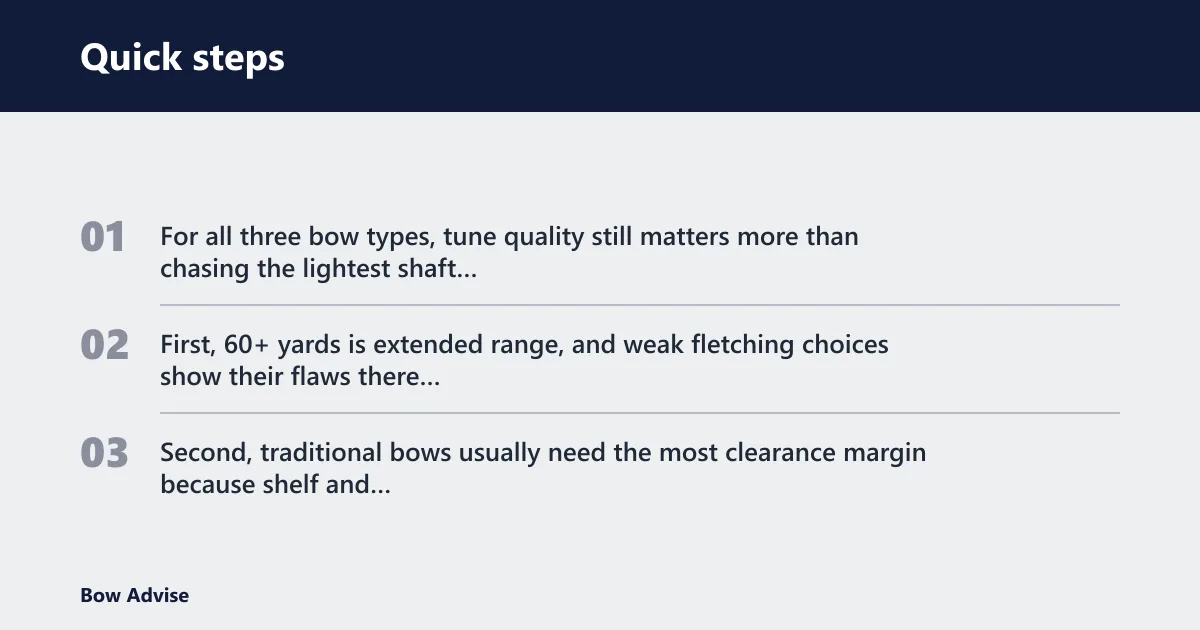
For all three bow types, tune quality still matters more than chasing the lightest shaft on paper.
| Distance band | Bow type | Recommended arrow weight | Diameter band | Vane size / configuration | Most likely failure mode |
|---|---|---|---|---|---|
| Up to 20 yards | Compound bow | 6–8 GPP | Standard or micro, with standard often fine | Short vane, straight or 1–2 degree offset | Over-fletching slows sight marks without better grouping |
| Up to 20 yards | Olympic recurve | 7–9 GPP | Standard or large | Short vane or feather, low profile, light offset | Weak clearance or poor tune shows as horizontal scatter |
| Up to 20 yards | Traditional bow | 8–10 GPP | Large or standard | Feather or short vane, straight to slight offset | Shelf contact and inconsistent release create flyers |
| Up to 30 to 40 yards | Compound bow | 6.5–8.5 GPP | Micro or standard | 1–2 degree offset or low helical 2–3 degrees | Extra vane drag costs speed with little wind gain |
| Up to 30 to 40 yards | Olympic recurve | 7.5–9.5 GPP | Standard, sometimes micro | Low helical 2–3 degrees or moderate feather profile | Too little steering leaves a looser group shape |
| Up to 30 to 40 yards | Traditional bow | 8.5–10.5 GPP | Standard or large | Feather, low helical equivalent, modest height | Clearance risk and tune tolerance limit consistency |
| 50+ yards and 60+ yards | Compound bow | 6–8 GPP | Micro preferred | Low to medium helical, about 2–5 degrees | Micro clearance issues or under-steering if vane is too small |
| 50+ yards and 60+ yards | Olympic recurve | 7–9 GPP | Micro or standard | Low helical 2–3 degrees, careful height choice | Wind drift shows weak spine or poor launch alignment fast |
| 50+ yards and 60+ yards | Traditional bow | 8–10 GPP | Standard or large, with clearance first | Feather with enough surface to settle, but not oversized | Distance magnifies every tuning error and release flaw |
Two patterns stand out. First, 60+ yards is extended range, and weak fletching choices show their flaws there quickly. Second, traditional bows usually need the most clearance margin because shelf and off-the-hand setups are less forgiving than a blade launcher or drop-away rest.
Black Eagle Spartan: best for micro-diameter compound setups
This suits compound target archers who want a small-diameter shaft with a known vane package and a spine class that fits many mid-power setups. Based on the spec sheet and reviews, the 400 spine with Bohning Blazer vanes gives a practical mix of steering and repeatability.
The drawback is that the included vane package leans toward more drag than a minimalist target build, so it is not the lightest wind-first option for every distance. That tradeoff can be worth it if clean launch and repeatable groups matter more than absolute speed.
Easton Axis 5mm: best for long-range wind control
This is aimed at archers who want a micro-profile shaft with a known small-diameter advantage and a compact vane package. The 5mm profile reduces frontal area, and the 2-inch Blazer vanes add enough steering for stable flight without a huge drag penalty.
The honest downside is clearance sensitivity. Micro shafts and short vanes can still be unforgiving if the rest tune is off or if the bow has limited clearance, so this is best for archers who can verify contact carefully.
Easton Legacy 5mm: best for traditional-style small-diameter target arrows
This fits archers who want a small-diameter shaft with a wood-grain look and a setup that stays compact in the wind. For outdoor target shooting, that profile can help at longer marks where the air starts to matter more.
The drawback is price. At $133.95, it sits above the simpler practice choices, and the listed pack format makes it less forgiving if a few shafts are lost or damaged. It is a good wind tool, but not the cheapest path.
PHILOCS custom length carbon arrows: best for mixed bows and simple tuning
This is the flexible choice for archers who need a target arrow that can be cut to length and adapted across traditional, recurve, and compound bows. The 6.2mm shaft and 2-inch vanes make it a balanced option when ease of setup matters more than chasing the smallest diameter on the line.
The drawback is that a 6.2mm shaft is not a true micro option, so it will not cut wind as well as a 5mm shaft at longer range. It is a practical all-around build, not a pure long-distance wind specialist.
ZSHJGJR carbon arrows: best for budget-friendly outdoor practice
This suits archers who want a straightforward carbon arrow for compound, recurve, or traditional bow practice without paying for a premium small-diameter package. The 31-inch length and removable tips make it flexible for general target use.
The drawback is that the product details do not point to a wind-first specialization. Based on the listing, it is more of a general-purpose arrow, so it may not match the same wind performance or consistency as a dedicated micro-diameter shaft.
Which one should you buy
Pick by bow type first. A compound target archer can usually start with a micro shaft and low-helical vane package. Olympic recurve archers often do best with a small-to-standard diameter shaft and just enough vane to settle the arrow. Traditional bow archers should favor clearance and a forgiving feather or vane setup before chasing the smallest shaft.
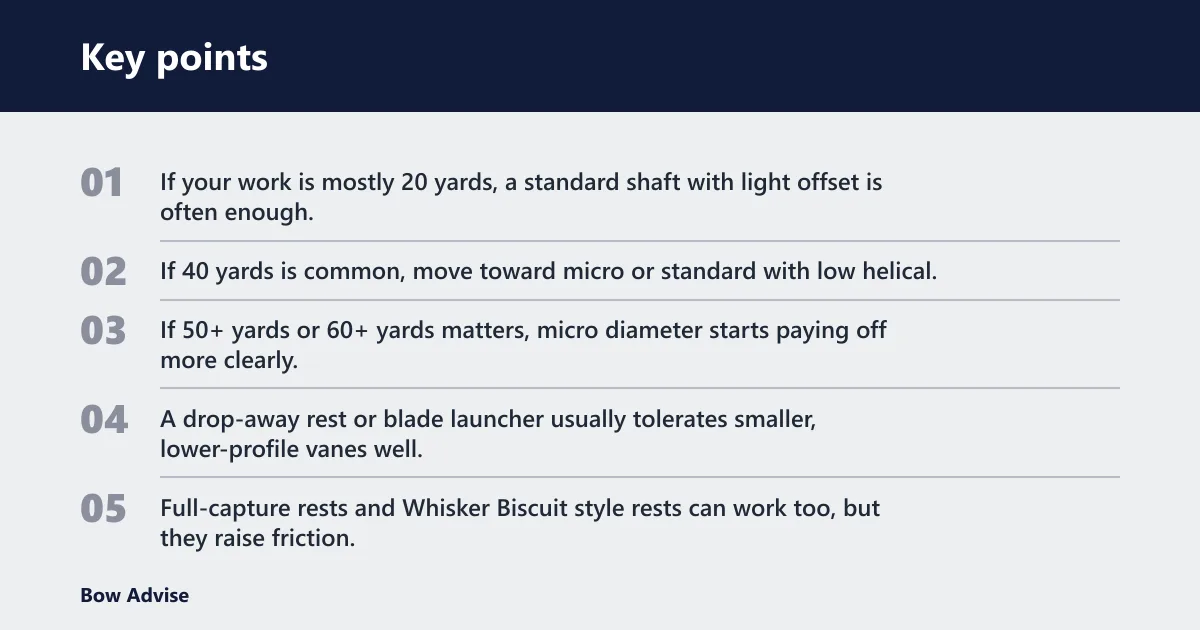
Pick by distance second. If your work is mostly 20 yards, a standard shaft with light offset is often enough. If 40 yards is common, move toward micro or standard with low helical. If 50+ yards or 60+ yards matters, micro diameter starts paying off more clearly.
Pick by clearance risk last. A drop-away rest or blade launcher usually tolerates smaller, lower-profile vanes well. Full-capture rests and Whisker Biscuit style rests can work too, but they raise friction. Shelf or off-the-hand setups need the most clearance margin, so avoid over-fletching there unless the bow truly needs it.
If the choice is between a tiny shaft with bad tune or a slightly larger shaft with clean tune, take the clean tune. Extra vane surface and extra weight stop paying off once they start costing speed, sightmark consistency, or clearance.
Say your compound groups are tight at 30 yards but open up at 50 yards in a crosswind. That is a good sign the shaft diameter or vane package is too generous for the distance. Shrinking diameter or trimming vane surface usually solves more than adding weight does.
Frequently asked questions
What arrow setup is best for windy outdoor target shooting?
The best default is a light but stable shaft with the smallest practical diameter and only enough vane to keep the arrow settled. For many compound archers that means a micro shaft with low helical. For recurve and traditional bows, the best choice often shifts toward more clearance margin.
Do heavier arrows fly better in the wind?
Heavier arrows can be calmer on release and less sensitive to small form errors, but they are not automatically better in wind. In target shooting, too much weight can slow sight marks and increase drop, which makes outdoor aiming harder. The useful target is stable, not simply heavy.
Should I use micro-diameter arrows in the wind?
Often yes, especially for 40 yards and beyond. A micro or 5mm shaft reduces frontal area, so crosswind has less to push on. The catch is clearance and tune. If the bow does not clear cleanly, a micro shaft can group worse than a standard shaft that is better tuned.
Are helical vanes better than offset vanes in wind?
Helical vanes create more spin than offset, and that faster rotation can help the arrow settle sooner after release. In wind, though, more helical also means more drag. Low helical is often the sweet spot for target work; high helical is usually reserved for special cases.
How much vane height do I need for outdoor target arrows?
Just enough to correct the arrow at your distance. More height gives more steering surface, but it also increases drag and clearance risk. Shorter, lower-profile vanes are usually enough for compound target arrows. Recurve and traditional setups may need more surface if the tune is less forgiving.
How do I balance speed vs stability for windy conditions?
Start with clean tune, then keep weight as low as the arrow can hold while staying stable. Use the smallest diameter that still groups well, and add only enough vane to control rotation. A little more steering can help; too much turns into dead drag and slower sight marks.