Best arrows for 3D archery (2026): we compared
For most 3D archers, durable carbon shafts with small vanes, a strong insert or outsert system, and a setup matched to draw weight and target speed work best; start with spine, then check shaft toughness and straightness. The wrong arrow costs points through bad planing, breaks nocks and shafts on hard targets, and drains money on mid-season replacements. This guide covers failure modes, course conditions, and the build details that matter for clean groups and long service life.
This guide is part of our Arrow dynamics in archery series.
Quick comparison
| Product | Badge | Best for | Price | ||
|---|---|---|---|---|---|
 | Hunter Ian Archery Pure Carbon Arrows 600 Spine 30 InchHunter Ian Archery | Our pick | 600 spine · 30" · 30-35 lbs · feather fletching | $37.99 Price as of 9 Oct 2026 | View |
 | TIGER ARCHERY 30" Carbon Arrows for Compound Recurve BowTIGER ARCHERY | Budget pick | 30" · 35-60 lbs · 2B/1W vanes | $32.99 Price as of 9 Oct 2026 | View |
 | PHILOCS 6/12pc Custom Length Carbon Arrows Spine 300 350PHILOCS | Also great | Custom length · 10-80 lbs · 2" vanes | $17.99 Price as of 9 Oct 2026 | View |
Use the table to match your arrow to the course, not just the bow. Tight-ring scored shoots, brush-contact layouts, and long walk-back rounds punish different weak points.
📊 TIGER ARCHERY arrows are listed at 30 inches long. Source: Top 10 Best 3D Archery Arrows That Boost Your Accuracy!.
How we chose the best 3D arrows
We compared arrows by four things: impact durability, flight forgiveness after tuning, pull ease on 3D targets, and how well the setup can be repaired after light damage. We also weighed shaft diameter, spine range, and front-end serviceability, because those are the parts that decide whether an arrow survives the next end.
Brand names matter less than that. A shaft that groups well but splits on foam ribs is a poor 3D arrow. A tough shaft that planes hard because the spine is wrong is just as bad.
Course conditions matter too. Tight scoring rings reward slimmer shafts, while rough target faces and repeated pull-throughs reward a setup that can survive nicks, bent points, and damaged nocks without throwing away the rest of the season.
Practical 3D arrow selection table
| Shooter type | Shaft diameter | Spine range | Point weight window | Vane size | Durability risk | Best-use scenario |
|---|---|---|---|---|---|---|
| Beginner | Mid-diameter carbon, about 6.2 mm to 7 mm class | Wide enough to tune cleanly to the bow, often a middle range for the draw weight | 100 to 125 grains | 3-inch vanes | Low if the shaft is not overspined or underspined | Mixed foam targets, learning form, repeatable group size |
| Hunter crossover | Mid-diameter carbon | Matched closely to hunting setup and draw weight | 100 to 125 grains, sometimes heavier for front-of-center | 3-inch vanes or similar compact vanes | Moderate; front-end hits and pass-through wear can add up | One arrow setup for both 3D and field practice |
| Tournament-focused 3D shooter | Slim carbon shaft | Tight match to bow tune and point weight | 90 to 125 grains, depending on spine and speed | Low-drag vanes, usually compact | Higher if the course has brush, hard angles, or dense foam | Tight scoring rings, long-distance target faces, lower drag priorities |
What are the best arrows for 3D archery?
The best arrows for 3D archery are usually durable carbon shafts with the right spine, modest vane size, and a diameter that fits your course. A mid-diameter carbon shaft is the safest default because it balances impact resistance, straight-line flight, and easier target use across mixed 3D layouts.
That answer changes with course design. On tight-ring targets, a slimmer shaft can save points. On rougher foam or brush-contact courses, durability and recoverability matter more than shaving a little drag.
Best overall pick: a mid-diameter carbon shaft with a balanced spine range. It gives the best mix of durability, flight forgiveness, and broad 3D course usefulness.
Why the default answer is carbon
Carbon shaft arrows are the common recommendation because they handle repeated impacts well, are lighter than aluminum in many setups, and resist wear and breakage. In practice and hunting arrows alike, carbon is the material most archers turn to when longevity matters.
That said, “carbon” is not enough by itself. A shaft can still fail from poor spine choice, a weak insert, a cracked nock, or a front-end hit that leaves the arrow straight-looking but no longer true in flight.
Are carbon arrows better for 3D archery?
Yes, carbon arrows are usually better for 3D archery because they combine good impact resistance with repeatable flight and broad availability in setups that overlap with hunting and practice. They are not immune to failure, but they usually survive more course abuse than softer materials.
Carbon also gives you more usable options in diameter, spine, and front-end design. That matters when you need an arrow that still groups after a hard hit into foam, a glancing strike on a stake, or a long walk-back round with repeated pulls.
What carbon solves, and what it does not
Carbon helps with shaft longevity. It does not fix a bad tune. Too stiff and the arrow can leave the bow poorly. Too weak and it can plane or react badly to broad course conditions and point weight changes.
For 3D, the big advantage is strength, weight efficiency, and enough model variety to match different bow speeds and scoring priorities.
What arrow spine should I use for 3D archery?
Use the spine that matches your bow draw weight, draw length, and point weight first, then refine for flight. Too stiff usually gives poor left-right tune response and weak group forgiveness; too weak can cause erratic flight, especially when point weight rises or the bow is faster than expected.
Spine matters because it controls how the shaft flexes at release. That flex changes grouping, recovery after launch, and how well the arrow handles a heavier point. A good 3D setup is tuned, not guessed.
How to think about spine in 3D
Start with the bow’s draw weight and the actual arrow length. Then account for point weight. A longer shaft or heavier point increases dynamic demand on the arrow, which means the same spine can behave softer than the label suggests.
For a 3D setup, the goal is a shaft that recovers quickly enough to group, but not so stiff that it refuses to tune. A shaft that is even slightly off can show up fast on scoring rings that punish inconsistent impact angle.
Common spine failure modes
When spine is too stiff, arrows may leave the bow with poor forgiveness and reduced left-right tuning range. When spine is too weak, they can react sharply to release errors and show more side-to-side spread at distance. Both problems get worse as point weight climbs.
That is why point selection and spine selection should be treated as one decision, not two separate ones.
How durable do 3D archery arrows need to be?
3D arrows need to survive repeated target impacts, not just one good shot. The best setup resists outright breakage, stays straight after lighter hits, and avoids repeat failures from nock cracks, bent points, or damaged vanes that change the next end.
Durability in 3D is more than “did it snap?” It also includes straightness retention, repairability, and how often an impact forces you to replace a front-end part or retire the shaft entirely.
Separate the failure types
- Outright breakage: the shaft cracks or splinters and is done.
- Straightness loss: the arrow survives, but it no longer flies true.
- Repairable damage: a nock, vane, or point fails, but the shaft remains usable.
- Repeat-impact wear: the arrow survives once, then degrades after more target hits.
Those failures do not behave the same on a course. A bent point may still allow usable flight. A cracked nock can make the next shot unsafe. A shaft that looks fine but has lost straightness can quietly ruin grouping.
What durability means in real rounds
On long walk-back rounds, every arrow may see more pulls, more restarts, and more chances to get nicked. On irregular foam targets, the front end gets punished by odd entry angles. Durable carbon helps, but inserts and nocks decide how much of the arrow you can save after impact.
Do lighter arrows fly better for 3D targets?
Lighter arrows can fly faster, but they do not automatically fly better for 3D. Speed helps with trajectory and some sight marks, yet very light setups can be less forgiving, more sensitive to tune, and less comfortable when the course punishes poor impact behavior or marginal spine matching.
The right question is whether the arrow is light enough for your bow speed and heavy enough to stay stable. In 3D, clean grouping and manageable impact damage usually matter more than raw speed alone.
Where lighter arrows help
They can flatten trajectory and reduce some holdover issues at distance. That may help on longer target lanes where tiny aiming errors matter. They also tend to increase speed when the bow is already tuned for that weight class.
Where lighter arrows hurt
Very light arrows can be less forgiving after release error, and they may give up some impact durability. If the point and shaft combination is too light for the bow, flight can become less stable and repeated course abuse can show damage faster.
What arrow diameter is best for 3D archery?
The best diameter depends on the course. Slim shafts can help in tight scoring rings and reduce edge contact on brushy lines. Mid-diameter shafts are often the better all-around choice because they keep target pull reasonable while still offering good durability and consistent flight.
Diameter affects more than drag. It changes how the arrow handles scoring ring lines, how hard it is to pull from foam, and how much side damage it takes from rough target faces or accidental contact.
Why slim shafts can score well
A smaller outer diameter reduces the chance of clipping a ring line and can help on narrow scoring windows. On 3D courses where points are tight, that matters. It may also cut some drag, though the real gain is usually the scoring margin, not a dramatic speed jump.
Why mid-diameter shafts are the default
Mid-diameter carbon shafts are easier to defend as a broad-use setup. They generally balance target pull, impact toughness, and availability. That is why they fit hunter crossover shooters and many beginners better than very slim shafts.
How do I keep arrows straight after repeated target impacts?
Keep arrows straight by checking shafts after every hard hit, replacing cracked nocks immediately, and pulling bent points before they start affecting flight. Straightness retention is a service issue as much as a material issue, and carbon shafts last longer when front-end damage is caught early.
If an arrow starts to group oddly after a hit, do not assume it is the bow. Bent points, cracked inserts, and damaged vanes can create the next miss even when the shaft still looks usable.
- Inspect the shaft for visible splinters, flat spots, or bends.
- Check the nock for hairline cracks and fit.
- Spin the point to look for wobble.
- Replace bent or loose inserts before the next round.
- Repair or replace vanes that have peeled back or torn.
Why repairability matters
Replaceable nocks reduce downtime. Good insert choice also matters because the front-end system controls how easily you can restore the arrow after impact. A shaft that is easy to service may cost less over a season than a slightly tougher shaft with hard-to-replace parts.
Suppose a 28-inch arrow takes a hard face hit and the point starts wobbling. If the nock and insert system are standard and easy to replace, the shaft may return to service quickly. If not, the whole arrow can become a nuisance even before it breaks.
Should I use the same arrows for 3D and hunting?
Yes, many archers can use the same arrows for 3D and hunting if the spine, point weight, and broadhead setup are compatible with both tasks. That works best when the arrow is a durable carbon shaft with a reasonable diameter and a front-end system that can handle repeated use.
The catch is that hunting and 3D do not always want the same trade-offs. Hunting often rewards penetration and broadhead tune; 3D often rewards repeatable flight, easy target pull, and lower course damage. One shaft can do both, but it needs careful choice.
When one setup makes sense
Use one setup if you shoot similar draw weight, want fewer arrow types to manage, and are comfortable tuning around a shared spine and point weight. A hunter crossover setup usually belongs here, especially with mid-diameter carbon and compact vanes.
When to separate them
Separate arrows if your hunting setup uses a very different point weight, broadhead behavior, or draw weight than your 3D course setup. A tournament-focused 3D arrow can be a poor hunting arrow if it is too slim, too light, or tuned only for target heads.
Best overall: Hunter Ian Archery Pure Carbon Arrows 600 Spine 30 Inch
This is the best fit for archers who want a straightforward carbon 3D arrow with a practical spine window and traditional-friendly build. The 600 spine, 30-inch length, 100-grain screw-in field points, and aluminum inserts make it a sensible choice for recurve and longbow shooters who want a dependable baseline.
What stands out is the pure carbon shaft and the 6.2 mm ID, which puts it in a useful mid-diameter class for 3D use. The turkey feather fletching also suits traditional bows well. The honest drawback is that feather fletching is not the most durable choice in wet or heavily abrasive course conditions, and the 30-35 lbs window is narrower than some crossover setups.
Best for tight-ring scoring: TIGER ARCHERY 30" Carbon Arrows for Compound Recurve Bow Hunting Target
This is the strongest pick for shooters who care about repeated target use and a small-enough shaft to help on tighter scoring windows. The 30-inch carbon shafts, 0.309 inch outer diameter, and 35 to 60 pound draw weight rating make it a practical 3D option for a wide range of compound and recurve setups.
Its 2 black and 1 white vane layout is simple and functional, and the nickel plated stainless steel tips are a useful detail for repeated target work. The drawback is that the narrow diameter can be less forgiving on rougher target faces, and any slim shaft can be less pleasant to recover after a hard off-angle impact than a broader setup.
Best for beginners: PHILOCS custom length carbon arrows
This is the best fit for newer archers who need flexibility in length and spine without jumping into a more specialized tournament shaft. The custom-length carbon construction, 300 to 800 spine range, removable 100-grain tips, and 2-inch vanes make it easier to match a setup to a broad range of bows.
The main strength is adjustability. That makes it useful for learning spine tuning and arrow fit. The honest drawback is that 2-inch vanes are smaller than the common 3-inch stability baseline, so a new shooter may need a cleaner release and better tune to get the same forgiveness.
Which one should you buy?
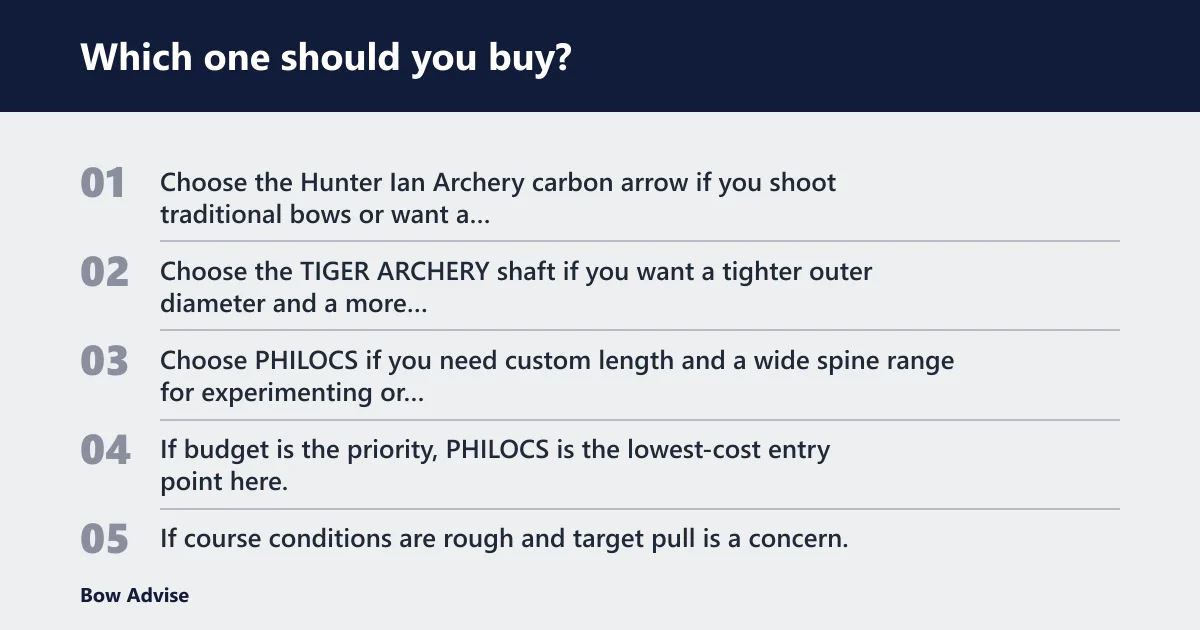
Choose the Hunter Ian Archery carbon arrow if you shoot traditional bows or want a mid-diameter carbon shaft that leans durable and simple. Choose the TIGER ARCHERY shaft if you want a tighter outer diameter and a more general-purpose 3D and target setup. Choose PHILOCS if you need custom length and a wide spine range for experimenting or shared use across bows.
If budget is the priority, PHILOCS is the lowest-cost entry point here. If course conditions are rough and target pull is a concern, TIGER ARCHERY is the more focused 3D pick. If your setup is traditional and you value a straightforward carbon build, Hunter Ian Archery is the cleaner match.
For archer type, beginners should favor wider spine flexibility and simple tuning. Hunter crossover shooters should prioritize carbon durability, manageable diameter, and a front-end system that can be repaired quickly. Tournament-focused shooters should narrow the field to shafts that match bow speed, scoring priorities, and the amount of course abuse they are willing to accept.
Say your local course has tight scoring rings but lots of brush between lanes. A slim shaft may help at the line, but a mid-diameter carbon arrow may save more time and money over a season if the targets and arrows keep taking side hits. The right answer depends on which failure you can live with.
Frequently asked questions
What are the best arrows for 3D archery?
The best arrows for 3D archery are usually durable carbon shafts with the correct spine, moderate vane size, and a diameter suited to the course. Mid-diameter carbon is the most balanced starting point because it offers durability, easy tuning, and solid performance on a wide range of 3D targets.
Are carbon arrows better for 3D archery?
Yes. Carbon arrows are usually the better choice because they resist wear and breakage better than many alternatives, and they are common in both practice and hunting setups. They still need the right spine and front-end components, but carbon is the safest default material for 3D use.
What arrow spine should I use for 3D archery?
Use the spine that matches your bow draw weight, draw length, and point weight. If the spine is too stiff, flight can be less forgiving. If it is too weak, arrow behavior can get sloppy fast. The best 3D spine is the one that tunes cleanly and repeats well.
How durable do 3D archery arrows need to be?
They need to survive repeated impacts, not just one shot. A good 3D arrow should resist straightness loss, shaft breakage, vane damage, and nock or insert failure. That matters because a damaged arrow can still look usable while quietly hurting the next end’s group size.
Do lighter arrows fly better for 3D targets?
Not always. Lighter arrows can fly faster, but they may be less forgiving and less durable under course abuse. For 3D, the better arrow is often the one that balances speed with clean flight, stable tune, and enough shaft strength to survive repeated target hits.
How do I keep arrows straight after repeated target impacts?
Inspect the shaft, nock, insert, and point after any hard hit. Replace cracked parts immediately, and retire arrows that no longer spin true. Straightness retention depends on catching small failures early, because a slightly damaged front end can affect the next shot even if the shaft is still intact.