Insert Weight vs Point Weight: Which Matters More?
Point weight usually changes arrow behavior more per grain than insert weight, because the mass sits at the tip; insert weight matters most when the total change is large enough to move the arrow into a different dynamic spine group. Ignore that, and you can chase inconsistent bareshafts, poor broadhead flight, or a setup that feels fine indoors but opens up downrange. This guide compares both weights, explains why the front of the shaft matters, and shows when a larger insert swap beats a small point change.
| Decision factor | Insert Weight | Point Weight | Winner |
|---|---|---|---|
| Per-grain effect on dynamic spine | Changes spine, but the effect is often smaller per grain because the mass sits behind the point. | Usually changes spine more per grain because it adds mass at the very tip. | Point Weight |
| Effect on FOC | Raises FOC, sometimes enough to move the build into a different balance window. | Raises FOC more efficiently per grain because the mass is farthest forward. | Point Weight |
| Big tuning moves | Best when the change is large enough to shift the arrow into a new spine response. | Best for smaller front-end trims when you want fine control. | Insert Weight |
| Broadhead tuning | Can help fixed-blade flight if the shaft is still close to tune. | Often gives faster feedback when broadheads need a small correction. | Point Weight |
| Best use case | When you need a larger front-end shift without changing the point style. | When you want a small, direct change in balance, trajectory, and tune. | Point Weight |
What the table means
Per-grain spine effect
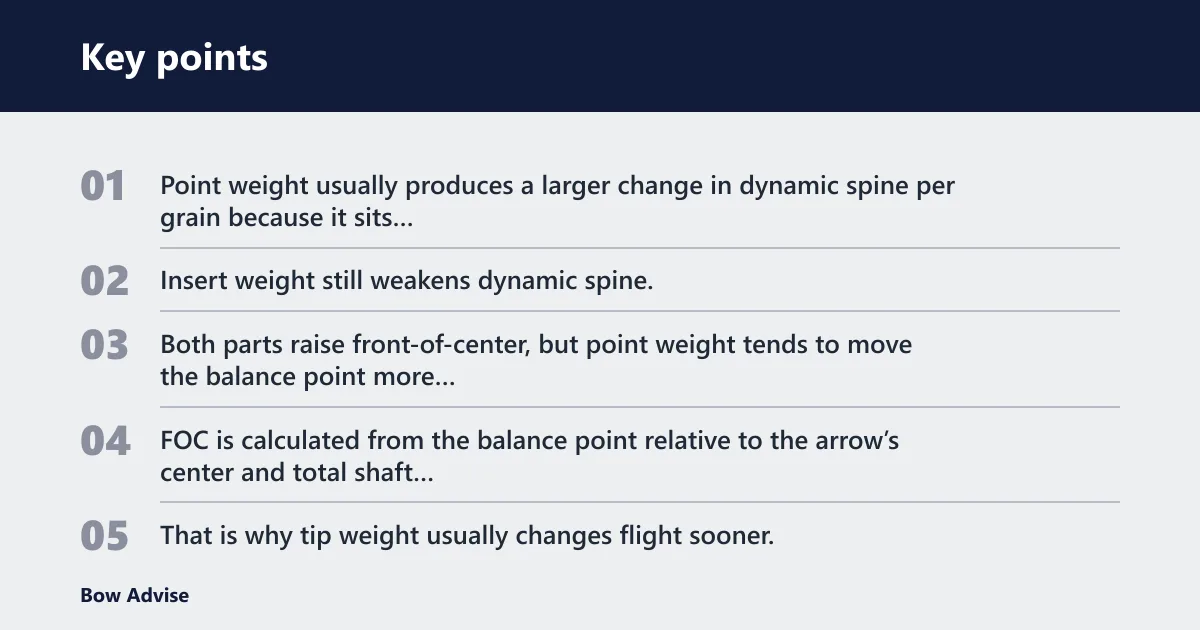
Point weight usually produces a larger change in dynamic spine per grain because it sits farthest forward on the finished arrow. That extra distance matters. Insert weight still weakens dynamic spine, but a small insert swap often has a gentler effect than the same grain change at the tip.
FOC change
Both parts raise front-of-center, but point weight tends to move the balance point more efficiently. FOC is calculated from the balance point relative to the arrow’s center and total shaft length, so moving mass farther forward has more effect than placing it slightly behind the tip. That is why tip weight usually changes flight sooner.
Larger tuning moves
Insert weight wins when the swap is large enough to push the shaft into a new dynamic spine response. A small tip change may not be enough to move a stubborn setup, while a heavier insert can shift the whole front end enough to show a different bareshaft or broadhead result. The arrow responds to the full front-end load, not one part alone.
Broadhead tuning
Fixed-blade heads are more tune-sensitive than field points, so front-end changes matter more in hunting builds. A moderate front-weight increase can help broadhead flight if the shaft is already close to tune. If the arrow is already borderline weak, though, heavier front mass can make the planing worse instead of better.
Best use case
Point weight is the sharper tool for small changes. Insert weight is the better move when the build needs a larger shift without changing the point style or jumping straight to a new shaft. If the arrow still misses the clean tune window after that, the real fix is probably spine or shaft length.
Does heavier point weight change arrow spine more than heavier insert weight?
Yes, usually. Point weight tends to change dynamic spine more per grain because the added mass sits at the furthest forward point of the arrow, where it has the strongest effect on the shaft’s bend response. Insert weight also weakens spine, but its effect is usually less direct grain for grain unless the total front-end change is large.
Why location matters more than raw grain count
Dynamic spine is the arrow’s in-flight bend response to total front-end mass, arrow length, bow speed, and bow type. More front mass weakens the arrow’s behavior, but the exact effect depends on where that mass sits and how the shaft leaves the bow. Longer arrows such as 30 to 31 inches react more than shorter 28-inch shafts.
Say your compound setup uses a 29-inch shaft and you swap from a 100-grain point to a 125-grain point. That extra tip mass often shows up faster on paper than the same grain increase buried in the insert, because the point sits farther forward. The effect is still tied to the whole build, not the number alone.
How the two changes interact
In a finished arrow, point weight and insert weight do not work separately. They combine into one front-end load that changes FOC and dynamic spine together. That is why a small point change can be enough on one arrow, while a similar grain change in the insert section barely moves another setup.
FOC and dynamic spine basics
FOC depends on the balance point of the completed arrow and the arrow’s total length. Move the balance point forward and FOC rises; move it back and FOC falls. More front weight also weakens dynamic spine, which is why a front-heavy build can fly well in one bow and poorly in another.
FOC formula and common ranges
FOC is found by comparing the balance point to the shaft’s center. In practical terms, you measure the finished arrow, locate the balance point, and calculate how far forward it sits from the middle of the shaft. Easton lists 7% to 15% FOC indoors for target archery, 10% to 15% outdoors, and notes that excessive FOC over 20% can cause vertical dispersion.
For hunting, common guidance moves higher. 10% to 15% FOC for hunting setups, and fixed-blade hunting is often described at 15% to 20%+. Heavy hunting FOC is listed at 15% for elk and bear. Negative FOC is unstable in flight.
Why longer arrows react more
Longer shafts have more bending length, so they respond more to the same front-weight change. That is why a 31-inch arrow often feels more sensitive than a 28-inch arrow with the same point or insert swap. Bow speed matters too: faster bows usually punish weak spine faster because the shaft has less time to recover.
Change point first or insert first?
Start with point weight when you need a small, fast tuning move. Start with insert weight when the change must be larger, or when the point style has to stay the same for hunting or broadhead compatibility. If either change pushes the shaft outside a clean tune window, change spine or shaft length instead of adding more front mass.
Use point weight for fine control
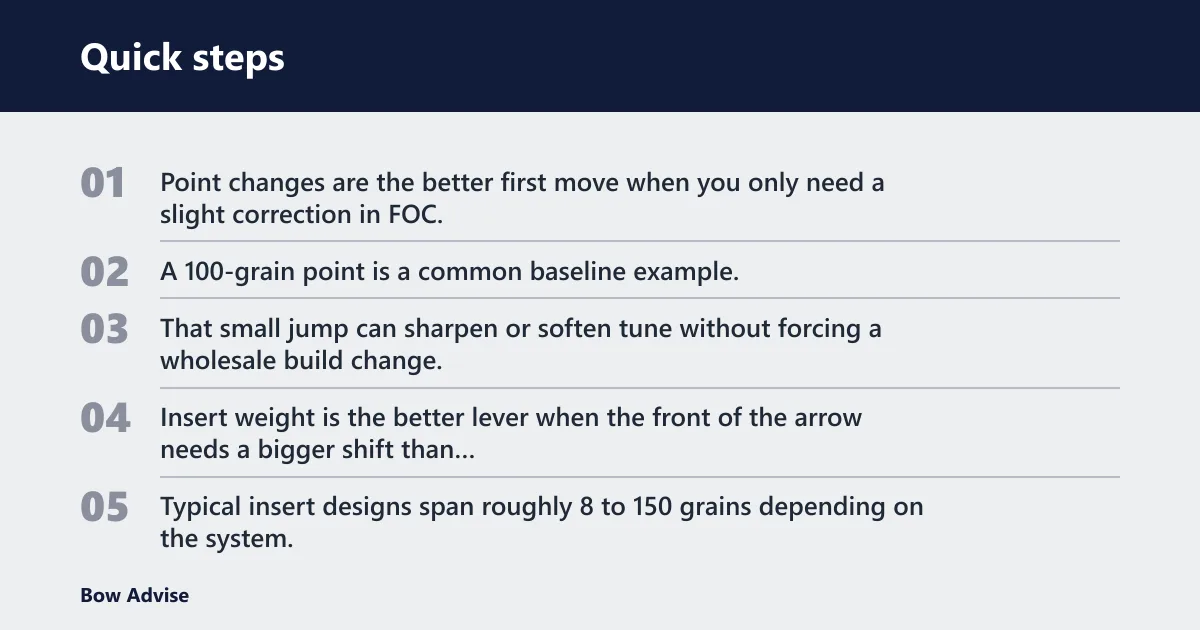
Point changes are the better first move when you only need a slight correction in FOC, point-on distance, or broadhead impact. A 100-grain point is a common baseline example, and 125 grains is often used as a step-up for both target and hunting use. That small jump can sharpen or soften tune without forcing a wholesale build change.
Use insert weight for larger shifts
Insert weight is the better lever when the front of the arrow needs a bigger shift than a point swap can provide. Typical insert designs span roughly 8 to 150 grains depending on the system. Those designs can change total arrow weight and FOC enough to expose a weak shaft.
A common first-timer mistake is choosing a heavy insert to chase higher FOC, then discovering the arrow is now too weak to tune cleanly. That does not mean the insert was wrong. It means the shaft, length, and bow speed were already near the edge.
Change spine or shaft length when the arrow leaves its clean window
Once the build needs a major correction, front weight stops being the best fix. If bareshafts will not clean up, fixed blades plane badly, or point impact stays stubbornly off after the usual tune steps, the shaft may simply be too weak or too stiff for the bow. At that point, moving to a different spine or trimming shaft length is the cleaner answer.
Front weight in target and hunting setups
Target archery usually rewards flatter flight and predictable grouping, so many target builds stay in the moderate FOC range. Hunting setups often accept more front weight because penetration, broadhead forgiveness, and downrange stability matter more than raw speed. Fixed blades raise the stakes further because they react to tune errors much sooner than field points.
Target archery
For indoor target work, Easton lists 7% to 15% FOC, while outdoor target work is commonly set at 10% to 15%. A lower or moderate FOC often keeps trajectory flatter and makes point-on distance easier to manage. Heavier front ends can still help if the shaft remains in tune, but they should not be added blindly.
3D and hunting
3D and hunting arrows often benefit from more front mass because the setup trades some speed for forgiveness and penetration. The common hunting range of 10% to 15% FOC gives a useful middle ground, while heavier hunting builds can go higher when the shaft still tunes well. A 6 to 8 GPP arrow is often considered a balanced hunting setup, and 8 to 10 GPP is common for heavier hunting builds.
GPP matters for safety too. The ATA minimum is 5 GPP, and under 5 GPP is unsafe. More front weight raises total arrow weight, so any FOC gain should stay inside that floor.
Fixed-blade hunting
Fixed-blade broadheads are more sensitive to launch tune than field points. Heavier front ends can improve broadhead flight, but only if the shaft still has enough stiffness to recover cleanly. Heavy hunting FOC around 15% for elk and bear makes sense only when the rest of the build supports it.
Insert weight vs point weight decision table
The same grain change does not have the same effect in every setup. Arrow length, bow speed, release style, and broadhead type all change how far a front-weight swap pushes dynamic spine. The table below gives a practical split for three common builds.
| Setup | Insert Weight | Point Weight | Likely effect on FOC | Likely effect on dynamic spine | Likely group size downrange | Recommended first change |
|---|---|---|---|---|---|---|
| Target setup | Useful when a larger front-end shift is needed without changing the point style. | Best for small balance changes and quick tuning checks. | Moderate increase; often kept in the 7% to 15% target band. | Both weaken spine, but point weight usually shows the change faster. | Can tighten groups if the shaft stays in tune; can open groups if the shaft becomes too weak. | Point Weight |
| 3D/hunting setup | Useful when moving toward more front mass for penetration and forgiveness. | Useful when adjusting trajectory and point-on distance in smaller steps. | Often moves toward 10% to 15% FOC, sometimes higher. | Can push the arrow into a weaker dynamic spine group if the change is large. | Can improve grouping if the arrow remains matched to the bow; can worsen broadhead impact if too weak. | Insert Weight |
| Fixed-blade hunting setup | Helpful when broadhead flight needs a larger front-end shift and the shaft still has room. | Best for fine correction before broadhead planing appears. | Often built toward 10% to 20%+ FOC depending on the setup. | Most likely to expose a marginal spine if the shaft is already weak. | Can shrink broadhead groups when the shaft is still clean; can spread them quickly if the arrow is over-soft. | Insert Weight |
Target setup comparison
For target shooting, point weight is usually the first change because it gives finer control over tune and trajectory. A small point swap can adjust point-on distance and grouping without forcing a major rebuild. Insert weight matters too, but it is usually the second move unless the original front end is clearly wrong.
3D and hunting setup comparison
For 3D and hunting, insert weight often becomes the better lever because the build may need a larger step toward more front mass. That can help with forgiveness and penetration, especially on a longer shaft. The risk is simple: if the shaft is already soft, the heavier insert can make the arrow behave like a weaker group and open the tune.
Fixed-blade hunting setup comparison
Fixed blades magnify any tuning mistake. In that case, point weight is often the cleaner first move for a small correction, while insert weight is the better choice when a larger front-end shift is needed and the shaft is still close to tune. If the broadhead still planes, changing spine is usually smarter than adding more weight.
When should I change shaft spine instead of just changing insert weight?
Change shaft spine when front-weight adjustments stop producing a clean tune. If the arrow still bareshafts poorly, shows inconsistent impact, or loses broadhead stability after a sensible point or insert change, the shaft is likely the wrong stiffness for the bow. More front mass cannot fix a mismatched spine forever.
Signs the shaft is too weak or too stiff
A weak shaft usually reacts badly to more front mass, especially on a longer arrow or a faster compound. A stiff shaft can also refuse to clean up if the front end is too light for the launch system. In both cases, the symptom is the same: more front-weight swapping does not solve the underlying tune issue.
Why a heavy insert can expose a bad spine choice
Heavier inserts can make an already marginal setup look good on paper and bad in flight. That happens because the front end pushes dynamic spine weaker while also raising total arrow weight. If the shaft was barely acceptable before the change, the heavier insert can move it out of the shootable zone.
- Weigh every insert, point, shaft, and nock on a grain scale before mixing parts.
- Match the finished arrow to the bow’s draw weight, length, and speed, not to a catalog spine alone.
- Make one front-weight change at a time.
- Recheck bareshafts or broadhead flight after any major front-end change.
- Stop adding weight when tune breaks; move to spine or shaft length instead.
Verdict: Insert Weight or point Weight?
Choose Insert Weight if you need a larger front-end shift to move a stubborn setup into a new dynamic spine response, or if you want to keep the same point style for hunting or broadhead compatibility while changing bareshaft or broadhead results.
Choose Point Weight if you want a small, direct change in balance, trajectory, or tune, such as stepping from a 100-grain point to a 125-grain point for fine control and faster feedback on paper.
Frequently asked questions
How many grains of insert weight equal a point weight change in dynamic spine?
There is no universal grain-for-grain swap, because arrow length, bow speed, draw weight, and existing tune all change the result.
Will a brass insert make my arrow too weak for my current spine?
It can, if the shaft was already close to the weak side. Brass is not automatically heavier than every aluminum or stainless option, because insert weights overlap by design. The real question is the finished front-end mass, the shaft length, and whether the bow still gives a clean bareshaft or broadhead result.
How much does point weight affect FOC and arrow drop downrange?
Point weight can move FOC noticeably because it sits at the very tip, and the balance shift affects how the arrow behaves in flight. A 100-grain point is a common baseline, while 125 grains often adds more front bias and more drop. Exact downrange change depends on total arrow weight and bow speed.
What happens to arrow speed and trajectory when I add front-end weight?
Adding front-end weight raises total arrow weight, so speed usually drops and the trajectory arc becomes steeper. That tradeoff is normal. The key is to stay inside a clean dynamic spine window, because speed loss is manageable, but a badly weak arrow can hurt grouping far more than a little extra drop.
Should compound and recurve shooters treat front weight the same way?
No. Both bows respond to front weight through dynamic spine and FOC, but compounds usually launch faster and can show weak-spine symptoms sooner. Recurves often tolerate different front-end windows because release style and arrow length interact differently with shaft bend. The same grain change can behave differently on each bow type.