Arrow speed vs accuracy: what matters most for archers
I pick the setup that groups best at my hunting or target distance. Speed only stays in the mix if it leaves tune, noise, and broadhead flight alone. Bad speed choices cost points, blood trail, and confidence. I’ll show how speed and accuracy trade off, and how I choose arrow weight, tune, and broadheads for target, tuning, and hunting.
| Decision factor | Arrow speed | accuracy: what actually matters most | Winner |
|---|---|---|---|
| What it measures | Arrow speed is easy to measure in fps. | Accuracy is group size, flight stability, and repeatability. | accuracy: what actually matters most |
| Downrange benefit | Flatter path and less drop at distance. | Tighter groups and less bad shot spread at your real range. | tie |
| Error tolerance | Often less forgiving if tune and release are off. | Rewards a setup that recovers well from small mistakes. | accuracy: what actually matters most |
| Hunting outcome | Can help with sight picture and holdover. | Usually matters more for broadhead flight and clean hits. | accuracy: what actually matters most |
| Best-fit use case | Useful when trajectory matters and the bow stays quiet and tuned. | Best for most shooters, especially with broadheads or weaker form days. | accuracy: what actually matters most |
Arrow speed vs accuracy: what are you actually comparing?
Arrow speed is a number. I can clock it in fps and compare one setup to another in a minute. Accuracy is messier, because it shows up as grouping consistency, flight stability, forgiveness to release error, and how well the bow tune holds together at your real distance.
In my shop, I treat speed as a result of the setup, not the target. If two arrows are both fast, the one that groups tighter at longer range is usually the better choice. That matters even more once you add broadheads, where a small tune miss shows up fast.
Why speed is easy to measure and accuracy is not
Speed is simple because the number is direct. Accuracy depends on your release, anchor, bow tune, nock fit, rest setup, and the arrow itself. A fast arrow can still scatter if dynamic spine is wrong or the broadhead starts planing.
What a real grouping test tells you at your distance
I care about groups at the distance you actually shoot. A setup that prints a nice hole at 10 yards may open up at 30 or 40 when the arrow has less room for error. That is why I test arrows on my own range before I trust them in season.
Does a faster arrow actually shoot more accurately?
A faster arrow can make sighting and holdover a bit simpler at longer range because it reduces drop. But raw fps does not make the arrow group better on its own. If tune, release, or broadhead flight is poor, speed can make the miss happen faster.
When speed helps
Speed helps when trajectory control matters. At longer target distances, a flatter arrow can reduce aiming error, and that can tighten real-world groups. It can also help a hunter when the gap between pin gaps feels cramped at odd ranges.
When speed hurts
Speed hurts when you buy it by cutting arrow weight too far, then lose tune margin, silence, or broadhead stability. Light arrows are more sensitive to wind and imperfect releases. I also notice more bow noise when I push speed before the setup is settled.
The tradeoff I see in practice
My first compound bow was set 10 lb too heavy. I flinched for a month before I backed the limb bolts out, and my groups told me the truth long before my pride did. Faster is nice. Stable is better.
How arrow weight changes speed, momentum, and energy
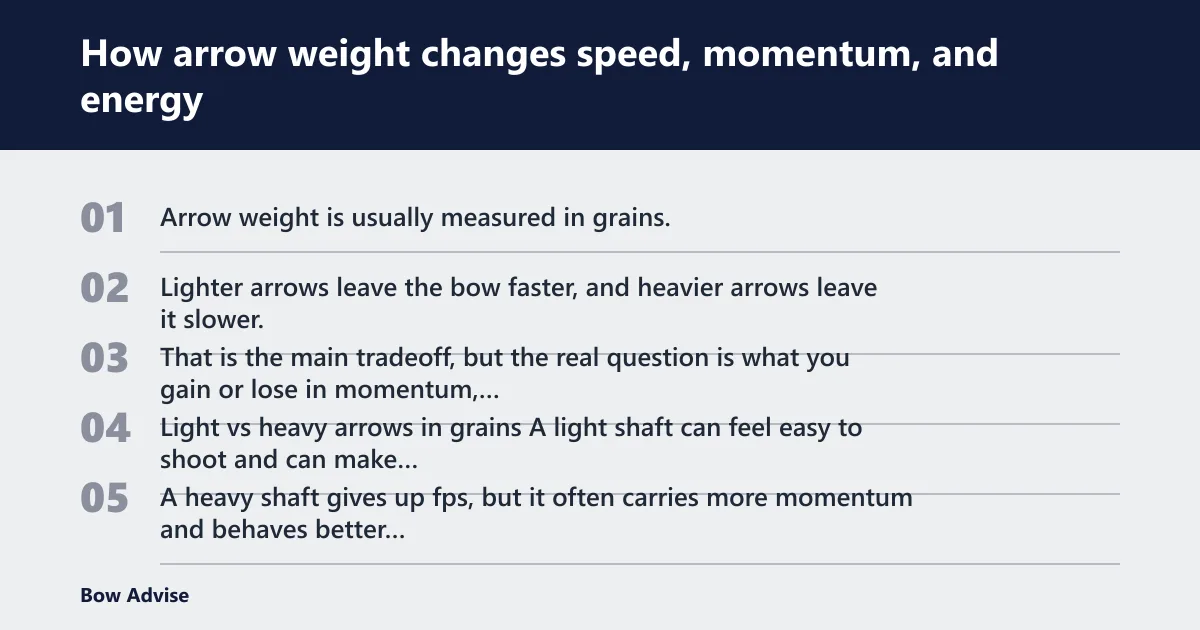
Arrow weight is usually measured in grains. Lighter arrows leave the bow faster, and heavier arrows leave it slower. That is the main tradeoff, but the real question is what you gain or lose in momentum, penetration, and tune behavior when you change weight.
Light vs heavy arrows in grains
A light shaft can feel easy to shoot and can make sighting simple. A heavy shaft gives up fps, but it often carries more momentum and behaves better through a broadhead. I do not choose weight by habit; I choose it by the job.
Why heavier arrows usually carry more momentum
Momentum is the mass-plus-velocity relationship that matters a lot for penetration. In arrows, it is often the better signal for hunting performance than energy alone. That does not mean heavy always wins, but it explains why broadheads often behave better on a heavier setup.
Why kinetic energy and momentum are not the same
Kinetic energy uses velocity squared in the equation, so fast arrows look good on paper. That is one reason people chase speed numbers. But energy is not the same as momentum, and it is not a direct penetration proxy the way many hunters assume.
| Comparison example | What it suggests | My practical read |
|---|---|---|
| 400-grain arrow traveling at 300 fps | Looks strong on energy and trajectory. | Good if tune stays clean and the bow stays quiet. |
| 550-grain arrow traveling at 260 fps | Slower, with more drop at distance. | Often better if you want steady broadhead behavior and more punch. |
Why spine matching matters more than weight alone

Static spine is the shaft stiffness at rest. Dynamic spine is how much the arrow bends in motion. Both affect tune, but dynamic spine is the one that shows up when the bowstring drives the arrow forward and the shaft has to recover cleanly.
Static spine vs dynamic spine
Static spine helps you pick the right shaft before you ever shoot it. Dynamic spine tells the truth once the bow fires. Changing point weight, draw weight, arrow length, or broadhead drag can make the arrow behave stiffer or weaker than the nominal spine suggests.
How poor spine choice changes flight recovery
If spine is off, the arrow can leave with more oscillation and recover late. That is bad for broadheads, because late recovery often means planing and wider groups. I see this more often than people expect when they chase speed with too-light arrows.
How bow tune changes grouping and broadhead behavior
Good bow tune can make archer’s paradox more controlled and predictable. A properly tuned bow lets the shaft clear, flex, and recover in a repeatable way. That is the shot forgiveness you feel when form is not perfect but the group still holds together.
What arrow factors affect grouping the most?
Grouping usually starts with flight stability, then moves to the parts that keep the arrow stable after launch. FOC, broadhead design, and arrow construction matter a lot because they shape how the shaft tracks the string and how fast it settles after release.
FOC and broadhead stability
FOC refers to the front-of-center balance point. More forward balance can improve broadhead stability and reduce planing, which matters when the head is steering the arrow in air. I pay attention to this more for hunting than for bare-shaft target work.
Broadhead design: fixed vs mechanical
Fixed broadheads usually demand cleaner tune and can expose bad arrow behavior sooner. Mechanical heads may fly easier for some shooters, but they cost energy to deploy and can change how much penetration you get. Broadhead design is a major factor in penetration, so I never ignore it.
Arrow construction: wall thickness, carbon modulus, fiber orientation, resin system
Arrow construction changes how consistent the shaft is from one piece to the next. Wall thickness, carbon modulus, fiber orientation, and resin system all affect stiffness and consistency. I have seen two arrows with similar labels act very differently once broadheads and field points were both tested.
When should you choose heavier arrows over lighter ones?
Choose heavier arrows when hunting penetration, broadhead control, and quiet shooting matter more than a flatter trajectory. Choose lighter arrows when you need more speed for sight marks or target gaps, but only if the tune stays strong and the arrow still groups at your distance.
Hunting: penetration, noise, and broadhead control
For hunting, I lean heavier when I want better penetration signals from momentum and calmer broadhead behavior. Heavier arrows also tend to be less sensitive to small release flaws. If the bow gets loud or the tune gets fussy, the speed gain is not buying enough.
Target: distance, sight marks, and wind conditions
For target work, a lighter arrow can help if you need a flatter sight picture and the range is calm. Wind changes that equation fast. Light arrows are more sensitive to wind and imperfect releases, so I would not pick them just because the fps number looks cleaner.
Recurve: why forgiveness often matters more than raw fps
With recurves, I care a lot about forgiveness and clean flight. Recurve shooters feel dynamic spine changes quickly, and broadheads are not the main story for most indoor or field work. A well-matched shaft that recovers cleanly is usually worth more than chasing speed.
Decision table: what matters most by shooter type

The right answer changes by shooter. A beginner target archer, a tuned compound hunter, and a recurve shooter do not need the same balance of fps, weight, and spine. I would not tune them the same way, and I would not judge them by the same arrow spec.
| Shooter type | Arrow speed priority | Arrow weight priority | Spine priority | What matters most |
|---|---|---|---|---|
| Beginner target archer | Moderate. Enough for clear sight marks. | Middle of the road. Avoid extremes. | High. Easy-tuning shafts beat chasing fps. | Forgiveness to release error and repeatable groups. |
| Tuned compound hunter | Moderate to high, only if tune stays clean. | Often heavier for momentum and broadhead control. | Very high. Dynamic spine must match the setup. | Broadhead flight, penetration, and quiet shot behavior. |
| Recurve shooter | Lower priority than clean launch. | Usually moderate to heavier for smooth flight. | Extremely high. Shaft recovery drives the group. | Clean paradox recovery and stable bare-shaft behavior. |
Beginner target archer
I want a beginner to avoid an arrow that is so light or stiff that every mistake gets magnified. Simple tuning and repeatable groups matter most. Speed can wait until the release, anchor, and tune are steady.
Tuned compound hunter
For a tuned compound hunter, I look for broadhead stability, enough momentum for penetration, and a setup that stays quiet. If a faster shaft forces me into a weak tune or noisy shot, I back off. I would rather give up fps than give up confidence at launch.
Recurve shooter
For a recurve shooter, I care most about spine match and recovery. Recurves show dynamic spine problems fast, so a shaft that groups well with field points and stays calm in flight usually beats a faster one that leaves ugly tears and broadhead drift.
Why did your groups open up after going lighter?
When groups get worse after moving lighter, the usual problem is that the setup lost tune margin. The arrow may be more sensitive to wind, release error, or broadhead steering. Speed improved, but forgiveness disappeared.
Quick troubleshooting checklist
- Recheck bare-shaft behavior at your real distance.
- Confirm point weight and shaft length did not push dynamic spine too weak.
- Test field points before blaming broadheads.
- Check nock fit, rest contact, and fletching clearance.
- Shoot in calm air and then in a light breeze.
- Return to the last arrow weight that grouped well, then move in smaller steps.
What to retest before changing arrow weight again
I would retest the bow tune first, then the arrow, then the broadhead. Too many shooters blame the shaft when the rest timing or center-shot is the real problem. If your lighter setup only looked better on paper, the target will expose it quickly.
Verdict
If you shoot target at short to medium distance and your tune is solid, arrow speed can matter enough to help sight marks and holdover. If you hunt, shoot broadheads, or struggle with release consistency, accuracy wins, which means the setup that groups best at your real distance should be the one you keep.
My rule is simple. Choose speed when it stays inside a good tune and does not cost grouping. Choose accuracy first when you care about broadhead flight, wind, forgiveness, or any shot where one bad arrow is expensive.
Frequently asked questions
Is a faster arrow actually more accurate?
Not by itself. Speed is a measurement in fps, while accuracy is about grouping consistency, flight stability, and how well the arrow forgives small release errors. A faster setup only wins if it keeps tune, stays quiet, and groups tighter at your real distance.
Does arrow weight matter more than speed?
Often, yes. Arrow weight changes speed, momentum, wind behavior, and broadhead control all at once. I care more about whether the shaft weight supports the tune and the job than about squeezing out a few more fps.
What arrow factors affect grouping the most?
Spine matching, bow tune, broadhead behavior, and arrow construction all matter a lot. FOC and head design shape how the arrow flies after launch, while wall thickness, carbon modulus, fiber orientation, and resin system affect consistency from shaft to shaft.
How does spine affect arrow speed and accuracy?
Spine affects both, but accuracy is usually the bigger story. Static spine is the shaft stiffness at rest, while dynamic spine is how much the arrow bends in motion. If dynamic spine is off, the arrow may recover late and group poorly even if the fps number looks good.
When should I choose heavier arrows over lighter ones?
I choose heavier arrows when I want better momentum, quieter launch behavior, and steadier broadhead performance. For hunting, that often matters more than a flatter trajectory. For target, I go heavier only if the bow still gives me the sight marks and distance I need.
Can a properly tuned lighter arrow be as accurate as a heavier one?
Yes, if the bow is tuned and the arrow matches the setup. A light shaft can shoot very well in calm conditions. The catch is that lighter arrows are more sensitive to wind and release flaws, so the margin for error is smaller.
What matters more for hunting: speed, momentum, or accuracy?
Accuracy comes first, because a misplaced shot ruins the rest of the equation. After that, momentum often tells me more about penetration than speed alone. I still want enough speed for a usable trajectory, but not at the cost of broadhead control or tune.