Carbon Express Maxima Red Arrow Review: Specs & Verdict
The Carbon Express Maxima Red SD is worth buying if your compound bow throws broadheads off line or you want a small-diameter hunting shaft with sorted consistency built in; for spine, I’d start .400 for lighter setups, .350 for most 60–70 lb rigs, and .300 for heavier bows or longer arrows. Pick the wrong spine and you can waste time and money chasing paper-tuned arrows that still hit broadheads sideways. I’ll cover how the tri-spine shaft actually behaves, which spine fits which setup, and when this arrow solves tuning problems versus when a standard shaft does the same job.
This guide is part of our Arrow dynamics in archery series.
Verdict


My take is simple: this is a tuning-first hunting shaft, not a universal answer. If you shoot a compound that is already close to tune, the Maxima Red SD’s small diameter, factory sorting, and front-end protection can be worth the premium. If you are new, under-bowed, or unsure about insert and point weight, a simpler shaft may get you to a clean broadhead tune faster.
Pros
- Small-diameter shaft that can help with broadhead forgiveness and penetration setup
- Laser Match Set sorting and tight straightness claims give buyers a consistency target
- Factory-fletched option reduces the amount of setup work
Cons
- More sensitive to spine, point weight, and insert choices than a basic hunting arrow
- Can be overkill on lighter bows or for shooters who do not need a micro-diameter shaft
- Premium pricing makes poor spine selection expensive
According to feradyne.com — The product page lists 15 reviews.
Specs at a glance
The numbers matter here because this arrow is sold as a setup tool as much as a hunting shaft. The Maxima Red SD uses a .203 inch inner diameter, comes in .300, .350, and .400 spine variants, and Carbon Express claims tight sorting and straightness control that buyers pay for when they want repeatable broadhead flight.
| Spec | What Carbon Express says | What it means in the shop |
|---|---|---|
| Inner diameter | .203 inch | Smaller shaft profile can help with insert support and hunting use, but component fit matters more |
| Spine options | .300, .350, .400 | You need to match bow speed, draw weight, and arrow length closely |
| Tri-Spine / RED ZONE Technology | Less than 1/3 oscillation vs single spine shafts; FOUR TIMES the ACCURACY claim | Think consistency aid, not a substitute for tuning |
| Laser Match Set | Spine tolerance +/- .0025; weight tolerance +/- 1.0 grains | Sorting should reduce arrow-to-arrow surprises |
| Straightness | +/- .002; laser checked to 1/10,000 of an inch | Tight manufacturing target for buyers who care about repeatable launch |
| Nock collar | BullDog Nock Collars, aircraft grade aluminum | Rear-end protection is built in, but impacts can still damage vanes or nocks |
| Reviews on product page | 15 reviews | Small sample; useful, but not enough to treat as final proof |
Package choices
The Maxima Red SD is sold as shafts or as fletched arrows, and the fletched version is the easier buy for hunters who want to get shooting quickly. Back Forty lists a 350 spine 6-pack at $119.99 and describes it as suitable for mid-to-heavy draw weights, with arrows sold as a 6-pack with vanes.
Factory fletching options include Q2i Rapt-X or Bohning Alpha vanes, and Carbon Express also uses Launchpad Precision Nocks for controlled release and shaft alignment. That matters if you want less setup work, but it also means you should verify how the supplied components match your insert and broadhead plan before you order more arrows.
Who it is for
The Maxima Red SD is for compound shooters who need help with broadhead flight and want a small-diameter hunting shaft with sorted consistency built in. It fits archers who are already paying attention to tune, or hunters who know their current arrows are close but not quite stable with fixed blades.
It is a weaker fit for brand-new shooters, very light setups, and anyone who has not yet sorted draw weight, arrow length, and point weight.
Who should skip it
If you just want a basic hunting arrow that is easy to get flying, this may be more arrow than you need. I also think beginners often do better with a simpler shaft until they can hold form through a full shot cycle and understand what broadhead impact is telling them.
What works in the Maxima Red SD?
The Maxima Red SD works because it tries to reduce arrow inconsistency at the shaft level, then gives you rear-end protection and factory component choices that support a hunting build. The tri-spine layout is the headline, but the straightness, spine sorting, and nock-collar choices are what matter when a fixed blade needs a clean launch.
Tri-Spine / RED ZONE Technology and broadhead tuning
Carbon Express claims the tri-spine design creates less than 1/3 the oscillation of single spine shafts and says the system delivers FOUR TIMES the ACCURACY. I would not treat that as magic. What it does mean, practically, is that the shaft is trying to be less unpredictable when a broadhead catches air on release.
That is useful when a bow is already close to tune and the broadhead is exposing weak spine behavior. It will not save a bow that is wildly off, and it will not fix the wrong point weight. It just gives you a better starting point than many generic hunting shafts.
BuffTuff Plus, BuffTuff, and Diamond Weave in plain terms
Carbon Express builds the front third with BuffTuff Plus, a high modulus carbon weave intended to add strength and spine consistency where the shaft takes the hardest hunting abuse. The middle third uses BuffTuff for a quieter finish and easier target removal. The back third uses Diamond Weave to support stiffness and spine behavior.
That layered idea makes more sense than the marketing language. The front needs to survive impact and insert stress. The middle needs to fly and recover. The rear needs to keep the shaft from acting sloppy when the bow launches it.
BullDog Nock Collars, Launchpad Precision Nocks, and rear protection
BullDog Nock Collars are made of aircraft grade aluminum, and that is the part I care about most on a micro-diameter hunting shaft. Rear impacts happen. Bowhunting cases get bumped, arrows hit hard foam, and a clean shaft can still lose a nock end fast if the setup is weak.
Launchpad Precision Nocks are meant to control release and align the shaft. That helps the same way a good nock fit helps any arrow: it reduces the chance that the string or nock interface introduces extra wobble before the shaft has a chance to stabilize.
What does not work as well?
The Maxima Red SD is not the easy choice when you want low-maintenance tuning or you shoot a lighter bow. The small diameter can be overkill if you are not chasing broadhead forgiveness, and the arrow becomes more sensitive to component selection than a standard-diameter hunting shaft.
I also would not ignore the downside of small-diameter shafts: component compatibility can get annoying, vane damage risk goes up when arrows are packed tightly, and the cost of a bad spine choice is higher. If you are not ready to fine-tune insert and point weight, this can turn into a slow, expensive process.
Where the premium stops making sense
If your bow already shoots fixed blades cleanly through paper and groups well at distance, a cheaper shaft may do the same job. The Maxima Red SD earns its keep when the tuning margin is tight. If you do not need that margin, you are paying for features you may never use.
What spine options does the Maxima Red SD come in?
The Maxima Red SD comes in .300, .350, and .400 spine variants. I would think about the choice in terms of draw weight, arrow length, and bow speed together, not as a simple “heavier bow equals stiffer shaft” rule. Short arrows and fast cams both push you toward stiffer options.
.300 spine use cases
The .300 spine is the stiffer choice for heavier setups, faster bows, and longer arrow builds where flex control matters most. I would look there if you are running a hard-hitting compound, longer-than-average arrows, or a broadhead setup that keeps showing weak spine behavior.
.350 spine use cases
The .350 spine is the middle ground and is the safest starting point for many 60–70 lb hunting rigs. Back Forty specifically describes the 350 spine as suitable for mid-to-heavy draw weights, which matches how I would approach it for most hunters who want a broadhead-capable build without going too stiff.
.400 spine use cases
The .400 spine makes the most sense for lighter draw weights, shorter setups, or archers who do not need the stiffness of the other options. If you are starting out and your bow is not especially fast, this is often the first spine I would look at before moving stiffer.
Which Maxima Red spine should I choose for my bow?
Choose spine from the whole setup, not one number on the bow label. Draw weight, arrow length, and peak bow speed all push the arrow differently. If you guess wrong, you can end up chasing broadhead tune with insert swaps, point weight changes, and rest adjustments that should have been unnecessary.
| Draw weight | Arrow length | Peak bow speed | Likely Maxima Red SD spine |
|---|---|---|---|
| 55–60 lb | Short to medium | Moderate | .400 |
| 60–70 lb | Medium | Moderate to fast | .350 |
| 65–75+ lb | Medium to long | Fast | .300 |
- Start with your actual draw length and finished arrow length.
- Decide whether you want a light, medium, or heavy front-end build.
- Match the spine to bow speed before choosing broadhead weight.
- Only then fine-tune insert weight and point weight.
- Paper tune, then verify fixed-blade impact.
Setup checklist for insert and point weight
For a Maxima Red SD build, I would start by deciding whether you need a standard hunting point weight or a heavier front end for fixed-blade stability. Then I would match the insert to the .203 inner diameter system and confirm broadhead fit before fletching or ordering more shafts.
- Verify your insert size and broadhead compatibility before final assembly.
- Keep point weight consistent across the dozen.
- If fixed blades plane, reduce variables before changing spine.
- Test nock fit and vane clearance before a hunting season build.
- Buy one spine step stiffer only after confirming the current arrow is weak.
What does.203 ID mean on Maxima Red arrows?
The .203 inch inner diameter means the shaft is smaller inside than a standard hunting arrow, which affects insert choice, component fit, and how the front end is built. In practical terms, it is a micro-diameter style shaft that can help with penetration setup and wind handling, but only if the rest of the build matches it.
For me, the important part is not the number itself. It is whether your inserts, collars, and broadheads actually fit the shaft cleanly and stay aligned. A small-diameter arrow is only useful if the front end stays straight under impact and launch.
How durable are Carbon Express Maxima Red arrows?
The Maxima Red SD looks durable on paper because Carbon Express builds in front-end reinforcement, rear protection, and layered carbon construction, but durability still depends on how you hit and what you hit. The BullDog Nock Collar helps at the rear, yet vane damage, crushed nocks, and insert issues can still happen.
That is the tradeoff with any hunting shaft built this way. You gain protection in some places, but you also add more components that need to match. If you are rough on arrows in foam or transport, the rear collar helps; if your broadheads are misaligned, no collar will fix that.
What is the straightness tolerance on the Maxima Red SD?
The straightness spec is listed at about +/- .002, and Carbon Express says it is laser checked very precisely. That is a tight spec and part of the value buyers are paying for, especially when they want arrows that behave the same shot after shot.
What that means for a buyer is simple: straighter shafts should reduce one more variable in the tune process. It does not guarantee perfect broadhead flight, but it gives you a cleaner baseline before you start blaming the rest, the nock, or the bow.
What grain weight and insert setup do Maxima Red arrows need?
The right grain weight depends on your spine choice, broadhead type, and how much front-end weight your bow likes. I would not lock into a single number here. Start with a setup that keeps the arrow stable through tune, then adjust only after paper and field-point grouping tell you something useful.
If your fixed blade is showing a weak tail or broadhead planing, first check point weight and insert weight before jumping to a different spine. On a .203 ID shaft, front-end component choice matters more than casual buyers expect.
Are Maxima Red arrows worth the price?
They are worth the price when you need what they are selling: sorted consistency, a smaller shaft profile, and a better chance of clean fixed-blade flight without a long tuning fight. Back Forty lists the 350 spine 6-pack at $119.99, which is a real premium compared with simpler hunting arrows.
Price per arrow makes that easier to see. At $119.99 for six, you are paying about $20 per arrow before you add replacement parts or lost-shaft math. That cost makes sense for a tuned compound hunter who wants repeatability. It makes less sense if you want a durable practice shaft and do not care about the micro-diameter build.
Value compared with simpler hunting shafts
A standard hunting shaft can be the better buy if you want easier setup, lower cost, and less component fuss. The Maxima Red SD earns its premium when broadhead accuracy is the real problem, not when you simply want arrows that fly well enough for target work and whitetail season.
Alternatives to consider
 As an Amazon Associate we earn from qualifying purchases. Prices and availability are accurate as of the date shown and are subject to change.

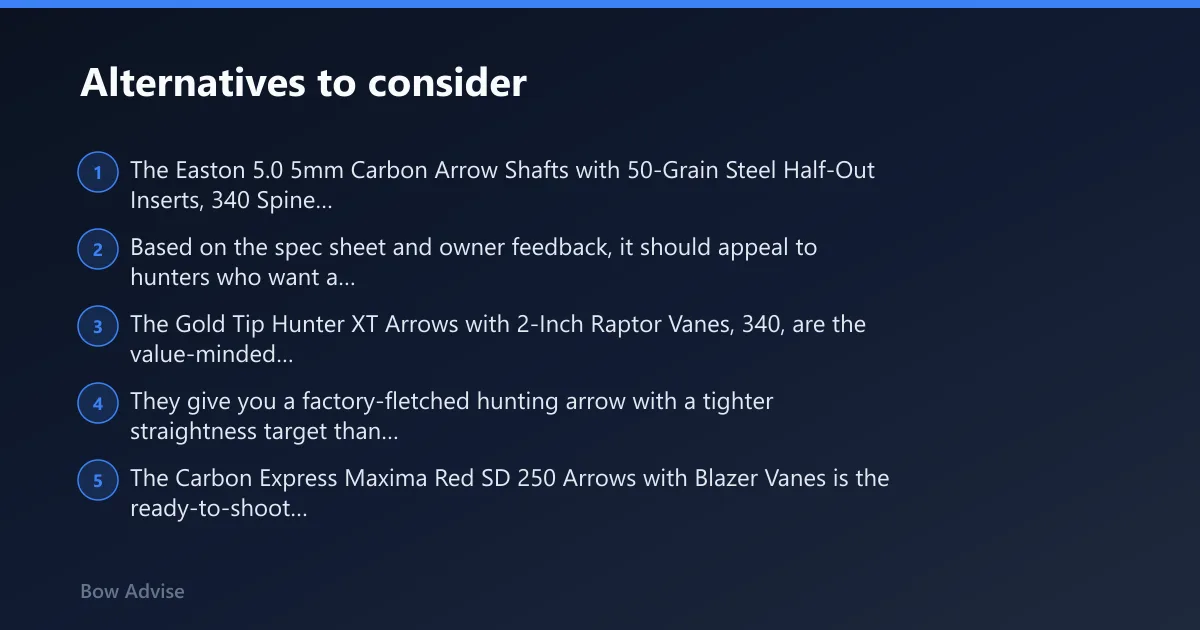
The Easton 5.0 5mm Carbon Arrow Shafts with 50-Grain Steel Half-Out Inserts, 340 Spine is the better pick if you want a micro-diameter hunting shaft with steel insert support and a more straightforward shaft-first build. Based on the spec sheet and owner feedback, it should appeal to hunters who want a strong front end, but it costs more and may not be as easy to tune if your setup is already close to stiff.
As an Amazon Associate we earn from qualifying purchases. Prices and availability are accurate as of the date shown and are subject to change.

The Gold Tip Hunter XT Arrows with 2-Inch Raptor Vanes, 340, are the value-minded alternative. They give you a factory-fletched hunting arrow with a tighter straightness target than many budget shafts and a simpler setup path, though they do not bring the small-diameter advantages or the same tri-spine concept that the Maxima Red SD uses.
The Carbon Express Maxima Red SD 250 Arrows with Blazer Vanes is the ready-to-shoot version if you want the Carbon Express platform without building from shafts. It keeps the small-diameter hunting logic and the factory-fletched convenience, but the downside is the same one I see with many pre-built arrows: if the spine or component package is not right for your bow, you still have to solve that before hunting season.
Should you buy it
Buy the Maxima Red SD if you already know your bow needs help with broadhead flight, if you want a small-diameter hunting shaft, and if you are willing to match spine, insert, and point weight carefully. The product makes the most sense for archers who value setup precision more than lowest price.
Skip it if you are new, under-bowed, or still learning how your compound reacts to broadheads. I like the idea here a lot, but only when the shooter is ready to use it properly. Otherwise, a simpler arrow gets you hunting faster.
Frequently asked questions
Is the Carbon Express Maxima Red good for hunting?
Yes, if your setup benefits from a small-diameter hunting shaft and you care about broadhead flight. It is a strong choice for compound hunters who want consistency, but it is not the easiest option for beginners or for bows that already tune well with simpler arrows.
Are Maxima Red arrows better for broadheads than standard shafts?
They can be, especially when broadhead planing is tied to shaft inconsistency or weak spine behavior. I would not call them automatically better for every bow. They work best when the shooter is already close to tune and wants a more forgiving hunting shaft.